Version 3 (current)
Nov 27, 2026. Version history
Galileo Galilei (1564–1642) was an Italian mathematician and natural philosopher who made some of the first telescopic observations of the heavens and was condemned by the Roman Inquisition in 1633 for holding that the Earth moves.
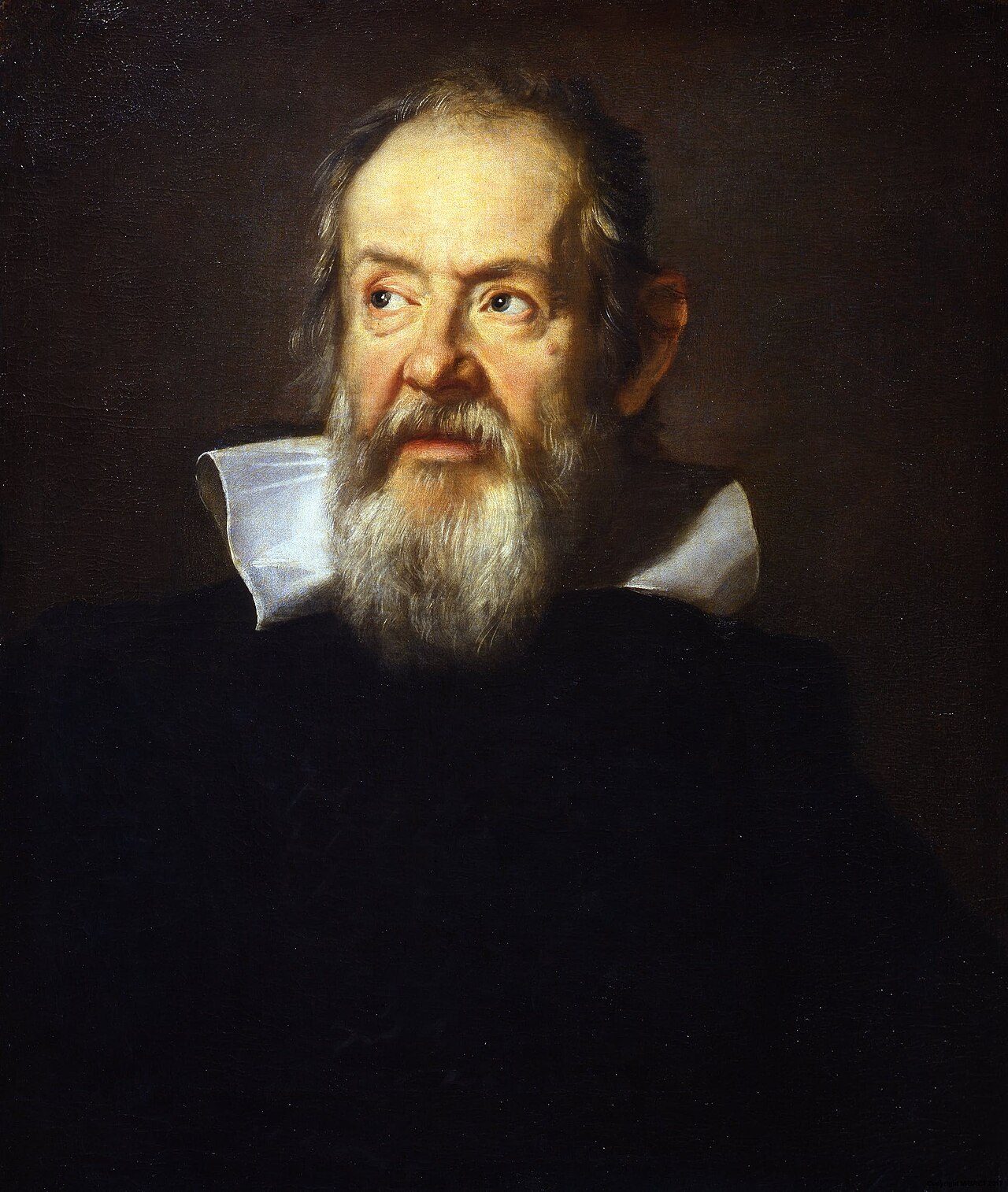
Via Wikimedia Commons: Justus Sustermans - Portrait of Galileo Galilei (Uffizi) by Justus Sustermans, public domain.
Early life and posts
Galileo was born in Pisa on 15 February 1564, the son of Vincenzo Galilei, a Florentine musician, and Giulia Ammannati.[2] He enrolled at the University of Pisa on 5 September 1580.[2] The Stanford Encyclopedia of Philosophy says he enrolled for a medical degree, did not complete it, and turned to mathematics, notably under Ostilio Ricci.[1]
In 1589 he took the chair of mathematics at Pisa, after an unsuccessful application at Bologna in 1588.[1][2] On 26 September 1592 the Venetian Senate gave him the mathematics chair at the University of Padua.[2] After negotiations in 1610 he returned to Florence as "Chief Mathematician and Philosopher to the Grand Duke" of Tuscany, with a sinecure professorship at Pisa.[1]
The telescope and the Starry Messenger
In 1609 Galileo heard of the spyglass, built an improved telescope, and by late autumn was using it to observe the sky.[1] His findings appeared in the book Sidereus nuncius (Starry Messenger), which the Museo Galileo dates to 12 March 1610.[1][2] It reported that Jupiter has four satellites, now called the Galilean moons. Galileo named them the "Medicean" stars in honour of the ruling Medici family.[1]
Later in 1610 he observed that Venus shows phases, which indicated that Venus orbits the Sun.[1] In Letters on Sunspots, printed in Rome in 1613, he argued that sunspots are features of the Sun's surface, and that tracking them showed the Sun turns on an axis. The Stanford Encyclopedia describes the work as his first open support for the heliocentric theory of Copernicus.[1][2] On 25 April 1611 he had been enrolled in the Accademia dei Lincei.[2]
Copernicanism and the 1616 admonition
Nicolaus Copernicus had proposed that the Earth and planets move around the Sun. On 21 December 1613 Galileo wrote the first of his "Copernican letters", addressed to Benedetto Castelli, and in 1615 he wrote two more to Piero Dini defending the theory.[2] The 1633 sentence states that he was denounced to the Holy Office, the Roman Inquisition's tribunal, in 1615 for holding that the Sun is immovable at the centre of the world and that the Earth moves, and for publishing letters on sunspots developing that view.[3]
In February 1616 Cardinal Robert Bellarmine admonished him not to hold or defend the Copernican doctrine.[2] The Museo Galileo dates the admonition to 26 February 1616 and records that the Holy Office had judged the heliocentric theory formally heretical.[2] In March 1616 Copernicus's On the Revolutions was suspended until corrected. Corrections were issued in 1620, and the book stayed on the Index until 1835.[1]
The Dialogue and the 1633 condemnation
Galileo's Dialogo sopra i due massimi sistemi del mondo (Dialogue on the Two Chief World Systems) was printed in Florence in 1632 by Giovanni Battista Landini, and on 22 February he presented it to the Grand Duke, Ferdinando II de' Medici.[2] By the middle of that year there were rumours that the book might be banned.[2] On 1 October 1632 the Florentine Inquisitor, Clemente Egidi, ordered him to appear before the Holy Office in Rome by the end of the month; because of poor health he postponed the journey several times, and on 30 December Pope Urban VIII instructed the Inquisitor to send him to Rome once physicians found him fit to travel.[2]
On 21 June 1633 Galileo was questioned by the Holy Office about his intentions. The Museo Galileo records that, although threatened with torture, he maintained that after the 1616 admonition he had always held the Copernican position to be false and had never defended it.[2] The next day, in the hall of the Dominican monastery of Santa Maria sopra Minerva, the sentence was read and he was made to sign a solemn abjuration.[2]
The sentence, in the English translation cited here, found that the proposition that the Sun is at the centre of the world and immovable was "absurd, philosophically false, and formally heretical", and that the proposition that the Earth moves was "at least erroneous in faith".[3] It declared Galileo "vehemently suspected" of heresy, rather than convicting him of heresy outright, and offered absolution if he abjured.[3] It ordered the Dialogue prohibited by public edict, condemned him to the prison of the Holy Office "during Our will and pleasure", and enjoined him, as a penance, to recite the Seven Penitential Psalms once a week for three years.[3]
Arcetri and the last years
On 1 December 1633 the Holy Office allowed Galileo to go back to his villa, "Il Gioiello" at Arcetri near Florence, but forbade him to receive anyone with whom he might discuss scientific subjects.[2] He had rented the villa in September 1631, near the convent of San Matteo where his daughters lived.[2] His daughter Virginia, a nun known as Suor Maria Celeste, died there on 2 April 1634; the Museo Galileo calls the loss a bitter blow.[2]
In February 1638 the Inquisitor of Florence, visiting at the pope's order, reported that Galileo was blind and in such poor health that he seemed "more a cadaver than a living person". Later that month the Holy Office authorised him to move to his house in Florence for treatment, with permission to attend the nearest church on feast days but not to speak with other people.[2] His Discorsi e dimostrazioni matematiche intorno a due nuove scienze (Discourses and Mathematical Demonstrations Relating to Two New Sciences), printing of which the Museo Galileo records as completed in July 1638 at Leiden by the Elzevier press, is described there as the birth certificate of the modern science of motion.[2]
Galileo died at Arcetri on 8 January 1642, at four in the morning according to his pupil Vincenzo Viviani, whose account the museum quotes.[2] He was buried on 9 January in the Basilica of Santa Croce in Florence, in a small room beside the Chapel of Saints Cosmas and Damian. Ecclesiastical authorities opposed a monumental tomb for a man condemned as "strongly suspected of heresy".[2]
Reassessment by the Catholic Church
On 10 November 1979 John Paul II told the Pontifical Academy of Sciences he hoped that theologians, scholars and historians would study the Galileo case more deeply, and on 3 July 1981 a letter from Cardinal Agostino Casaroli, the Secretary of State, set up a commission for the purpose.[4] It held seven meetings between 1981 and 1983.[4] On 31 October 1992 Cardinal Paul Poupard presented its final report to the Pontifical Academy, and the pope gave a closing address.[4][5]
Poupard said that Galileo's judges, unable to separate faith from an "age-old cosmology", wrongly believed that the Copernican view, not yet definitively proven, threatened Catholic tradition; he called this a "subjective error of judgment" that led to a disciplinary measure from which Galileo "had much to suffer".[4] The pope described the affair as a "painful misunderstanding" and a "tragic reciprocal incomprehension", and said the case had become a symbol of a supposed Church rejection of scientific progress.[5] News reports of the day described the ceremony as a reversal of the 1633 censure.[5]
The Jesuit astronomer George Coyne, who had sat on the commission, disagreed with how the two addresses framed events. He wrote that their picture of mutual incomprehension, in which Galileo is faulted for not treating Copernicanism as a hypothesis, "does not stand up to historical scrutiny", and that the framing leaves no one responsible for Galileo's sufferings.[4]
Sources
- "Galileo Galilei", Stanford Encyclopedia of Philosophy. Opened 27 November 2026.
- Museo Galileo, "Life", a dated chronology of Galileo's life. Opened 27 November 2026.
- "Documents in the Case of Galileo: Indictment, Sentence and Abjuration of 1633", English translation from the Internet Modern History Sourcebook, ed. Paul Halsall (1998). Opened 27 November 2026.
- George V. Coyne, S.J., "The Church's Most Recent Attempt to Dispel the Galileo Myth", Vatican Observatory (chapter in a volume edited by Ernan McMullin). Opened 27 November 2026.
- "Galileo gets Catholic Church reprieve -- 376 years later", United Press International, 31 October 1992. Opened 27 November 2026.
