Compare versions
Version 1 → Version 2 (current). Removed · Added. This shows the entry's text as it is written, including its formatting marks.
Version 1 · Version 2 (current) · Version history
Side by side · Together
Version 1Version 2 (current)
16 unchanged paragraphs
Epiphany is a Christian feast, usually kept on 6 January, that marks the manifestation of Jesus Christ: in Western churches chiefly the visit of the Magi, and in Eastern churches chiefly his baptism in the River Jordan.[4]
Epiphany is a Christian feast, usually kept on 6 January, that marks the manifestation of Jesus Christ: in Western churches chiefly the visit of the Magi, and in Eastern churches chiefly his baptism in the River Jordan.[4]
## Name and meaning
## Name and meaning
The Orthodox Church in America explains that "Epiphany" means a shining forth or manifestation, and that its service books more often call the feast Theophany, the shining forth and manifestation of God.[5] The 1909 Catholic Encyclopedia lists other names used over the centuries, among them the Feast of the Three Kings and Twelfth Day in the West, and the Syriac name denho.[3] Britannica describes the feast as commemorating three manifestations: to the Gentiles (non-Jews), represented by the Magi; of Christ's divinity at his baptism in the Jordan; and at his first miracle, at Cana in Galilee.[4]
The Orthodox Church in America explains that "Epiphany" means a shining forth or manifestation, and that its service books more often call the feast Theophany, the shining forth and manifestation of God.[5] The 1909 Catholic Encyclopedia lists other names used over the centuries, among them the Feast of the Three Kings and Twelfth Day in the West, and the Syriac name denho.[3] Britannica describes the feast as commemorating three manifestations: to the Gentiles (non-Jews), represented by the Magi; of Christ's divinity at his baptism in the Jordan; and at his first miracle, at Cana in Galilee.[4]
## What the churches mark
## What the churches mark
**Western churches.** Britannica reports that Roman Catholics, Lutherans, Anglicans and other Western churches keep the feast on 6 January, with the main emphasis on the visit of the Magi.[4] In the United States, the Catholic bishops' liturgical calendar places the Epiphany of the Lord on the Sunday between 2 and 8 January; in 2027 that is Sunday 3 January, with Matthew 2:1-12 as the Gospel reading.[2] The same calendar lists Wednesday 6 January 2027 as an ordinary Christmas weekday in the United States and the Baptism of the Lord on Sunday 10 January 2027.[2]
**Western churches.** Britannica reports that Roman Catholics, Lutherans, Anglicans and other Western churches keep the feast on 6 January, with the main emphasis on the visit of the Magi.[4] In the United States, the Catholic bishops' liturgical calendar places the Epiphany of the Lord on the Sunday between 2 and 8 January; in 2027 that is Sunday 3 January, with Matthew 2:1-12 as the Gospel reading.[2] The same calendar lists Wednesday 6 January 2027 as an ordinary Christmas weekday in the United States and the Baptism of the Lord on Sunday 10 January 2027.[2]
**Eastern Orthodox churches.** The Orthodox Church in America teaches that the feast at first included Christ's birth, the adoration of the Wise Men and the other events of his childhood up to his baptism by John in the Jordan, and that the present-day celebration emphasises the appearance of Jesus as the human Messiah of Israel and the divine Son of God, one of the Holy Trinity.[5] It calls the Great Blessing of Water the main feature of the feast: at the end of the rite the celebrant sprinkles the water toward the four directions and then blesses the people and their homes with it.[5] The same church holds that, historically, Christmas was made to imitate Epiphany because Christmas was established later.[5]
**Eastern Orthodox churches.** The Orthodox Church in America teaches that the feast at first included Christ's birth, the adoration of the Wise Men and the other events of his childhood up to his baptism by John in the Jordan, and that the present-day celebration emphasises the appearance of Jesus as the human Messiah of Israel and the divine Son of God, one of the Holy Trinity.[5] It calls the Great Blessing of Water the main feature of the feast: at the end of the rite the celebrant sprinkles the water toward the four directions and then blesses the people and their homes with it.[5] The same church holds that, historically, Christmas was made to imitate Epiphany because Christmas was established later.[5]
**Armenian Apostolic Church.** The Armenian Church celebrates Christ's birth and his baptism together on 6 January, according to its Eastern Diocese in America (writing in 2024).[6] On the eve, worshippers hold lit candles at the Jrakalouyts lamp-lighting service, and after the Divine Liturgy on the day the Blessing of Water (Churorhnek) recalls the baptism: a cross is dipped in water, holy chrism (muron) is poured in from a dove-shaped vessel, and worshippers drink the blessed water.[6] The diocese explains the date as an older tradition that the Armenian Church kept after Rome moved the celebration of Christ's birth to 25 December.[6]
**Armenian Apostolic Church.** The Armenian Church celebrates Christ's birth and his baptism together on 6 January, according to its Eastern Diocese in America (writing in 2024).[6] On the eve, worshippers hold lit candles at the Jrakalouyts lamp-lighting service, and after the Divine Liturgy on the day the Blessing of Water (Churorhnek) recalls the baptism: a cross is dipped in water, holy chrism (muron) is poured in from a dove-shaped vessel, and worshippers drink the blessed water.[6] The diocese explains the date as an older tradition that the Armenian Church kept after Rome moved the celebration of Christ's birth to 25 December.[6]
**Churches on the Julian calendar.** Some Eastern Orthodox churches keep the feast on 19 January, since their Christmas Eve falls on 6 January.[4] A news-agency report from Sofia, published by ABC News, explained that the Orthodox churches of Russia and Serbia, among others, follow the older Julian calendar and so keep Epiphany on 19 January, while the churches of Greece, Bulgaria and Romania keep it on 6 January.[14] The holiday listing site Office Holidays gives Tuesday 19 January 2027 as Orthodox Epiphany, a national holiday that year in Ethiopia, Eritrea and Georgia.[10]
**Churches on the Julian calendar.** Some Eastern Orthodox churches keep the feast on 19 January, since their Christmas Eve falls on 6 January.[4] A news-agency report from Sofia, published by ABC News, explained that the Orthodox churches of Russia and Serbia, among others, follow the older Julian calendar and so keep Epiphany on 19 January, while the churches of Greece, Bulgaria and Romania keep it on 6 January.[14] The holiday listing site Office Holidays gives Tuesday 19 January 2027 as Orthodox Epiphany, a national holiday that year in Ethiopia, Eritrea and Georgia.[10]
## The Gospel account
## The Gospel account
The Gospel of Matthew tells of magi from the east who came to Jerusalem asking where the newborn king of the Jews was, saying they had seen his star.[1] King Herod learned from the chief priests and scribes that the Messiah was to be born in Bethlehem and sent the magi there; the star went before them to the house where the child was with Mary, and they paid him homage and offered gold, frankincense and myrrh.[1] Warned in a dream, they went home by another way.[1] The text does not say how many magi there were and gives no names.[1]
The Gospel of Matthew tells of magi from the east who came to Jerusalem asking where the newborn king of the Jews was, saying they had seen his star.[1] King Herod learned from the chief priests and scribes that the Messiah was to be born in Bethlehem and sent the magi there; the star went before them to the house where the child was with Mary, and they paid him homage and offered gold, frankincense and myrrh.[1] Warned in a dream, they went home by another way.[1] The text does not say how many magi there were and gives no names.[1]
## History of the feast
## History of the feast
The Catholic Encyclopedia of 1909 traces the feast to the Eastern Church.[3] Its earliest evidence is a remark by the early Christian writer Clement of Alexandria that the followers of Basilides celebrated the day of Christ's baptism after a night of readings, on dates that correspond to 6 and 10 January.[3] The same article notes that Origen did not list such a feast, and it gives the historian Ammianus Marcellinus's mention of the feast in 361 as the first certain reference to it as a church festival.[3] The writer Epiphanius called 6 January Christ's birthday, that is, his Epiphany, and Egeria (named Silvia in the article) described a night procession from Jerusalem to Bethlehem on 5 January; in Jerusalem the feast had so strong a Nativity character that, in 385 at least, the baptism was not commemorated.[3]
The Catholic Encyclopedia of 1909 traces the feast to the Eastern Church.[3] Its earliest evidence is a remark by the early Christian writer Clement of Alexandria that the followers of Basilides celebrated the day of Christ's baptism after a night of readings, on dates that correspond to 6 and 10 January.[3] The same article notes that Origen did not list such a feast, and it gives the historian Ammianus Marcellinus's mention of the feast in 361 as the first certain reference to it as a church festival.[3] The writer Epiphanius called 6 January Christ's birthday, that is, his Epiphany, and Egeria (named Silvia in the article) described a night procession from Jerusalem to Bethlehem on 5 January; in Jerusalem the feast had so strong a Nativity character that, in 385 at least, the baptism was not commemorated.[3]
Britannica dates the Western adoption to the later fourth century: Rome was celebrating Christ's birth on 25 December by 354 and began keeping Epiphany on 6 January later in that century.[4] The [Christmas](https://micwyn.com/t/2237/christmas) entry covers the December date. According to the Catholic Encyclopedia, the West kept the feast's main features but gave more and more weight to the Magi; the Epiphany sermons of Pope Leo I and of Augustine deal almost entirely with them.[3] It also records a widespread custom of announcing the date of Easter on the feast.[3]
Britannica dates the Western adoption to the later fourth century: Rome was celebrating Christ's birth on 25 December by 354 and began keeping Epiphany on 6 January later in that century.[4] The [Christmas](https://micwyn.com/t/2237/christmas) entry covers the December date. According to the Catholic Encyclopedia, the West kept the feast's main features but gave more and more weight to the Magi; the Epiphany sermons of Pope Leo I and of Augustine deal almost entirely with them.[3] It also records a widespread custom of announcing the date of Easter on the feast.[3]
Why 6 January was chosen is not known. The Catholic Encyclopedia stated in 1909 that the reason was "impossible to discover", and called the theory of Monsignor Duchesne, who explained both 6 January and 25 December by reckoning back from 6 April, "the only tolerable solution".[3] It found any link between Roman Epiphany customs and the Saturnalia, a Roman December festival, difficult to establish.[3] None of the sources consulted for this entry supports the claim that Epiphany descends from a pagan festival.
Why 6 January was chosen is not known. The Catholic Encyclopedia stated in 1909 that the reason was "impossible to discover", and called the theory of Monsignor Duchesne, who explained both 6 January and 25 December by reckoning back from 6 April, "the only tolerable solution".[3] It found any link between Roman Epiphany customs and the Saturnalia, a Roman December festival, difficult to establish.[3] None of the sources consulted for this entry supports the claim that Epiphany descends from a pagan festival.
## The Magi in later tradition
## The Magi in later tradition
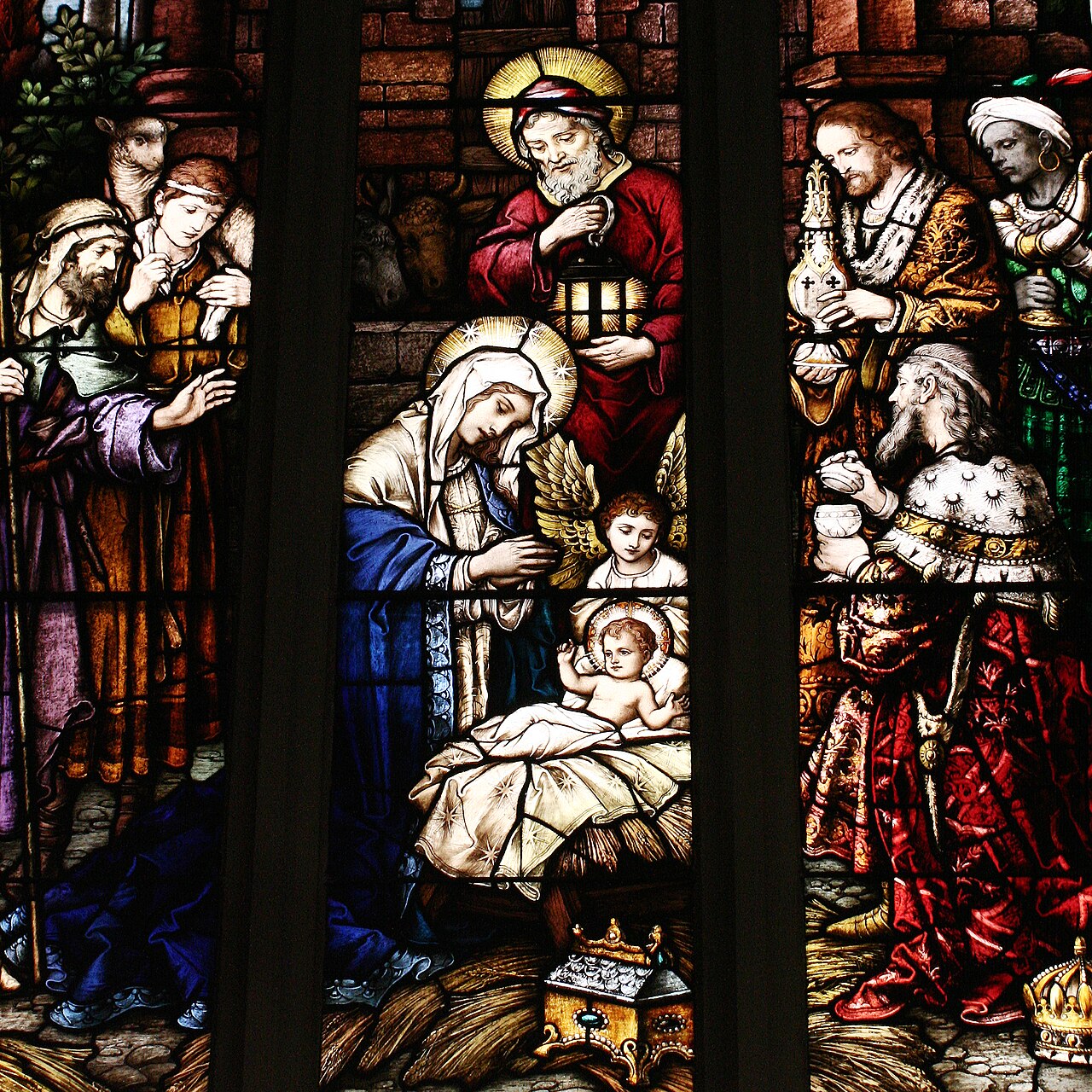
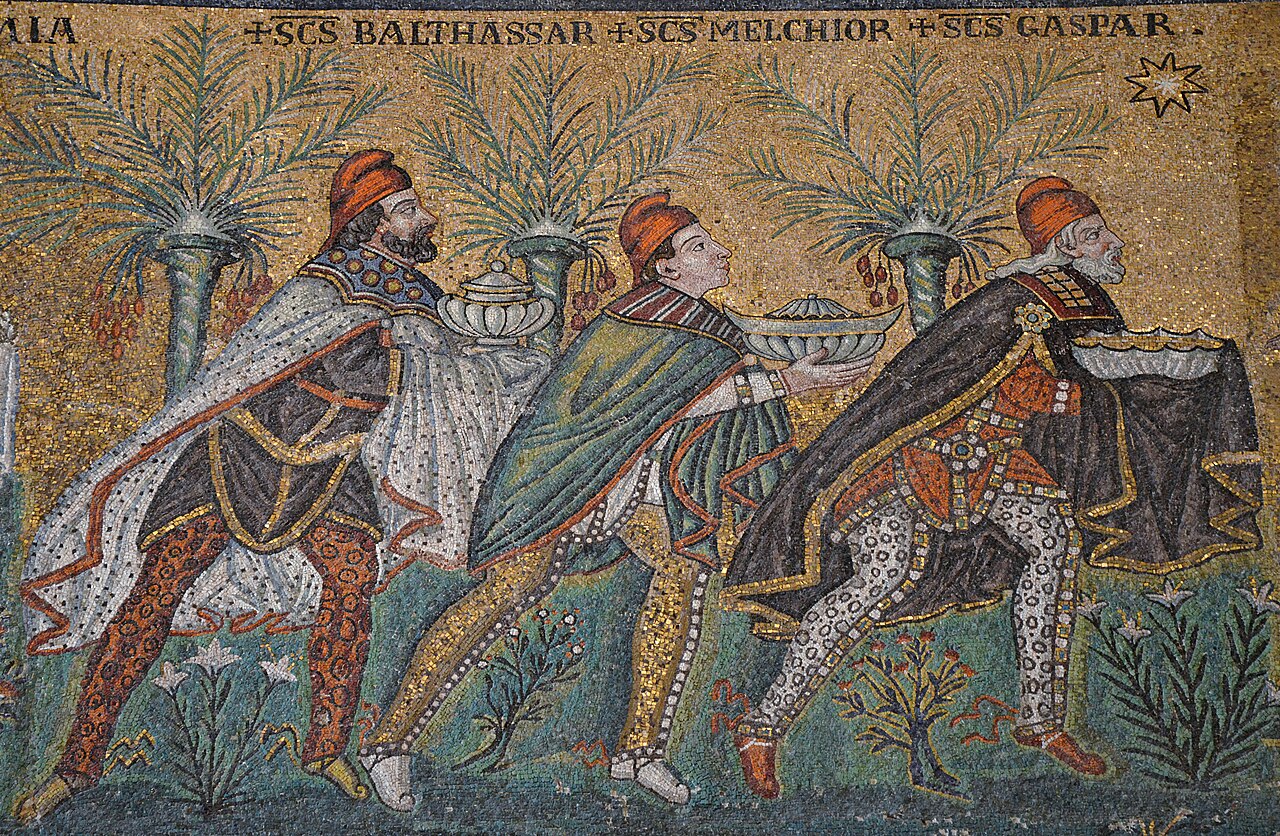
Names for the Magi do not come from the Gospel.[1] Richard Stracke's Christian Iconography site says the names first appear in a Greek work of the fifth century, the Chronica Alexandrina, whose earliest known Latin translation, the Excerpta Latina Barbari, dates from about a century after the Ravenna mosaic described below.[7]
Names for the Magi do not come from the Gospel.[1] Richard Stracke's Christian Iconography site says the names first appear in a Greek work of the fifth century, the Chronica Alexandrina, whose earliest known Latin translation, the Excerpta Latina Barbari, dates from about a century after the Ravenna mosaic described below.[7]
*Via Wikimedia Commons: [Detail of nave mosaic depicting the Three Magi (Balthasar, Melchior, a](https://commons.wikimedia.org/wiki/File:Detail_of_nave_mosaic_depicting_the_Three_Magi_(Balthasar,_Melchior,_and_Gaspar)_wearing_trousers_and_Phrygian_caps_as_a_sign_of_their_Oriental_origin,_c._500_AD,_Basilica_of_Sant%27_Apollinare_Nuovo,_Ravenna.jpg) by Following Hadrian, [CC BY-SA 2.0](https://creativecommons.org/licenses/by-sa/2.0).*
13 unchanged paragraphs
In the sixth-century mosaic in the church of Sant'Apollinare Nuovo in Ravenna, Italy, the Magi are named and shown at different ages: Balthassar middle-aged with a black beard, Melchior a beardless youth and Gaspar white-haired and bearded, all wearing Phrygian caps to mark their eastern origin.[7] The same site notes that everything above the figures' waists is a nineteenth-century restoration.[7]
In the sixth-century mosaic in the church of Sant'Apollinare Nuovo in Ravenna, Italy, the Magi are named and shown at different ages: Balthassar middle-aged with a black beard, Melchior a beardless youth and Gaspar white-haired and bearded, all wearing Phrygian caps to mark their eastern origin.[7] The same site notes that everything above the figures' waists is a nineteenth-century restoration.[7]
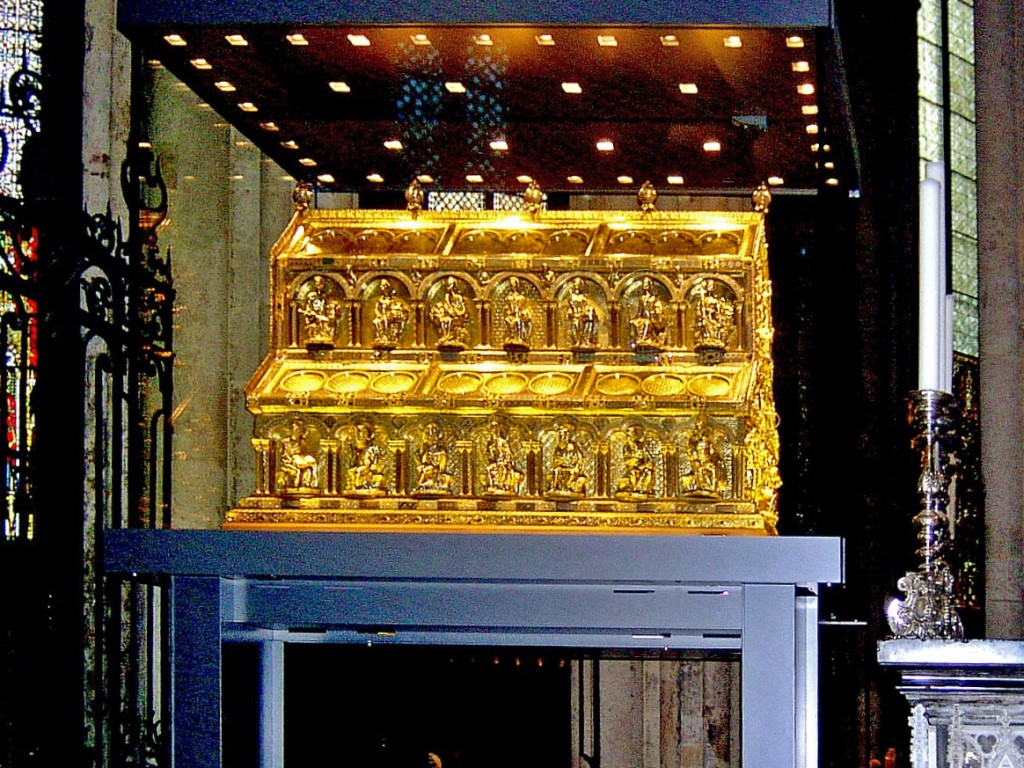
Cologne Cathedral in Germany holds what it describes as the remains of the Magi, brought from Milan in 1164.[8] DOMRADIO, the Archdiocese of Cologne's media service, reported in July 2026 that Emperor Frederick Barbarossa gave the relics to his chancellor, Rainald von Dassel, after taking Milan, and that they reached Cologne in procession at the end of July 1164.[9] The earlier story, that Helena found them in the Holy Land and took them to Constantinople and that Bishop Eustorgius brought them to Milan, is a legend whose source, John of Hildesheim's Historia Trium Regum, dates from the fourteenth century; the cathedral's provost told DOMRADIO that no one at the cathedral claims they are certainly the Magi's relics.[9] The cathedral dates its Shrine of the Three Kings to about 1190 to 1220, made by the workshop of the goldsmith Nicholas of Verdun and later Cologne and Mosan workshops, and calls it the largest and artistically most important reliquary of the Middle Ages.[8]
Cologne Cathedral in Germany holds what it describes as the remains of the Magi, brought from Milan in 1164.[8] DOMRADIO, the Archdiocese of Cologne's media service, reported in July 2026 that Emperor Frederick Barbarossa gave the relics to his chancellor, Rainald von Dassel, after taking Milan, and that they reached Cologne in procession at the end of July 1164.[9] The earlier story, that Helena found them in the Holy Land and took them to Constantinople and that Bishop Eustorgius brought them to Milan, is a legend whose source, John of Hildesheim's Historia Trium Regum, dates from the fourteenth century; the cathedral's provost told DOMRADIO that no one at the cathedral claims they are certainly the Magi's relics.[9] The cathedral dates its Shrine of the Three Kings to about 1190 to 1220, made by the workshop of the goldsmith Nicholas of Verdun and later Cologne and Mosan workshops, and calls it the largest and artistically most important reliquary of the Middle Ages.[8]

*Via Wikimedia Commons: [Cologne Dreikoenigsschrein Koelner Dom](https://commons.wikimedia.org/wiki/File:Cologne_Dreikoenigsschrein_Koelner_Dom.jpg) by ksh:User:Jüppsche based on Dreikönigsschrein im Dom1.JPG, [CC BY-SA 3.0](http://creativecommons.org/licenses/by-sa/3.0/).*
*Via Wikimedia Commons: [Cologne Dreikoenigsschrein Koelner Dom](https://commons.wikimedia.org/wiki/File:Cologne_Dreikoenigsschrein_Koelner_Dom.jpg) by ksh:User:Jüppsche based on Dreikönigsschrein im Dom1.JPG, [CC BY-SA 3.0](http://creativecommons.org/licenses/by-sa/3.0/).*
## Customs by country
## Customs by country
**Spain and Latin America.** The Smithsonian describes Three Kings' Day (Día de Reyes) as a festive tradition in Spain, Puerto Rico, Mexico and many Latin American countries, where children receive their Christmas presents on 6 January from the Three Kings (Reyes Magos) rather than from Santa Claus.[12] It lists family gatherings, parades and the Roscón or Rosca de Reyes, a round cake with a small figure of a baby hidden inside, among the customs of the day.[12]
**Spain and Latin America.** The Smithsonian describes Three Kings' Day (Día de Reyes) as a festive tradition in Spain, Puerto Rico, Mexico and many Latin American countries, where children receive their Christmas presents on 6 January from the Three Kings (Reyes Magos) rather than from Santa Claus.[12] It lists family gatherings, parades and the Roscón or Rosca de Reyes, a round cake with a small figure of a baby hidden inside, among the customs of the day.[12]
**Italy.** In Italian folklore La Befana is an old woman who fills children's stockings with gifts on Epiphany; in the legend Britannica records, she was too busy to travel with the Wise Men, promised to see them on their way back, and has searched for them ever since because they returned by another route.[15] The Catholic Encyclopedia noted in 1909 that the name Befana, from Epiphania, survived in a great fair held in Rome at that season.[3]
**Italy.** In Italian folklore La Befana is an old woman who fills children's stockings with gifts on Epiphany; in the legend Britannica records, she was too busy to travel with the Wise Men, promised to see them on their way back, and has searched for them ever since because they returned by another route.[15] The Catholic Encyclopedia noted in 1909 that the name Befana, from Epiphania, survived in a great fair held in Rome at that season.[3]
**Germany.** Around 6 January, children and young people across Germany go from door to door as star singers (Sternsinger), blessing homes and collecting donations for children around the world.[13] The German Catholic children's mission society Kindermissionswerk traces the custom, in which boys once dressed as kings re-enacted the Magi's visit, to the Middle Ages, and revived it in 1959 as the Aktion Dreikönigssingen, joined in 1961 by the Federation of German Catholic Youth (BDKJ).[13] They write a blessing over the door in chalk, such as "20 * C + M + B + 27" for 2027; the society says the letters originally stood for Caspar, Melchior and Balthasar and are now read as the Latin "Christus mansionem benedicat" ("Christ bless this house").[13] As of November 2026 its website estimated, from questionnaires and extrapolation, that about 300,000 children and young people take part each year, supporting about 600 projects for children in need.[13]
**Germany.** Around 6 January, children and young people across Germany go from door to door as star singers (Sternsinger), blessing homes and collecting donations for children around the world.[13] The German Catholic children's mission society Kindermissionswerk traces the custom, in which boys once dressed as kings re-enacted the Magi's visit, to the Middle Ages, and revived it in 1959 as the Aktion Dreikönigssingen, joined in 1961 by the Federation of German Catholic Youth (BDKJ).[13] They write a blessing over the door in chalk, such as "20 * C + M + B + 27" for 2027; the society says the letters originally stood for Caspar, Melchior and Balthasar and are now read as the Latin "Christus mansionem benedicat" ("Christ bless this house").[13] As of November 2026 its website estimated, from questionnaires and extrapolation, that about 300,000 children and young people take part each year, supporting about 600 projects for children in need.[13]
**England and elsewhere in the West.** The evening before Epiphany is called Twelfth Night, closing the twelve days of Christmas.[4] Britannica notes that many countries mark the feast with special pastries, that children often find small gifts in their shoes in memory of the Magi's gifts, and that houses are blessed with holy water.[4]
**England and elsewhere in the West.** The evening before Epiphany is called Twelfth Night, closing the twelve days of Christmas.[4] Britannica notes that many countries mark the feast with special pastries, that children often find small gifts in their shoes in memory of the Magi's gifts, and that houses are blessed with holy water.[4]
**Orthodox lands.** In 1909 the Catholic Encyclopedia described the blessing of waters by dipping a crucifix into a river, sea or lake as a very popular ceremony in the East, where people held that the blessed water could cure ailments.[3] In Bulgaria, according to the same report, young men dive into rivers and lakes to retrieve crosses thrown in by priests, in the belief that the finder will be healthy through the year, and men in white embroidered shirts wade into the river to perform a men's round dance, the mazhko horo.[14]
**Orthodox lands.** In 1909 the Catholic Encyclopedia described the blessing of waters by dipping a crucifix into a river, sea or lake as a very popular ceremony in the East, where people held that the blessed water could cure ailments.[3] In Bulgaria, according to the same report, young men dive into rivers and lakes to retrieve crosses thrown in by priests, in the belief that the finder will be healthy through the year, and men in white embroidered shirts wade into the river to perform a men's round dance, the mazhko horo.[14]
**Ethiopia.** Timkat, the Ethiopian celebration of Christ's baptism, was inscribed by UNESCO on its Representative List of the Intangible Cultural Heritage of Humanity in 2019.[11] UNESCO describes the eve, Ketera, on 18 January, when each parish's tabot (a replica of the Ark of the Covenant) is carried to a pool, river or reservoir and the night is spent in prayer, and the main day on 19 January, with the sprinkling of blessed water before the tabots return to their churches.[11] In 2027, 19 January falls on a Tuesday.[10]
**Ethiopia.** Timkat, the Ethiopian celebration of Christ's baptism, was inscribed by UNESCO on its Representative List of the Intangible Cultural Heritage of Humanity in 2019.[11] UNESCO describes the eve, Ketera, on 18 January, when each parish's tabot (a replica of the Ark of the Covenant) is carried to a pool, river or reservoir and the night is spent in prayer, and the main day on 19 January, with the sprinkling of blessed water before the tabots return to their churches.[11] In 2027, 19 January falls on a Tuesday.[10]
## Sources
## Sources
1. "Matthew 2:1-12", New American Bible, Revised Edition (NABRE). Bible.com (YouVersion). No date shown; accessed 26 November 2026. https://www.bible.com/bible/463/MAT.2.1-12.nabre
2. Secretariat of Divine Worship. "Liturgical Calendar for the Dioceses of the United States of America 2027". United States Conference of Catholic Bishops. First printing April 2025, emended February 2026; accessed 26 November 2026. https://www.usccb.org/resources/2027cal.pdf
3. Martindale, Cyril Charles. "Epiphany". The Catholic Encyclopedia, vol. 5. New York: Robert Appleton Company, 1909; New Advent. Accessed 26 November 2026. https://www.newadvent.org/cathen/05504c.htm
4. "Epiphany". Encyclopaedia Britannica. No date shown; accessed 26 November 2026. https://www.britannica.com/topic/Epiphany
5. "Epiphany". The Orthodox Faith, Volume II: Worship, The Church Year. Orthodox Church in America. No date shown; accessed 26 November 2026. https://www.oca.org/orthodoxy/the-orthodox-faith/worship/the-church-year/epiphany
6. "Celebrating Christ's Birth and Baptism". The Armenian Church, Eastern Diocese of America. 4 January 2024; accessed 26 November 2026. https://armenianchurch.us/celebrating-christs-birth-and-baptism-6/
7. Stracke, Richard. "The Procession of Virgins at Sant'Apollinare Nuovo: The Magi". Christian Iconography. No date shown; accessed 26 November 2026. https://christianiconography.info/Edited in 2013/Italy/sApolNuovoLeftNave.magi.html
8. "Dreikönigenschrein - Einleitung". Kölner Dom (Cologne Cathedral). No date shown; accessed 26 November 2026. https://www.koelner-dom.de/kunstwerke/dreikoenigenschrein
9. Peter, Mathias. "Der lange Weg der Heiligen Drei Könige nach Köln". DOMRADIO.DE. 23 July 2026; accessed 26 November 2026. https://www.domradio.de/artikel/der-lange-weg-der-heiligen-drei-koenige-nach-koeln
10. "Orthodox Epiphany around the world in 2027". Office Holidays. No date shown; accessed 26 November 2026. https://www.officeholidays.com/holidays/orthodox-epiphany
11. "Ethiopian epiphany". Representative List of the Intangible Cultural Heritage of Humanity (inscribed 2019, 14.COM). UNESCO. Accessed 26 November 2026. https://ich.unesco.org/en/RL/timkat-epiphany-in-ethiopia-01491
12. "Three Kings Day". Smithsonian Newsdesk. No date shown; accessed 26 November 2026. https://newsdesk.si.edu/snapshot/three-kings-day
13. "FAQ zum Sternsingen: Fragen und Antworten". Kindermissionswerk "Die Sternsinger". No date shown; accessed 26 November 2026. https://www.sternsinger.de/sternsingen/sternsinger-faq/
14. "Bulgarians celebrate the feast of Epiphany with a ritual plunge into icy rivers". ABC News (wire report; no byline or date shown). Accessed 26 November 2026. https://abcnews.go.com/International/wireStory/bulgarians-celebrate-feast-epiphany-ritual-plunge-icy-rivers-117377846
15. "Befana". Encyclopaedia Britannica. No date shown; accessed 26 November 2026. https://www.britannica.com/topic/Befana
