Compare versions
Version 1 → Version 2 (current). Removed · Added. This shows the entry's text as it is written, including its formatting marks.
Version 1 · Version 2 (current) · Version history
Side by side · Together
Judy Garland (10 June 1922 – 22 June 1969) was an American singer and actress, best known for playing Dorothy in The Wizard of Oz (1939) and for a concert career that included her 1961 appearance at Carnegie Hall.
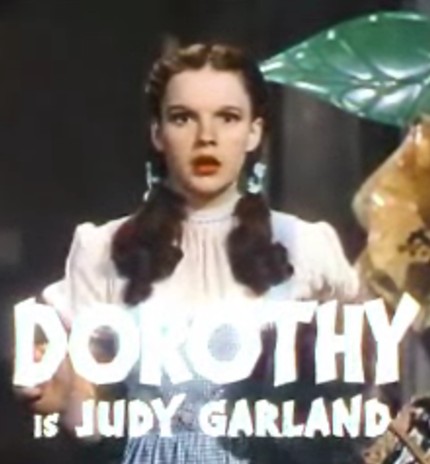
*Via Wikimedia Commons: [Judy Garland in The Wizard of Oz trailer](https://commons.wikimedia.org/wiki/File:Judy_Garland_in_The_Wizard_of_Oz_trailer.jpg) by Trailer screenshot Licencing information : https://web.archi/, public domain.*
## Childhood
Garland was born Frances Ethel Gumm in Grand Rapids, Minnesota, the youngest of the three children of Frank and Ethel Gumm.[1] Her parents were vaudeville performers who owned a movie theatre, where the family performed between films.[3] She first sang on its stage at the age of two, performing "Jingle Bells".[1][3] She toured in an act with her two older sisters, which in 1934 took the name the Garland Sisters; she changed her own first name to Judy, after a song by Hoagy Carmichael.[3]
## At Metro-Goldwyn-Mayer
In September 1935 she signed with Metro-Goldwyn-Mayer (MGM), without a screen test, on a seven-year contract that started at 100 dollars a week.[1][3] Her father died that November.[1] Her first feature was Pigskin Parade (1936), made on loan to another studio.[3] Her singing of "You Made Me Love You" at a birthday party for the actor Clark Gable led MGM to put the song into Broadway Melody of 1938.[1][3] She then made a series of films with Mickey Rooney.[3]
The Wizard of Oz, released in 1939, made her internationally famous, and its song "Over the Rainbow" became identified with her.[2][3] She received a special juvenile Academy Award for the role, presented in February 1940.[1][3] Her later MGM musicals included Babes in Arms, Strike Up the Band, For Me and My Gal, Meet Me in St. Louis (1944), The Harvey Girls and Easter Parade (1948).[1][3] The PBS series American Masters calls Meet Me in St. Louis MGM's greatest financial success after Gone with the Wind.[1] The Clock (1945) gave her a straight dramatic role.[3]
Garland had serious health problems during these years, including dependence on drugs, and missed work.[3] She was replaced on two films, and MGM released her from her contract in September 1950.[1][3]
## Concert stage
Garland had made her concert debut in Philadelphia in 1943.[1] After leaving MGM she rebuilt her career on stage, opening at the London Palladium in April 1951 and then at the Palace Theatre in New York that October.[1] The Palace engagement ran for about twenty weeks, and she received a special Tony Award in 1952.[1][3] In 1959 she became the first popular singer to play the Metropolitan Opera House.[1]
Her concert at Carnegie Hall in New York on 23 April 1961 became her most celebrated.[1][2] The two-record album, Judy at Carnegie Hall, stayed on the Billboard charts for 73 weeks, 13 of them at number one.[2] It won her two Grammy Awards, for Album of the Year and for best female solo vocal performance, and she was the first woman to win Album of the Year.[2][3]
## Later films and television
A Star Is Born (1954), co-starring James Mason and made in partnership with Warner Bros. through a company she formed with her husband Sidney Luft, brought her a Golden Globe and an Academy Award nomination for best actress.[1][3] She was nominated for a second Academy Award, for best supporting actress, for Judgment at Nuremberg (1961).[1][3] Her last film was I Could Go On Singing.[3]
She made her television debut on CBS in 1955.[1] The weekly series The Judy Garland Show ran from 1963 to 1964, and she was nominated for an Emmy Award for it.[3]
## Personal life
Garland married five times: to the composer David Rose, the director Vincente Minnelli, the producer Sidney Luft, the actor Mark Herron and Mickey Deans.[3] She had three children: Liza Minnelli, born in 1946, and Lorna and Joey Luft.[1][3]
## Death and legacy
Her last concert was in Copenhagen in March 1969.[1] She died in London on 22 June 1969, aged 47, of an accidental overdose of sleeping pills.[1][2] Over one 24-hour period, 22,000 people filed past her coffin.[1]
She received a Grammy Lifetime Achievement Award after her death, in 1997.[3] The American Film Institute ranked "Over the Rainbow" first on its list of 100 film songs.[2] A Judy Garland Museum in Grand Rapids opened in 1975 and holds an annual festival.[3] The 2019 film Judy, with Renée Zellweger, portrayed her final year in London.[3]
## Sources
1. PBS American Masters. "Judy Garland's life and career timeline". Accessed 26 November 2026. https://www.pbs.org/wnet/americanmasters/judy-garland-career-timeline/601/
2. Frank Villella. "Judy Garland @ 100: 'Miss Show Business'". Chicago Symphony Orchestra, 2022; accessed 26 November 2026. https://cso.org/experience/article/10167/judy-garland-100-miss-show-business
3. Biography.com. "Judy Garland: Biography, Actor, Singer, Grammy Winner". Accessed 26 November 2026. https://www.biography.com/actors/judy-garland
