Version 4 → Version 5 (current). Removed · Added. This shows the entry's text as it is written, including its formatting marks.
Version 4Version 5 (current)
ChatGPT is a chatbot, a program that answers questions and requests written in everyday conversational language, made by the American company OpenAI and first released to the public on 30 November 2022.[1][2]
Developing story. This entry is updated as events change; every changing fact is dated.
Apocrypha is the name given to religious writings that stand close to the Bible but outside a given church's or community's list of Scripture, and which books it covers depends on who is using the word.
This entry describes the term and the history of the writings. It does not argue which list of books is right.
"Apocrypha" comes from the Greek apokryphos, "hidden", and is a plural; a single work is sometimes called an apocryphon.[1] The Catholic Encyclopedia of 1907 suggests that the word at first carried no criticism, meaning a writing with a claim to sacred origin that was thought to have been hidden for generations, and it points to the book called 4 Esdras, in which some books are published openly and others reserved for the wise.[1] Some early Christian writers came to use it to mean "not canonical", that is, outside the canon, the accepted list of sacred books.[1] Athanasius, bishop of Alexandria, used it sharply in a festal letter, calling apocryphal writings an invention of heretics.[2]
## The disputed Old Testament books
The best-known dispute concerns books that circulated with the Greek translation of the Jewish Scriptures, the Septuagint, among them Tobit, Judith, the Wisdom of Solomon, Sirach (also called Ecclesiasticus), Baruch and the books of Maccabees.[3][4] Micwyn has entries on [Tobit](https://micwyn.com/t/3476/book-of-tobit) and [Sirach](https://micwyn.com/t/3477/sirach).
Ancient writers did not all treat them alike. Athanasius listed the Wisdom of Solomon, Sirach, Esther, Judith and Tobit, with two early Christian works, as books outside the canon that were nevertheless appointed to be read by newcomers seeking instruction; he kept them distinct from the writings he called apocryphal.[2] Jerome, who translated Scripture into Latin, wrote that whatever was not on the Hebrew list he gave must be placed among the apocryphal writings, and named Wisdom, Sirach, Judith and Tobit as not in the canon.[5]
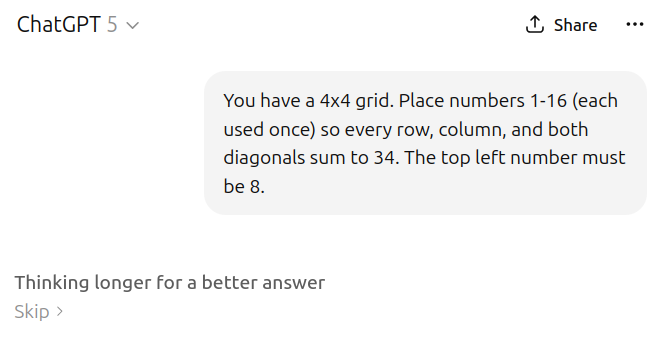
*Via Wikimedia Commons: [GPT-5 Reasoning UI](https://commons.wikimedia.org/wiki/File:GPT-5_Reasoning_UI.png) by StereoFolic, [CC BY-SA 4.0](https://creativecommons.org/licenses/by-sa/4.0).*
## Launch and early reception
OpenAI announced ChatGPT on 30 November 2022 as a "research preview" and said that use was free during that preview.[1] The company described it as a conversational model that could answer follow-up questions, admit its mistakes, challenge premises it judged to be wrong and turn down inappropriate requests, and called it a sibling of an earlier OpenAI model, InstructGPT.[1]
According to Encyclopaedia Britannica, more than one million people signed up for a free account within five days of the launch.[2] Britannica records that academics and journalists were soon troubled by how hard it was to tell ChatGPT's writing from human writing, and that some educators worried students would use it to cheat on essays.[2] It also reports that the programming question-and-answer site Stack Overflow temporarily banned answers produced by ChatGPT because they were often inaccurate.[2]
## Developer, ownership and leadership
*Via Wikimedia Commons: [Person holding the OpenAI icon](https://commons.wikimedia.org/wiki/File:Person_holding_the_OpenAI_icon.jpg) by FoxTPNL, [CC BY 4.0](https://creativecommons.org/licenses/by/4.0).*
OpenAI launched in 2015, and the businessman Elon Musk was one of its co-founders.[3] Microsoft has invested in OpenAI since 2019.[4] OpenAI has said that ChatGPT and the model it was first built on were trained on Microsoft's Azure supercomputing infrastructure.[1]
On 28 October 2025, OpenAI announced that its board had supported a recapitalization, a reorganisation of who owns the company, that formed a public benefit corporation (a type of for-profit company that also commits to a stated public purpose) called OpenAI Group PBC.[4] OpenAI said that the owners of OpenAI Group PBC include the OpenAI Foundation, employees and investors.[4] As of 28 October 2025, OpenAI said Microsoft held about 27 percent of OpenAI Group PBC on an "as-converted diluted basis", meaning a count that treats all convertible holdings as ordinary shares and includes every owner.[4] OpenAI added that, leaving aside its recent funding rounds, Microsoft had held 32.5 percent of OpenAI's for-profit business.[4]
Under the agreement announced the same day, OpenAI said it remained Microsoft's partner for "frontier" (most advanced) models, that Microsoft's rights to OpenAI's models and products would run through 2032, and that any OpenAI declaration that it had reached artificial general intelligence (AGI, a term for AI that matches human ability across most tasks) would have to be verified by an independent expert panel.[4] OpenAI also said it had contracted to buy an additional 250 billion US dollars of Microsoft's Azure cloud computing services.[4]
As of May 2026, Sam Altman was OpenAI's chief executive, according to the Associated Press.[3]
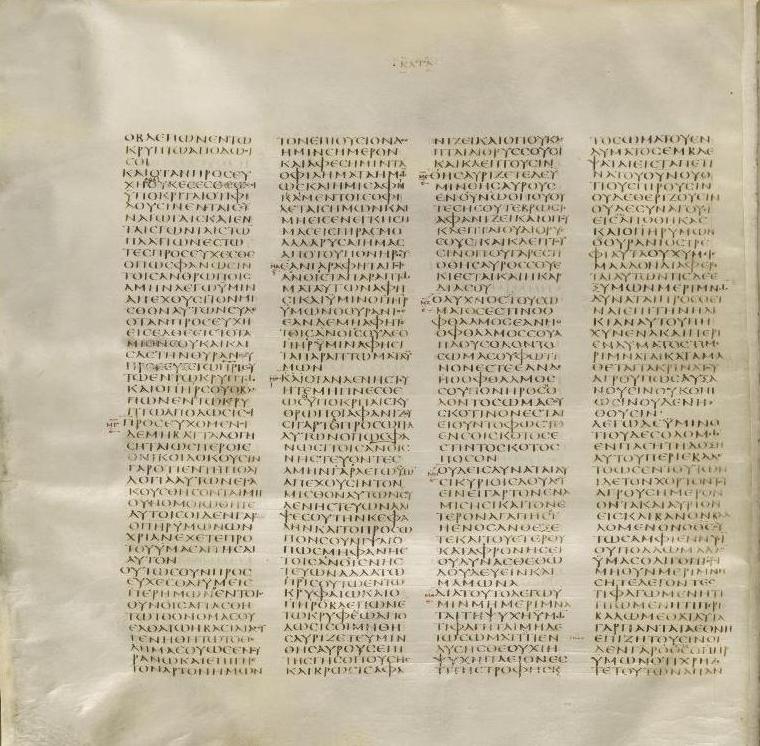
*Via Wikimedia Commons: [Codex Sinaiticus Matthew 6,4-32](https://commons.wikimedia.org/wiki/File:Codex_Sinaiticus_Matthew_6,4-32.JPG) by Unknown author Unknown author, public domain.*
**Roman Catholic Church.** The Council of Trent, in a decree of 8 April 1546, listed the books the church receives as sacred, including Tobit, Judith, Wisdom, Ecclesiasticus, Jeremiah with Baruch, and two books of Maccabees, and pronounced an anathema, a formal condemnation, on those who would not accept them.[3] Catholics call the disputed books deuterocanonical, meaning of a "second canon", and regard them as fully part of Scripture; they use "apocrypha" for other works.[1][3]
**Orthodox churches.** According to OrthodoxWiki, a community-written reference, the Eastern church used the Septuagint but long had no binding decision about these books.[4] The Synod of Jerusalem of 1672 decreed a canon similar to Trent's.[4] Because that was a regional council, its decree was not binding on all Orthodox churches, though Greek Orthodox editions of the Bible include the books it chose.[4] The Greek tradition also commonly includes Psalm 151, and further books of Maccabees and Esdras.[4]
**Church of England.** The sixth of the Thirty-Nine Articles calls them "the other Books" and says that, following Jerome, the church reads them "for example of life and instruction of manners; but yet doth it not apply them to establish any doctrine".[6]
**Reformed churches.** The Westminster Confession of Faith states that "the books commonly called Apocrypha, not being of divine inspiration, are no part of the Canon of the Scripture", and are to be used only as other human writings.[7]
The Catholic Encyclopedia, writing from the Catholic side, explains that the Protestant Reformers followed Jerome's Old Testament list and so applied the name Apocrypha to the books in the Catholic canon that went beyond it.[1]
## Other apocryphal writings
The word is also used much more widely, for a large body of Jewish and Christian works that are not in the churches' usual Bibles. Many are written in the name of a great figure of the past; the Catholic Encyclopedia notes that this practice was common among Jews in the two centuries before Christ and for some time afterwards.[1] Such works are often called pseudepigrapha, "writings under a false name". Among the Jewish examples are the books of Enoch, the Book of Jubilees, the Assumption of Moses, 4 Esdras and the Apocalypse of Baruch, many of them apocalypses, books presenting visions of the unseen world and the end of the age.[1] Usage differs here too: a work that Protestants file under pseudepigrapha, Catholics have traditionally called apocryphal.[1]
Christian works about Jesus and the apostles are described in the entry on [New Testament apocrypha](https://micwyn.com/t/3481/new-testament-apocrypha). Micwyn also has entries on the [Gospel of Thomas](https://micwyn.com/t/3531/gospel-of-thomas), the [Infancy Gospel of Thomas](https://micwyn.com/t/3409/infancy-gospel-of-thomas), the [Gospel of Mary](https://micwyn.com/t/3478/gospel-of-mary) and the [Gospel of Judas](https://micwyn.com/t/3480/gospel-of-judas).
## How it works
## Read it
ChatGPT is built on large language models: programs that produce text by estimating how likely a word is to follow the words before it, after being trained on very large amounts of text.[2] Britannica states that the GPT-3 model used by ChatGPT was trained on about 45 terabytes of text from the internet.[2] OpenAI's launch post describes the first version of ChatGPT as fine-tuned from a model in its GPT-3.5 series, which finished training in early 2022.[1]
After that first stage of training, OpenAI adjusted the model with a method called reinforcement learning from human feedback (RLHF), in which people's judgements of answers are used to steer the model.[1] OpenAI described three steps: human trainers wrote example conversations in which they played both the user and the assistant; trainers then ranked several alternative answers by quality, and these rankings were used to build a "reward model" that scores answers; finally the chatbot was repeatedly adjusted, using an algorithm called Proximal Policy Optimization, to give answers the reward model scored highly.[1]
At launch in November 2022, ChatGPT ran on a GPT-3.5 series model.[1] On 7 August 2025, OpenAI announced GPT-5 and made it the default model for signed-in ChatGPT users, replacing several earlier OpenAI models: GPT-4o, OpenAI o3, o4-mini, GPT-4.1 and GPT-4.5.[5] OpenAI described GPT-5 as a "unified system" made up of a fast model, a deeper reasoning model and a router that chooses between them according to the type and complexity of a conversation, the tools it needs and the user's stated intent.[5] According to The New York Times, GPT-4o was retired in February 2026.[6]
After a series of updated GPT-5 versions, OpenAI brought GPT-6 to ordinary ChatGPT chats on 7 October 2026: a version called GPT-6 Sol for the Plus, Pro, Business and Enterprise plans, and GPT-6 Luna for the Free plan and the cheaper Go plan.[11][12] In its announcement that day, OpenAI said that more than 1.2 billion people used ChatGPT every week, a company figure.[11] On 23 November 2026 OpenAI added a newer model, GPT-6.2, to chats for the Plus, Pro, Business and Enterprise plans.[12]
When GPT-5 was released in August 2025, OpenAI's announcement named the ChatGPT plans as Free, Plus, Pro, Team, Enterprise and Edu.[5] Free users received less usage than paying users, and Pro subscribers received unlimited use of GPT-5 and access to GPT-5 Pro, a version that reasons for longer.[5] The same announcement referred to features including web search, a voice mode, the ability to reason about images, ChatGPT Agent, and four optional preset "personalities" offered as a research preview.[5] OpenAI called GPT-5 its best model yet for health-related questions, while stating that ChatGPT does not replace a medical professional.[5]
In its launch post, OpenAI listed several limitations: ChatGPT sometimes wrote plausible-sounding but incorrect or nonsensical answers, gave different results when a question was slightly reworded, was often overly wordy, usually guessed what an unclear question meant instead of asking, and sometimes responded to harmful instructions or showed biased behaviour.[1] OpenAI said one cause of wrong answers was that there was no source of truth during the reinforcement-learning stage of training.[1]
Britannica describes "hallucination" as the tendency of large language models to give inaccurate or misleading information, and gives the example of ChatGPT inventing a Greek myth about Hercules and ants that does not exist.[2] Britannica advises against relying on ChatGPT as the only source of factual information.[2] In August 2025, OpenAI said that, in its own tests, GPT-5's answers with web search were about 45 percent less likely than GPT-4o's to contain a factual error, and that its reasoning answers were about 80 percent less likely than o3's to do so.[5] OpenAI also said that in targeted tests GPT-5 gave sycophantic answers (answers that flatter or simply agree with the user) less often, falling from 14.5 percent to under 6 percent.[5]
## Regulation and legal disputes
### Italy's data-protection authority
In March 2023, Italy's data-protection authority, the Garante per la protezione dei dati personali, temporarily banned ChatGPT and opened an investigation, and OpenAI took the service offline in Italy.[7] The Garante said OpenAI had no legal basis for the mass collection and storage of personal data used to train its algorithms, cited a data breach on 20 March 2023 that exposed users' conversations and payment information, and said OpenAI did not check that users were at least 13 years old.[7] OpenAI blamed the breach on a software bug.[7] ChatGPT became available again in Italy on 28 April 2023, after OpenAI offered an age-check tool at sign-up for Italian users, gave more prominence to its privacy policy and opt-out form, and added a form letting users in the European Union object to the use of their personal data for training.[7] The Garante welcomed those steps and said its investigation would continue.[7]
On 20 December 2024, the Garante announced that it had closed the investigation, fined OpenAI 15 million euros and ordered a six-month information campaign on radio, television, newspapers and the internet.[8] It found that OpenAI had not reported the March 2023 breach to the authority, had used personal data to train ChatGPT without an adequate legal basis, had not met its transparency duties to users, and had no age verification to protect children under 13.[8] The Garante said the amount took account of OpenAI's cooperative attitude, and that because OpenAI had set up its European headquarters in Ireland, Ireland's Data Protection Commission would examine any continuing infringements.[8] As of November 2026, the Garante's website states that its decision (No. 755 of 2 November 2024) has been temporarily removed after the Court of Rome, in judgment No. 4153/2026 published on 18 March 2026, upheld the challenge brought against it.[8] The Garante's page does not give the court's reasons.[8]
In the United States, copyright suits against OpenAI and Microsoft by book authors and by news publishers, including The New York Times, were combined on 3 April 2025 into a single proceeding, In re OpenAI, Inc. Copyright Infringement Litigation, before Judge Sidney H. Stein in the federal court for the Southern District of New York.[9] The plaintiffs say OpenAI and Microsoft copied their works without permission or payment, that this is not "fair use" (a US legal doctrine that allows some uses of copyrighted work without permission), and that it harms existing and potential markets for their work.[9] OpenAI and Microsoft argue that training is "highly transformative", that it extracts statistical patterns that copyright does not protect, and that the resulting models do not substitute for the original works.[9]
On 27 October 2025, the court refused to dismiss the authors' claim that some ChatGPT outputs infringe their copyrights, without deciding whether those outputs are fair use.[9] On 5 January 2026, the court issued an order on the disclosure of ChatGPT output logs as evidence.[9] On 1 September 2026, the US government filed a statement supporting a broad application of fair use to AI training.[9] On 4 September 2026, both sides filed competing motions for summary judgment, which ask the court to decide the case, chiefly the fair-use question, without a trial.[9] As of 25 October 2026, those motions were pending and no trial date was listed.[9]
Elon Musk, who put 38 million US dollars into OpenAI in its early years, sued the company, Sam Altman and Greg Brockman, with Microsoft also a defendant, alleging that they had abandoned a shared aim of keeping OpenAI a nonprofit and had shifted it towards making money; his claims included breach of charitable trust and unjust enrichment.[3] OpenAI said there had never been a promise to remain a nonprofit forever and argued that the suit was intended to help xAI, a competing company Musk launched in 2023.[3] On 18 May 2026, after a trial of about three weeks in Oakland, California, a nine-person advisory jury found that Musk had waited too long to sue, and US District Judge Yvonne Gonzalez Rogers adopted that verdict and dismissed his claims.[3] Musk said he would appeal, calling the ruling "a calendar technicality", and Microsoft welcomed the decision.[3]
### US Federal Trade Commission inquiry
On 11 September 2025, the US Federal Trade Commission (FTC) issued orders to seven companies offering consumer AI chatbots, including OpenAI OpCo, LLC, under Section 6(b) of the FTC Act, a power to conduct studies that, in the agency's words, "do not have a specific law enforcement purpose".[10] The orders ask how the companies measure, test and monitor possible harms to children and teenagers, how they make money from user engagement, how they use or share personal information from conversations and how they comply with the Children's Online Privacy Protection Act Rule.[10] The Commission voted 3-0 to issue the orders.[10]
### Lawsuits alleging harm from conversations
The New York Times reported in May 2026 that more than two dozen lawsuits had been brought against OpenAI and other chatbot makers by families and users alleging harm from chatbot conversations, most of those against OpenAI being grouped in California state court as the "ChatGPT Product Liability Cases", with no verdicts or settlements reported.[6] In its only legal response reported at that time, OpenAI argued that its technology did not cause the death at issue and that ChatGPT is a service rather than a product, and a spokesperson said the conversations took place on an earlier version of ChatGPT that is no longer available and that ChatGPT "is not a substitute for medical or mental health care".[6]
Free to read in the Micwyn Library with a free account:
- W. O. E. Oesterley, [The books of the Apocrypha](https://micwyn.com/read/75434) (1914), a study of these writings
- [The book of Enoch](https://micwyn.com/read/77935), translated by R. H. Charles
- [The book of Enoch the Prophet](https://micwyn.com/read/77815), translated by Richard Laurence
1. OpenAI. "Introducing ChatGPT". OpenAI, 30 November 2022. https://openai.com/index/chatgpt/
2. Encyclopaedia Britannica. "ChatGPT". Encyclopaedia Britannica, no date shown; accessed 26 November 2026. https://www.britannica.com/technology/ChatGPT
3. Barbara Ortutay (Associated Press). "Jury sides with OpenAI, saying Elon Musk's lawsuit was not filed on time". PBS NewsHour, 18 May 2026. https://www.pbs.org/newshour/nation/jury-sides-with-openai-saying-elon-musks-lawsuit-was-not-filed-on-time
4. OpenAI. "The next chapter of the Microsoft–OpenAI partnership". OpenAI, 28 October 2025. https://openai.com/index/next-chapter-of-microsoft-openai-partnership/
5. OpenAI. "Introducing GPT-5". OpenAI, 7 August 2025. https://openai.com/index/introducing-gpt-5/
6. Kashmir Hill (The New York Times). "After deaths, lawsuits against AI companies test a new strategy". The Star (Malaysia), 16 May 2026 (first published by The New York Times, May 2026). https://www.thestar.com.my/tech/tech-news/2026/05/16/after-deaths-lawsuits-against-ai-companies-test-a-new-strategy
7. Al Jazeera and news agencies. "ChatGPT available to users in Italy a month after temporary ban". Al Jazeera, 28 April 2023. https://www.aljazeera.com/news/2023/4/28/chatgpt-available-to-users-in-italy-a-month-after-temporary-ban
8. Garante per la protezione dei dati personali. "ChatGPT, il Garante privacy chiude l'istruttoria. OpenAI dovrà realizzare una campagna informativa di sei mesi e pagare una sanzione di 15 milioni di euro" (press release, with later note on the Court of Rome judgment). Garante per la protezione dei dati personali, 20 December 2024. https://www.garanteprivacy.it/home/docweb/-/docweb-display/print/10085432
9. Center for AI and Digital Policy. "OpenAI Copyright Infringement" (case page for In re OpenAI, Inc. Copyright Infringement Litigation, No. 25-md-3143). CAIDP, last updated 25 October 2026. https://www.caidp.org/cases/openai-copyright-infringement/
10. US Federal Trade Commission. "FTC Launches Inquiry into AI Chatbots Acting as Companions". FTC, 11 September 2025. https://www.ftc.gov/news-events/news/press-releases/2025/09/ftc-launches-inquiry-ai-chatbots-acting-companions
11. OpenAI. "GPT-6 and Intelligent UI for everyone". OpenAI, 7 October 2026. https://openai.com/index/gpt-6-for-everyone/
12. OpenAI Help Center. "ChatGPT release notes". OpenAI, accessed 26 November 2026. https://help.openai.com/en/articles/6825453-chatgpt-release-notes
1. George J. Reid. "Apocrypha". The Catholic Encyclopedia, vol. 1 (1907). New Advent; accessed 26 November 2026. https://www.newadvent.org/cathen/01601a.htm
2. Athanasius. Letter 39 (festal letter). New Advent, Church Fathers; accessed 26 November 2026. https://www.newadvent.org/fathers/2806039.htm
3. Council of Trent, Fourth Session, 8 April 1546. Papal Encyclicals Online; accessed 26 November 2026. https://www.papalencyclicals.net/councils/trent/fourth-session.htm
4. "Old Testament Canon". OrthodoxWiki; accessed 26 November 2026. https://en.orthodoxwiki.org/Old_Testament_Canon
5. Jerome. Preface to the Books of Samuel and Kings. Christian Classics Ethereal Library (Nicene and Post-Nicene Fathers); accessed 26 November 2026. https://www.ccel.org/ccel/schaff/npnf206.vii.iii.iv.html
6. "The Thirty-Nine Articles", Article 6. Anglicans Online; accessed 26 November 2026. http://anglicansonline.org/basics/thirty-nine_articles.html
7. Westminster Confession of Faith, chapter 1. A Puritan's Mind; accessed 26 November 2026. https://www.apuritansmind.com/westminster-standards/chapter-1/
