Compare versions
Version 3 → Version 5 (current). Removed · Added. This shows the entry's text as it is written, including its formatting marks.
Version 3 · Version 5 (current) · Version history
Side by side · Together
Donald Trump (born 14 June 1946) is an American businessman and Republican politician who served as the 45th president of the United States from 2017 to 2021 and became the 47th president in January 2025.
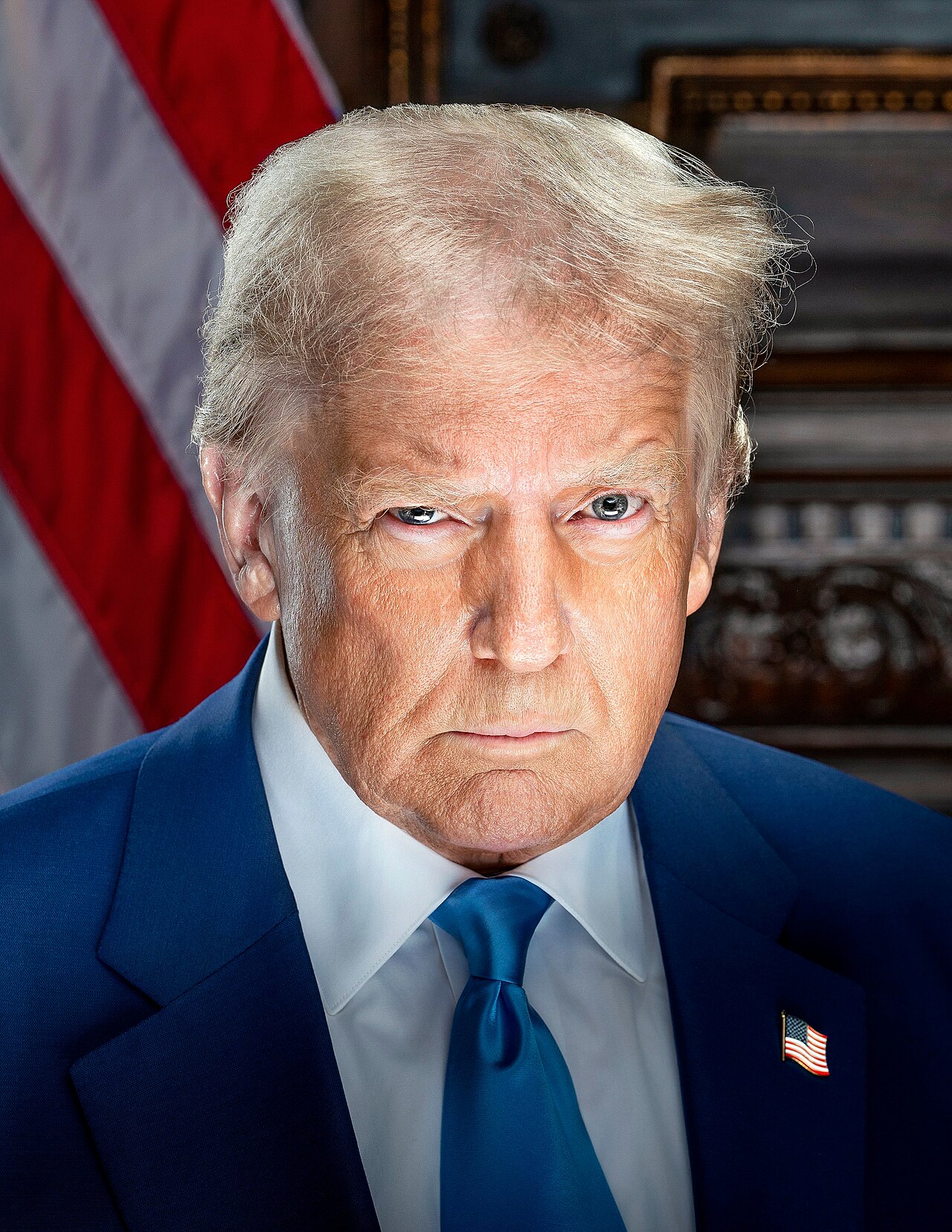
*Via Wikimedia Commons: [January 2025 Official Presidential Portrait of Donald J. Trump](https://commons.wikimedia.org/wiki/File:January_2025_Official_Presidential_Portrait_of_Donald_J._Trump.jpg) by Daniel Torok, public domain.*
Developing story. This entry is updated as events change; every changing fact is dated.
This entry covers his public life: business, elections, policy, and court cases.
## At a glance
- **Born:** 14 June 1946, Queens, New York City.[1]
- **Party:** Republican.
- **Terms:** 20 January 2017 to 20 January 2021; since 20 January 2025.[1]
- **Elections:** won in 2016 (304 electoral votes to 227), lost in 2020 (232 to 306), won in 2024 (312 to 226).[1][2]
- **Impeachments:** two, in 2019 and 2021; acquitted by the Senate both times.[1][3]
- **Congress now:** Democrats won both chambers in November 2026.[20]
## Before politics
Trump took over the property business of his father, Fred, and expanded it into hotels, casinos, golf courses, beauty pageants and branded products.[1] Many of his traditional businesses, including the casinos, struggled and went through a series of bankruptcies, while the Trump name remained a strong brand.[1] In the 2000s he starred in the television programme The Apprentice.[1]
## 2016 election
Trump was elected on 8 November 2016 in what was widely seen as an upset.[1] He won the Electoral College, the body of state electors that formally chooses the president, while Hillary Clinton received about 2.8 million more votes nationally.[1][2] He was the first president never to have held public office or military command before.[1]
## First term (2017–2021)
### Taxes, spending and regulation
In December 2017 Trump signed the Tax Cuts and Jobs Act, which lowered tax rates for companies and individuals.[3] The Miller Center, a research institute at the University of Virginia, judges that it eased the burden mostly on high-income Americans and gave moderate cuts to most others.[3] Trump suspended or revoked nearly 100 federal regulations and ordered agencies to remove two rules for each new one.[3] His administration said its deregulation would save consumers and businesses more than 220 billion dollars a year once fully in effect.[4]
Before the pandemic the unemployment rate reached 3.5 per cent, which the administration described as the lowest in half a century, with record lows for several groups of workers.[4]
### Health care
Efforts to repeal the Affordable Care Act, the 2010 health law, failed in the Senate in 2017. The tax law did remove the penalty for not having insurance.[3]
### Immigration
Soon after taking office Trump barred entry to citizens of seven mainly Muslim countries and paused refugee admissions; after court challenges the order was revised.[3] A dispute over money for a wall on the Mexican border led to a 35-day government shutdown beginning in December 2018.[3] New barriers were built along more than 450 miles of the border, nearly 50 miles of it where none had stood.[3] In 2018 a "zero tolerance" policy separated at least 2,300 children from their parents; after strong protest Trump ended it by executive order in June, and hundreds of children had still not been reunited by the 2020 election.[3]
### Supreme Court
Trump appointed three justices: Neil Gorsuch, Brett Kavanaugh and Amy Coney Barrett. All were confirmed mostly on party lines and moved the court markedly to the right.[3] Democrats objected in particular to the filling of seats in circumstances they called unfair; Kavanaugh denied an allegation of assault raised during confirmation.[3]
### Trade and foreign policy
Trump described his approach as "America First".[5] He withdrew from the planned Trans-Pacific Partnership trade pact, replaced the North American Free Trade Agreement with the United States-Mexico-Canada Agreement, and from 2018 imposed tariffs on Chinese goods; China retaliated, and a later agreement eased the dispute.[5] Supporters praised him for standing up for American manufacturers, and critics said the tariffs raised costs and hurt trade.[5]
He withdrew from the Paris climate agreement, the World Health Organization and the 2015 nuclear deal with Iran, and pressed NATO allies, which he argued did not pay enough for their defence.[5] His government recognised Jerusalem as Israel's capital and brokered the Abraham Accords, under which the United Arab Emirates and Bahrain normalised relations with Israel.[5] He met North Korea's leader Kim Jong-un three times and in 2019 became the first sitting United States president to enter North Korea, though Kim did not give up nuclear weapons.[5] He ordered strikes on Syria in 2017, announced a withdrawal of troops from Syria in 2018, and in 2020 reached a deal with the Taliban that led to the withdrawal from Afghanistan completed the following year.[5]
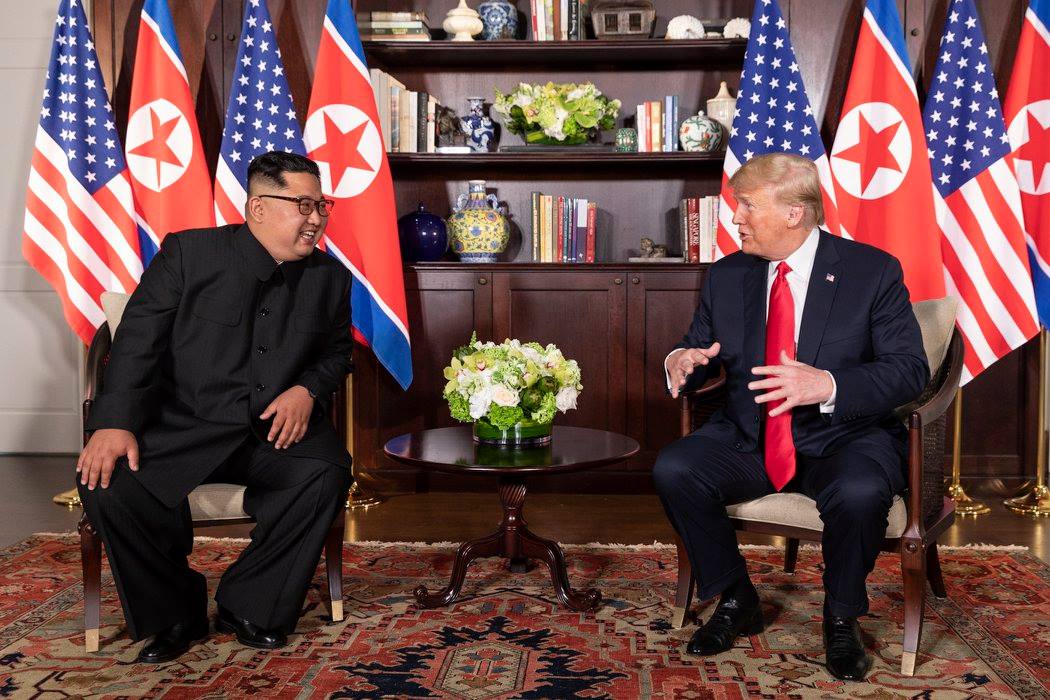
*Via Wikimedia Commons: [Trump Kim Summit at the Capella Hotel (3)](https://commons.wikimedia.org/wiki/File:Trump_Kim_Summit_at_the_Capella_Hotel_(3).jpg) by Shealeah Craighead, public domain.*
### COVID-19
In March 2020 Trump declared a national emergency and signed the CARES Act, a 2.2 trillion dollar relief law.[3][6] Public health experts gave the administration credit for speeding vaccine development, and vaccines became available at the end of 2020.[3] Critics said he played down the danger and undermined health advice.[3] By April 2020 more people had died of the disease in the United States than in any other country.[3] Trump was himself hospitalised with it in October 2020.[3] Unemployment, which peaked at 14.7 per cent in April 2020, had fallen to 6.7 per cent by December.[4]
### Russia investigation
Trump dismissed the FBI director, James Comey, in May 2017, and a special counsel, Robert Mueller, was then appointed to investigate Russian interference in the 2016 election.[3] Mueller found that Russia interfered and noted numerous links between the Russian government and the campaign, but did not find clear evidence of a conspiracy; on obstruction of justice he made no determination, writing that the report did not conclude Trump had committed a crime but also did not exonerate him.[3] A later special counsel, John Durham, criticised the FBI's handling of the matter but did not find that laws were broken.[5]
### First impeachment
On 18 December 2019 the House of Representatives impeached Trump, that is, formally charged him, for abuse of power and obstruction of Congress, over pressure on Ukraine to announce an investigation of Joe Biden.[3] The Senate acquitted him on 5 February 2020.[3] One Republican senator, Mitt Romney, voted to convict on one charge.[3]
## 2020 election and 6 January 2021
Biden won by about 7 million votes and 306 electoral votes to 232; see [2020 United States presidential election](https://micwyn.com/t/2892/2020-united-states-presidential-election).[6] Trump did not concede, said without evidence that the election had been stolen, and filed lawsuits, of which only one of about 60 succeeded.[6] He pressed state officials and Vice President Mike Pence over the certification of the result.[6] On 6 January 2021, after a rally he addressed, a crowd of his supporters broke into the Capitol while Congress was meeting; more than a hundred police officers were injured and several people died.[6] Congress certified Biden's victory that night.[6]
The House impeached him again on 13 January 2021 for incitement of insurrection, with ten Republicans voting in favour. In February the Senate voted 57 to 43 to convict, short of the two-thirds required.[3][6]
## Between the terms
Trump announced a new campaign on 15 November 2022.[6] In 2024 the Supreme Court ruled unanimously that states could not remove him from the ballot under the Constitution's bar on insurrectionists.[6] In July 2024 a bullet grazed his ear in an assassination attempt at a rally in Pennsylvania, and in September a would-be assassin was arrested at one of his golf courses in Florida.[6] Biden withdrew from the race after a poor debate, and Trump chose Senator JD Vance as running mate.[6]
On 5 November 2024 he defeated Vice President Kamala Harris, with 49.9 per cent of the popular vote to 48.4 per cent and 312 electoral votes to 226.[1][6] He is the second president, after Grover Cleveland, to serve two non-consecutive terms.[1] See [2024 United States presidential election](https://micwyn.com/t/2891/2024-united-states-presidential-election).
## Second term (since 2025)
His stated priorities were restricting immigration and carrying out mass deportations, cutting taxes, replacing the Affordable Care Act and imposing tariffs.[3] He created an advisory body called the Department of Government Efficiency, associated with [Elon Musk](https://micwyn.com/t/3537/elon-musk), to cut regulation and spending.[3]
### Tax and spending law
In July 2025 Congress passed the package Trump called the "big, beautiful bill", his main second-term law.[7] It provided about 4.5 trillion dollars in tax cuts, continuing the 2017 cuts and adding deductions for tips and overtime, and offset part of the cost with about 1.2 trillion dollars of reductions to Medicaid health care and food aid, largely through work requirements, and by rolling back clean energy tax credits.[7] Republicans said it prevented a tax rise, would help the economy and would target aid at those it was meant for.[7] Democrats said the cuts would cost lives and take food from people who needed it.[7] The nonpartisan Congressional Budget Office estimated that it would add 3.3 trillion dollars to deficits over ten years and leave 11.8 million more people without health coverage.[7]
### Immigration enforcement
Immigration was a stated priority, including mass deportations.[3] NPR described a strategy of record funding for enforcement agencies, ending legal routes to stay, reshaping immigration courts and expanding detention and deportation, with federal raids in cities across the country.[22]
The administration won some rulings. In June 2026 the Supreme Court held that the president has broad power to end temporary protected status, a permission to stay granted to people from certain countries, and that the government may block most asylum seekers from entering.[22] It lost another: on 30 June 2026 the court rejected Trump's order, signed on his first day, that would have denied citizenship to children born in the United States to parents present illegally or temporarily.[23]
A large operation in Minneapolis drew protests after federal agents killed two United States citizens, Renee Macklin Good and Alex Pretti, in January 2026. The operation was ended in February.[24][25] As of April 2026, federal investigations had not been resolved and Minnesota officials had sued, saying federal authorities were withholding evidence.[25]
### Tariffs
In February 2026 the Supreme Court ruled 6 to 3 against global tariffs that Trump had imposed under an emergency powers law.[8] He criticised the justices in the majority and announced a new global tariff of 10 per cent under another law that limits such a measure to 150 days.[8]
### Government shutdown
A shutdown that lasted a record 43 days ended when Trump signed a funding bill on 12 November 2025.[9]
### Gaza
Trump put forward a plan to end the war between Israel and Hamas, and on 13 October 2025 attended a signing ceremony in Egypt.[10] Hamas released the last 20 living Israeli hostages and Israel freed more than 1,900 Palestinians.[10] Questions including disarmament, Israeli withdrawal and the government of Gaza remained to be settled.[10]
### War with Iran
On 28 February 2026 Israel and the United States attacked Iran, and Iran's supreme leader, Ayatollah Ali Khamenei, was killed.[11][12] Iran struck Israel and several Gulf states.[12] A ceasefire was agreed on 7 April, and in June Trump signed an initial agreement providing for an end to hostilities, reopening of the Strait of Hormuz and 60 days of talks on Iran's nuclear programme.[11][12] Fighting resumed in July after Iranian attacks on commercial shipping, and in early August Trump said he would pause new strikes pending talks.[11]
### 2026 midterm elections
The Democrats won both the House and the Senate.[19][20] The Associated Press described the result as a rebuke to Trump and reported voter frustration with high prices, the Iran war and concerns about corruption. Trump said he would use his veto against the Democrats' agenda.[20] He has also accused his Commerce Department of issuing wrong growth figures before the elections and asked for an investigation.[21]
## Court cases
### New York criminal conviction
In May 2024 a New York jury convicted Trump on 34 felony counts of falsifying business records, in a case about a payment made before the 2016 election to an adult film performer, Stormy Daniels.[1][13] He was sentenced to an unconditional discharge, leaving the conviction without punishment.[1] He is the first president convicted of a crime and denies wrongdoing.[13] On 23 November 2026 a federal appeals panel told a lower court to decide promptly whether the case belongs in federal court, where he could argue that presidential immunity requires the verdict to be set aside; the order also set in motion a halt to his appeal in the state courts.[13]
### Federal prosecutions
Special counsel Jack Smith had charged Trump over efforts to overturn the 2020 election and over classified documents. After the 2024 election prosecutors moved to drop both cases against him, citing Justice Department policy against prosecuting a sitting president, and said this was not a view on the merits.[14]
### Civil cases
A jury found Trump liable for sexually abusing the writer E. Jean Carroll in the mid-1990s and later defaming her, and awarded 5 million dollars. Appeals failed, the Supreme Court declined to hear the case, and he paid.[15] A separate jury award of 83.3 million dollars for defamation was upheld by a federal appeals court in 2025; further review was being sought.[16] In August 2025 a New York appeals court threw out a civil fraud penalty, which with interest had passed 500 million dollars, in a case over his financial statements; the judges were divided on the underlying finding of fraud, and further appeal was possible.[17]
## Assessments
Views of Trump are sharply divided. The Miller Center writes that he reshaped the Republican Party around his priorities and repeatedly broke political norms, above all the peaceful transfer of power after 2020.[18] His administration's own account of the first term stresses job growth, low unemployment, tax cuts and deregulation.[4]
## What's unsettled
As of 26 November 2026: the New York conviction is still being litigated; further court review is possible in civil cases; the war with Iran had no outcome reported here after August; the new Democratic Congress takes office in 2027; and the second term has more than two years to run.
## Sources
1. Miller Center, University of Virginia. "Donald Trump: Life in Brief". https://millercenter.org/president/trump/life-in-brief
2. National Archives. "2016 Electoral College Results". https://www.archives.gov/electoral-college/2016
3. Miller Center. "Donald Trump: Domestic Affairs". https://millercenter.org/president/trump/domestic-affairs
4. The White House (archived, first term). "Trump Administration Accomplishments". https://trumpwhitehouse.archives.gov/trump-administration-accomplishments/
5. Miller Center. "Donald Trump: Foreign Affairs". https://millercenter.org/president/trump/foreign-affairs
6. Miller Center. "Donald Trump: Campaigns and Elections". https://millercenter.org/president/trump/campaigns-and-elections
7. Associated Press. "House Republicans pass Trump's 'big, beautiful' tax and spending bill". PBS News, July 2025. https://www.pbs.org/newshour/politics/watch-live-house-votes-on-trumps-big-beautiful-tax-and-spending-bill-after-senate-passage
8. Associated Press. "Supreme Court strikes down Trump's sweeping tariffs". PBS News, February 2026. https://www.pbs.org/newshour/politics/supreme-court-strikes-down-trumps-sweeping-tariffs
9. Associated Press. "Trump signs government funding bill, ending record 43-day shutdown". PBS News, November 2025. https://www.pbs.org/newshour/politics/trump-signs-government-funding-bill-ending-record-43-day-shutdown
10. NPR. "Israeli hostages freed, hundreds of Palestinians released, as Trump hails 'historic dawn'". 13 October 2025. https://www.npr.org/2025/10/13/g-s1-93207/hamas-releasing-israeli-hostages
11. PBS News. "Trump frequently announces he's halting strikes in Iran. But they keep happening". 2026. https://www.pbs.org/newshour/politics/trump-frequently-announces-hes-halting-strikes-in-iran-but-they-keep-happening
12. PBS News. "Deal is reached to end Iran war and Trump orders stop to U.S. naval blockade". June 2026. https://www.pbs.org/newshour/world/deal-is-reached-to-end-iran-war-and-trump-orders-stop-to-us-naval-blockade
13. Associated Press. "Federal appeals court gives President Donald Trump a path to erasing hush money conviction". PBS News, 23 November 2026. https://www.pbs.org/newshour/politics/federal-appeals-court-gives-president-donald-trump-a-path-to-erasing-hush-money-conviction
14. Associated Press. "Special counsel moves to dismiss Trump's election interference and classified documents cases". PBS News, 25 November 2024. https://www.pbs.org/newshour/politics/special-counsel-moves-to-dismiss-trumps-election-interference-and-classified-documents-cases
15. Associated Press. "Supreme Court again denies Trump's push to toss out $5 million verdict in E. Jean Carroll case". PBS News, August 2026. https://www.pbs.org/newshour/politics/supreme-court-again-denies-trumps-push-to-toss-out-5-million-verdict-in-e-jean-carroll-case
16. Associated Press. "Appeals court upholds E. Jean Carroll's $83.3 million defamation judgment against Trump". PBS News, September 2025. https://www.pbs.org/newshour/politics/appeals-court-upholds-e-jean-carrolls-83-3-million-defamation-judgment-against-trump
17. Associated Press. "Trump's massive civil fraud penalty for exaggerating financial statements is thrown out by appeals court". PBS News, August 2025. https://www.pbs.org/newshour/politics/trumps-massive-civil-fraud-penalty-for-exaggerating-financial-statements-is-thrown-out-by-appeals-court
18. Miller Center. "Donald Trump: Impact and Legacy". https://millercenter.org/president/trump/impact-and-legacy
19. PBS News. "Democrats win control of U.S. House, in major rebuke to Trump". November 2026. https://www.pbs.org/newshour/politics/democrats-win-control-of-the-u-s-house
20. Associated Press. "Democrats take control of the Senate after winning key midterm races". PBS News, November 2026. https://www.pbs.org/newshour/politics/democrats-take-control-of-the-senate-after-winning-key-midterm-races
21. PBS News. "Trump calls GDP figures 'fake' and demands an investigation of Commerce Department". November 2026. https://pbs.org/newshour/politics/trump-calls-gdp-figures-fake-and-demands-an-investigation-of-commerce-department21. PBS News. "Trump calls GDP figures 'fake' and demands an investigation of Commerce Department". November 2026. https://pbs.org/newshour/politics/trump-calls-gdp-figures-fake-and-demands-an-investigation-of-commerce-department
22. NPR. "Supreme Court immigration rulings could speed U.S. population drop". 27 June 2026. https://www.npr.org/2026/06/27/nx-s1-5871338/tps-population-scotus-immigration-trump
23. Associated Press. "Supreme Court rejects Trump limits on birthright citizenship". PBS News, 30 June 2026. https://www.pbs.org/newshour/politics/supreme-court-rejects-trump-limits-on-birthright-citizenship
24. NPR. "Trump border czar Tom Homan announces Minnesota immigration surge is ending". 12 February 2026. https://www.npr.org/2026/02/12/nx-s1-5712280/minnesota-ice-surge-ends
25. NPR. "Months after the ICE shootings in Minnesota, a federal probe remains elusive". 10 April 2026. https://www.npr.org/2026/04/10/nx-s1-5775847/alex-pretti-renee-good-ice-shootings-federal-investigations
