← Fastest piston-engined aircraft
Compare versions
Version 1 → Version 2 (current). Removed · Added. This shows the entry's text as it is written, including its formatting marks.
Version 1 · Version 2 (current) · Version history
Side by side · Together
The fastest piston-engined aircraft is the one that has flown the highest officially timed speed over a short straight course using an engine that drives a propeller through pistons, a title whose holder depends on which record rules a source follows.[1][2]
*Via Wikimedia Commons: [Messerschmitt Me 209 V1 Kraków](https://commons.wikimedia.org/wiki/File:Messerschmitt_Me_209_V1_Krak%C3%B3w.jpg) by W2k2, [CC BY 4.0](https://creativecommons.org/licenses/by/4.0).*
## The 1939 record: Messerschmitt Me 209 V1
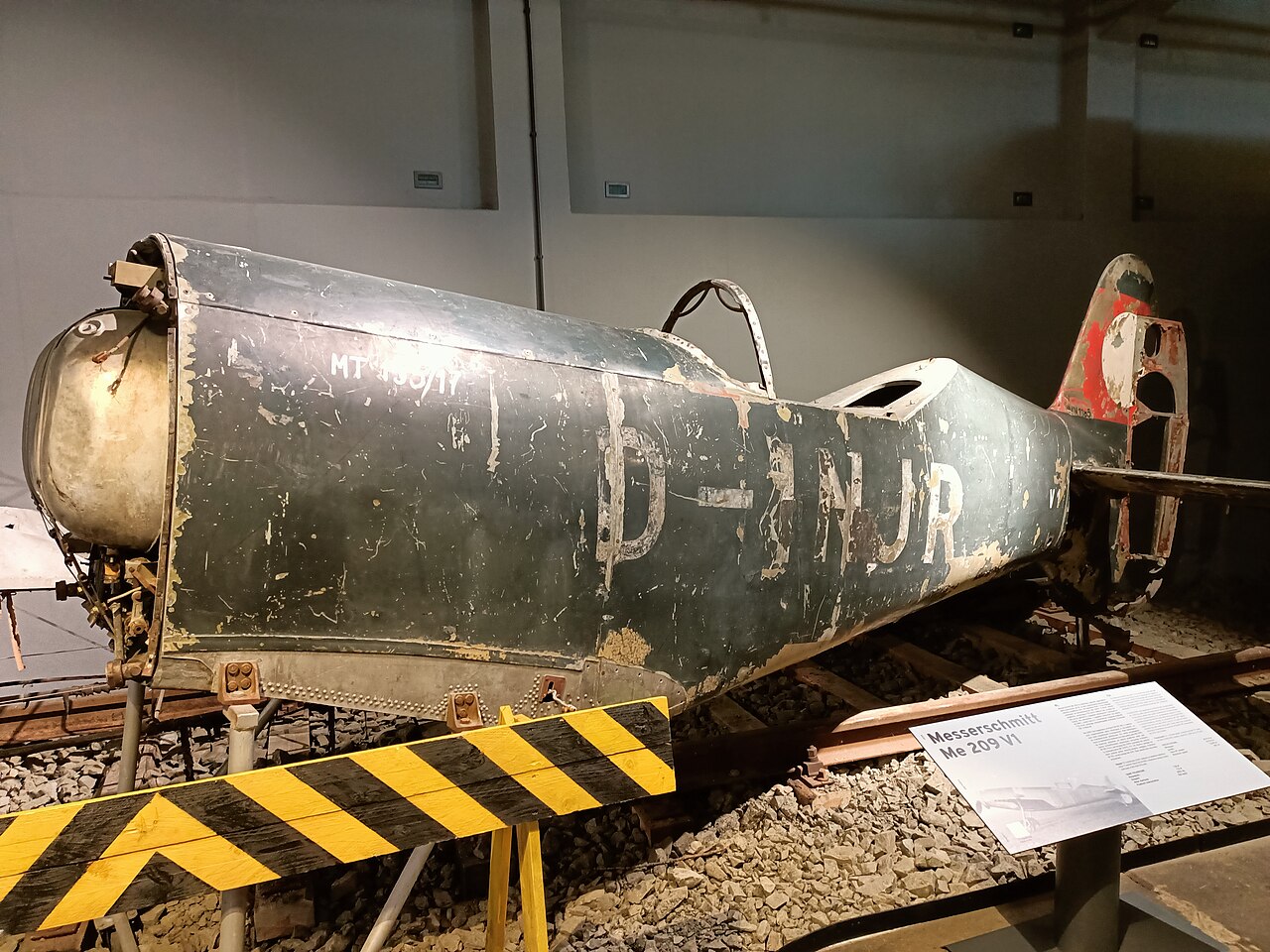
On 26 April 1939 the German test pilot Fritz Wendel reached 755 km/h in the Messerschmitt Me 209 V1, an aircraft built to take the absolute world speed record.[5] The prototype used a Daimler-Benz DB 601 engine; the museum that now holds it lists the record-flight version as rated at 1,324 kW (1,775 hp).[5] The aircraft was stripped of almost all equipment, and its cooling system evaporated engine water through openings in the wings and condensed it again for reuse, which limited a flight to about 30 minutes.[5] Air & Space magazine gives the same flight as 469 mph.[2] The mark stood for piston-engined aircraft until 1969.[5]
## 1969 to 1989: racing Bearcats
Air & Space lists Darryl Greenamyer's 482 mph in the Grumman Bearcat *Conquest 1* in 1969 as the next entry in the line of piston-engine records.[2] The Smithsonian's National Air and Space Museum says that Lyle Shelton bought a wrecked Bearcat in 1969 and rebuilt it as *Rare Bear*, replacing the standard Pratt & Whitney R-2800 engine with the more powerful Wright R-3350.[3]
## Rare Bear, 1989
Guinness World Records records the run of *Rare Bear*, flown by Shelton, at 850.24 km/h (528.31 mph) over a 3 km course on 21 August 1989 as a Fédération Aéronautique Internationale (FAI) approved world record.[1] The Smithsonian's National Air and Space Museum gives the same figure, date and Las Vegas as the place.[3] Guinness describes the aircraft as a modified Second World War Grumman F8F Bearcat with a Curtiss-Wright R3350 engine producing over 4,000 hp.[1]
## The 2017 Voodoo flight and the status of the record
*Via Wikimedia Commons: [P 51 Voodoo 2014 Reno Air Races hangar photo Don Ramey Logan](https://commons.wikimedia.org/wiki/File:P_51_Voodoo_2014_Reno_Air_Races_hangar_photo_Don_Ramey_Logan.jpg) by Don Ramey Logan, [CC BY-SA 4.0](https://creativecommons.org/licenses/by-sa/4.0).*
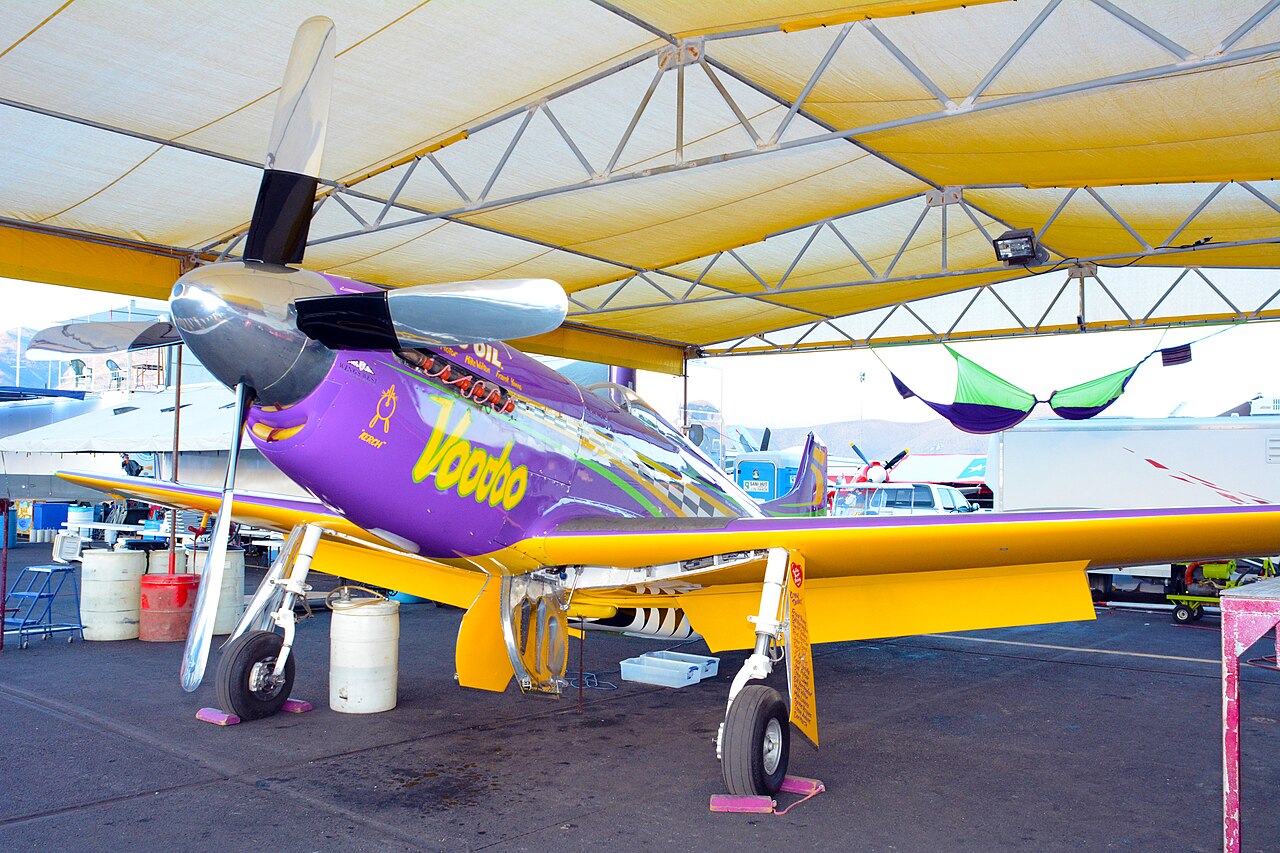
On 2 September 2017 Steve Hinton flew *Voodoo*, a heavily modified North American P-51 Mustang with a racing-tuned Rolls-Royce Merlin engine, over a 3 km course at a private airstrip in Idaho.[2] Air & Space reports a preliminary 531.53 mph, later revised to 531.64 mph.[2] Under the FAI's present rules, which sort records by aircraft weight class, this was a record for the 3,000 to 6,000 kg class.[2] It did not beat *Rare Bear* by the 1% margin that the earlier rules required, a figure the magazine puts at 533.59 mph.[2] Flying magazine, reporting the flight days afterwards, also called the result short of that mark.[4]
The record books therefore differ. The magazine says the FAI database lists Shelton's 1989 record as "retired by changes of the sporting code", while the U.S. National Aeronautic Association disputes that.[2] Guinness still lists *Rare Bear* as the holder.[1] As of 27 November 2026, this entry has not confirmed any later change in these listings.
## How Voodoo was changed for the attempt
Air & Space reports that the engineers at Aviation Partners used computational fluid dynamics to locate shock waves on the Mustang's wing, and that the team then fitted 35 milled carbon-fibre pieces that reshaped the airfoils, mostly on the upper surface.[2] The magazine says the changes raised the wing's critical Mach number (the speed at which air over the wing first reaches the speed of sound) from 0.72 to 0.76, worth about 28 mph at 7,000 feet on the same power.[2] It gives the engine's output as 3,100 horsepower, against 1,425 for a stock Mustang engine, with a supercharger able to run at 140 inches of manifold pressure instead of 60, and a 50/50 mix of distilled water and methanol injected to control engine heat.[2]
## Sources
1. Guinness World Records, "Fastest aircraft, piston-engined". https://www.guinnessworldrecords.com/world-records/fastest-aircraft-piston-engined
2. Scott Germain, "World's Fastest Piston-Power Airplane", Air & Space magazine (Smithsonian), August 2018. https://www.smithsonianmag.com/air-space-magazine/worlds-fastest-piston-airplane-180969509/
3. Smithsonian National Air and Space Museum, How Things Fly, "Ask an Explainer: What is the fastest piston plane?", 29 April 2017. https://howthingsfly.si.edu/ask-an-explainer/what-fastest-piston-plane
4. "P-51 Voodoo Becomes Fastest Piston in the World", Flying magazine, 6 September 2017. https://www.flyingmag.com/p-51-voodoo-becomes-fastest-piston-in-world
5. Polish Aviation Museum, Kraków, "Messerschmitt Me 209 V1". https://muzeumlotnictwa.pl/en/exhibits/messerschmitt-me-209-v1-2/
