Compare versions
Version 2 → Version 3. Removed · Added. This shows the entry's text as it is written, including its formatting marks.
Version 2 · Version 3 · Version history
Side by side · Together
Version 2Version 3
10 unchanged paragraphs
Canada is a country in northern North America, a federal state of ten provinces and three territories, a parliamentary democracy and a constitutional monarchy, with its capital at Ottawa.[3][4]
Canada is a country in northern North America, a federal state of ten provinces and three territories, a parliamentary democracy and a constitutional monarchy, with its capital at Ottawa.[3][4]
Developing story. This entry is updated as events change; every changing fact is dated.
Developing story. This entry is updated as events change; every changing fact is dated.
## At a glance
## At a glance
- **Capital:** Ottawa.[4]
- **Government:** federal parliamentary democracy and constitutional monarchy.[3]
- **Head of state:** the King, usually represented by the Governor General.[5]
- **Divisions:** ten provinces and three territories.[4]
- **Area:** about 10 million square kilometres.[4]
- **Population:** an estimated 41,651,653 on 1 July 2025.[7]
- **Official languages:** English and French.[8]
## Geography
## Geography
Canada is the second largest country in the world and borders three oceans: the Pacific to the west, the Atlantic to the east and the Arctic to the north.[4] Queen Victoria chose Ottawa, on the Ottawa River, as capital in 1857.[4]
Canada is the second largest country in the world and borders three oceans: the Pacific to the west, the Atlantic to the east and the Arctic to the north.[4] Queen Victoria chose Ottawa, on the Ottawa River, as capital in 1857.[4]
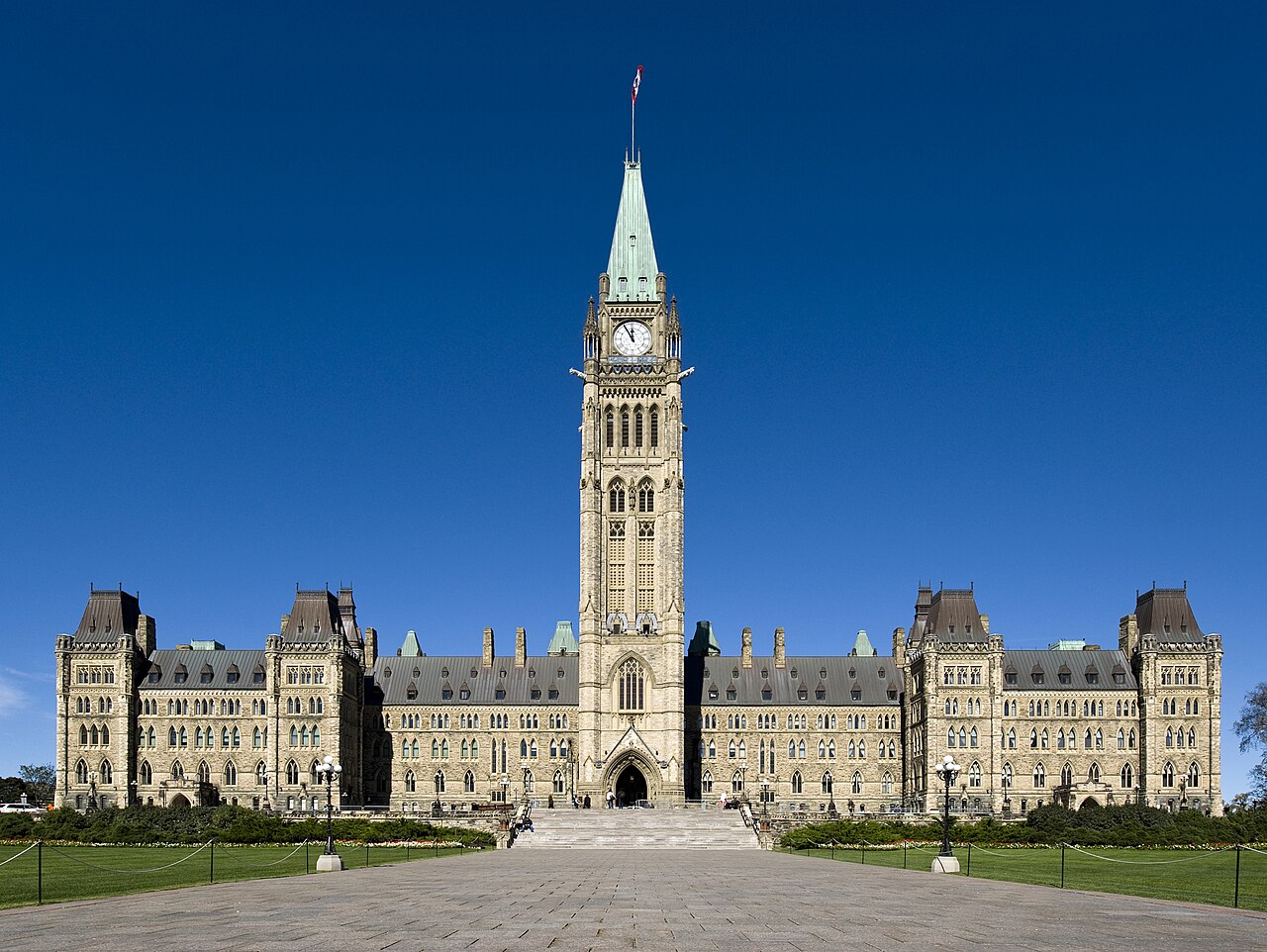

*Via Wikimedia Commons: [Centre Block - Parliament Hill](https://commons.wikimedia.org/wiki/File:Centre_Block_-_Parliament_Hill.jpg) by Saffron Blaze, [CC BY-SA 3.0](https://creativecommons.org/licenses/by-sa/3.0).*
*Via Wikimedia Commons: [Centre Block - Parliament Hill](https://commons.wikimedia.org/wiki/File:Centre_Block_-_Parliament_Hill.jpg) by Saffron Blaze, [CC BY-SA 3.0](https://creativecommons.org/licenses/by-sa/3.0).*
### Landscapes
### Landscapes
The country's regions differ sharply. Five Great Lakes lie between Ontario and the United States, and more than half of Canadians live in cities and towns near the Great Lakes and the St. Lawrence River.[4] Manitoba, Saskatchewan and Alberta, the Prairie Provinces, have rich energy resources and very fertile farmland.[4] British Columbia is known for its mountains, and much of the North is tundra, a rocky Arctic plain where the ground stays frozen and no trees grow.[4] Mount Logan, in Yukon, is the highest mountain in Canada.[4]
The country's regions differ sharply. Five Great Lakes lie between Ontario and the United States, and more than half of Canadians live in cities and towns near the Great Lakes and the St. Lawrence River.[4] Manitoba, Saskatchewan and Alberta, the Prairie Provinces, have rich energy resources and very fertile farmland.[4] British Columbia is known for its mountains, and much of the North is tundra, a rocky Arctic plain where the ground stays frozen and no trees grow.[4] Mount Logan, in Yukon, is the highest mountain in Canada.[4]
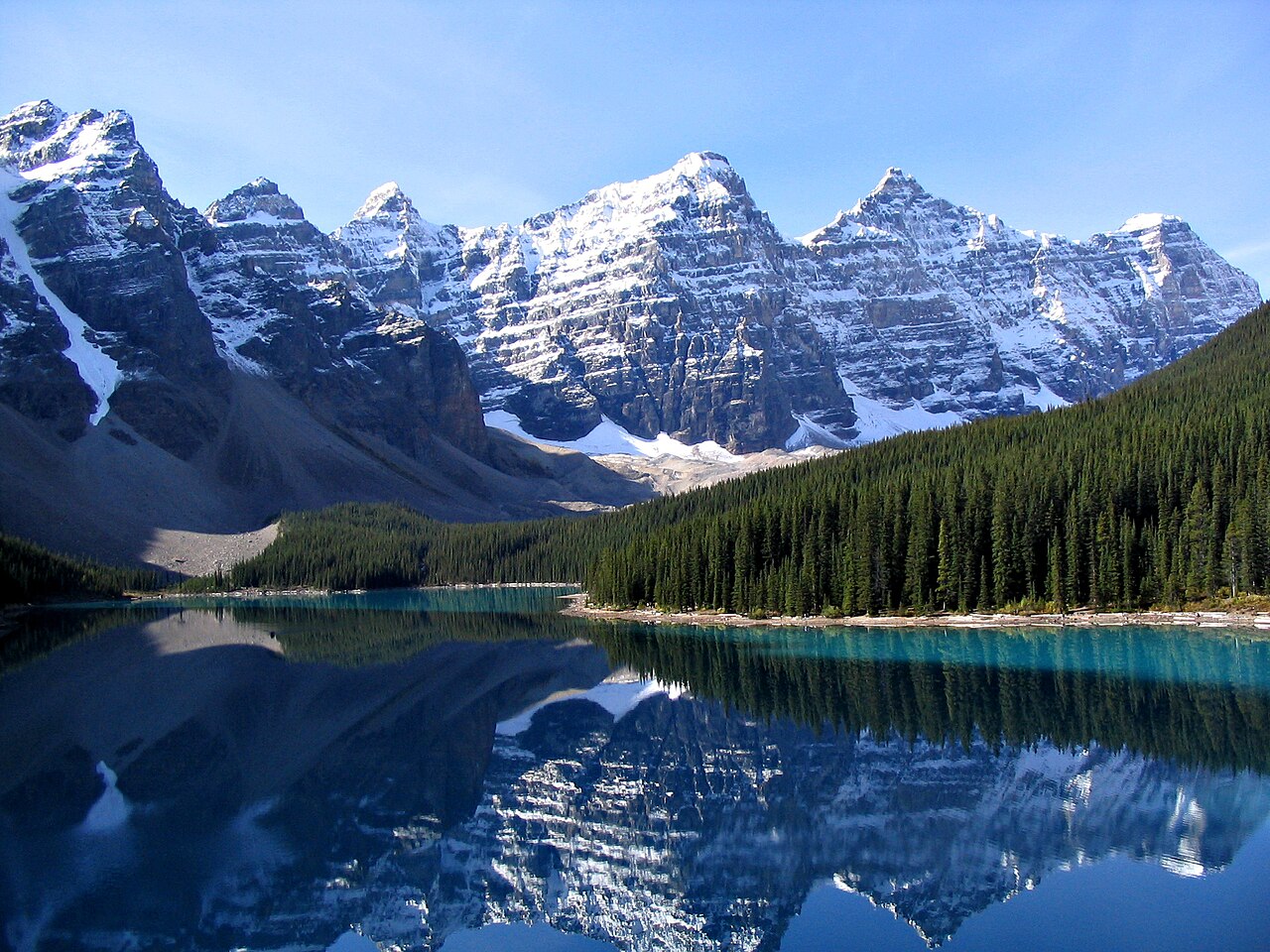
*Via Wikimedia Commons: [Moraine Lake 17092005](https://commons.wikimedia.org/wiki/File:Moraine_Lake_17092005.jpg) by Gorgo, public domain.*
23 unchanged paragraphs
## Government
## Government
The responsibilities of the federal and provincial governments were set out in 1867 in the British North America Act, now called the Constitution Act, 1867.[3] The federal government handles national and international matters, including defence, foreign policy, currency, criminal law and citizenship; the provinces handle education, health, natural resources, property and civil rights, highways and local government; agriculture and immigration are shared.[3]
The responsibilities of the federal and provincial governments were set out in 1867 in the British North America Act, now called the Constitution Act, 1867.[3] The federal government handles national and international matters, including defence, foreign policy, currency, criminal law and citizenship; the provinces handle education, health, natural resources, property and civil rights, highways and local government; agriculture and immigration are shared.[3]
Parliament consists of the King, the Senate and the House of Commons.[5] Executive power belongs to the King but is exercised by convention on the advice of ministers who have the support of the House of Commons; the prime minister and other ministers form the Cabinet.[5] As of August 2026 the prime minister was Mark Carney.[10]
Parliament consists of the King, the Senate and the House of Commons.[5] Executive power belongs to the King but is exercised by convention on the advice of ministers who have the support of the House of Commons; the prime minister and other ministers form the Cabinet.[5] As of August 2026 the prime minister was Mark Carney.[10]
## History
## History
### Indigenous peoples and European contact
### Indigenous peoples and European contact
Indigenous peoples lived in the land before Europeans arrived. The government's citizenship guide says warfare was common among groups competing for land and resources, that large numbers later died of European diseases to which they had no immunity, and that in the first two centuries of contact Indigenous peoples and Europeans formed strong economic, religious and military bonds.[1]
Indigenous peoples lived in the land before Europeans arrived. The government's citizenship guide says warfare was common among groups competing for land and resources, that large numbers later died of European diseases to which they had no immunity, and that in the first two centuries of contact Indigenous peoples and Europeans formed strong economic, religious and military bonds.[1]
### New France and British rule
### New France and British rule
Jacques Cartier made three voyages between 1534 and 1542 and claimed the land for the king of France.[1] Samuel de Champlain built a fortress at what is now Québec City in 1608, and the fur trade, driven by European demand for beaver pelts, became central to the colony.[1] The British defeated the French on the Plains of Abraham in 1759, ending France's empire in America, and the Quebec Act of 1774 restored French civil law alongside British criminal law.[1]
Jacques Cartier made three voyages between 1534 and 1542 and claimed the land for the king of France.[1] Samuel de Champlain built a fortress at what is now Québec City in 1608, and the fur trade, driven by European demand for beaver pelts, became central to the colony.[1] The British defeated the French on the Plains of Abraham in 1759, ending France's empire in America, and the Quebec Act of 1774 restored French civil law alongside British criminal law.[1]
### Building a nation
### Building a nation
Canada became a self-governing Dominion on 1 July 1867.[1] British Columbia joined in 1871 after Ottawa promised a railway to the west coast, and the last spike of the Canadian Pacific Railway was driven on 7 November 1885.[1] Louis Riel, who had led an uprising that seized Fort Garry, was tried and executed for treason after a second rebellion in 1885, a decision strongly opposed in Quebec.[1] The railway helped large numbers of immigrants settle the West before 1914.[1]
Canada became a self-governing Dominion on 1 July 1867.[1] British Columbia joined in 1871 after Ottawa promised a railway to the west coast, and the last spike of the Canadian Pacific Railway was driven on 7 November 1885.[1] Louis Riel, who had led an uprising that seized Fort Garry, was tried and executed for treason after a second rebellion in 1885, a decision strongly opposed in Quebec.[1] The railway helped large numbers of immigrants settle the West before 1914.[1]
### World war
### World war
When Britain declared war in 1914, Canada formed an expeditionary force. The Canadian Corps captured Vimy Ridge in April 1917, with 10,000 killed or wounded.[1] From 1914 to 1920 the government interned more than 8,000 former subjects of Austria-Hungary, mainly Ukrainian men, as "enemy aliens".[1]
When Britain declared war in 1914, Canada formed an expeditionary force. The Canadian Corps captured Vimy Ridge in April 1917, with 10,000 killed or wounded.[1] From 1914 to 1920 the government interned more than 8,000 former subjects of Austria-Hungary, mainly Ukrainian men, as "enemy aliens".[1]
### The modern country
### The modern country
Confederation in 1867 set the federal framework described above.[3] Oil discovered in Alberta in 1947 began the modern energy industry.[2] Indigenous people received the vote in 1960.[2] Quebec changed rapidly in the 1960s in what is called the Quiet Revolution, and a movement for independence grew; it was defeated in referendums in 1980 and 1995.[2] The constitution was amended in 1982 without Quebec's agreement.[2]
Confederation in 1867 set the federal framework described above.[3] Oil discovered in Alberta in 1947 began the modern energy industry.[2] Indigenous people received the vote in 1960.[2] Quebec changed rapidly in the 1960s in what is called the Quiet Revolution, and a movement for independence grew; it was defeated in referendums in 1980 and 1995.[2] The constitution was amended in 1982 without Quebec's agreement.[2]
## Economy and trade
## Economy and trade
The government describes Canada as one of the ten largest economies, dependent on trade for its standard of living.[6] Forestry, fishing, farming, mining and energy are the main natural resource industries, and resources make up a large share of exports.[6] The United States is by far the largest trading partner; the government's guide says each is the other's largest and that over three quarters of Canadian exports go there.[6] Free trade with the United States began in 1988 and was widened to Mexico in 1994.[6] The later agreement among the three is the United States-Mexico-Canada Agreement (USMCA), due for review in July 2026, and Canada asked for it to be renewed for 16 years.[9]
The government describes Canada as one of the ten largest economies, dependent on trade for its standard of living.[6] Forestry, fishing, farming, mining and energy are the main natural resource industries, and resources make up a large share of exports.[6] The United States is by far the largest trading partner; the government's guide says each is the other's largest and that over three quarters of Canadian exports go there.[6] Free trade with the United States began in 1988 and was widened to Mexico in 1994.[6] The later agreement among the three is the United States-Mexico-Canada Agreement (USMCA), due for review in July 2026, and Canada asked for it to be renewed for 16 years.[9]
In August 2026 United States tariffs of 50 per cent on many Canadian imports took effect, including some goods previously protected under USMCA, and Carney promised matching retaliation.[10] Trade talks collapsed on 21 August, Canada's retaliatory tariffs on about 20 billion dollars of United States goods took effect on 8 September, and Carney said Canada would move faster to reduce its economic reliance on its neighbour.[11][12] This entry does not follow developments after early September. See [Donald Trump](https://micwyn.com/t/3542/donald-trump) and [United States](https://micwyn.com/t/3541/united-states).
In August 2026 United States tariffs of 50 per cent on many Canadian imports took effect, including some goods previously protected under USMCA, and Carney promised matching retaliation.[10] Trade talks collapsed on 21 August, Canada's retaliatory tariffs on about 20 billion dollars of United States goods took effect on 8 September, and Carney said Canada would move faster to reduce its economic reliance on its neighbour.[11][12] This entry does not follow developments after early September. See [Donald Trump](https://micwyn.com/t/3542/donald-trump) and [United States](https://micwyn.com/t/3541/united-states).
## Population and language
## Population and language
Statistics Canada estimated the population at 41,651,653 on 1 July 2025, up 0.1 per cent over the previous three months, which it called the lowest rate for that quarter since 2020.[7] English and French are the official languages, and about 2.6 million young Canadians study one of them as a second language.[8]
Statistics Canada estimated the population at 41,651,653 on 1 July 2025, up 0.1 per cent over the previous three months, which it called the lowest rate for that quarter since 2020.[7] English and French are the official languages, and about 2.6 million young Canadians study one of them as a second language.[8]
## What's unsettled
## What's unsettled
As of 27 November 2026 the trade dispute with the United States and the future of USMCA were open questions, and population figures are revised regularly.
As of 27 November 2026 the trade dispute with the United States and the future of USMCA were open questions, and population figures are revised regularly.
## Sources
## Sources
1. Government of Canada. "Discover Canada: Canada's History". https://www.canada.ca/en/immigration-refugees-citizenship/corporate/publications-manuals/discover-canada/read-online/canadas-history.html
2. Government of Canada. "Discover Canada: Modern Canada". https://www.canada.ca/en/immigration-refugees-citizenship/corporate/publications-manuals/discover-canada/read-online/modern-canada.html
3. Government of Canada. "Discover Canada: How Canadians Govern Themselves". https://www.canada.ca/en/immigration-refugees-citizenship/corporate/publications-manuals/discover-canada/read-online/how-canadians-govern-themselves.html
4. Government of Canada. "Discover Canada: Canada's Regions". https://www.canada.ca/en/immigration-refugees-citizenship/corporate/publications-manuals/discover-canada/read-online/canadas-regions.html
5. Department of Justice Canada. "The Canadian Constitution". https://www.justice.gc.ca/eng/csj-sjc/just/05.html
6. Government of Canada. "Discover Canada: Canada's Economy". https://www.canada.ca/en/immigration-refugees-citizenship/corporate/publications-manuals/discover-canada/read-online/canadas-economy.html
7. Statistics Canada. "Canada's population estimates: Age and gender, July 1, 2025". The Daily. https://www150.statcan.gc.ca/n1/daily-quotidien/250924/dq250924a-eng.htm
8. Government of Canada. "Statistics on official languages in Canada". https://www.canada.ca/en/canadian-heritage/services/official-languages-bilingualism/publications/statistics.html
9. Associated Press. "Canada calls on U.S. and Mexico to renew free trade agreement for another 16 years". PBS News, 2026. https://www.pbs.org/newshour/world/canada-calls-on-u-s-and-mexico-to-renew-free-trade-agreement-for-another-16-years
10. Associated Press. "What to know about Trump's 50% tariffs on Canadian goods that just went into effect". PBS News, August 2026. https://www.pbs.org/newshour/economy/what-to-know-about-trumps-50-tariffs-on-canadian-goods-that-just-went-into-effect
11. Associated Press. "U.S. and Canada fall deeper into a trade war with new tariffs as talks collapse and blame is spread". PBS News, August 2026. https://www.pbs.org/newshour/world/u-s-imposes-50-tariffs-on-20-billion-worth-of-canadian-products-canada-says-it-will-retaliate
12. Associated Press. "Carney says Canada moving from U.S. reliance as tariffs take effect". PBS News, September 2026. https://www.pbs.org/newshour/nation/carney-says-canada-moving-from-u-s-reliance-as-tariffs-take-effect
