Compare versions
Version 2 → Version 6 (current). Removed · Added. This shows the entry's text as it is written, including its formatting marks.
Version 2 · Version 6 (current) · Version history
Side by side · Together
Canada is a country in northern North America, a federal state of ten provinces and three territories, a parliamentary democracy and a constitutional monarchy, with its capital at Ottawa.[3][4]
Developing story. This entry is updated as events change; every changing fact is dated.
## At a glance
- **Capital:** Ottawa.[4]
- **Government:** federal parliamentary democracy and constitutional monarchy.[3]
- **Head of state:** the King, usually represented by the Governor General.[5]
- **Divisions:** ten provinces and three territories.[4]
- **Area:** about 10 million square kilometres.[4]
- **Population:** an estimated 41,651,653 on 1 July 2025.[7]
- **Official languages:** English and French.[8]
## Geography
Canada is the second largest country in the world and borders three oceans: the Pacific to the west, the Atlantic to the east and the Arctic to the north.[4] Queen Victoria chose Ottawa, on the Ottawa River, as capital in 1857.[4]
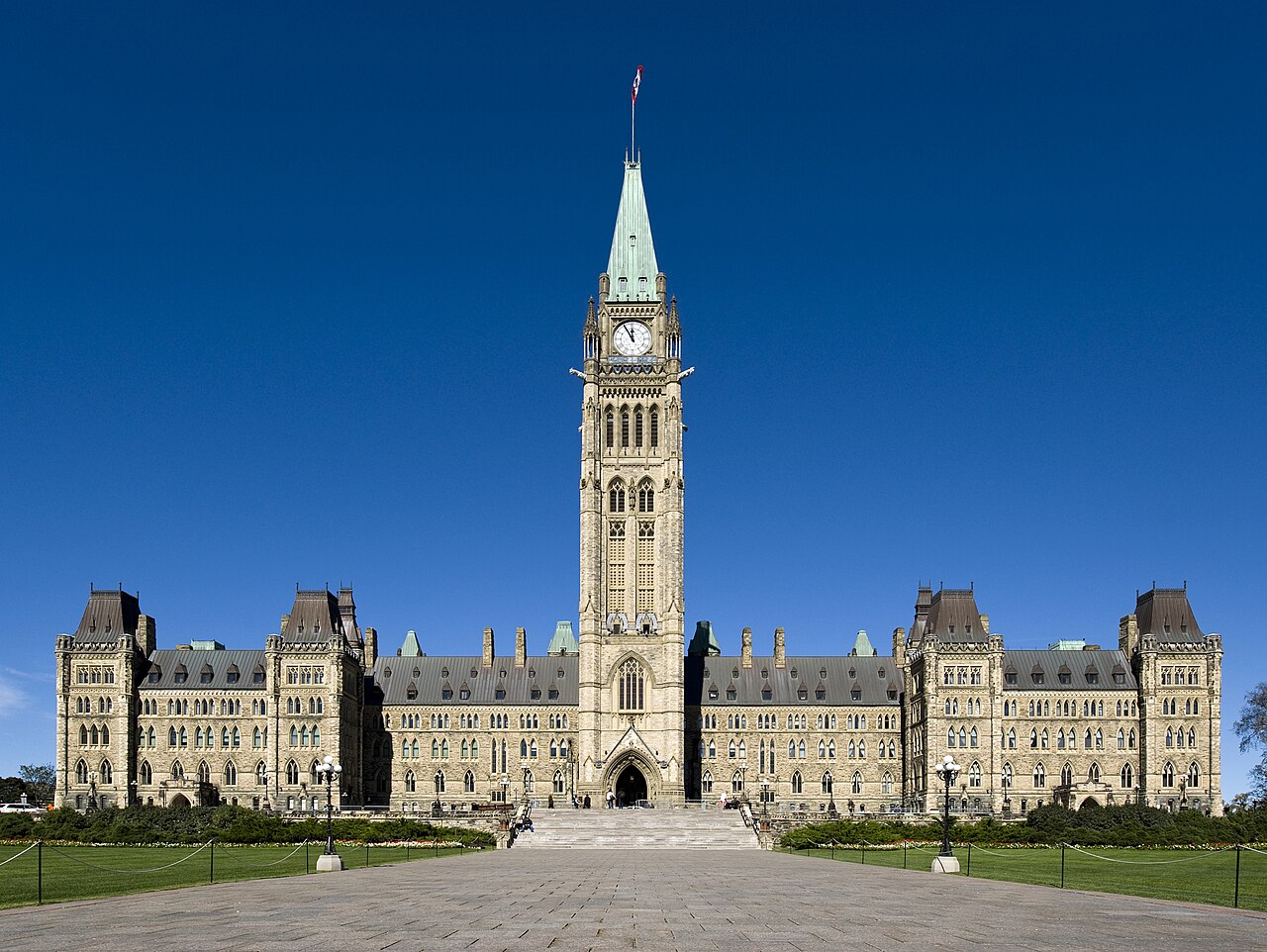
*Via Wikimedia Commons: [Centre Block - Parliament Hill](https://commons.wikimedia.org/wiki/File:Centre_Block_-_Parliament_Hill.jpg) by Saffron Blaze, [CC BY-SA 3.0](https://creativecommons.org/licenses/by-sa/3.0).*
### Landscapes
The country's regions differ sharply. Five Great Lakes lie between Ontario and the United States, and more than half of Canadians live in cities and towns near the Great Lakes and the St. Lawrence River.[4] Manitoba, Saskatchewan and Alberta, the Prairie Provinces, have rich energy resources and very fertile farmland.[4] British Columbia is known for its mountains, and much of the North is tundra, a rocky Arctic plain where the ground stays frozen and no trees grow.[4] Mount Logan, in Yukon, is the highest mountain in Canada.[4]
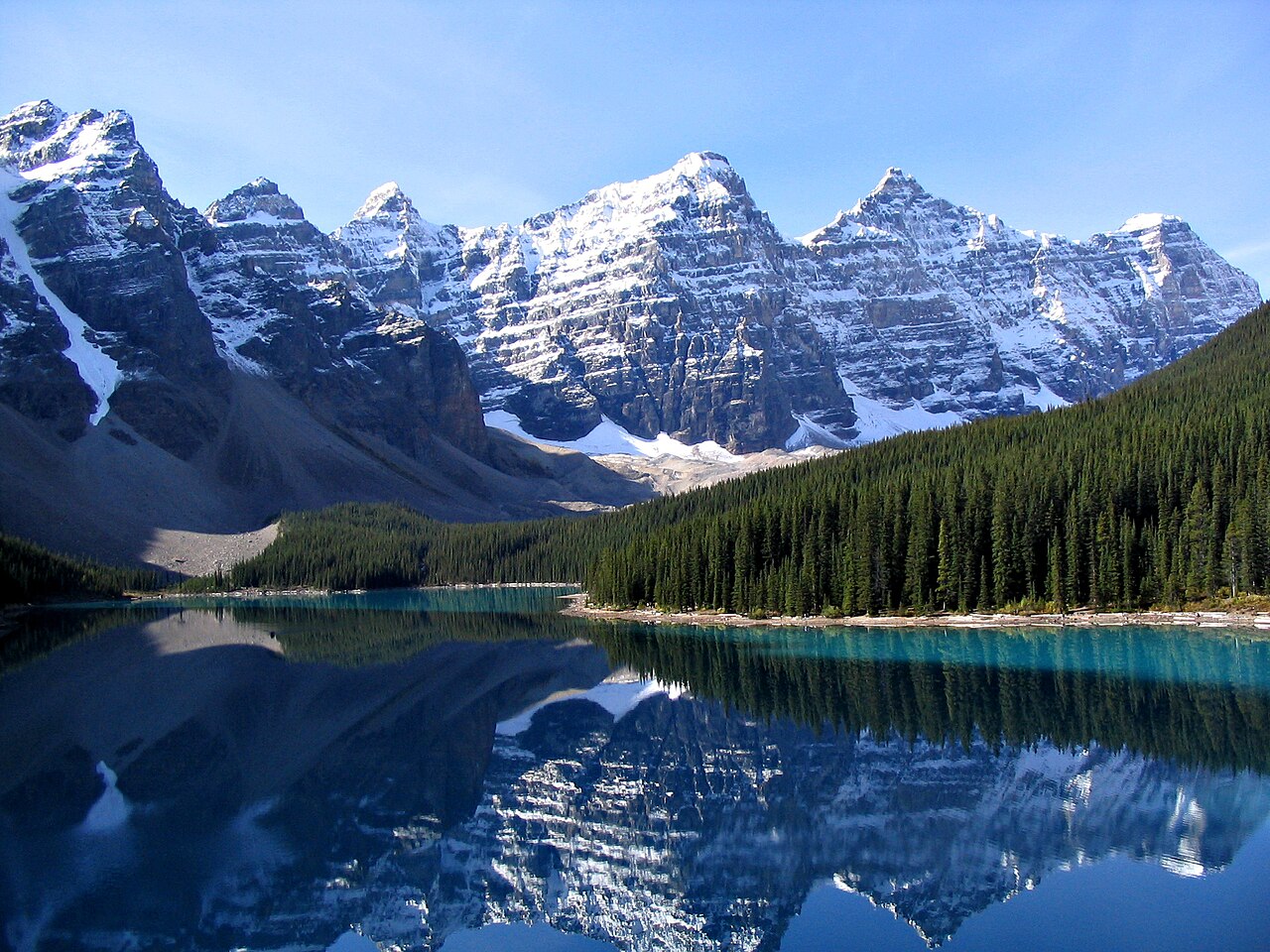
*Via Wikimedia Commons: [Moraine Lake 17092005](https://commons.wikimedia.org/wiki/File:Moraine_Lake_17092005.jpg) by Gorgo, public domain.*
## Government
The responsibilities of the federal and provincial governments were set out in 1867 in the British North America Act, now called the Constitution Act, 1867.[3] The federal government handles national and international matters, including defence, foreign policy, currency, criminal law and citizenship; the provinces handle education, health, natural resources, property and civil rights, highways and local government; agriculture and immigration are shared.[3]
Parliament consists of the King, the Senate and the House of Commons.[5] Executive power belongs to the King but is exercised by convention on the advice of ministers who have the support of the House of Commons; the prime minister and other ministers form the Cabinet.[5] As of August 2026 the prime minister was Mark Carney.[10]
## History
### Indigenous peoples and European contact
Indigenous peoples lived in the land before Europeans arrived. The government's citizenship guide says warfare was common among groups competing for land and resources, that large numbers later died of European diseases to which they had no immunity, and that in the first two centuries of contact Indigenous peoples and Europeans formed strong economic, religious and military bonds.[1]
### New France and British rule
Jacques Cartier made three voyages between 1534 and 1542 and claimed the land for the king of France.[1] Samuel de Champlain built a fortress at what is now Québec City in 1608, and the fur trade, driven by European demand for beaver pelts, became central to the colony.[1] The British defeated the French on the Plains of Abraham in 1759, ending France's empire in America, and the Quebec Act of 1774 restored French civil law alongside British criminal law.[1]
### Building a nation
Canada became a self-governing Dominion on 1 July 1867.[1] British Columbia joined in 1871 after Ottawa promised a railway to the west coast, and the last spike of the Canadian Pacific Railway was driven on 7 November 1885.[1] Louis Riel, who had led an uprising that seized Fort Garry, was tried and executed for treason after a second rebellion in 1885, a decision strongly opposed in Quebec.[1] The railway helped large numbers of immigrants settle the West before 1914.[1]
### World war
When Britain declared war in 1914, Canada formed an expeditionary force. The Canadian Corps captured Vimy Ridge in April 1917, with 10,000 killed or wounded.[1] From 1914 to 1920 the government interned more than 8,000 former subjects of Austria-Hungary, mainly Ukrainian men, as "enemy aliens".[1]
### Women's vote and the war's end
In 1918 the Canadian Corps under General Sir Arthur Currie took part in the last hundred days of the First World War, including the victory at Amiens.[1] Women gained the federal vote in stages, first nurses at the front and relatives of serving men, and then most women citizens aged 21 and over in 1918; Quebec gave women the vote in 1940.[1]
### Second World War
More than a million Canadian men and women served in uniform between September 1939 and August 1945, on land, at sea and in the air.[17] On D-Day, 6 June 1944, 15,000 Canadian troops stormed and captured Juno Beach in Normandy.[1]
### The modern country
Confederation in 1867 set the federal framework described above.[3] Oil discovered in Alberta in 1947 began the modern energy industry.[2] Indigenous people received the vote in 1960.[2] Quebec changed rapidly in the 1960s in what is called the Quiet Revolution, and a movement for independence grew; it was defeated in referendums in 1980 and 1995.[2] The constitution was amended in 1982 without Quebec's agreement.[2]
### After 1945
Between 1945 and 1970 the country had one of the strongest economies among industrial nations.[2] It joined the North Atlantic Treaty Organization and, with the United States, the North American Aerospace Defence Command; it fought in the Korean War, with 500 dead and 1,000 wounded, and has taken part in many peacekeeping and security missions, including in Egypt, Cyprus, Haiti and Afghanistan.[2] Pension plans for Canada and Quebec date from 1965, and the Canada Health Act sets a basic standard of health coverage.[2]
## Canada since the 1990s
### Governments, 1993 to 2025
Jean Chrétien, a Liberal, ended ten years as prime minister in December 2003 and was succeeded by Paul Martin.[22] On 17 March 2003 Chrétien had announced that Canada would not take part in the United States-led invasion of Iraq.[23] In January 2006 Stephen Harper's Conservatives defeated Martin's Liberals, winning 124 of 308 seats, short of a majority.[24] In October 2015 the Liberals, led by Justin Trudeau, defeated Harper and won a majority.[25]
### Trade
Free trade with the United States, begun in 1988, was widened in 1994 to include Mexico.[6]
### Quebec and the North
A second referendum on Quebec sovereignty was defeated in 1995, though the government's guide notes that Quebec's autonomy within Canada remains a lively subject.[2] In 1999 the territory of Nunavut, meaning "our land" in Inuktitut, was created from the eastern part of the Northwest Territories.[4] The three northern territories hold about a third of the country's land and only a very small share of its people.[4]
### Security
Canadian forces took part in international operations in the former Yugoslavia and Afghanistan.[2] More than 40,000 members of the Canadian Armed Forces served in the Afghanistan mission between October 2001 and March 2014, the largest deployment since the Second World War.[28] Combat operations ended in 2011, and 158 Canadian soldiers died during the mission.[29]
### Same-sex marriage
In 2005 Parliament passed the Civil Marriage Act, which defines civil marriage as the lawful union of two persons,[26] and same-sex marriage became a reality nationwide.[27]
### Cannabis
On 17 October 2018 Canada made recreational cannabis legal, the second country to do so after Uruguay.[21]
### Change of leader in 2025
Prime Minister Justin Trudeau announced his resignation in January 2025. Mark Carney won the Liberal Party leadership in March and succeeded Trudeau.[19] The general election of 28 April 2025 was fought largely over who could better handle United States President Donald Trump, who had imposed steep tariffs and spoken of annexing Canada. Carney's Liberals won.[20] At first they were short of a majority; after several defections from other parties, by-election wins on 13 April 2026 gave them one.[30][31]
## Rights
The constitution was amended in 1982 to entrench the Canadian Charter of Rights and Freedoms, which protects freedoms including thought, belief and expression, and equality rights.[14]
## Residential schools and reconciliation
A Truth and Reconciliation Commission was created through a legal settlement between survivors of the residential schools, which Indigenous children attended, and others.[16] It issued 94 Calls to Action, and the government says it has been working with Indigenous partners to respond since 2015, including by establishing a National Day for Truth and Reconciliation as a federal holiday.[15]
## Culture
Canadians have written significantly in both English and French.[2] In painting the country is best known for the Group of Seven, founded in 1920, who developed a style suited to its wilderness landscapes; Emily Carr painted West Coast forests and Indigenous artefacts.[2] Basketball was invented by the Canadian James Naismith in 1891, and ice hockey is the national sport, in which Wayne Gretzky is regarded as one of the greatest players.[2]
## Economy and trade
The government describes Canada as one of the ten largest economies, dependent on trade for its standard of living.[6] Forestry, fishing, farming, mining and energy are the main natural resource industries, and resources make up a large share of exports.[6] The United States is by far the largest trading partner; the government's guide says each is the other's largest and that over three quarters of Canadian exports go there.[6] Free trade with the United States began in 1988 and was widened to Mexico in 1994.[6] The later agreement among the three is the United States-Mexico-Canada Agreement (USMCA), due for review in July 2026, and Canada asked for it to be renewed for 16 years.[9]
In August 2026 United States tariffs of 50 per cent on many Canadian imports took effect, including some goods previously protected under USMCA, and Carney promised matching retaliation.[10] Trade talks collapsed on 21 August, Canada's retaliatory tariffs on about 20 billion dollars of United States goods took effect on 8 September, and Carney said Canada would move faster to reduce its economic reliance on its neighbour.[11][12] This entry does not follow developments after early September. See [Donald Trump](https://micwyn.com/t/3542/donald-trump) and [United States](https://micwyn.com/t/3541/united-states).
## Population and language
Statistics Canada estimated the population at 41,651,653 on 1 July 2025, up 0.1 per cent over the previous three months, which it called the lowest rate for that quarter since 2020.[7] English and French are the official languages, and about 2.6 million young Canadians study one of them as a second language.[8]
Immigration shapes the population: in 2021 more than 8.3 million people, or 23.0 per cent, were or had been landed immigrants or permanent residents, the largest share in over 150 years, and Statistics Canada projected that immigrants could make up 29 to 34 per cent by 2041.[18]
The World Bank reports that about 83 per cent of people live in towns and cities, life expectancy was about 82 years in 2024 and output was about 2.3 trillion US dollars in 2025.[13]
## What's unsettled
As of 27 November 2026 the trade dispute with the United States and the future of USMCA were open questions, and population figures are revised regularly.
## Sources
1. Government of Canada. "Discover Canada: Canada's History". https://www.canada.ca/en/immigration-refugees-citizenship/corporate/publications-manuals/discover-canada/read-online/canadas-history.html
2. Government of Canada. "Discover Canada: Modern Canada". https://www.canada.ca/en/immigration-refugees-citizenship/corporate/publications-manuals/discover-canada/read-online/modern-canada.html
3. Government of Canada. "Discover Canada: How Canadians Govern Themselves". https://www.canada.ca/en/immigration-refugees-citizenship/corporate/publications-manuals/discover-canada/read-online/how-canadians-govern-themselves.html
4. Government of Canada. "Discover Canada: Canada's Regions". https://www.canada.ca/en/immigration-refugees-citizenship/corporate/publications-manuals/discover-canada/read-online/canadas-regions.html
5. Department of Justice Canada. "The Canadian Constitution". https://www.justice.gc.ca/eng/csj-sjc/just/05.html
6. Government of Canada. "Discover Canada: Canada's Economy". https://www.canada.ca/en/immigration-refugees-citizenship/corporate/publications-manuals/discover-canada/read-online/canadas-economy.html
7. Statistics Canada. "Canada's population estimates: Age and gender, July 1, 2025". The Daily. https://www150.statcan.gc.ca/n1/daily-quotidien/250924/dq250924a-eng.htm
8. Government of Canada. "Statistics on official languages in Canada". https://www.canada.ca/en/canadian-heritage/services/official-languages-bilingualism/publications/statistics.html
9. Associated Press. "Canada calls on U.S. and Mexico to renew free trade agreement for another 16 years". PBS News, 2026. https://www.pbs.org/newshour/world/canada-calls-on-u-s-and-mexico-to-renew-free-trade-agreement-for-another-16-years
10. Associated Press. "What to know about Trump's 50% tariffs on Canadian goods that just went into effect". PBS News, August 2026. https://www.pbs.org/newshour/economy/what-to-know-about-trumps-50-tariffs-on-canadian-goods-that-just-went-into-effect
11. Associated Press. "U.S. and Canada fall deeper into a trade war with new tariffs as talks collapse and blame is spread". PBS News, August 2026. https://www.pbs.org/newshour/world/u-s-imposes-50-tariffs-on-20-billion-worth-of-canadian-products-canada-says-it-will-retaliate
12. Associated Press. "Carney says Canada moving from U.S. reliance as tariffs take effect". PBS News, September 2026. https://www.pbs.org/newshour/nation/carney-says-canada-moving-from-u-s-reliance-as-tariffs-take-effect12. Associated Press. "Carney says Canada moving from U.S. reliance as tariffs take effect". PBS News, September 2026. https://www.pbs.org/newshour/nation/carney-says-canada-moving-from-u-s-reliance-as-tariffs-take-effect
13. World Bank. World Development Indicators: urban share, life expectancy and GDP for Canada. https://data.worldbank.org/country/canada
14. Government of Canada. "Discover Canada: Rights and Responsibilities of Citizenship". https://www.canada.ca/en/immigration-refugees-citizenship/corporate/publications-manuals/discover-canada/read-online/rights-resonsibilities-citizenship.html
15. Government of Canada. "Delivering on Truth and Reconciliation Commission Calls to Action". https://www.rcaanc-cirnac.gc.ca/eng/1450124405592/1529106060525
16. National Centre for Truth and Reconciliation. "Truth and Reconciliation Commission of Canada". https://nctr.ca/about/history-of-the-nctr/truth-and-reconciliation-commission-of-canada/
17. Veterans Affairs Canada. "Second World War". https://www.veterans.gc.ca/en/remembrance/military-history/second-world-war
18. Statistics Canada. "Immigrants make up the largest share of the population in over 150 years". The Daily, 26 October 2022. https://www150.statcan.gc.ca/n1/daily-quotidien/221026/dq221026a-eng.htm
19. Associated Press. "Mark Carney wins Liberal Party vote to replace Trudeau as Canada's prime minister". PBS News, March 2025. https://www.pbs.org/newshour/world/mark-carney-wins-liberal-party-vote-to-replace-trudeau-as-canadas-prime-minister
20. NPR. "Mark Carney's Liberal Party wins Canada's elections". 28 April 2025. https://www.npr.org/2025/04/28/nx-s1-5379573/canada-election-mark-carney-prime-minister
21. NPR. "It's Legal. In Canada, Recreational Marijuana Gets Green Light". 17 October 2018. https://www.npr.org/2018/10/17/658038965/its-legal-in-canada-recreational-marijuana-gets-green-light
22. PBS NewsHour. "New Canadian Leader". December 2003. https://www.pbs.org/newshour/show/new-canadian-leader
23. Anderson, Antony. "Jean Chrétien had an impossible choice to make on the Iraq War, and he got it right" (opinion column). The Hub, 11 March 2024. https://thehub.ca/2024/03/11/antony-anderson-chretien-iraq-war/
24. PBS NewsHour. "Conservatives to Lead New Government in Canada". 24 January 2006. https://www.pbs.org/newshour/politics/politics-jan-june06-canada_01-24
25. CBC News. "Justin Trudeau pledges 'real change' as Liberals leap ahead to majority government". 19 October 2015. https://www.cbc.ca/lite/story/1.3278537
26. Justice Laws Website. "Civil Marriage Act". https://laws-lois.justice.gc.ca/eng/acts/C-31.5/page-1.html
27. EBSCO Research Starters. "Canada Legalizes Same-Gender Marriage". https://www.ebsco.com/research-starters/social-sciences-and-humanities/canada-legalizes-same-gender-marriage
28. Government of Canada. "Canada's accomplishments in Afghanistan". May 2014. https://www.canada.ca/en/news/archive/2014/05/canada-accomplishments-afghanistan.html
29. Canadian War Museum. "Remembrance: the War in Afghanistan". https://www.warmuseum.ca/remembrance-day-resources/canada-and-the-war-in-afghanistan
30. Associated Press. "Canadian Prime Minister Carney secures a majority government with special election wins". WTOP, April 2026. https://wtop.com/world/2026/04/canadian-pm-carney-is-on-the-verge-of-a-majority-government-in-a-special-election/
31. Al Jazeera. "Carney vows focus on affordability after winning Canada's special election". 14 April 2026. https://www.aljazeera.com/amp/news/2026/4/14/carney-vows-focus-on-affordability-after-winning-canadas-special-election
