Compare versions
Version 1 → Version 2. Removed · Added. This shows the entry's text as it is written, including its formatting marks.
Version 1 · Version 2 · Version history
Side by side · Together
Version 1Version 2
3 unchanged paragraphs
China, officially the People's Republic of China, is a country in East Asia that has been governed by the Chinese Communist Party since 1949.[5][8]
China, officially the People's Republic of China, is a country in East Asia that has been governed by the Chinese Communist Party since 1949.[5][8]
Developing story. This entry is updated as events change; every changing fact is dated.
Developing story. This entry is updated as events change; every changing fact is dated.
## At a glance
## At a glance
- **Official name:** People's Republic of China, proclaimed in 1949.[5]
- **Ruling party:** Chinese Communist Party.[8]
- **Leader:** Xi Jinping, general secretary of the party, as of 2025.[8]
- **Economy:** classed by the World Bank as upper-middle-income.[1]
- **Growth since 1978:** over 9 per cent a year on average.[1]
- **Capital:** Beijing.
- **Official name:** People's Republic of China, proclaimed in 1949.[5]
- **Ruling party:** Chinese Communist Party.[8]
- **Leader:** Xi Jinping, general secretary of the party, as of 2025.[8]
- **Economy:** classed by the World Bank as upper-middle-income.[1]
- **Growth since 1978:** over 9 per cent a year on average.[1]
22 unchanged paragraphs
## History
## History
### Dynasties
### Dynasties
China's long history is usually told through its ruling dynasties, or royal houses; the Shang and Zhou are among the earliest.[2] The period from 475 to 221 BCE came before unification under the Qin, whose first emperor died in 210 BCE.[2]
China's long history is usually told through its ruling dynasties, or royal houses; the Shang and Zhou are among the earliest.[2] The period from 475 to 221 BCE came before unification under the Qin, whose first emperor died in 210 BCE.[2]
### Foreign pressure in the nineteenth century
### Foreign pressure in the nineteenth century
Britain and China fought the First Opium War from 1839 to 1842, over a trade in which opium was smuggled into southern China.[3] The war and the treaties that followed belonged to an era in which Western powers pressed their demands on China.[3] The Treaty of Wangxia of 3 July 1844 was the first formal treaty between China and the United States.[3]
Britain and China fought the First Opium War from 1839 to 1842, over a trade in which opium was smuggled into southern China.[3] The war and the treaties that followed belonged to an era in which Western powers pressed their demands on China.[3] The Treaty of Wangxia of 3 July 1844 was the first formal treaty between China and the United States.[3]
### Republic and civil war
### Republic and civil war
In October 1911 revolutionaries in the south began a revolt against the Qing dynasty that replaced it with the Republic of China; Sun Yat-sen led the movement.[4] The Nationalist Party and the Chinese Communist Party cooperated for a time, until the Nationalists turned on the Communists in 1927.[5] Full civil war ended in 1949, when Mao Zedong proclaimed the People's Republic.[5] The defeated Republic of China's government and many of its soldiers moved to the island of Taiwan.[6]
In October 1911 revolutionaries in the south began a revolt against the Qing dynasty that replaced it with the Republic of China; Sun Yat-sen led the movement.[4] The Nationalist Party and the Chinese Communist Party cooperated for a time, until the Nationalists turned on the Communists in 1927.[5] Full civil war ended in 1949, when Mao Zedong proclaimed the People's Republic.[5] The defeated Republic of China's government and many of its soldiers moved to the island of Taiwan.[6]
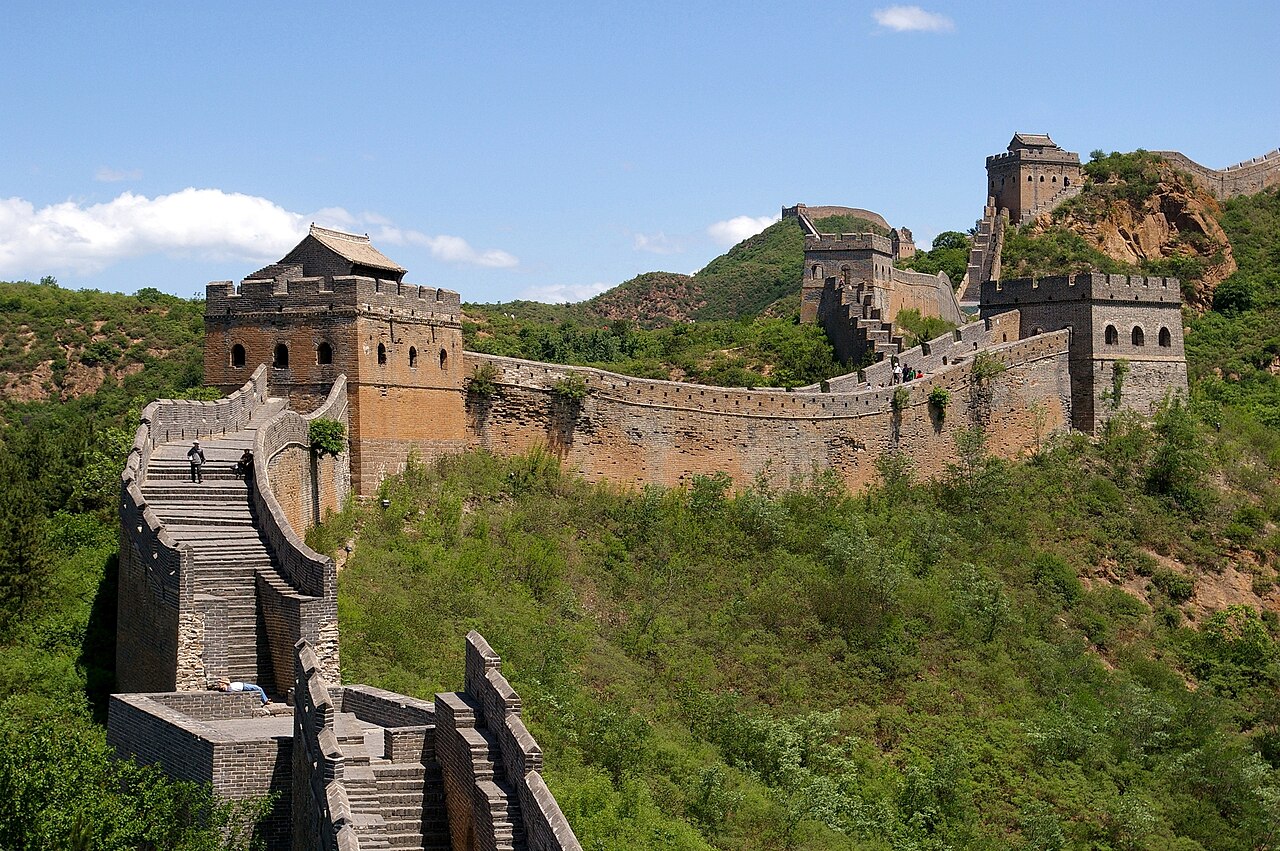

*Via Wikimedia Commons: [20090529 Great Wall 8185](https://commons.wikimedia.org/wiki/File:20090529_Great_Wall_8185.jpg) by Jakub Hałun, [CC BY-SA 3.0](https://creativecommons.org/licenses/by-sa/3.0).*
*Via Wikimedia Commons: [20090529 Great Wall 8185](https://commons.wikimedia.org/wiki/File:20090529_Great_Wall_8185.jpg) by Jakub Hałun, [CC BY-SA 3.0](https://creativecommons.org/licenses/by-sa/3.0).*
### Opening to the United States
### Opening to the United States
President Richard Nixon visited China in February 1972 and met Mao, and the two governments issued the Shanghai Communiqué.[6] They established full diplomatic relations on 1 January 1979.[7] In doing so the United States acknowledged the Chinese position that there is one China and Taiwan is part of it, while continuing relations with Taiwan under the Taiwan Relations Act, which Chinese leaders repeatedly objected to.[7]
President Richard Nixon visited China in February 1972 and met Mao, and the two governments issued the Shanghai Communiqué.[6] They established full diplomatic relations on 1 January 1979.[7] In doing so the United States acknowledged the Chinese position that there is one China and Taiwan is part of it, while continuing relations with Taiwan under the Taiwan Relations Act, which Chinese leaders repeatedly objected to.[7]
### 1989
### 1989
Demonstrators gathered in Tiananmen Square in Beijing in 1989 in large numbers, and on the night of 3 and 4 June the army stormed the square.[9] The suppression cooled relations with the United States.[9] See [1989 Tiananmen Square protests](https://micwyn.com/t/3430/1989-tiananmen-square-protests).
Demonstrators gathered in Tiananmen Square in Beijing in 1989 in large numbers, and on the night of 3 and 4 June the army stormed the square.[9] The suppression cooled relations with the United States.[9] See [1989 Tiananmen Square protests](https://micwyn.com/t/3430/1989-tiananmen-square-protests).
## Economy
## Economy
According to the World Bank, since reform and opening began in 1978 growth has averaged more than 9 per cent a year, lifting almost 800 million people out of extreme poverty and turning China from a low-income into an upper-middle-income country; extreme poverty was eradicated by 2020.[1] The Bank notes that in 2024, 15.2 per cent of people still lived on less than 8.30 dollars a day, a higher benchmark it uses for comparison.[1]
According to the World Bank, since reform and opening began in 1978 growth has averaged more than 9 per cent a year, lifting almost 800 million people out of extreme poverty and turning China from a low-income into an upper-middle-income country; extreme poverty was eradicated by 2020.[1] The Bank notes that in 2024, 15.2 per cent of people still lived on less than 8.30 dollars a day, a higher benchmark it uses for comparison.[1]
Real gross domestic product grew 5.3 per cent year on year in the first half of 2025.[1] The Bank says the model of heavy investment and export manufacturing has largely reached its limits and left economic and environmental imbalances, and that an ageing population and shrinking workforce are slowing growth.[1]
Real gross domestic product grew 5.3 per cent year on year in the first half of 2025.[1] The Bank says the model of heavy investment and export manufacturing has largely reached its limits and left economic and environmental imbalances, and that an ageing population and shrinking workforce are slowing growth.[1]
## Government and rights
## Government and rights
Human Rights Watch, a non-governmental organisation, reports in its 2026 world report that the party has tightened ideological control, that the government controls all major channels of information and runs one of the world's strictest systems of surveillance and censorship, and that it has pursued harsh forced assimilation of Tibetans and Uyghurs and a repressive national security regime in Hong Kong.[8] The organisation says several hundred thousand Uyghurs remain unjustly imprisoned in Xinjiang.[8]
Human Rights Watch, a non-governmental organisation, reports in its 2026 world report that the party has tightened ideological control, that the government controls all major channels of information and runs one of the world's strictest systems of surveillance and censorship, and that it has pursued harsh forced assimilation of Tibetans and Uyghurs and a repressive national security regime in Hong Kong.[8] The organisation says several hundred thousand Uyghurs remain unjustly imprisoned in Xinjiang.[8]
## What's unsettled
## What's unsettled
The status of Taiwan, relations with the United States and the human rights allegations above remain disputed. Economic figures are revised.
The status of Taiwan, relations with the United States and the human rights allegations above remain disputed. Economic figures are revised.
## Sources
## Sources
1. World Bank. "China: Overview". https://www.worldbank.org/en/country/china/overview
2. Asia for Educators, Columbia University. "Timelines: China". https://afe.easia.columbia.edu/timelines/china_timeline.htm
3. U.S. Department of State, Office of the Historian. "The Opening to China Part I: the First Opium War, the United States, and the Treaty of Wangxia". https://history.state.gov/milestones/1830-1860/china-1
4. Office of the Historian. "The Chinese Revolution of 1911". https://history.state.gov/milestones/1899-1913/chinese-rev
5. Office of the Historian. "The Chinese Revolution of 1949". https://history.state.gov/milestones/1945-1952/chinese-rev
6. Office of the Historian. "Rapprochement with China, 1972". https://history.state.gov/milestones/1969-1976/rapprochement-china
7. Office of the Historian. "China Policy". Milestones 1977-1980. https://history.state.gov/milestones/1977-1980/china-policy
8. Human Rights Watch. "World Report 2026: China". https://www.hrw.org/world-report/2026/country-chapters/china
9. Office of the Historian. "Tiananmen Square, 1989". https://history.state.gov/milestones/1989-1992/tiananmen-square
