Compare versions
Version 1 → Version 7 (current). Removed · Added. This shows the entry's text as it is written, including its formatting marks.
Version 1 · Version 7 (current) · Version history
Side by side · Together
Version 1Version 7 (current)
3 unchanged paragraphs
China, officially the People's Republic of China, is a country in East Asia that has been governed by the Chinese Communist Party since 1949.[5][8]
China, officially the People's Republic of China, is a country in East Asia that has been governed by the Chinese Communist Party since 1949.[5][8]
Developing story. This entry is updated as events change; every changing fact is dated.
Developing story. This entry is updated as events change; every changing fact is dated.
## At a glance
## At a glance
- **Official name:** People's Republic of China, proclaimed in 1949.[5]
- **Ruling party:** Chinese Communist Party.[8]
- **Leader:** Xi Jinping, general secretary of the party, as of 2025.[8]
- **Economy:** classed by the World Bank as upper-middle-income.[1]
- **Growth since 1978:** over 9 per cent a year on average.[1]
- **Capital:** Beijing.
- **Official name:** People's Republic of China, proclaimed in 1949.[5]
- **Ruling party:** Chinese Communist Party.[8]
- **Leader:** Xi Jinping, general secretary of the party, as of 2025.[8]
- **Economy:** classed by the World Bank as upper-middle-income.[1]
- **Growth since 1978:** over 9 per cent a year on average.[1]
## Geography and population
China stretches some 5,000 kilometres across East Asia, with broad plains, large deserts and high mountains, and has a coastline of about 18,000 kilometres; its historic centre lay inland, on the middle and lower Yellow River.[18] The World Bank gives a total area of about 9.56 million square kilometres; about two thirds of people live in towns and cities, and life expectancy was 78 years in 2024.[40]
The land falls in a staircase from the Qinghai-Tibetan plateau, sometimes called the "roof of the world", with average heights above 4,000 metres, down to the sea.[10] Five mountain ranges and the courses of the rivers divide it into basins, plateaus and plains.[10] The eastern third, including the North China Plain along the lower Yellow River and the plains of the Yangzi, is the historic core and holds most arable land and people.[10] Western China is thinly settled and much of the mountainous south is poorly suited to farming.[10]
The World Bank puts the population at about 1.41 billion in 2025.[11] China's statistics bureau reported 7.92 million births and 11.31 million deaths that year, a fall of 3.39 million and the fourth annual decline in a row; the birth rate, 5.63 per 1,000 people, was the lowest on record.[12] CNN noted that India now has more people.[12]
## History
## History
### Dynasties
### Early dynasties
Chinese myth begins with the creator Pangu and a line of sage emperors. The first dynasty, or royal house, of tradition is the Xia, from about the 21st to the 16th century BCE; excavations suggest that such a culture existed, and thousands of finds in the Yellow River valley document the Shang that followed.[19] The Zhou overthrew the Shang and ruled from 1027 to 221 BCE, longer than any other dynasty.[2] Their thinkers set out the "mandate of heaven", the idea that a ruler governs by divine right but that losing the throne shows the mandate has been lost.[20]
### Empire
In 221 BCE the state of Qin unified much of the country. Its king took the title First Emperor, imposed a central bureaucracy, standardised law, writing and coinage, and put down dissent, burning books.[21] After the Han dynasty fell, nearly four centuries of division followed, during which Buddhism, which had arrived in the first century CE, spread widely.[22] The Sui reunified China in 589 and extended the Grand Canal, and the Tang (618 to 907), with its capital at Chang'an, is regarded as a high point of Chinese civilisation.[23]
The Mongols under Kublai Khan founded the Yuan dynasty (1279 to 1368), the first non-Chinese house to rule all China.[24] The Ming (1368 to 1644), founded by a peasant and former monk, sent great fleets as far as East Africa until the voyages stopped after 1433.[25] The Manchus then ruled as the Qing, keeping Confucian institutions and the civil service examinations and sponsoring vast scholarly projects.[26]
### Foreign pressure in the nineteenth century
### The nineteenth century
Britain and China fought the First Opium War from 1839 to 1842, over a trade in which opium was smuggled into southern China.[3] The war and the treaties that followed belonged to an era in which Western powers pressed their demands on China.[3] The Treaty of Wangxia of 3 July 1844 was the first formal treaty between China and the United States.[3]
Britain and other Western traders paid for Chinese tea, silk and porcelain partly with opium from India, which was banned by imperial decree.[27] The First Opium War of 1839 to 1842 and the treaties after it opened an era of Western pressure.[3] The Treaty of Wangxia of 1844 was China's first formal treaty with the United States.[3] The Taiping Rebellion (1851 to 1864), led by Hong Xiuquan amid famine and disaster, was the largest uprising in modern Chinese history.[28]
### Republic and civil war
### Republic, invasion and civil war
Failed reforms turned many to revolution. Sun Yat-sen, a republican, organised the movement, and the revolt of 1911 replaced the Qing with the Republic of China.[29][4] Warlords then fought for control, and in 1915 Japan pressed its "Twenty-One Demands".[30] The Nationalists turned on their Communist partners in 1927.[5] Japan seized Manchuria in 1931 and later pushed into northern and coastal China.[31] During the Second World War the United States aided the Nationalist government.[32] Civil war resumed and ended in 1949, when Mao Zedong proclaimed the People's Republic.[5] The defeated government moved to Taiwan.[6]
### Under Mao
The First Five-Year Plan (1953 to 1957) built heavy industry on the Soviet model and collectivised farming; the 1953 census counted 583 million people on the mainland.[33] In 1958 the Great Leap Forward tried to speed development through mass mobilisation.[34] Its failure led Mao to hand many duties to others.[13] In 1966 he launched the Cultural Revolution with student "Red Guards"; it removed opponents but caused serious disorder, and the army was called in.[13]
### Reform
After Mao died in 1976, Deng Xiaoping returned to power. A party meeting in December 1978 made economic results, not class struggle, the test of policy under the "Four Modernizations".[35]
6 unchanged paragraphs
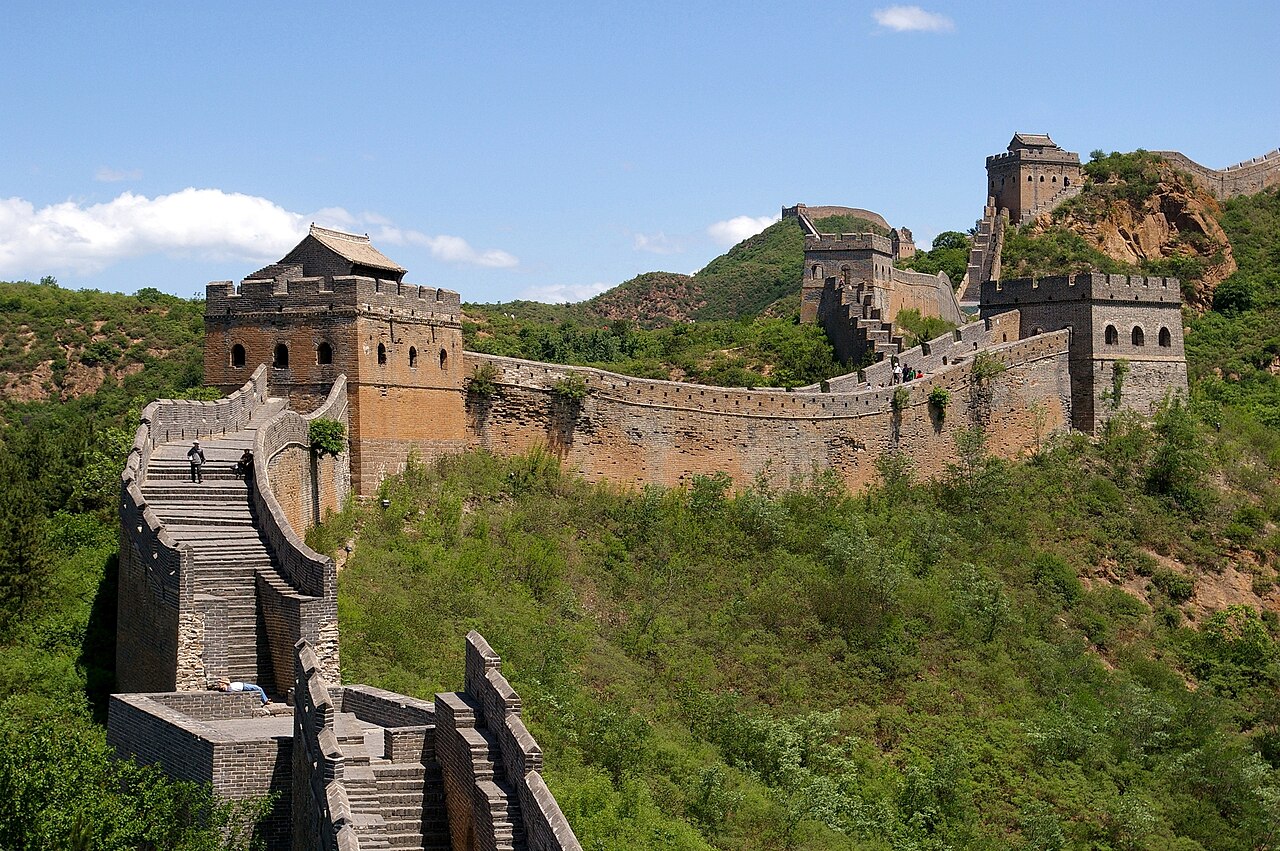

*Via Wikimedia Commons: [20090529 Great Wall 8185](https://commons.wikimedia.org/wiki/File:20090529_Great_Wall_8185.jpg) by Jakub Hałun, [CC BY-SA 3.0](https://creativecommons.org/licenses/by-sa/3.0).*
*Via Wikimedia Commons: [20090529 Great Wall 8185](https://commons.wikimedia.org/wiki/File:20090529_Great_Wall_8185.jpg) by Jakub Hałun, [CC BY-SA 3.0](https://creativecommons.org/licenses/by-sa/3.0).*
### Opening to the United States
### Opening to the United States
President Richard Nixon visited China in February 1972 and met Mao, and the two governments issued the Shanghai Communiqué.[6] They established full diplomatic relations on 1 January 1979.[7] In doing so the United States acknowledged the Chinese position that there is one China and Taiwan is part of it, while continuing relations with Taiwan under the Taiwan Relations Act, which Chinese leaders repeatedly objected to.[7]
President Richard Nixon visited China in February 1972 and met Mao, and the two governments issued the Shanghai Communiqué.[6] They established full diplomatic relations on 1 January 1979.[7] In doing so the United States acknowledged the Chinese position that there is one China and Taiwan is part of it, while continuing relations with Taiwan under the Taiwan Relations Act, which Chinese leaders repeatedly objected to.[7]
### 1989
### 1989
Demonstrators gathered in Tiananmen Square in Beijing in 1989 in large numbers, and on the night of 3 and 4 June the army stormed the square.[9] The suppression cooled relations with the United States.[9] See [1989 Tiananmen Square protests](https://micwyn.com/t/3430/1989-tiananmen-square-protests).
Demonstrators gathered in Tiananmen Square in Beijing in 1989 in large numbers, and on the night of 3 and 4 June the army stormed the square.[9] The suppression cooled relations with the United States.[9] See [1989 Tiananmen Square protests](https://micwyn.com/t/3430/1989-tiananmen-square-protests).
## China since 1989
### Jiang Zemin: recovery and opening
After the 1989 crackdown, Deng Xiaoping brought in Jiang Zemin, then party chief in Shanghai, to hold the party and country together; Jiang replaced Zhao Ziyang, who had been dismissed for sympathy with the student protesters.[41] Jiang led the party until 2002 and was president until 2003. In those years market reforms were revived, growth was explosive, Hong Kong returned from British rule in 1997 and China joined the World Trade Organization.[41][14] Hu Jintao succeeded him.[41]
### Xi Jinping
Xi Jinping became party leader in 2012. He consolidated power quickly, including through a harsh campaign against corruption that also removed political rivals.[42] There is no formal limit on the post of general secretary, but the recent norm had been to step down after two five-year terms; in October 2022 Xi took a third.[42]
### Hong Kong
At the 1997 handover Hong Kong was promised a high degree of autonomy for 50 years. Huge and often violent protests against the government followed in 2019, and in 2020 Beijing imposed a sweeping national security law.[43] CNN reported in 2022 that most pro-democracy groups had disbanded since, while Hong Kong's leaders maintained that the city was as free as before.[43]
### COVID-19
China enforced a strict "zero-COVID" policy with lockdowns and mass testing. In December 2022, after street protests in several cities, the government sharply rolled back the restrictions.[44]
### Space
In June 2024 the Chang'e 6 probe brought back the first samples ever taken from the far side of the Moon, landing in Inner Mongolia.[45]
### Relations with the United States in 2026
President [Donald Trump](https://micwyn.com/t/3542/donald-trump) visited Beijing in May 2026; afterwards the two governments' accounts of what had been agreed differed on points including agriculture, tariffs and rare earths, metals used in advanced manufacturing.[46] Xi visited Washington in September, with expectations of a breakthrough low.[47] Days later the two agreed to cut tariffs on 60 billion dollars of goods, 30 billion on each side.[48]
## Society and culture
About 93 per cent of the population was counted as Han in a Library of Congress study of the 1980s, which noted large regional differences, including in spoken Chinese, alongside a common written form; the state officially recognised 56 nationalities including the Han.[36] The study described traditional elites as dismissive of organised religion and the Communist Party as regarding religion as a relic of the past.[37]
Classical literature reaches back to the Zhou period and includes the Classics associated with Confucius, among them the Book of Changes and the Classic of Poetry.[38] Music is documented from the same era, and a court Music Bureau set up under the Qin was greatly expanded by the Han.[39]
## Economy
## Economy
Output was about 19.5 trillion US dollars in 2025, or about 13,900 dollars per person.[40]
According to the World Bank, since reform and opening began in 1978 growth has averaged more than 9 per cent a year, lifting almost 800 million people out of extreme poverty and turning China from a low-income into an upper-middle-income country; extreme poverty was eradicated by 2020.[1] The Bank notes that in 2024, 15.2 per cent of people still lived on less than 8.30 dollars a day, a higher benchmark it uses for comparison.[1]
According to the World Bank, since reform and opening began in 1978 growth has averaged more than 9 per cent a year, lifting almost 800 million people out of extreme poverty and turning China from a low-income into an upper-middle-income country; extreme poverty was eradicated by 2020.[1] The Bank notes that in 2024, 15.2 per cent of people still lived on less than 8.30 dollars a day, a higher benchmark it uses for comparison.[1]
Real gross domestic product grew 5.3 per cent year on year in the first half of 2025.[1] The Bank says the model of heavy investment and export manufacturing has largely reached its limits and left economic and environmental imbalances, and that an ageing population and shrinking workforce are slowing growth.[1]
Real gross domestic product grew 5.3 per cent year on year in the first half of 2025.[1] The Bank says the model of heavy investment and export manufacturing has largely reached its limits and left economic and environmental imbalances, and that an ageing population and shrinking workforce are slowing growth.[1]
China has been a member of the World Trade Organization since 11 December 2001.[14] The economy grew 5 per cent in 2025, in line with the government's target, with growth slowing to 4.5 per cent in the last quarter.[12]
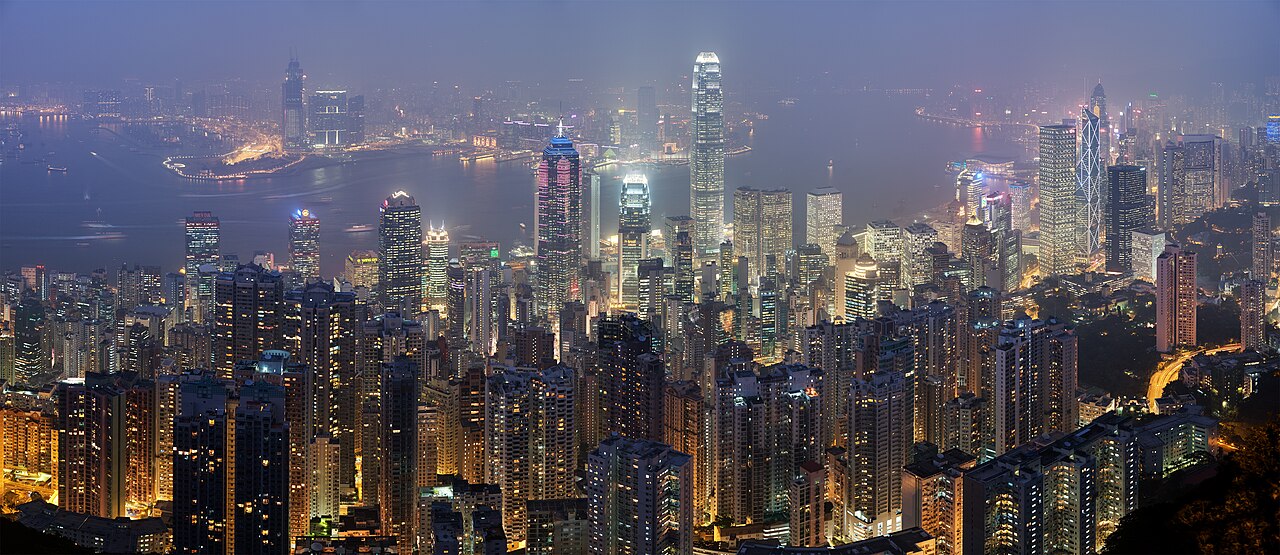
*Via Wikimedia Commons: [Hong Kong Skyline Restitch - Dec 2007](https://commons.wikimedia.org/wiki/File:Hong_Kong_Skyline_Restitch_-_Dec_2007.jpg) by Diliff, [CC BY 3.0](https://creativecommons.org/licenses/by/3.0).*
## Hong Kong and Taiwan
Hong Kong's Basic Law calls the territory an inalienable part of China, authorises a high degree of autonomy with its own legislature and courts, and states that its capitalist system and way of life shall remain unchanged for 50 years.[15]
Beijing regards Taiwan as part of China.[7] In December 2025 it held military drills around the island that it called a stern warning against separatists and outside interference, after anger at United States arms sales and remarks by Japan's prime minister; Taiwan put its forces on alert and condemned them.[16]
## Government and rights
## Government and rights
Human Rights Watch, a non-governmental organisation, reports in its 2026 world report that the party has tightened ideological control, that the government controls all major channels of information and runs one of the world's strictest systems of surveillance and censorship, and that it has pursued harsh forced assimilation of Tibetans and Uyghurs and a repressive national security regime in Hong Kong.[8] The organisation says several hundred thousand Uyghurs remain unjustly imprisoned in Xinjiang.[8]
Human Rights Watch, a non-governmental organisation, reports in its 2026 world report that the party has tightened ideological control, that the government controls all major channels of information and runs one of the world's strictest systems of surveillance and censorship, and that it has pursued harsh forced assimilation of Tibetans and Uyghurs and a repressive national security regime in Hong Kong.[8] The organisation says several hundred thousand Uyghurs remain unjustly imprisoned in Xinjiang.[8]
China rejects accusations over Xinjiang. When the United Nations human rights office published a report on the region in 2022, China denounced it as a patchwork of false information serving political aims.[17]
3 unchanged paragraphs
## What's unsettled
## What's unsettled
The status of Taiwan, relations with the United States and the human rights allegations above remain disputed. Economic figures are revised.
The status of Taiwan, relations with the United States and the human rights allegations above remain disputed. Economic figures are revised.
## Sources
## Sources
1. World Bank. "China: Overview". https://www.worldbank.org/en/country/china/overview
2. Asia for Educators, Columbia University. "Timelines: China". https://afe.easia.columbia.edu/timelines/china_timeline.htm
3. U.S. Department of State, Office of the Historian. "The Opening to China Part I: the First Opium War, the United States, and the Treaty of Wangxia". https://history.state.gov/milestones/1830-1860/china-1
4. Office of the Historian. "The Chinese Revolution of 1911". https://history.state.gov/milestones/1899-1913/chinese-rev
5. Office of the Historian. "The Chinese Revolution of 1949". https://history.state.gov/milestones/1945-1952/chinese-rev
6. Office of the Historian. "Rapprochement with China, 1972". https://history.state.gov/milestones/1969-1976/rapprochement-china
7. Office of the Historian. "China Policy". Milestones 1977-1980. https://history.state.gov/milestones/1977-1980/china-policy
8. Human Rights Watch. "World Report 2026: China". https://www.hrw.org/world-report/2026/country-chapters/china
9. Office of the Historian. "Tiananmen Square, 1989". https://history.state.gov/milestones/1989-1992/tiananmen-square
10. Asia for Educators, Columbia University. "China: geography and maps". https://afe.easia.columbia.edu/china/geog/maps.htm
11. World Bank. "Population, total" (indicator SP.POP.TOTL). https://data.worldbank.org/indicator/SP.POP.TOTL?locations=CN
12. CNN. "China's 2025 GDP hits target despite US trade war, birth rate drops to record low". 18 January 2026. https://edition.cnn.com/2026/01/18/china/china-gdp-birth-rate-population-intl-hnk
13. Asia for Educators. "Three Chinese Leaders: Mao Zedong, Zhou Enlai, and Deng Xiaoping". https://afe.easia.columbia.edu/special/china_1950_leaders.htm
14. World Trade Organization. "China: member information". https://www.wto.org/english/thewto_e/countries_e/china_e.htm
15. Hong Kong Government. "Basic Law, Chapter I". https://www.basiclaw.gov.hk/en/basiclaw/chapter1.html
16. NPR. "Chinese military stages drills around Taiwan to warn 'external forces'". 29 December 2025. https://www.npr.org/2025/12/29/g-s1-103877/chinese-military-drills-around-taiwan
17. Associated Press. "China denounces U.N. report detailing human rights abuses of Uyghurs". PBS News, 2022. https://www.pbs.org/newshour/world/china-denounces-u-n-report-detailing-human-rights-abuses-of-uyghurs
18. Library of Congress Country Studies (written in the 1980s). "China: Geography". https://countrystudies.us/china/32.htm
19. Library of Congress Country Studies (written in the 1980s). "China: The Ancient Dynasties". https://countrystudies.us/china/4.htm
20. Library of Congress Country Studies (written in the 1980s). "China: The Zhou Period". https://countrystudies.us/china/5.htm
21. Library of Congress Country Studies (written in the 1980s). "China: The Imperial Era". https://countrystudies.us/china/7.htm
22. Library of Congress Country Studies (written in the 1980s). "China: Era of Disunity". https://countrystudies.us/china/8.htm
23. Library of Congress Country Studies (written in the 1980s). "China: Restoration of Empire". https://countrystudies.us/china/9.htm
24. Library of Congress Country Studies (written in the 1980s). "China: Mongolian Interlude". https://countrystudies.us/china/10.htm
25. Library of Congress Country Studies (written in the 1980s). "China: The Chinese Regain Power". https://countrystudies.us/china/11.htm
26. Library of Congress Country Studies (written in the 1980s). "China: The Rise of the Manchus". https://countrystudies.us/china/12.htm
27. Library of Congress Country Studies (written in the 1980s). "China: The Opium War, 1839-42". https://countrystudies.us/china/15.htm
28. Library of Congress Country Studies (written in the 1980s). "China: The Taiping Rebellion, 1851-64". https://countrystudies.us/china/16.htm
29. Library of Congress Country Studies (written in the 1980s). "China: The Republican Revolution of 1911". https://countrystudies.us/china/19.htm
30. Library of Congress Country Studies (written in the 1980s). "China: Nationalism and Communism". https://countrystudies.us/china/21.htm
31. Library of Congress Country Studies (written in the 1980s). "China: Anti-Japanese War". https://countrystudies.us/china/22.htm
32. Library of Congress Country Studies (written in the 1980s). "China: Return to Civil War". https://countrystudies.us/china/23.htm
33. Library of Congress Country Studies (written in the 1980s). "China: The Transition to Socialism, 1953-57". https://countrystudies.us/china/25.htm
34. Library of Congress Country Studies (written in the 1980s). "China: The Great Leap Forward, 1958-60". https://countrystudies.us/china/26.htm
35. Library of Congress Country Studies (written in the 1980s). "China: The Four Modernizations, 1979-82". https://countrystudies.us/china/30.htm
36. Library of Congress Country Studies (written in the 1980s). "China: Minorities". https://countrystudies.us/china/36.htm
37. Library of Congress Country Studies (written in the 1980s). "China: Religion". https://countrystudies.us/china/61.htm
38. Library of Congress Country Studies (written in the 1980s). "China: Traditional Literature". https://countrystudies.us/china/73.htm
39. Library of Congress Country Studies (written in the 1980s). "China: Music". https://countrystudies.us/china/76.htm
40. World Bank. World Development Indicators: surface area, urban share, life expectancy and GDP for China. https://data.worldbank.org/country/china
41. Associated Press. "Jiang Zemin, who led China's economic rise after ending of pro-democracy protests, dies". PBS News, 30 November 2022. https://www.pbs.org/newshour/world/jiang-zemin-who-led-chinas-economic-rise-after-ending-of-pro-democracy-protests-dies
42. NPR. "China's party congress is set to grant Xi Jinping a 3rd term. But that's not all". 13 October 2022. https://www.npr.org/2022/10/13/1124553497/china-communist-party-congress-xi-jinping
43. CNN. "China's Xi Jinping claims Hong Kong handover marked 'beginning of true democracy'". 1 July 2022. https://www.cnn.com/2022/07/01/asia/hong-kong-china-anniversary-day-intl-hnk
44. NPR. "China announces rollback of strict anti-COVID-19 measures". 7 December 2022. https://www.npr.org/2022/12/07/1141172723/china-announces-a-roll-back-of-its-strict-anti-covid-19-measures
45. NPR. "China returns the first-ever sample of the moon's far side". 24 June 2024. https://www.npr.org/2024/06/24/nx-s1-5015208/china-return-first-ever-sample-return-moon-far-side
46. NPR. "The aftermath of Trump-Xi summit: comparing U.S. and China announcements". 22 May 2026. https://www.npr.org/2026/05/22/g-s1-123647/comparing-u-s-and-china-announcements
47. NPR. "Trump and Xi strike cordial tone at summit amid underlying tensions". 24 September 2026. https://www.npr.org/2026/09/24/g-s1-144806/trump-xi-summit
48. CNN. "US and China agree to cut tariffs on $60 billion worth of goods, from coal to toys". 28 September 2026. https://edition.cnn.com/2026/09/28/business/us-china-tariff-cuts-60-billion-intl
