Version 5
Nov 27, 2026. Compare with the current version · Version history
Vietnam is a country in Southeast Asia on the eastern side of the Indochinese peninsula, ruled by the Communist Party of Vietnam, with its capital at Hanoi.[1][17]
Developing story. This entry is updated as events change; every changing fact is dated.
At a glance
- Capital: Hanoi.
- Government: one-party state led by the Communist Party.[17]
- Party leader: To Lam, general secretary, reappointed in January 2026.[18]
- Area: about 331,000 square kilometres.[1][14]
- Population: about 101.6 million in 2025.[14]
- Economy: about 515 billion US dollars of output in 2025, 5,066 per person.[14][15]
- World Bank class: upper-middle-income since July 2026.[15]
Geography
Vietnam is S-shaped, about 1,650 kilometres from north to south and only about 50 kilometres wide at its narrowest, with a coastline of some 3,260 kilometres not counting islands.[1] It borders China, Laos and Cambodia.[1] It is a country of tropical lowlands, hills and densely forested highlands, with level land on no more than a fifth of its area.[1]
The north has highlands and the Red River Delta; the south has the central mountain chain, coastal lowlands and the Mekong River Delta.[1] The Red River Delta, the ancestral home of the ethnic Vietnamese, is smaller than the Mekong's but more densely settled.[1] The Red River rises in China's Yunnan Province. The delta lies mostly within three metres of sea level and floods often, and a system of dikes and canals built over centuries protects and irrigates its rice land.[1] The Paracel Islands, occupied by China in 1974, are claimed by both countries.[1]
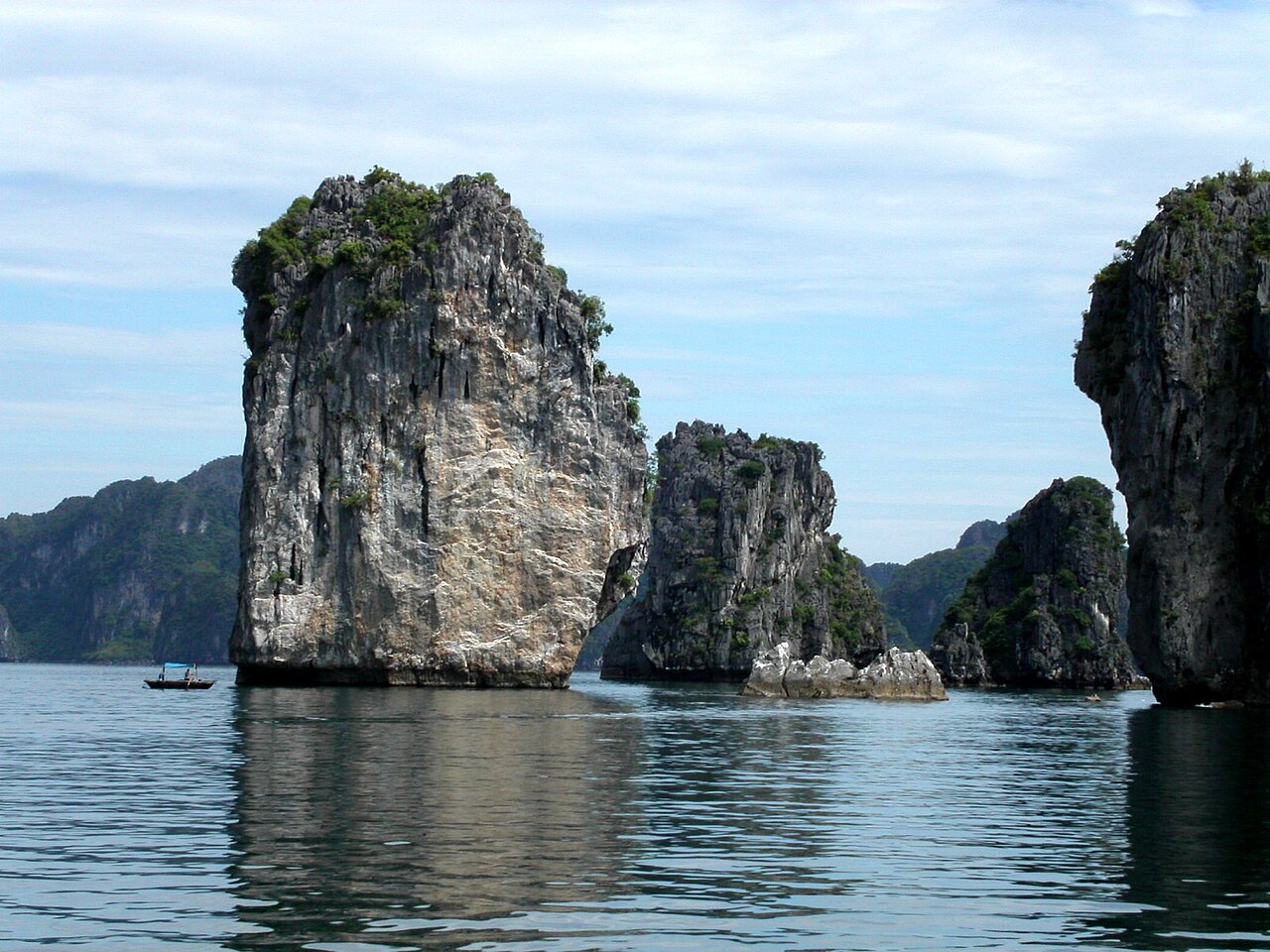
Via Wikimedia Commons: Halong Bay in Vietnam by Thomas Hirsch / User:Ravn, CC BY-SA 3.0.
Population and peoples
The World Bank puts the population at about 101.6 million in 2025, up from 101.0 million in 2024, with about 39 per cent living in towns and cities. Life expectancy was about 74.7 years in 2024.[14]
Most people are ethnic Vietnamese, living alongside many minorities. The 1979 census listed 53 minority groups making up 12.7 per cent of the population, including the Hoa, people of Chinese origin; many highland peoples are known collectively as Montagnards.[2]
History
Chinese rule
In 111 BCE armies of the Han emperor Wu Di defeated the rulers of Nam Viet and brought it into the Chinese empire.[3] As China raised taxes and pressed assimilation, the sisters Trung Trac and Trung Nhi led a revolt in 39 CE. It was put down within two years, and they are still celebrated as heroines.[3] Ngo Quyen defeated a Chinese fleet in 938, using iron-tipped stakes driven into the bed of the Bach Dang River, and Chinese political rule ended.[5][16]
Independent dynasties
Ly Cong Uan founded the Ly dynasty in 1009 and moved the capital to the site of modern Hanoi; the dynasty lasted until 1225, and in 1054 the country took the name Dai Viet.[4] Under the Tran dynasty (1225 to 1400) the country prospered and, in 1257, 1284 and 1287, defeated invasions by the Mongols of Kublai Khan, the last under the general Tran Hung Dao.[5]
After a period of Ming Chinese rule, Le Loi won independence in 1428 and founded the Le dynasty. Its greatest ruler, Le Thanh Tong, reorganised government, issued a legal code that gave women a higher position than Chinese law did, and conquered the southern kingdom of Champa in 1471.[6]
The Le weakened, and in 1545 the country was divided, with the Nguyen family taking control of the south.[7] The Tay Son rebellion of 1771 to 1802, led by three brothers under the slogan of taking from the rich to give to the poor, ended the old order.[8] Nguyen Anh defeated the Tay Son and in 1802 became the emperor Gia Long, ruling a united country from Hue; the name Viet Nam was first used then, and he relied heavily on Chinese models of government.[9]
French rule
French forces took Tourane in 1858 and Saigon in 1859, and in 1862 the emperor Tu Duc ceded three southern provinces by treaty.[10] The colonial state raised revenue through rice exports, heavy taxes and monopolies on opium, salt and alcohol, and granted much land to French settlers.[11]
Resistance continued, including a movement of scholars of whom Phan Boi Chau was the best known.[12] Ho Chi Minh, born in 1890, left as a ship's kitchen hand in 1911, became a communist in France and founded a revolutionary youth league in Guangzhou in 1925.[13]
War and independence
In August 1945, as Japan surrendered, the communist-led Viet Minh launched a general uprising and quickly took most towns in the north.[19] Fighting with France followed: after a French naval bombardment of Haiphong in November 1946, war broke out that December.[20] The French stronghold at Dien Bien Phu fell on 7 May 1954 and France withdrew.[21] The Geneva agreements divided the country along the 17th parallel.[21][22]
In the south, Prime Minister Ngo Dinh Diem received United States support and aid from 1955 and moved against communists and religious sects.[23] An insurgency grew from 1959.[24] After the Gulf of Tonkin Resolution of August 1964 the United States committed large forces.[22] A peace agreement was reached in early 1973, and North Vietnamese tanks took Saigon on 30 April 1975.[25] See Vietnam War.
Since 1975
The victorious government set out to rebuild and to bring the south into its socialist system.[26] Reforms called Doi Moi, meaning renovation, began in 1986.[15] The United States opened a liaison office in Hanoi on 28 January 1995.[27]
Government and politics
The Communist Party is the controlling force. A Library of Congress study written in the late 1980s described how the party's leading role overrode that of the government, and how it kept control by placing members in key posts and through mass organisations such as the Fatherland Front.[28] The country has had constitutions of 1946, 1959 and 1980, and later ones are not covered here.[29] At its congress in January 2026 the party reappointed To Lam as general secretary and set a goal of rapid growth.[18]
Religion
Historically most Vietnamese have identified with Buddhism.[30] The 1980 constitution proclaimed freedom of worship while forbidding the misuse of religion against state law, and the Library of Congress study judged the position of religion precarious in the late 1980s.[30]
Economy
According to the World Bank, integration into world trade and investment since the reforms has lifted millions out of poverty and improved health, education and living standards. Output per person rose from under 500 US dollars in 1986 to 5,066 in 2025, extreme poverty fell from 14 per cent in 2010 to under 4 per cent in 2025, and health insurance covered 95 per cent of people.[15] The Bank reclassified Vietnam as upper-middle-income in July 2026. The government aims for high-income status by 2045; the Bank lists an ageing population, changing trade patterns, automation and climate risks as challenges.[15]
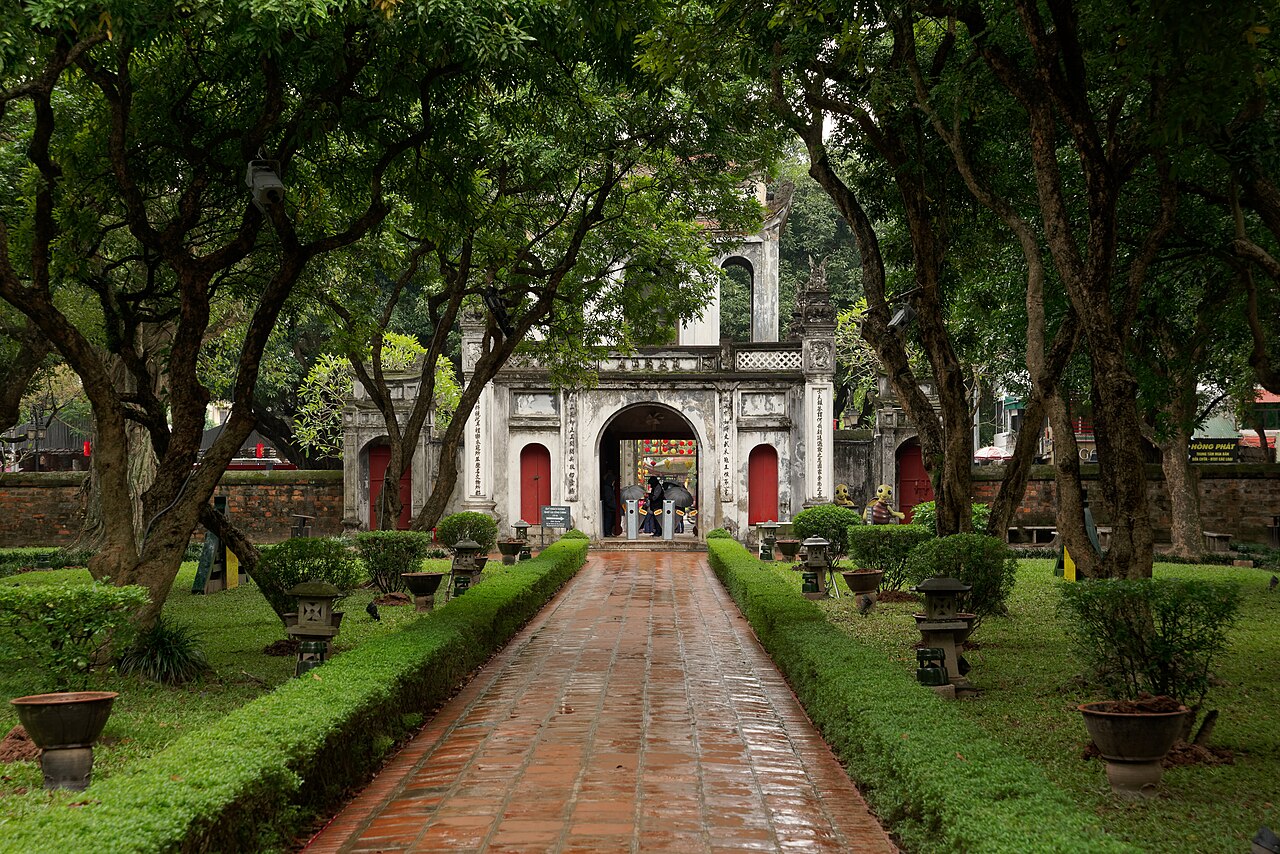
Via Wikimedia Commons: Main gate of the Temple of Literature, Hanoi, Vietnam, 20240123 0929 3 by Jakub Hałun, CC BY 4.0.
Foreign relations
Until 1975 foreign policy was subordinate to reunification; afterwards Hanoi turned to its relations with Laos, Cambodia, China, the Soviet Union and the West.[31] In 1979 China made a limited invasion of Vietnam.[1] The Association of Southeast Asian Nations (ASEAN), formed in 1967, was at first rebuffed by Hanoi.[32]
Rights
Human Rights Watch, a non-governmental organisation, reports that courts controlled by the party routinely deny defendants due process, that a 2025 restructuring added to the power of the Ministry of Public Security, and that in 2025 Vietnam held more than 160 political prisoners and arrested at least 40 more people for criticising the government.[17] This entry does not report the government's response.
What's unsettled
Whether the growth and income targets will be met is open. Much of the description of society and government above comes from a study of the late 1980s and may no longer hold.
Sources
The Library of Congress country study of Vietnam was written in the late 1980s.
- Library of Congress Country Studies. "Vietnam: Geography". countrystudies.us/vietnam/33.htm
- Library of Congress Country Studies. "Vietnam: Minorities". countrystudies.us/vietnam/36.htm
- Library of Congress Country Studies. "The Chinese Millennium". countrystudies.us/vietnam/4.htm
- Library of Congress Country Studies. "The Ly Dynasty". countrystudies.us/vietnam/8.htm
- Library of Congress Country Studies. "The Tran Dynasty and the Defeat of the Mongols". countrystudies.us/vietnam/9.htm
- Library of Congress Country Studies. "The Le Dynasty and Southward Expansion". countrystudies.us/vietnam/11.htm
- Library of Congress Country Studies. "Partition and the Advent of the Europeans". countrystudies.us/vietnam/12.htm
- Library of Congress Country Studies. "The Tay Son Rebellion". countrystudies.us/vietnam/13.htm
- Library of Congress Country Studies. "The Nguyen Dynasty and Expanding French Influence". countrystudies.us/vietnam/14.htm
- Library of Congress Country Studies. "Under French Rule". countrystudies.us/vietnam/15.htm
- Library of Congress Country Studies. "Colonial Administration". countrystudies.us/vietnam/16.htm
- Library of Congress Country Studies. "Phan Boi Chau and the Rise of Nationalism". countrystudies.us/vietnam/17.htm
- Library of Congress Country Studies. "Ho Chi Minh and the Communist Movement". countrystudies.us/vietnam/18.htm
- World Bank. World Development Indicators: surface area, population, urban share, life expectancy and GDP for Viet Nam. data.worldbank.org/country/viet-nam
- World Bank. "Viet Nam: Overview". worldbank.org/en/country/vietnam/overview
- Asia for Educators, Columbia University. "Timelines: Vietnam". afe.easia.columbia.edu/timelines/vietnam_timeline.htm
- Human Rights Watch. "World Report 2026: Vietnam". hrw.org/world-report/2026/country-chapters/vietnam
- NPR. "Vietnam leader To Lam consolidates power as country targets 10% growth". 23 January 2026. npr.org/2026/01/23/g-s1-106993/vietnam-leader-to-lam-consolidates-p…
- Library of Congress Country Studies. "The General Uprising and Independence". countrystudies.us/vietnam/22.htm
- Library of Congress Country Studies. "First Indochina War". countrystudies.us/vietnam/23.htm
- U.S. Department of State, Office of the Historian. "Dien Bien Phu and the Fall of French Indochina, 1954". history.state.gov/milestones/1953-1960/dien-bien-phu
- Office of the Historian. "The Gulf of Tonkin and Escalation, 1964". history.state.gov/milestones/1961-1968/gulf-of-tonkin
- Library of Congress Country Studies. "The Aftermath of Geneva". countrystudies.us/vietnam/25.htm
- Library of Congress Country Studies. "Second Indochina War". countrystudies.us/vietnam/26.htm
- Office of the Historian. "Ending the Vietnam War, 1969-1973". history.state.gov/milestones/1969-1976/ending-vietnam
- Library of Congress Country Studies. "Vietnam after 1975". countrystudies.us/vietnam/40.htm
- Office of the Historian. "Vietnam: relations with the United States". history.state.gov/countries/vietnam
- Library of Congress Country Studies. "The Vietnamese Communist Party". countrystudies.us/vietnam/52.htm
- Library of Congress Country Studies. "System of Government". countrystudies.us/vietnam/56.htm
- Library of Congress Country Studies. "Religion". countrystudies.us/vietnam/42.htm
- Library of Congress Country Studies. "Foreign Relations". countrystudies.us/vietnam/58.htm
- Library of Congress Country Studies. "ASEAN". countrystudies.us/vietnam/63.htm
