Compare versions
Version 2 → Version 4 (current). Removed · Added. This shows the entry's text as it is written, including its formatting marks.
Version 2 · Version 4 (current) · Version history
Side by side · Together
Australia is a country made up of a continent, Tasmania and many smaller islands. It is a federation of six states and two mainland territories, a representative democracy and a constitutional monarchy, with its capital at Canberra.[1][2][3]
Developing story. This entry is updated as events change; every changing fact is dated.
## At a glance
- **Capital:** Canberra.[1]
- **Government:** federal parliamentary democracy and constitutional monarchy.[2]
- **Head of state:** King Charles III, represented by the Governor-General.[1]
- **Prime minister:** Anthony Albanese, in a second term since the May 2025 election.[4]
- **Area:** about 7.69 million square kilometres.[5]
- **Population:** 27.9 million at 31 March 2026.[6]
- **Largest city:** Sydney.[1]
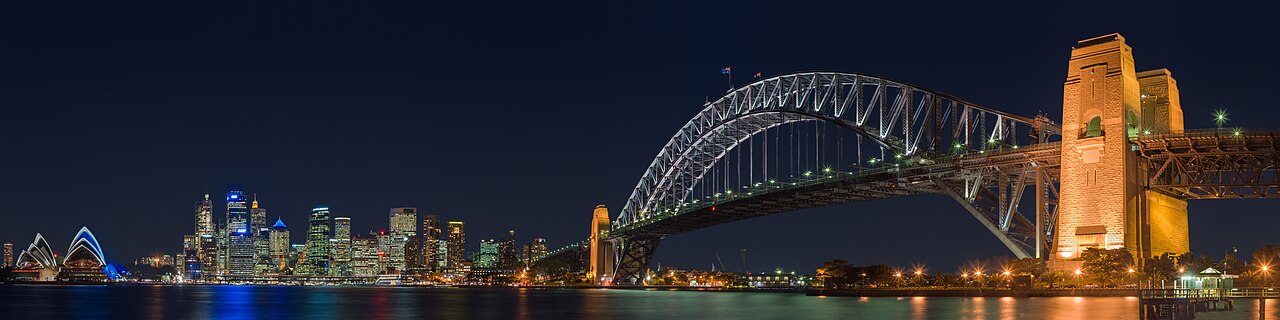
*Via Wikimedia Commons: [Sydney Harbour Bridge night](https://commons.wikimedia.org/wiki/File:Sydney_Harbour_Bridge_night.jpg) by Diliff, [CC BY-SA 3.0](https://creativecommons.org/licenses/by-sa/3.0).*
## Land
Australia is the sixth largest country in the world.[5] Official guidance for new citizens describes it as one of the world's oldest land masses and the flattest and driest inhabited one. Much of it has poor soil and low rainfall; the remote dry inland is called the outback. The north is tropical, the centre largely desert, and the south ranges from cool winters with mountain snow to dry summer heatwaves.[7]
Natural places on the World Heritage List include the Great Barrier Reef, the Greater Blue Mountains and the Wet Tropics of Queensland, while Uluru-Kata Tjuta and Kakadu national parks are listed for both nature and culture.[7]
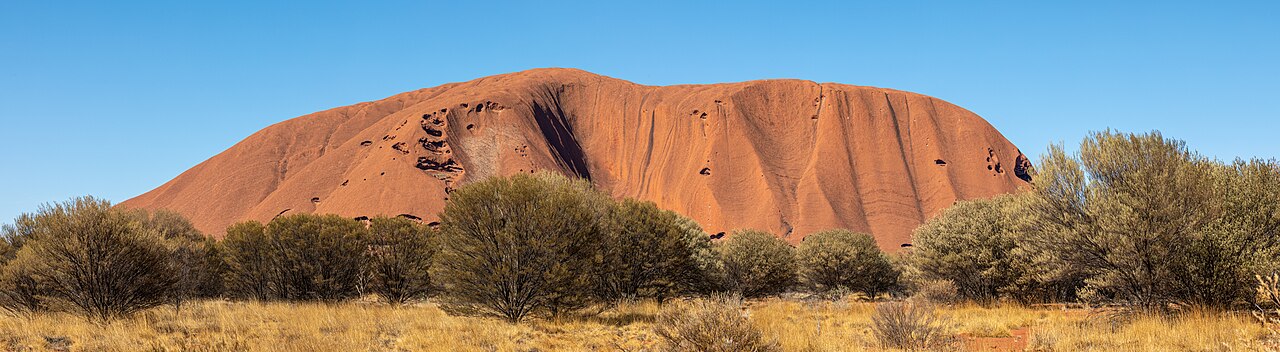
*Via Wikimedia Commons: [Petermann Ranges (AU), Uluru-Kata Tjuta National Park, Uluru -- 2019 -](https://commons.wikimedia.org/wiki/File:Petermann_Ranges_(AU),_Uluru-Kata_Tjuta_National_Park,_Uluru_--_2019_--_3602-6.jpg) by Dietmar Rabich, [CC BY-SA 4.0](https://creativecommons.org/licenses/by-sa/4.0).*
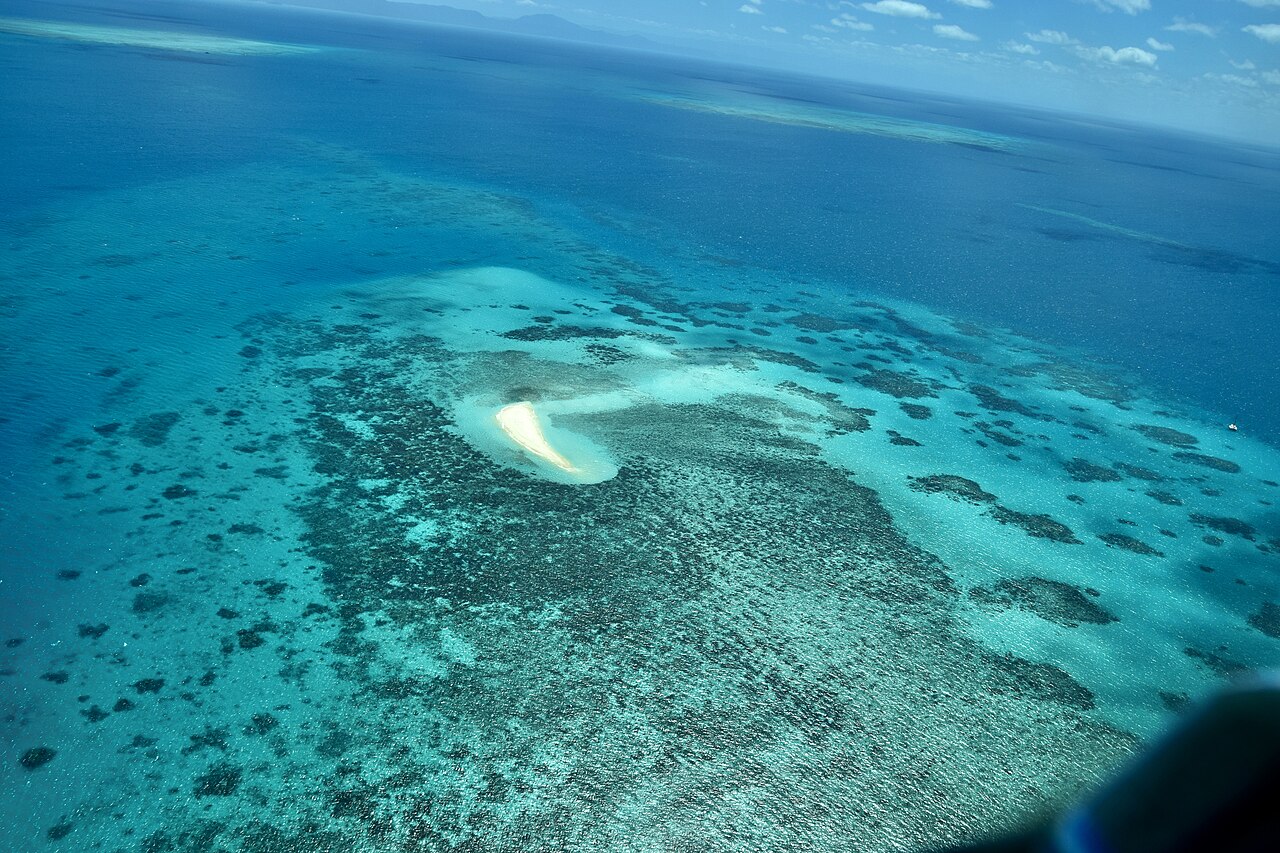
*Via Wikimedia Commons: [Aerial View of Great Barrier Reef (Ank Kumar) 02](https://commons.wikimedia.org/wiki/File:Aerial_View_of_Great_Barrier_Reef_(Ank_Kumar)_02.jpg) by Ank Kumar, [CC BY-SA 4.0](https://creativecommons.org/licenses/by-sa/4.0).*
## States and territories
The six states are New South Wales, Victoria, Queensland, Western Australia, South Australia and Tasmania, with capitals at Sydney, Melbourne, Brisbane, Perth, Adelaide and Hobart. The two mainland territories are the Australian Capital Territory, home of Canberra, and the Northern Territory, whose capital is Darwin. Western Australia is the largest state and Tasmania the smallest.[1]
## People
The population was about 27.9 million at 31 March 2026. Over the preceding year, net overseas migration added about 292,000 people and natural increase about 101,000.[6] About 88 per cent of people live in towns and cities, life expectancy was about 83 years in 2024 and about 18 per cent were aged 65 or over in 2025.[3] English is the national language, and more than 100 Aboriginal and Torres Strait Islander languages are also spoken.[1]
About three per cent of people identify as Aboriginal or Torres Strait Islander, and more than a quarter of residents were born overseas.[7]
## First peoples
Aboriginal and Torres Strait Islander peoples are the first inhabitants and have the oldest continuing cultures in the world. The archaeological record indicates that Aboriginal people arrived between 65,000 and 40,000 years ago.[1] In 1788 there were an estimated 750,000 to 1.4 million of them, in about 250 nations with more than 700 language groups.[7]
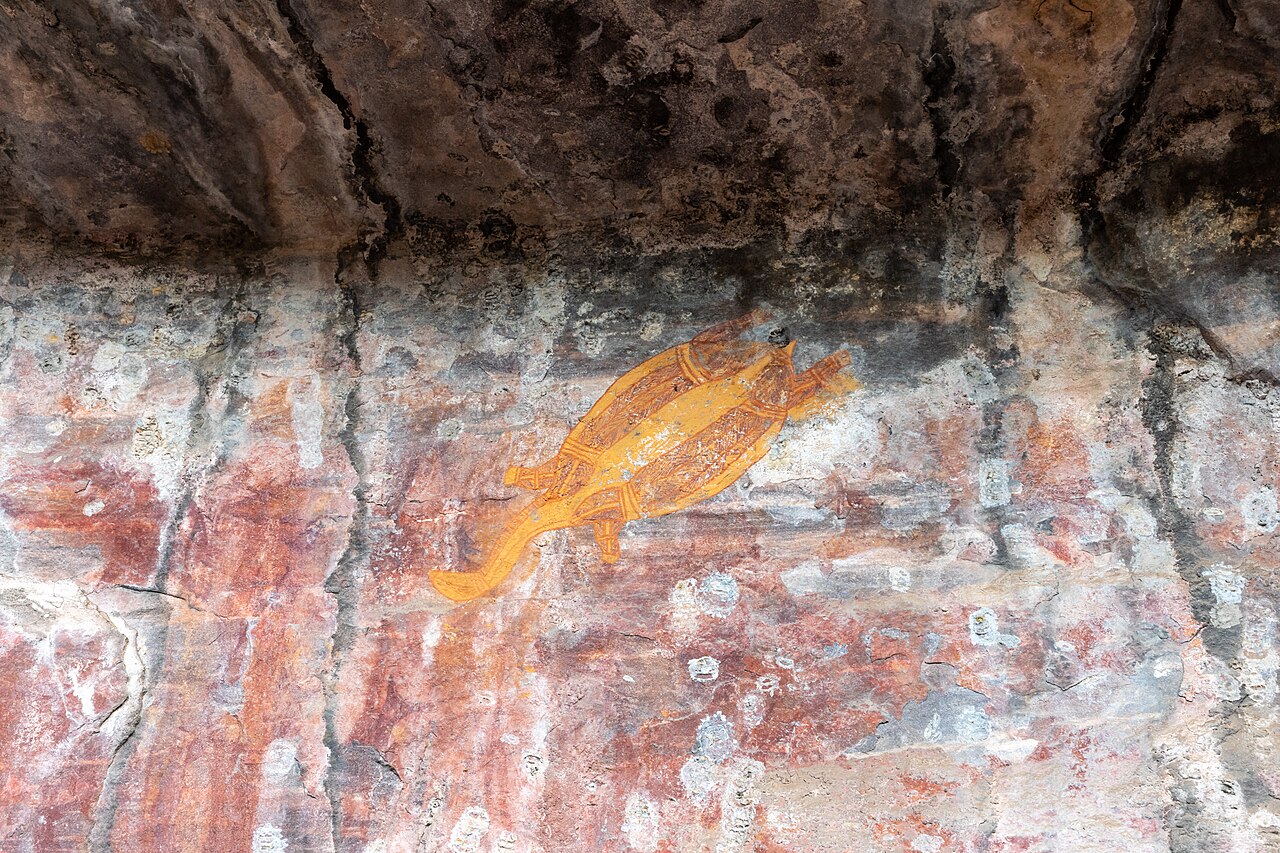
*Via Wikimedia Commons: [Kakadu (AU), Kakadu National Park, Ubirr Rock Art -- 2019 -- 4169](https://commons.wikimedia.org/wiki/File:Kakadu_(AU),_Kakadu_National_Park,_Ubirr_Rock_Art_--_2019_--_4169.jpg) by Dietmar Rabich, [CC BY-SA 4.0](https://creativecommons.org/licenses/by-sa/4.0).*
### Languages and beliefs
Before British settlement more than 700 Aboriginal and Torres Strait Islander languages and dialects were spoken. More than 100 are still used, though fewer than twenty are being passed on to children. The term the Dreaming is often used for the system of knowledge, faith and practice that guides Aboriginal life; its stories, told through music, song and dance, explain how the land was shaped and carry practical lessons. Rock painting, carving and ground designs were early forms of Indigenous art.[7]
## History
### European arrival
In 1606 the Dutch navigator Willem Janszoon charted part of Cape York, and later Dutch sailors explored the western coast, calling the land New Holland. In 1642 Abel Tasman reached what is now Tasmania. The English navigator William Dampier later landed on the north-west coast.[7] In 1770 James Cook charted the east coast, which Europeans had not explored, named it New South Wales and claimed it for King George III.[7]
### Convict colonies
After the American colonies became independent, Britain could no longer send convicts there, and its prisons were crowded.[7] On 26 January 1788 Captain Arthur Phillip brought a fleet of 11 ships to found a colony in New South Wales.[8][7] The early years brought the settlement close to starvation.[8] More than 160,000 convicts were transported before the system ended, last in Western Australia in 1868.[7]
For Indigenous people the arrival was catastrophic. The British made no treaty with them. Settlers moved onto their land and many Aboriginal people were killed, usually without punishment; an even greater number died of introduced diseases.[7] Many Aboriginal Australians call 26 January, now Australia Day, "Invasion Day".[8]
### Gold
Gold was found in New South Wales and Victoria in 1851.[1] The non-Indigenous population rose from about 430,000 in 1851 to 1.7 million in 1871, and gold overtook wool as the most valuable export. Chinese arrivals met hostility on the goldfields, which sometimes turned to riots.[7]
### Federation
On 1 January 1901 six British colonies united as the Commonwealth of Australia, under a constitution approved by referendums in the colonies and passed by the British Parliament. Edmund Barton was the first prime minister. Most women could not vote in those referendums, and Aboriginal and Torres Strait Islander people were mostly excluded.[9]
### War and depression
In the [First World War](https://micwyn.com/t/2882/world-war-i), 416,809 Australians enlisted from a population of under five million; more than 60,000 were killed and 156,000 wounded, gassed or taken prisoner. It remains the country's costliest conflict.[10] The Gallipoli campaign in Turkey, which began with the landing of 25 April 1915, cost more than 26,000 Australian casualties, including 8,141 deaths.[11] The date is marked as Anzac Day.[7]
In the Great Depression almost 32 per cent of Australians were out of work by mid-1932.[7] In the [Second World War](https://micwyn.com/t/2855/world-war-ii) Australians fought in Europe, the Mediterranean and North Africa, held Tobruk through a long siege, and stopped a Japanese advance on the Kokoda Track in Papua New Guinea. About 15,000 were among those captured when Singapore fell in 1942.[7]
### Independence in stages
Federation did not end British authority over external affairs. Britain's Statute of Westminster of 1931 recognised the equality of the self-governing dominions, and Australia adopted it in 1942, backdated to 1939.[12]
### Migration
For decades the "White Australia" policy restricted who could come. After 1945 the government sought large-scale migration, at first from Britain and Europe, including about 170,000 people displaced by war. The Snowy Mountains hydro-electric scheme, built from 1949 to 1974, drew much of its workforce from migrants. The government began admitting some non-European migrants in 1966, and the White Australia policy ended in 1973.[7]
### Korea and Vietnam
Australian forces fought in the Korean War and, from 1962 to 1973, in the [Vietnam War](https://micwyn.com/t/3310/vietnam-war), a commitment that was divisive at home, particularly over conscription.[7]
## Indigenous rights
Commonwealth voting rights were not extended to all Aboriginal people until 1962. In 1967 more than 90 per cent of voters approved changes so that Aboriginal people would be counted in the census.[7] In 1992 the High Court's Mabo decision, on a case brought by Eddie Mabo, recognised that Indigenous people could hold claims to land under their own traditional law, and the Native Title Act followed in 1993.[7]
A 1997 report, Bringing Them Home, recorded the effects of the forced removal of Indigenous children from their families.[13] On 13 February 2008 Prime Minister Kevin Rudd apologised to the Stolen Generations in Parliament, which endorsed the apology unanimously.[13][7]
In October 2023 voters rejected a proposal to recognise First Peoples in the constitution through an Aboriginal and Torres Strait Islander Voice, a body that would have advised government.[14]
## Government and politics
Power is divided among Parliament, the executive and the courts, and between the federal government and the states.[2] There are three levels of government: federal, state or territory, and local.[1][2]
Parliament has two houses. The House of Representatives has about 150 members from electorates drawn by population. The Senate has 76 members, twelve from each state whatever its size and two from each mainland territory.[1] The prime minister leads the government; the King appoints the Governor-General, on the prime minister's advice, to sign bills into law, start the process for federal elections and act as commander-in-chief.[1]
The Constitution can be changed only by referendum, with a majority of voters nationally and a majority in a majority of states. An independent Australian Electoral Commission runs elections and referendums, and ballots are secret.[1]
Federal elections are held about every three years,[2] and voting is compulsory.[1]
Labor under Anthony Albanese won the election of May 2025, winning a majority in the lower house. Albanese was the first prime minister in two decades to win re-election, and the opposition leader, Peter Dutton, lost his own seat.[4]
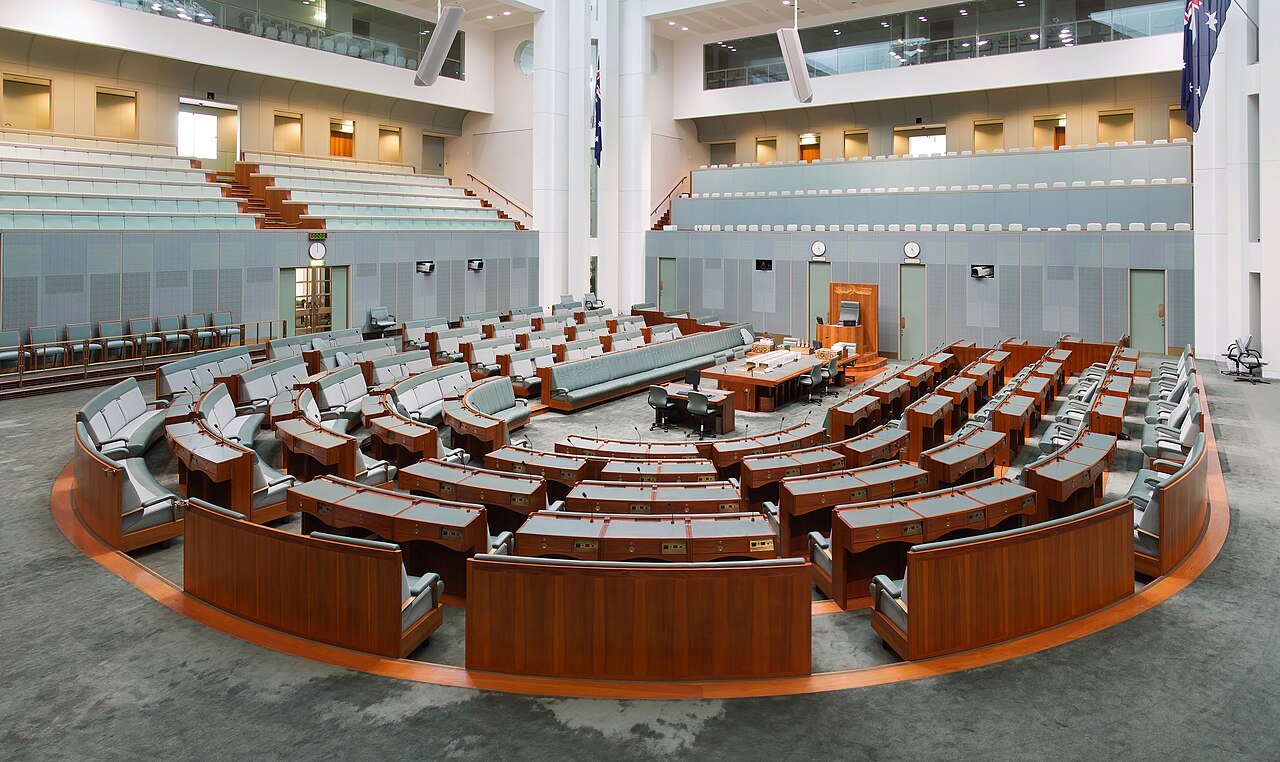

*Via Wikimedia Commons: [Australian House of Representatives - Parliament of Australia](https://commons.wikimedia.org/wiki/File:Australian_House_of_Representatives_-_Parliament_of_Australia.jpg) by JJ Harrison ( https://www.jjharrison.com.au/ ), [CC BY-SA 3.0](https://creativecommons.org/licenses/by-sa/3.0).*
## Economy
Output was about 1.8 trillion US dollars in 2025, or about 65,000 dollars per person.[3] In the June quarter of 2026 the economy grew 0.4 per cent, and 2.1 per cent over the year.[15]
Service industries, including tourism, education and financial services, account for a large share of activity. The country is rich in coal, copper, natural gas and mineral sands. Its main exports are coal, iron ore, natural gas, education and tourism, and its largest trading partners include China, Japan, the United States and South Korea.[7]
## Culture
Writers such as Henry Lawson and Miles Franklin wrote about the bush, and Banjo Paterson wrote the words of "Waltzing Matilda".[7] Nellie Melba, a soprano, was the first Australian singer to win international fame.[7] The best-known visual art includes Indigenous painting and the late nineteenth-century bush scenes of painters such as Tom Roberts. The novelist Patrick White won the Nobel Prize in Literature in 1973.[7] The Sydney Opera House is on the World Heritage List.[7]
Sport is a large part of national life, including cricket, whose contests with England date from the late nineteenth century, the football codes, among them Australian Rules, and swimming and tennis. The Melbourne Cup horse race was first run in 1861.[7]
## Science and inventions
Australian Nobel laureates include the physiologist John Eccles, the immunologist Peter Doherty, Barry Marshall and Robin Warren, who showed the role of a bacterium in stomach ulcers, the biologist Elizabeth Blackburn and the astronomer Brian Schmidt, honoured for the discovery that the universe's expansion is accelerating.[7] In remote areas, the Royal Flying Doctor Service, begun in 1928, brought medical care by air, and the School of the Air taught children by two-way radio.[7]
## What's unsettled
At the end of the parliamentary year on 27 November 2026, Albanese acknowledged that the government had not got everything right and defended its stability, amid pressure over the cost of living, with the One Nation party emerging as a challenge to both Labor and the Coalition opposition.[16]
## See also
- [United Kingdom](https://micwyn.com/t/3571/united-kingdom)
- [Canada](https://micwyn.com/t/3568/canada)
- [World War I](https://micwyn.com/t/2882/world-war-i)
- [World War II](https://micwyn.com/t/2855/world-war-ii)
- [Elizabeth II](https://micwyn.com/t/3294/elizabeth-ii)
## Sources
1. Department of Home Affairs. "Australian Citizenship: Our Common Bond" (testable section). https://immi.homeaffairs.gov.au/citizenship-subsite/files/our-common-bond-testable.pdf
2. Parliamentary Education Office. "Australian system of government". https://peo.gov.au/understand-our-parliament/how-parliament-works/system-of-government/australian-system-of-government
3. World Bank. World Development Indicators: capital, urban share, life expectancy, age and GDP for Australia. https://api.worldbank.org/v2/country/AUS?format=json
4. CNN. "Australia election results: Anthony Albanese's Labor Party retains power". 3 May 2025. https://edition.cnn.com/2025/05/03/australia/australia-election-results-albanese-dutton-intl-hnk
5. Geoscience Australia. "How large is Australia?". https://www.ga.gov.au/scientific-topics/national-location-information/dimensions/area-of-australia-states-and-territories
6. Australian Bureau of Statistics. "National, state and territory population, March 2026". https://www.abs.gov.au/statistics/people/population/national-state-and-territory-population/latest-release
7. Department of Home Affairs. "Australian Citizenship: Our Common Bond" (non-testable section). https://immi.homeaffairs.gov.au/citizenship-subsite/files/our-common-bond-non-testable.pdf
8. HISTORY. "British settlement begins in Australia". https://www.history.com/this-day-in-history/january-26/australia-day
9. Parliamentary Education Office. "Federation". https://peo.gov.au/understand-our-parliament/history-of-parliament/federation/federation
10. Australian War Memorial. "First World War 1914-18". https://www.awm.gov.au/articles/atwar/first-world-war
11. Australian War Memorial. "Gallipoli". https://www.awm.gov.au/articles/encyclopedia/gallipoli
12. U.S. Department of State, Office of the Historian. "Australia". https://history.state.gov/countries/australia
13. Parliamentary Education Office. "Apology to the Stolen Generations". https://peo.gov.au/understand-our-parliament/history-of-parliament/history-milestones/australian-parliament-history-timeline/events/apology-to-the-stolen-generations
14. CNN. "Australians vote No in referendum that promised change for First Nations people". 14 October 2023. https://www.cnn.com/2023/10/14/australia/australia-referendum-results-intl-hnk/index.html
15. Australian Bureau of Statistics. "Australian National Accounts: National Income, Expenditure and Product, June 2026". https://www.abs.gov.au/statistics/economy/national-accounts/australian-national-accounts-national-income-expenditure-and-product/latest-release
16. ABC News. "Federal politics: PM concedes government doesn't 'get everything right' as political year wraps". 27 November 2026. https://www.abc.net.au/news/2026-11-27/federal-politics-live-blog-november-27/107431796
