Compare versions
Version 1 → Version 3 (current). Removed · Added. This shows the entry's text as it is written, including its formatting marks.
Version 1 · Version 3 (current) · Version history
Side by side · Together
Proof of work is a method of showing that a computer spent a measurable amount of effort on a task, in a form that anyone else can check almost instantly; Bitcoin uses it to decide which block of transactions is added to its shared record.
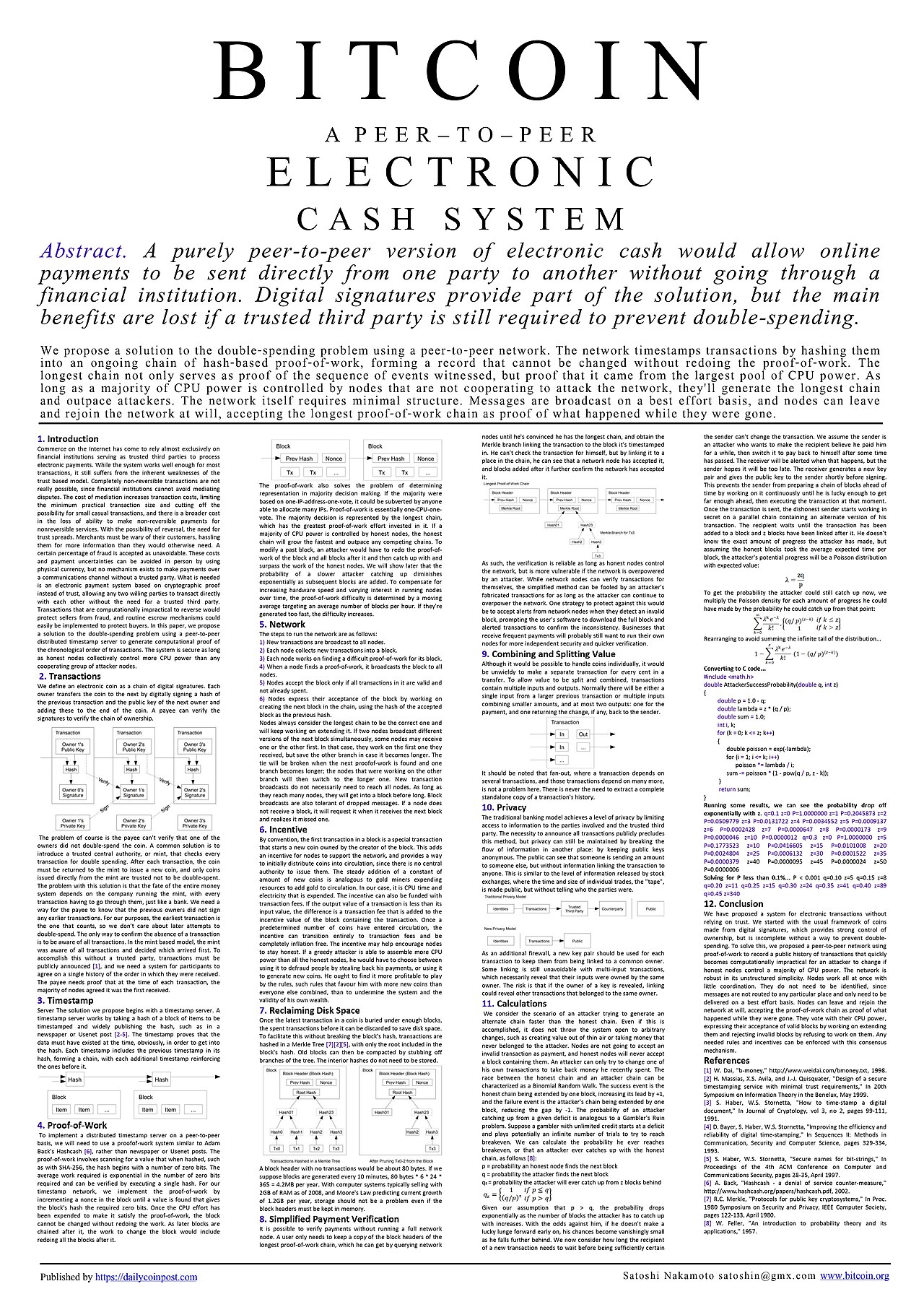
*Via Wikimedia Commons: [Bitcoin-whitepaper-poster page-0001](https://commons.wikimedia.org/wiki/File:Bitcoin-whitepaper-poster_page-0001.jpg) by Satoshi Nakamoto, [CC0](http://creativecommons.org/publicdomain/zero/1.0/deed.en).*
## The idea
A proof-of-work system rests on a "cost function": a calculation that is cheap to verify but can be made expensive to carry out, with the expense set by an adjustable parameter.[2] Adam Back's 2002 paper on Hashcash, which gathers the work done on the idea, describes the person who must do the work as computing a "token" and the server as checking it, and compares making the token to minting money.[2] Because the best way to find a valid token is to start from a random value and keep trying, the time any one attempt takes is unpredictable, even though the average effort is known.[2]
Hashcash's cost function looks for a "partial hash collision": a value whose cryptographic hash begins with a chosen number of zero bits.[2] Bitcoin's whitepaper describes the same family of puzzle: scanning for a value that, when hashed with SHA-256, gives a hash starting with a required number of zero bits. The average work needed grows exponentially with the number of zero bits, yet checking an answer takes a single hash.[1]
## Origins: fighting junk mail and denial of service
Back wrote that Hashcash was first proposed in May 1997 to throttle systematic abuse of free internet resources such as email and anonymous remailers.[2] He added that when he published, he was unaware of earlier work by Cynthia Dwork and Moni Naor, who had proposed a processing-based "pricing function" to combat junk email.[2] The 2002 paper also covers using such puzzles to resist denial-of-service attacks, in which an attacker floods a server with connection requests.[2] The same paper mentions a proposal by Markus Jakobsson and Ari Juels to make the work serve a second, otherwise useful purpose.[2]
## Dwork and Naor's pricing functions (1992)
The idea of making a requester pay in computation before gaining access to a resource predates Hashcash. Cynthia Dwork and Moni Naor presented "Pricing via Processing or Combatting Junk Mail" at CRYPTO '92, the 12th annual International Cryptology Conference, held in Santa Barbara in August 1992.[5][6] The abstract describes a technique for combating junk mail and, more generally, for controlling access to a shared resource.[5] Its main idea is to require a user to compute a moderately hard, but not intractable, function in order to gain access to the resource, which prevents frivolous use.[5] The authors suggested several such "pricing functions", based on extracting square roots modulo a prime, on the Fiat-Shamir signature scheme, and on the Ong-Schnorr-Shamir signature scheme, which the abstract describes as "cracked".[5] The paper appears on pages 139 to 147 of volume 740 of Springer's Lecture Notes in Computer Science.[6]
## Use in Bitcoin
Bitcoin's whitepaper says a peer-to-peer timestamp network needs a proof-of-work system "similar to Adam Back's Hashcash".[1] In Bitcoin, a miner increments a number called a nonce in the block until the block's hash has the required zero bits; once that effort is spent, the block cannot be changed without redoing the work, and changing an older block would mean redoing every block after it.[1]
The whitepaper also presents proof of work as a way to decide who counts in a majority vote. Voting by IP address could be subverted by anyone able to allocate many addresses, so it describes proof of work as "essentially one-CPU-one-vote": the longest chain is the one with the most work invested in it, and it wins if honest nodes control a majority of the computing power.[1]
Bitcoin's developer documentation gives the mechanism in more detail. A block's proof of work is a hash of its 80-byte header that must not exceed a target value; a lower target means more attempts are needed on average.[3] Only the header is hashed, so including more transactions does not slow the hashing.[3] The documentation explains that the cost of altering a block rises with every block added after it.[3]
## Difficulty adjustment
To compensate for faster hardware and changing numbers of participants, the whitepaper says the difficulty is set by a moving average aimed at a target number of blocks per hour, rising if blocks come too fast.[1] The developer documentation states the rule as implemented: every 2,016 blocks the network compares the time the last 2,016 blocks took with an ideal of 1,209,600 seconds (two weeks), and raises or lowers the difficulty in proportion, by at most 300% upward and 75% downward.[3] It also notes that an off-by-one error in Bitcoin Core makes the calculation use timestamps from only 2,015 of those blocks.[3] See also [Bitcoin halving](/t/3482/bitcoin-halving).
## Cost, incentives and attacks
The whitepaper compares the effort miners spend to gold miners using resources to add gold to circulation: here the resources are CPU time and electricity, and each block's creator receives newly created coins and transaction fees.[1] It argues that an attacker who could gather more computing power than all honest nodes would do better to follow the rules and earn those rewards than to undermine the system.[1] The developer documentation notes that a "51 percent attack" on transaction history requires a majority of the network's hashing power, though it adds that even less than half may have a good chance of success.[3]
## Energy use and how it is estimated
Because proof of work spends electricity by design, the question of how much it uses is a standing topic. The Cambridge Bitcoin Electricity Consumption Index (CBECI), maintained by the Cambridge Centre for Alternative Finance, does not measure consumption directly: it estimates Bitcoin's electricity demand, reporting network power in gigawatts, updated every 24 hours, and an annualised figure in terawatt-hours.[7] As of 28 November 2026 its methodology page describes a hybrid top-down approach, originally developed by Marc Bevand, that assumes miners are rational and run only hardware that is profitable.[7] Its inputs are the network's mean hashrate, the block subsidy and transaction fees in US dollars, the efficiency of mining equipment in joules per terahash, an assumed electricity price of USD 0.05 per kilowatt-hour, and a power usage effectiveness (PUE) figure, the ratio of a data centre's total energy use to that used by its computing equipment.[7]
The index gives three values. A lower bound assumes every miner uses the most efficient hardware and a PUE of 1.01, which the page itself calls "purely hypothetical"; an upper bound assumes the least efficient profitable hardware and a PUE of 1.20; and a best guess uses a weighted basket of profitable hardware and a PUE of 1.10.[7] The page lists its own limitations: results depend heavily on the assumed electricity cost, the true hardware mix is unknown, and proprietary manufacturer hardware may be unaccounted for.[7]
## Alternatives
Proof of work is not the only way to agree on a shared record. Ethereum used it until 15 September 2022, when an upgrade called the Merge replaced it with proof of stake; ethereum.org states that this reduced the network's energy consumption by about 99.95%.[4]
## Sources
1. Satoshi Nakamoto, "Bitcoin: A Peer-to-Peer Electronic Cash System" (whitepaper), bitcoin.org. https://bitcoin.org/bitcoin.pdf
2. Adam Back, "Hashcash - A Denial of Service Counter-Measure", 1 August 2002. http://www.hashcash.org/papers/hashcash.pdf
3. Bitcoin Developer Guide, "Block Chain: Proof Of Work", developer.bitcoin.org. https://developer.bitcoin.org/devguide/block_chain.html
4. "The Merge", ethereum.org (page last updated 29 October 2026). https://ethereum.org/en/roadmap/merge/
5. Cynthia Dwork and Moni Naor, "Pricing via Processing or Combatting Junk Mail", CRYPTO '92, August 1992 (Microsoft Research publication page). https://www.microsoft.com/en-us/research/publication/pricing-via-processing-or-combatting-junk-mail/
6. Cynthia Dwork and Moni Naor, "Pricing via Processing or Combatting Junk Mail", Advances in Cryptology - CRYPTO '92, Lecture Notes in Computer Science 740, Springer, 1992, pp. 139-147 (IACR CryptoDB record). https://iacr.org/cryptodb/data/paper.php?pubkey=1268
7. Cambridge Centre for Alternative Finance, "Cambridge Bitcoin Electricity Consumption Index: Methodology" (opened 28 November 2026). https://ccaf.io/cbnsi/cbeci/methodology
