Version 2 (current)
Nov 28, 2026. Version history
Steve Jobs (1955–2011) was an American businessman who co-founded Apple Computer, now Apple Inc., founded the computer company NeXT, controlled the animation studio Pixar, and was a pioneer of the personal computer era.[1]
Early life
Steven Paul Jobs was born on 24 February 1955 in San Francisco, California.[1] He was adopted as an infant.[2] His adoptive parents were Paul and Clara Jobs.[3] He was raised in the part of California now known as Silicon Valley.[1] In 1968 the family moved into a house on Crist Drive in Los Altos, according to the Associated Press.[4] He attended Homestead High School in Cupertino and, as a student, went to after-school lectures at the Hewlett-Packard company in Palo Alto.[3]
Jobs enrolled at Reed College in Portland, Oregon, and dropped out.[1] In his 2005 Stanford commencement address he said that he left because the cost was using up his parents' savings, and that he then sat in on classes that interested him, including calligraphy, which a decade later shaped the typefaces of the first Macintosh.[5] In early 1974 he took a job designing video games at Atari, and he saved enough money for a pilgrimage to India to experience Buddhism.[1] Back in California in the autumn of 1974, he renewed his friendship with Stephen Wozniak, a former high school friend who was working at Hewlett-Packard.[1]
Founding Apple
On 1 April 1976, Jobs, Wozniak and Ronald Wayne founded Apple Computer Company as a partnership.[3] Jobs persuaded Wozniak to start a company to sell a computer Wozniak had designed, and the first product, the Apple I, followed in July 1976.[3] Britannica reports that the Apple I was built in the Jobs family garage, paid for by selling Jobs's Volkswagen minibus and Wozniak's programmable calculator.[1] The Associated Press reported that the first Apple I computers were built at the Crist Drive house and that 50 were sold to a shop in Mountain View.[4]

Via Wikimedia Commons: Apple Garage by Mathieu Thouvenin, CC BY-SA 2.0.
The Apple II, completed in 1977, came with a keyboard and a moulded plastic case, and Apple Computer was incorporated the same year.[1] The Apple II went on sale in June 1977; a Smithsonian curator described it as Apple's "first big seller" and one of the first computers able to run a spreadsheet program.[6] Britannica's summary dates Apple's change into a public corporation to 1980, when Jobs became its chairman, and the Centre for Computing History gives 12 December 1980 as the day Apple's shares first traded.[2][3] In 1983 Apple became the quickest company up to that time to enter the Fortune 500 list of the largest United States companies, and in the same year Jobs recruited John Sculley, president of PepsiCo, as chief executive.[1]
The Lisa, the Macintosh and the 1985 departure
In 1979 Jobs led a group of Apple engineers to a demonstration at Xerox's Palo Alto Research Center (PARC).[1] He left the engineering team of the Lisa computer to lead a project for a lower-cost machine, which became the Macintosh.[1] The Lisa was released in 1983 and, according to the Smithsonian, was too expensive to succeed, although it pioneered ideas that the Macintosh later made affordable.[6]
Jobs introduced the Macintosh in a widely publicised demonstration in January 1984.[1] It brought the graphical user interface, a way of operating a computer by pointing at icons and menus on screen with a mouse instead of typing commands, to a broad public, and that approach became an industry standard.[2][6]
Accounts of how Jobs left Apple differ in emphasis. Britannica writes that in 1985 Sculley convinced Apple's board of directors to remove Jobs.[1] The Smithsonian describes a battle between Jobs and Sculley for control of the company, after which Jobs left.[6] Britannica's summary refers to management conflicts.[2] The Centre for Computing History dates his departure to 17 September 1985 and says he sold all but one of his Apple shares.[3] Jobs himself told Stanford graduates in 2005 that being fired from Apple was "the best thing that could have ever happened" to him.[5]
NeXT and Pixar
Soon after leaving Apple, Jobs founded NeXT Inc., which designed powerful workstation computers for the education market, with funding partners that included Ross Perot and Canon Inc.[1] The NeXT computer was introduced in 1988.[3] In the early 1990s the company turned its focus to its NEXTSTEP software system.[1]
In 1986 Jobs funded the spin-out of the Graphics Group from the computer graphics division of Lucasfilm; the group became Pixar.[3] Britannica describes this as his acquiring a controlling interest in Pixar.[1] In 1995 Pixar released Toy Story, the first full-length feature film made entirely with computer animation, and Pixar's public stock offering the same year made Jobs a billionaire.[1]
In January 2006, the Walt Disney Company agreed to buy Pixar in a stock deal valued at $7.4 billion.[8] CNN reported that, under the deal, Jobs would join Disney's board and become Disney's largest individual shareholder.[8]
Return to Apple
By late 1996 Apple was losing large sums of money and had hired Gilbert Amelio as chief executive.[7] Amelio chose NeXT's NEXTSTEP software as the basis for a replacement for the ageing Macintosh operating system, bought NeXT for more than $400 million and brought Jobs back as a consultant.[7] The Centre for Computing History records that the purchase was announced on 20 December 1996 and completed on 7 February 1997, with Apple paying $427 million in cash and stock.[9] In June 1997 Apple's board asked Jobs to lead the company again.[7] He served first as interim chief executive and took the post permanently in 2000.[9]
Britannica writes that Jobs formed an alliance with Microsoft, ended Amelio's agreements allowing other companies to make Macintosh clones, simplified the product line and ran an advertising campaign urging customers to "think different".[7] The iMac, announced on 6 May 1998, was by the end of that year the top-selling personal computer in the United States, and Apple reported steady profits.[3][7]
The iPod, iPhone and iPad
In 2001 Apple introduced the iTunes music software and, later that year, the iPod portable music player; the Centre for Computing History dates the iPod's launch to 23 October 2001.[7][3] From 2003 Apple sold downloadable songs from the major record labels, and by 2006 more than one billion songs and videos had been sold through the iTunes Store.[7] On 9 January 2007 the company changed its name to Apple Inc., and later that year it launched the touch-screen iPhone.[7]
Apple opened its App Store, an online shop for applications ("apps", programs made by Apple and other developers that run on the phone), in July 2008.[10] On 14 July 2008 Apple reported that users of the iPhone and iPod touch had downloaded more than 10 million applications since the store opened late the previous week, and quoted Jobs calling it "a grand slam".[10] Apple released the iPad tablet computer in 2010.[2] The Centre for Computing History records that on 26 May 2010 Apple overtook Microsoft as the world's most valuable technology company.[3]
Stanford commencement address
On a Sunday in June 2005, Jobs, then 50, gave the main address at Stanford University's 114th Commencement in Stanford Stadium, before a crowd that Stanford put at about 23,000.[5] Stanford News reported that he spoke about his adoption, his removal from Apple in 1985 and his cancer diagnosis, and urged graduates not to waste their time living someone else's life.[5] He told them that they could connect the dots of their lives only by looking backwards, and the university's report of the speech was headlined with his words "Stay hungry, stay foolish".[5]
Illness and resignation
On 1 August 2004 Jobs told Apple employees, in an e-mail reported by the Associated Press, that he had undergone surgery to remove a cancerous tumour from his pancreas.[11] He said it was an islet cell neuroendocrine tumour, a rare form that can be cured by surgery if found early, as his had been, and that it was not the far more common and deadly adenocarcinoma.[11] He took August off to recover, and Tim Cook, then executive vice president for worldwide sales and operations, ran the company in his absence.[11]
On 5 January 2009, after months of public speculation about his weight loss, Jobs wrote in a letter published by Apple that doctors had found a hormone imbalance and that he would continue as chief executive while being treated.[12] Within about a week he announced a medical leave lasting until the end of June.[7] On 23 June 2009, with his permission, the Methodist University Hospital Transplant Institute in Memphis, Tennessee, confirmed that he had received a liver transplant there, stating that he had been the sickest patient on the waiting list when a donor organ became available and that he had an excellent prognosis.[13] He returned to work on 29 June 2009, and in January 2011 he took another medical leave.[7]
On 24 August 2011 Jobs wrote to Apple's board and the Apple community that the day had come when he could no longer meet his duties as chief executive.[14] He resigned, asked to stay on as chairman, director and employee, and recommended that the board follow its succession plan and name Tim Cook as chief executive.[14] He became chairman.[7]
Death
Jobs died on 5 October 2011 in Palo Alto, California, at the age of 56.[1][16] Apple's board of directors announced his death the same day, crediting him with countless innovations and expressing sympathy to his wife, Laurene, and his family.[15] The Associated Press reported that his death certificate, released on 10 October 2011 by the Santa Clara County Public Health Department, listed respiratory arrest resulting from pancreatic cancer that had spread to other organs, that he died at home, and that no autopsy was performed.[16] He died the day after Apple announced a new iPhone model.[16]
Stock option review
In 2006 a special committee of Apple's outside directors investigated the company's past grants of stock options, which give employees the right to buy shares later at a set price.[17] Apple reported on 4 October 2006 that grants made on 15 dates between 1997 and 2002 appeared to carry grant dates earlier than their approval, and that in a few instances Jobs had known that favourable grant dates were selected but had not received or otherwise benefited from those grants and had not been aware of the accounting consequences.[17] The committee found no misconduct by any member of Apple's management at that time, and Jobs apologised to shareholders and employees, saying the problems had happened on his watch.[17]
Legacy and recognition
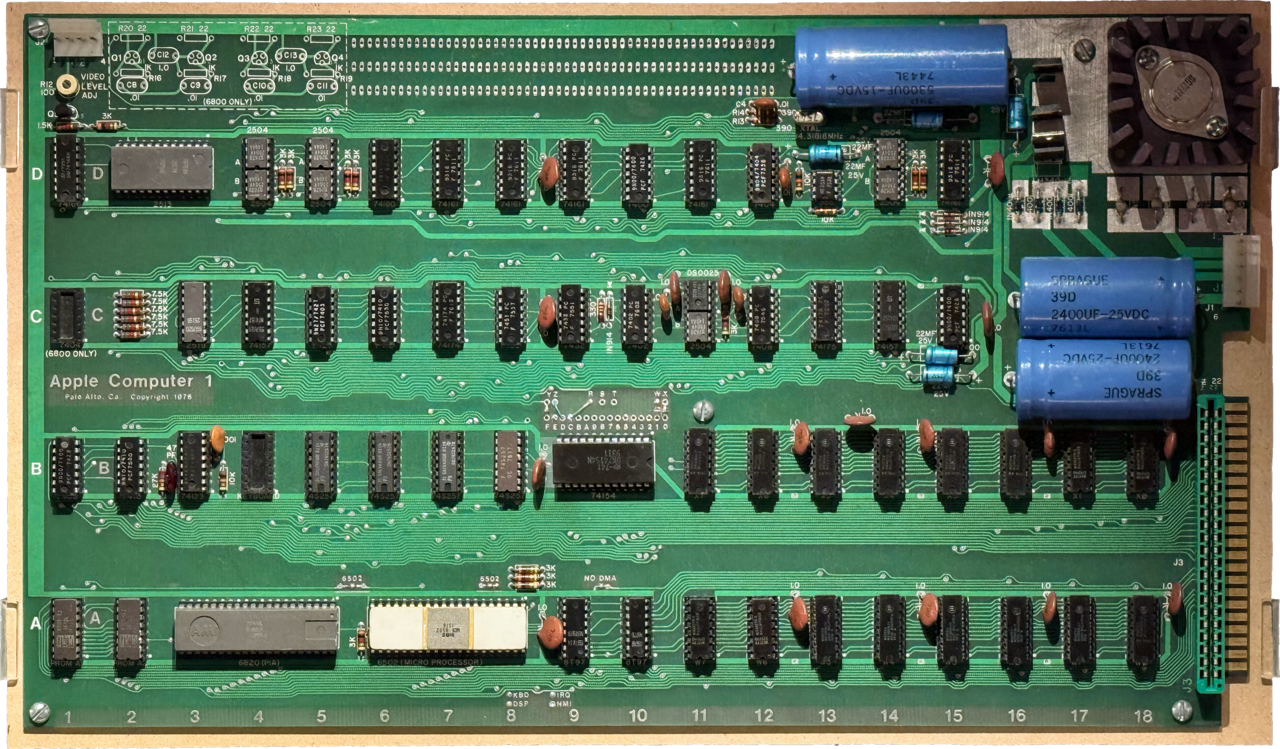
Via Wikimedia Commons: Apple Computer 1 (Apple I) from Smithsonian National Museum of America by Blakespot, CC0.
Under Jobs's leadership Apple became an industry leader and one of the world's most valuable companies, according to Britannica.[2] A Smithsonian curator observed that his products were often neither the cheapest nor always the most technically advanced, but were highly desirable, and noted that Jobs had received a Computerworld Smithsonian Award in 1995.[6] The National Museum of American History holds several Apple products in its permanent collection.[6]
In October 2013 the Los Altos historical commission voted unanimously to designate the Crist Drive house, where the first Apple I computers were built, a historic resource, the Associated Press reported.[4]
In April 2011 PCWorld reported that the publisher Simon & Schuster would bring out the first authorised biography of Jobs, written by Walter Isaacson with Jobs's cooperation.[19] It was published in 2011.[7] On 7 July 2022 President Joe Biden awarded Jobs the Presidential Medal of Freedom, the highest civilian honour in the United States, posthumously, at a White House ceremony for 17 recipients.[18][1]
Sources
- Encyclopaedia Britannica (Britannica Money). "Steve Jobs." Encyclopaedia Britannica. No date shown; accessed 28 November 2026. britannica.com/money/Steve-Jobs
- Encyclopaedia Britannica. "Steve Jobs summary." Encyclopaedia Britannica. No date shown; accessed 28 November 2026. britannica.com/summary/Steve-Jobs
- Centre for Computing History. "Steve Jobs." Centre for Computing History, Cambridge. No date shown; accessed 28 November 2026. computinghistory.org.uk/det/926/Steve-Jobs/
- Associated Press. "Home where Steve Jobs built Apple gets historic designation." Global News. 30 October 2013. globalnews.ca/news/931891/home-where-steve-jobs-built-apple-gets-hi…
- Stanford News. "Steve Jobs to 2005 graduates: 'Stay hungry, stay foolish'." Stanford University. June 2005. news.stanford.edu/2005/06/14/jobs-061505/
- Smithsonian Magazine. "The Many Contributions of Steve Jobs (1955-2011)." Smithsonian Institution. No date shown; accessed 28 November 2026. smithsonianmag.com/smithsonian-institution/the-many-contributions-o…
- Encyclopaedia Britannica (Britannica Money). "Steve Jobs: Saving Apple" (sections Saving Apple, Reinventing Apple, Health issues). Encyclopaedia Britannica. No date shown; accessed 28 November 2026. britannica.com/money/Steve-Jobs/Saving-Apple
- CNNMoney. "Disney buys Pixar." CNN. 24 January 2006. money.cnn.com/2006/01/24/news/companies/disney_pixar_deal/?iid=EL
- Centre for Computing History. "Apple buys NeXT, and Steve Jobs returns." Centre for Computing History, Cambridge. No date shown; accessed 28 November 2026. computinghistory.org.uk/det/5547/Apple-buys-NeXT-and-Steve-Jobs-ret…
- Apple. "iPhone App Store Downloads Top 10 Million in First Weekend." Apple Newsroom. 14 July 2008. apple.com/newsroom/2008/07/14iPhone-App-Store-Downloads-Top-10-Mill…
- Associated Press. "Apple CEO Steve Jobs Undergoes Surgery to Remove Cancerous Tumor." eWeek. 1 August 2004. eweek.com/apple/apple-ceo-steve-jobs-undergoes-surgery-to-remove-ca…
- Steve Jobs. "Letter from Apple CEO Steve Jobs." Apple Newsroom. 5 January 2009. apple.com/newsroom/2009/01/05Letter-from-Apple-CEO-Steve-Jobs/
- CBS News. "Hospital Confirms Jobs' Liver Transplant." CBS News. 23 June 2009. cbsnews.com/news/hospital-confirms-jobs-liver-transplant
- Steve Jobs. "Letter from Steve Jobs." Apple Newsroom. 24 August 2011. apple.com/newsroom/2011/08/24Letter-from-Steve-Jobs/
- Apple. "Statement by Apple's Board of Directors." Apple Newsroom. 5 October 2011. apple.com/newsroom/2011/10/05Statement-by-Apples-Board-of-Directors/
- Associated Press. "Steve Jobs' death caused by respiratory arrest, cancer." MPR News. 10 October 2011. mprnews.org/story/2011/10/10/steve-jobs-death-respiratory-arrest-ca…
- Apple. "Apple's Special Committee Reports Findings of Stock Option Investigation." Apple Newsroom. 4 October 2006. apple.com/newsroom/2006/10/04Apples-Special-Committee-Reports-Findi…
- Eugene Scott and Matt Viser (The Washington Post). "Biden honors 17 people with Presidential Medal of Freedom." The Spokesman-Review. 7 July 2022. spokesman.com/stories/2022/jul/07/biden-honors-17-people-with-presi…
- Sarah Jacobsson Purewal. "Official Steve Jobs Bio Dropping Early 2012." PCWorld. 11 April 2011. pcworld.com/article/490327/official_steve_jobs_bio_dropping_early_2…
