Compare versions
Version 1 → Version 2 (current). Removed · Added. This shows the entry's text as it is written, including its formatting marks.
Version 1 · Version 2 (current) · Version history
Side by side · Together
Version 1Version 2 (current)
31 unchanged paragraphs
Manchester United Football Club is a professional men's football club based in Manchester, England, founded in 1878 as Newton Heath LYR and playing at Old Trafford since 1910.[1][2]
Manchester United Football Club is a professional men's football club based in Manchester, England, founded in 1878 as Newton Heath LYR and playing at Old Trafford since 1910.[1][2]
## Founding and early years
## Founding and early years
The club was formed in 1878 under the name Newton Heath LYR, a team of railway workers.[2] Britannica describes it as one of the richest and best-supported football clubs in the world, nicknamed "the Red Devils" after its red shirts.[1] Newton Heath joined the Football League in 1892, was relegated after two seasons and then ran into financial trouble.[2] According to the club's own history, the brewery owner John Henry Davies rescued it, and it was renamed Manchester United in 1902.[2]
The club was formed in 1878 under the name Newton Heath LYR, a team of railway workers.[2] Britannica describes it as one of the richest and best-supported football clubs in the world, nicknamed "the Red Devils" after its red shirts.[1] Newton Heath joined the Football League in 1892, was relegated after two seasons and then ran into financial trouble.[2] According to the club's own history, the brewery owner John Henry Davies rescued it, and it was renamed Manchester United in 1902.[2]
Ernest Mangnall, whom the club's history describes as widely seen as its first manager, arrived in 1903 and built a stronger side.[2] He signed the winger Billy Meredith from Manchester City, and United won the Football League title for the first time in 1907-08, followed by the 1908 Charity Shield and the 1909 FA Cup, in which they beat Bristol City 1-0 in the final.[2] The club's list of honours records a second league title in 1911.[3]
Ernest Mangnall, whom the club's history describes as widely seen as its first manager, arrived in 1903 and built a stronger side.[2] He signed the winger Billy Meredith from Manchester City, and United won the Football League title for the first time in 1907-08, followed by the 1908 Charity Shield and the 1909 FA Cup, in which they beat Bristol City 1-0 in the final.[2] The club's list of honours records a second league title in 1911.[3]
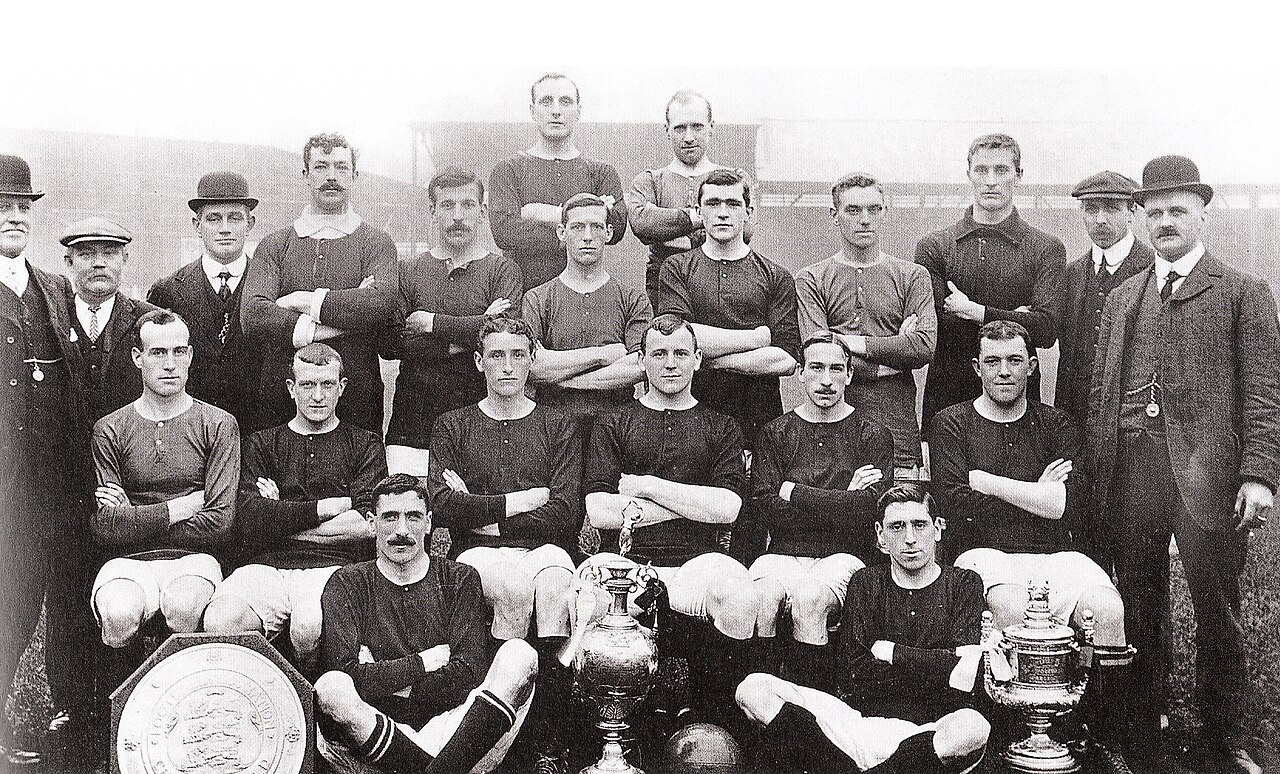

*Via Wikimedia Commons: [Manchester United 1908-09](https://commons.wikimedia.org/wiki/File:Manchester_United_1908-09.jpg) by Unknown author Unknown author, public domain.*
*Via Wikimedia Commons: [Manchester United 1908-09](https://commons.wikimedia.org/wiki/File:Manchester_United_1908-09.jpg) by Unknown author Unknown author, public domain.*
## Grounds
## Grounds
### North Road, Bank Street and Old Trafford
### North Road, Bank Street and Old Trafford
United's first ground was at North Road, and the club later moved to Bank Street in Clayton, where the state of the pitch and fumes from nearby factories were problems, according to a 2016 history published by FIFA, world football's governing body.[4] The chairman, John Henry Davies, pressed for a better ground, and the first match at Old Trafford was played against Liverpool on 19 February 1910.[4] Britannica records that the club has played there ever since.[1]
United's first ground was at North Road, and the club later moved to Bank Street in Clayton, where the state of the pitch and fumes from nearby factories were problems, according to a 2016 history published by FIFA, world football's governing body.[4] The chairman, John Henry Davies, pressed for a better ground, and the first match at Old Trafford was played against Liverpool on 19 February 1910.[4] Britannica records that the club has played there ever since.[1]
During the Second World War the stadium was requisitioned by the Army and was bombed on 22 December 1940 and again on 11 March 1941; the second raid destroyed most of the ground, including the main stand on the south side.[4] United played their home matches at Maine Road, the ground of their neighbours Manchester City, and ran up debts of £15,000 in rent before Old Trafford reopened in 1949.[4] Rebuilding went on in stages, with floodlights added in 1959 and a new North Stand in 1965.[4] FIFA's 2016 article gave the capacity as 75,957 and noted that the conversion to an all-seater stadium after the 1990 Taylor Report, an official inquiry into stadium safety, had at one stage cut it to about 44,000.[4] The same article attributes the stadium's nickname, the "Theatre of Dreams", to the former United player Bobby Charlton.[4]
During the Second World War the stadium was requisitioned by the Army and was bombed on 22 December 1940 and again on 11 March 1941; the second raid destroyed most of the ground, including the main stand on the south side.[4] United played their home matches at Maine Road, the ground of their neighbours Manchester City, and ran up debts of £15,000 in rent before Old Trafford reopened in 1949.[4] Rebuilding went on in stages, with floodlights added in 1959 and a new North Stand in 1965.[4] FIFA's 2016 article gave the capacity as 75,957 and noted that the conversion to an all-seater stadium after the 1990 Taylor Report, an official inquiry into stadium safety, had at one stage cut it to about 44,000.[4] The same article attributes the stadium's nickname, the "Theatre of Dreams", to the former United player Bobby Charlton.[4]
### Plans for a new stadium
### Plans for a new stadium
On 11 March 2025 the club announced plans to build a new 100,000-seat stadium next to the existing Old Trafford site, as part of a wider regeneration of the area, theScore reported.[5] The design is by the architects Foster + Partners, the cost was reported at £2 billion, and the club said it hoped to complete the project in five years, though no construction start date or funding arrangement had been announced at that time.[5] In its annual results of 23 September 2026, the club reported that it had secured the land required for the new stadium and had spent £63.5 million during the year on acquiring it.[6] Neither source gives a date for the start of construction.[5][6]
On 11 March 2025 the club announced plans to build a new 100,000-seat stadium next to the existing Old Trafford site, as part of a wider regeneration of the area, theScore reported.[5] The design is by the architects Foster + Partners, the cost was reported at £2 billion, and the club said it hoped to complete the project in five years, though no construction start date or funding arrangement had been announced at that time.[5] In its annual results of 23 September 2026, the club reported that it had secured the land required for the new stadium and had spent £63.5 million during the year on acquiring it.[6] Neither source gives a date for the start of construction.[5][6]
## Major eras and managers
## Major eras and managers
### Matt Busby
### Matt Busby
Matt Busby was appointed manager in 1945 and guided the club over the next 24 years, according to Britannica, which credits him with five English league titles and two FA Cups.[1] The club's list of honours shows league titles in 1952, 1956, 1957, 1965 and 1967.[3] Busby's team of 1958 was broken up by the Munich air disaster (see below), and he rebuilt it during the 1960s.[1][7]
Matt Busby was appointed manager in 1945 and guided the club over the next 24 years, according to Britannica, which credits him with five English league titles and two FA Cups.[1] The club's list of honours shows league titles in 1952, 1956, 1957, 1965 and 1967.[3] Busby's team of 1958 was broken up by the Munich air disaster (see below), and he rebuilt it during the 1960s.[1][7]
On 29 May 1968, at Wembley, United beat the Portuguese champions Benfica 4-1 after extra time to win the European Cup, the competition that later became the UEFA Champions League.[7] The score was 1-1 after 90 minutes; Bobby Charlton, a survivor of the Munich crash, scored twice, and George Best and Brian Kidd, on his 19th birthday, scored the others.[7][17] Britannica and The Irish Times both record that United were the first English club to win the trophy.[1][7]
On 29 May 1968, at Wembley, United beat the Portuguese champions Benfica 4-1 after extra time to win the European Cup, the competition that later became the UEFA Champions League.[7] The score was 1-1 after 90 minutes; Bobby Charlton, a survivor of the Munich crash, scored twice, and George Best and Brian Kidd, on his 19th birthday, scored the others.[7][17] Britannica and The Irish Times both record that United were the first English club to win the trophy.[1][7]
### Alex Ferguson, 1986 to 2013
### Alex Ferguson, 1986 to 2013
Alex Ferguson, who had previously coached Aberdeen, managed the club from 1986 to 2013.[1] The club's list of honours records 13 league titles between 1993 and 2013, beginning with the title of 1992-93, the first season of the [Premier League](https://micwyn.com/t/3611/premier-league).[3] ESPN counts all 13 as won under Ferguson.[8] In 1998-99 the club won the league, the FA Cup and the Champions League in the same season, which Britannica calls the first "treble" in English football history.[1] A second Champions League followed in 2007-08.[1] According to ESPN's statistical summary, Ferguson won 38 trophies with United, among them 13 English league titles, five FA Cups, four League Cups and two Champions Leagues, in 1,500 matches; his last match in charge was on 19 May 2013.[8]
Alex Ferguson, who had previously coached Aberdeen, managed the club from 1986 to 2013.[1] The club's list of honours records 13 league titles between 1993 and 2013, beginning with the title of 1992-93, the first season of the [Premier League](https://micwyn.com/t/3611/premier-league).[3] ESPN counts all 13 as won under Ferguson.[8] In 1998-99 the club won the league, the FA Cup and the Champions League in the same season, which Britannica calls the first "treble" in English football history.[1] A second Champions League followed in 2007-08.[1] According to ESPN's statistical summary, Ferguson won 38 trophies with United, among them 13 English league titles, five FA Cups, four League Cups and two Champions Leagues, in 1,500 matches; his last match in charge was on 19 May 2013.[8]
### After Ferguson
### After Ferguson
A list of the club's managers since 2013, published by the Indian newspaper Deccan Herald when Ruben Amorim was appointed, gives the following sequence: David Moyes (2013-14), Ryan Giggs as caretaker (2014), Louis van Gaal (2014-16), José Mourinho (2016-18), Ole Gunnar Solskjaer (interim from December 2018, permanent from March 2019, until November 2021), Michael Carrick as caretaker (2021), Ralf Rangnick as interim manager (2021-22), Erik ten Hag (2022-24) and Ruud van Nistelrooy as interim manager (2024).[9] The same list credits Van Gaal with an FA Cup, Mourinho with the Europa League, a League Cup and a Community Shield, and Ten Hag with an FA Cup and a League Cup.[9] The Associated Press reported on 1 November 2024 that Amorim had been hired as the sixth permanent manager since Ferguson's retirement.[10]
A list of the club's managers since 2013, published by the Indian newspaper Deccan Herald when Ruben Amorim was appointed, gives the following sequence: David Moyes (2013-14), Ryan Giggs as caretaker (2014), Louis van Gaal (2014-16), José Mourinho (2016-18), Ole Gunnar Solskjaer (interim from December 2018, permanent from March 2019, until November 2021), Michael Carrick as caretaker (2021), Ralf Rangnick as interim manager (2021-22), Erik ten Hag (2022-24) and Ruud van Nistelrooy as interim manager (2024).[9] The same list credits Van Gaal with an FA Cup, Mourinho with the Europa League, a League Cup and a Community Shield, and Ten Hag with an FA Cup and a League Cup.[9] The Associated Press reported on 1 November 2024 that Amorim had been hired as the sixth permanent manager since Ferguson's retirement.[10]
### 2025-26 season
### 2025-26 season
Amorim left the club on 5 January 2026.[11] Darren Fletcher took temporary charge for a 2-2 draw at Burnley and a defeat by Brighton & Hove Albion in the third round of the FA Cup, and on 13 January 2026 the club named Michael Carrick, a former United midfielder, head coach until the end of the season.[11][12] Reuters reported on 22 May 2026 that Carrick had been given a permanent contract running to 2028, after winning 11 of his 16 matches, including victories over Arsenal, Manchester City, Liverpool and Chelsea.[12] The club's annual results confirmed that the team finished third in the 2025-26 Premier League and returned to the UEFA Champions League for 2026-27.[6]
Amorim left the club on 5 January 2026.[11] Darren Fletcher took temporary charge for a 2-2 draw at Burnley and a defeat by Brighton & Hove Albion in the third round of the FA Cup, and on 13 January 2026 the club named Michael Carrick, a former United midfielder, head coach until the end of the season.[11][12] Reuters reported on 22 May 2026 that Carrick had been given a permanent contract running to 2028, after winning 11 of his 16 matches, including victories over Arsenal, Manchester City, Liverpool and Chelsea.[12] The club's annual results confirmed that the team finished third in the 2025-26 Premier League and returned to the UEFA Champions League for 2026-27.[6]
### 2026-27 season
### 2026-27 season
On 12 November 2026 the club announced that Carrick had left his post as men's first-team head coach after what it called a disappointing start to the season.[13] Al Jazeera reported that United were 18th in the Premier League at the time, with one win, five draws and four defeats from 10 matches, and had won three of 15 matches in all competitions, including two of four in the Champions League.[13] On 13 November 2026 the club confirmed Mauricio Pochettino as head coach; ESPN reported that he had signed a contract of two and a half years.[15]
On 12 November 2026 the club announced that Carrick had left his post as men's first-team head coach after what it called a disappointing start to the season.[13] Al Jazeera reported that United were 18th in the Premier League at the time, with one win, five draws and four defeats from 10 matches, and had won three of 15 matches in all competitions, including two of four in the Champions League.[13] On 13 November 2026 the club confirmed Mauricio Pochettino as head coach; ESPN reported that he had signed a contract of two and a half years.[15]
## Honours
## Honours
As of 28 November 2026, the club's trophy room page lists the following major honours, the most recent being the FA Cup of 2024:[3]
As of 28 November 2026, the club's trophy room page lists the following major honours, the most recent being the FA Cup of 2024:[3]
- English league champions: 20 titles (1908, 1911, 1952, 1956, 1957, 1965, 1967, 1993, 1994, 1996, 1997, 1999, 2000, 2001, 2003, 2007, 2008, 2009, 2011 and 2013, each year marking the end of a season)[3]
- FA Cup: 13 (1909, 1948, 1963, 1977, 1983, 1985, 1990, 1994, 1996, 1999, 2004, 2016 and 2024)[3]
- League Cup: 6 (1991-92, 2005-06, 2008-09, 2009-10, 2016-17 and 2022-23)[3]
- European Cup and UEFA Champions League: 3 (1968, 1999 and 2008)[3]
- UEFA Europa League: 1 (2016-17)[3]
- UEFA Cup Winners' Cup: 1 (1991)[3]
- UEFA Super Cup: 1 (1991)[3]
- Intercontinental Cup: 1 (1999)[3]
- FIFA Club World Cup: 1 (2008)[3]
- FA Charity Shield and Community Shield: 21, four of them shared (most recently 2016)[3]
Britannica's entry, which shows no date of revision, gives 20 league titles and 12 FA Cups; the club's own list includes a 13th FA Cup, won in 2024.[1][3]
Britannica's entry, which shows no date of revision, gives 20 league titles and 12 FA Cups; the club's own list includes a 13th FA Cup, won in 2024.[1][3]
## Munich air disaster
## Munich air disaster
On 6 February 1958 a British European Airways aircraft chartered by Manchester United crashed at Munich-Riem Airport.[17] The team was returning from a European Cup tie against Red Star Belgrade and had stopped at Munich to refuel; in a blizzard, the aircraft crashed on its third attempt to take off.[16] Britannica describes how, after two aborted take-offs, the plane failed to reach take-off speed, slid off the runway, broke through a fence and struck a house and a shed containing fuel, which exploded; officials concluded that slush on the runway had slowed the aircraft.[17]
On 6 February 1958 a British European Airways aircraft chartered by Manchester United crashed at Munich-Riem Airport.[17] The team was returning from a European Cup tie against Red Star Belgrade and had stopped at Munich to refuel; in a blizzard, the aircraft crashed on its third attempt to take off.[16] Britannica describes how, after two aborted take-offs, the plane failed to reach take-off speed, slid off the runway, broke through a fence and struck a house and a shed containing fuel, which exploded; officials concluded that slush on the runway had slowed the aircraft.[17]
Twenty-three of the 44 people on board died.[16][17] The club lists those who died as eight players (Geoff Bent, Roger Byrne, Eddie Colman, Duncan Edwards, Mark Jones, David Pegg, Tommy Taylor and Liam Whelan), three club officials (the secretary Walter Crickmer, the trainer Tom Curry and the coach Bert Whalley), eight journalists, two members of the crew (the captain, Ken Rayment, and Tom Cable), the travel agent Bela Miklos and the supporter Willie Satinoff, a friend of Busby.[14] Edwards survived the crash but died of his injuries 15 days later.[14] Busby was badly injured and spent months in hospital; the goalkeeper Harry Gregg helped rescue several people, among them Bobby Charlton and Dennis Viollet.[17]
Twenty-three of the 44 people on board died.[16][17] The club lists those who died as eight players (Geoff Bent, Roger Byrne, Eddie Colman, Duncan Edwards, Mark Jones, David Pegg, Tommy Taylor and Liam Whelan), three club officials (the secretary Walter Crickmer, the trainer Tom Curry and the coach Bert Whalley), eight journalists, two members of the crew (the captain, Ken Rayment, and Tom Cable), the travel agent Bela Miklos and the supporter Willie Satinoff, a friend of Busby.[14] Edwards survived the crash but died of his injuries 15 days later.[14] Busby was badly injured and spent months in hospital; the goalkeeper Harry Gregg helped rescue several people, among them Bobby Charlton and Dennis Viollet.[17]

13 unchanged paragraphs
*Via Wikimedia Commons: [The Munich Clock, Old Trafford - geograph.org.uk - 5671544](https://commons.wikimedia.org/wiki/File:The_Munich_Clock,_Old_Trafford_-_geograph.org.uk_-_5671544.jpg) by David Dixon, [CC BY-SA 2.0](https://creativecommons.org/licenses/by-sa/2.0).*
*Via Wikimedia Commons: [The Munich Clock, Old Trafford - geograph.org.uk - 5671544](https://commons.wikimedia.org/wiki/File:The_Munich_Clock,_Old_Trafford_-_geograph.org.uk_-_5671544.jpg) by David Dixon, [CC BY-SA 2.0](https://creativecommons.org/licenses/by-sa/2.0).*
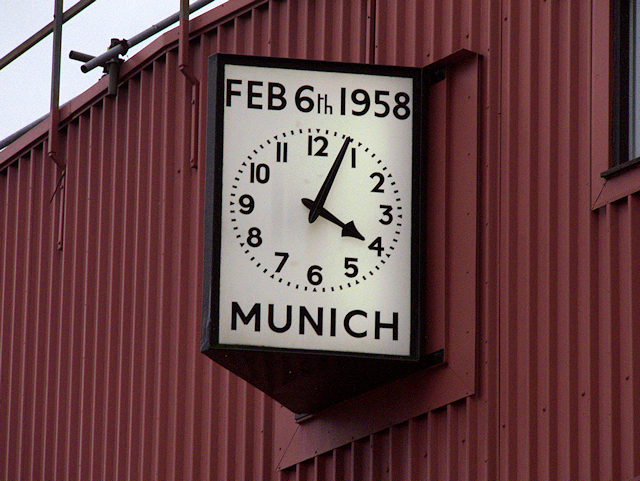
According to a 2024 club brochure, the Munich Memorial Plaque, inscribed with the names of the victims in black and gold glass, was unveiled at Old Trafford by Busby on 25 February 1960 and was first placed above the entrance to the directors' box.[16] The Munich Memorial Clock, unveiled by Dan Marsden, then chairman of the club's Ground Committee, overlooks the plaque at the junction of the South Stand and East Stand; the brochure notes that, contrary to a common belief, the clock is not fixed at 3.04pm, the time of the crash.[16]
According to a 2024 club brochure, the Munich Memorial Plaque, inscribed with the names of the victims in black and gold glass, was unveiled at Old Trafford by Busby on 25 February 1960 and was first placed above the entrance to the directors' box.[16] The Munich Memorial Clock, unveiled by Dan Marsden, then chairman of the club's Ground Committee, overlooks the plaque at the junction of the South Stand and East Stand; the brochure notes that, contrary to a common belief, the clock is not fixed at 3.04pm, the time of the crash.[16]
## Ownership and finances
## Ownership and finances
### The Glazer takeover
### The Glazer takeover
The family of Malcolm Glazer took full control of the club in June 2005 through a £790 million leveraged buyout, a purchase financed largely by borrowing, which placed about £525 million of debt on the club, according to Sky Sports.[18] Sky Sports records that the refinancing of that debt announced in January 2010 led to supporter protests in which the green and gold colours of Newton Heath became prominent at Old Trafford.[18] After the collapse of the European Super League plan in April 2021, supporters forced their way onto the Old Trafford pitch on 2 May 2021, and the match against Liverpool was postponed, which Sky Sports described as the first Premier League match called off because of fan protests.[18] On 22 November 2022 the club confirmed that the Glazers were open to selling it, while saying other options would also be considered.[18]
The family of Malcolm Glazer took full control of the club in June 2005 through a £790 million leveraged buyout, a purchase financed largely by borrowing, which placed about £525 million of debt on the club, according to Sky Sports.[18] Sky Sports records that the refinancing of that debt announced in January 2010 led to supporter protests in which the green and gold colours of Newton Heath became prominent at Old Trafford.[18] After the collapse of the European Super League plan in April 2021, supporters forced their way onto the Old Trafford pitch on 2 May 2021, and the match against Liverpool was postponed, which Sky Sports described as the first Premier League match called off because of fan protests.[18] On 22 November 2022 the club confirmed that the Glazers were open to selling it, while saying other options would also be considered.[18]
### Stock market listing
### Stock market listing
Manchester United priced its initial public offering, its first sale of shares to the public, on 9 August 2012 at $14 a share, below the expected range of $16 to $20; it sold 17 million shares, raised $233 million and listed on the New York Stock Exchange under the ticker MANU.[19] Sky Sports notes that the Glazers' Class B shares carry ten times the voting power of the Class A shares sold to the public.[18]
Manchester United priced its initial public offering, its first sale of shares to the public, on 9 August 2012 at $14 a share, below the expected range of $16 to $20; it sold 17 million shares, raised $233 million and listed on the New York Stock Exchange under the ticker MANU.[19] Sky Sports notes that the Glazers' Class B shares carry ten times the voting power of the Class A shares sold to the public.[18]
### Jim Ratcliffe and INEOS
### Jim Ratcliffe and INEOS
Sky Sports reported on 21 February 2024 that Sir Jim Ratcliffe had completed his purchase of 25% of the club's Class A shares and 25% of its Class B shares, a stake of 27.7%, at $33 (£26) a share, after approval from the Premier League and the Football Association.[20] The deal gave Ratcliffe's company INEOS control of football operations; it included an initial investment of $200 million (£158.5 million) on completion and a further $100 million due by 31 December 2024, which was to raise his holding to 28.9%.[20] Joel Glazer, the club's executive co-chairman, welcomed Ratcliffe as co-owner.[20]
Sky Sports reported on 21 February 2024 that Sir Jim Ratcliffe had completed his purchase of 25% of the club's Class A shares and 25% of its Class B shares, a stake of 27.7%, at $33 (£26) a share, after approval from the Premier League and the Football Association.[20] The deal gave Ratcliffe's company INEOS control of football operations; it included an initial investment of $200 million (£158.5 million) on completion and a further $100 million due by 31 December 2024, which was to raise his holding to 28.9%.[20] Joel Glazer, the club's executive co-chairman, welcomed Ratcliffe as co-owner.[20]
### Financial results for 2025-26
### Financial results for 2025-26
Manchester United plc reported on 23 September 2026 that, for the year ended 30 June 2026, revenue reached a record £677.6 million, up from £666.5 million the year before, although the men's team had not played in UEFA competition.[6] Commercial revenue was £317.3 million, broadcasting revenue £206.8 million and matchday revenue £153.5 million.[6] The company reported an operating profit of £22.6 million, against an operating loss of £18.4 million in 2024-25, and a loss for the year of £43.0 million, against £33.0 million.[6] Employee benefit expenses, which include wages, were £302.0 million.[6] As of 30 June 2026, the company reported non-current borrowings of £577.6 million (US$775 million) and current borrowings, including accrued interest, of £111.4 million, of which £110.0 million was drawn on a revolving credit facility, a borrowing line it uses for seasonal cash needs; cash and cash equivalents were £67.2 million.[6]
Manchester United plc reported on 23 September 2026 that, for the year ended 30 June 2026, revenue reached a record £677.6 million, up from £666.5 million the year before, although the men's team had not played in UEFA competition.[6] Commercial revenue was £317.3 million, broadcasting revenue £206.8 million and matchday revenue £153.5 million.[6] The company reported an operating profit of £22.6 million, against an operating loss of £18.4 million in 2024-25, and a loss for the year of £43.0 million, against £33.0 million.[6] Employee benefit expenses, which include wages, were £302.0 million.[6] As of 30 June 2026, the company reported non-current borrowings of £577.6 million (US$775 million) and current borrowings, including accrued interest, of £111.4 million, of which £110.0 million was drawn on a revolving credit facility, a borrowing line it uses for seasonal cash needs; cash and cash equivalents were £67.2 million.[6]
## Sources
## Sources
1. "Manchester United". Encyclopaedia Britannica. No date shown; accessed 28 November 2026. https://www.britannica.com/topic/Manchester-United
2. "History by decade: 1878-1909". Manchester United. No date shown; accessed 28 November 2026. https://www.manutd.com/en/club/history/history-by-decade/1878-1909
3. "Trophy Room". Manchester United. No date shown; accessed 28 November 2026. https://www.manutd.com/en/history/trophy-room
4. "Old Trafford: History and innovation combine". FIFA. 2 April 2016. https://inside.fifa.com/en/news/old-trafford-history-and-innovation-combine-2156320
5. Gianluca Nesci. "Man United to replace Old Trafford with new 100,000-seat stadium". theScore. 11 March 2025. https://www.thescore.com/epl/news/3239275/man-united-to-replace-old-trafford-with-new-100-000-seat-stadium
6. "Manchester United PLC Reports Fourth Quarter and Full Year Fiscal 2026 Results" (Form 6-K, Exhibit 99.1). Manchester United plc, filed with the US Securities and Exchange Commission. 23 September 2026. https://www.sec.gov/Archives/edgar/data/0001549107/000110465926109806/tm2625945d1_ex99-1.htm
7. Ruaidhrí Croke. "A legacy that still lives on: Manchester United's 1968 European Cup win". The Irish Times. 5 May 2018. https://www.irishtimes.com/sport/soccer/a-legacy-that-still-lives-on-manchester-united-s-1968-european-cup-win-1.3484317
8. Paul Carr. "Sir Alex Ferguson by the numbers". ESPN. 8 May 2013, updated 30 May 2014. https://www.espn.com/soccer/story/_/id/37387878/
9. "Explained: Who has managed Manchester United since Sir Alex Ferguson retired". Deccan Herald. No date shown (published at the time of Ruben Amorim's appointment, November 2024); accessed 28 November 2026. https://www.deccanherald.com/sports/football/explained-who-has-managed-manchester-united-since-sir-alex-ferguson-retired-3258967
10. The Associated Press. "Manchester United has hired Ruben Amorim as its sixth permanent manager since the retirement of Alex Ferguson in 2013". ABC News. 1 November 2024. https://abcnews.go.com/US/wireStory/manchester-united-hired-ruben-amorim-sixth-permanent-manager-115388151
11. "Man Utd appoint Carrick as head coach". Premier League. 13 January 2026. https://www.premierleague.com/en/news/4536781/man-utd-appoint-carrick-as-interim-head-coach
12. Reuters. "Soccer-Carrick to continue as Man United head coach until 2028". The Star. 22 May 2026. https://www.thestar.com.my/sport/football/2026/05/22/soccer-carrick-to-continue-as-man-united-head-coach
13. Manasi Pathak. "Manchester United sack Michael Carrick as manager". Al Jazeera. 12 November 2026. https://www.aljazeera.com/sports/2026/11/12/manchester-united-sack-michael-carrick-as-manager
14. "Forever remembered". Manchester United. No date shown; accessed 28 November 2026. https://www.manutd.com/en/news/detail/munich-air-disaster-was-the-darkest-day-in-manchester-united-history
15. Rob Dawson. "Man United confirm Mauricio Pochettino as Michael Carrick replacement". ESPN. 13 November 2026. https://www.espn.com/soccer/story/_/id/50469660/man-united-mauricio-pochettino-manager-michael-carrick
16. "Munich Air Disaster" (memorial brochure). Manchester United. 2024. https://assets.manutd.com/AssetPicker/images/0/0/19/191/1294307/Munich_Air_Disaster_brochure_20241706883366820.pdf
17. "Munich air disaster". Encyclopaedia Britannica. No date shown; accessed 28 November 2026. https://www.britannica.com/event/Munich-air-disaster
18. Dan Sansom. "The Glazers at Manchester United: The story of their turbulent tenure so far". Sky Sports. November 2023. https://www.skysports.com/football/story-telling/11096/12987531/the-glazers-at-man-utd-the-story-of-their-turbulent-tenure-so-far
19. "Manchester United prices IPO at $14, below the range". Renaissance Capital. 9 August 2012. https://www.renaissancecapital.com/IPO-Center/News/12246/manchester-united-prices-ipo-at-14-below-the-range
20. "Sir Jim Ratcliffe completes deal to buy Manchester United minority stake". Sky Sports. 21 February 2024. https://www.skysports.com/football/news/11667/13071401/ratcliffe-completes-deal-to-buy-man-utd-minority-stake
