Compare versions
Version 1 → Version 2 (current). Removed · Added. This shows the entry's text as it is written, including its formatting marks.
Version 1 · Version 2 (current) · Version history
Side by side · Together
The UEFA Champions League is the annual competition for Europe's leading men's football clubs, organised by UEFA (the Union of European Football Associations); it began in 1955 as the European Champion Clubs' Cup and took its present name in 1992/93.[1][2]
## Origins as the European Cup
The idea for a European club competition came from the French sports newspaper L'Équipe and its editor Gabriel Hanot, a former France international who won 12 caps between 1908 and 1919.[1] Hanot and his colleague Jacques Ferran campaigned for the idea during the 1950s, drawing on what they had seen of club football in South America.[1] Their first plan was for 16 clubs from 16 countries, not necessarily national champions, to play home-and-away ties, with the club scoring more goals over the two matches going through.[1]
UEFA had been founded in 1954, and FIFA, world football's governing body, approved the project in May 1955.[1] UEFA's Executive Committee confirmed the new competition on 21 June 1955.[2] In the early years clubs kept the takings from their home matches and paid their own organising costs, including those of referees.[1]
The first match, on 4 September 1955, was a 3-3 draw between Sporting Clube de Portugal and FK Partizan.[1] The 16 entrants of 1955/56 included Real Madrid, AC Milan, Stade de Reims, Hibernian, Rapid Wien and PSV Eindhoven.[1] Real Madrid beat Reims in the final in Paris in June 1956 and went on to win the first five editions.[1] UEFA describes that first season as a 16-team invitational tournament.[2]
## Format and its changes
### The knockout era
From 1956/57 more nations took part, and a preliminary round of 12 teams was played before the 16-team first round.[2] In 1967/68 UEFA set up a 32-team tournament proper, with four two-legged rounds followed by a one-match final, a model that lasted more than 20 years.[2] Over time the away goals rule (under which goals scored away from home counted extra when a tie finished level on aggregate) and penalty shoot-outs replaced play-off matches and coin tosses as ways of settling drawn ties.[1]
### From European Cup to Champions League
On 19 September 1991 an Extraordinary UEFA Congress in Montreux approved the changes that became the Champions League from 1992/93.[2] The 1991/92 season was a transition: after two knockout rounds, eight teams played in two groups, and the two group winners met in the final.[2] In 1992/93 the competition took its new name and identity, including its anthem and its "starball" logo; UEFA says the name was chosen to give prominence to the group stage.[2]
A 16-team group stage came in 1994/95.[2] In 1997/98 the runners-up of the leagues of the eight top-ranked national associations were admitted, and champions from smaller nations returned after three years in the UEFA Cup.[2] Two group stages were introduced in 1999/2000, with 32 teams in the first; in 2003/04 the second group stage gave way to a knockout round of 16.[2] A qualifying system with two separate paths and an extra play-off round followed in 2009/10.[2] From 2015/16 the winners of the UEFA Europa League, Europe's second-tier club competition, received a Champions League place, and the maximum number of clubs from one country rose to five.[2] After play was suspended because of COVID-19 in 2020, the 2019/20 season was finished with a one-off "final eight" tournament in Lisbon, where Bayern München beat Paris Saint-Germain 1-0 in a final played without spectators.[2]
### The league phase from 2024/25
UEFA approved its present format on 10 May 2022, following an April 2021 decision to introduce a new competition system.[3] From 2024/25 the group stage of 32 teams in eight groups of four was replaced by a single "league phase" of 36 clubs ranked together in one table.[3] Each club plays eight matches against eight different opponents, four at home and four away, drawn from four seeded pots.[3] The top eight go straight to the round of 16; the clubs placed 9th to 24th play two-legged knockout play-offs; those placed 25th or lower are eliminated and do not drop into the Europa League.[3] From the round of 16 the knockout format is unchanged, and the final is played on a Saturday at a neutral venue chosen by UEFA.[3]
The four extra places went to the third-placed club of the association ranked fifth, to one more domestic champion through qualifying, and to two "European Performance Spots" for the associations whose clubs did best in Europe the previous season.[3]
## The trophy
The original trophy was given permanently to Real Madrid after their sixth title in 1966.[1] The present trophy, which UEFA describes as the fifth version of the design, was commissioned by UEFA General Secretary Hans Bangerter after Real Madrid were allowed to keep the original, and was designed and made in Bern, Switzerland.[1] As of November 2026, UEFA.com gives its height as 73.5cm and its weight as 7.5kg.[4] A rule introduced in 1968/69 let a club keep the cup after five wins or three wins in a row, and as of October 2020 UEFA.com listed Real Madrid, Ajax, Bayern, Milan, Liverpool and Barcelona as holding versions of it.[1] Before 2008/09 the rule was changed so that the original stays with UEFA and winners receive a replica.[1]
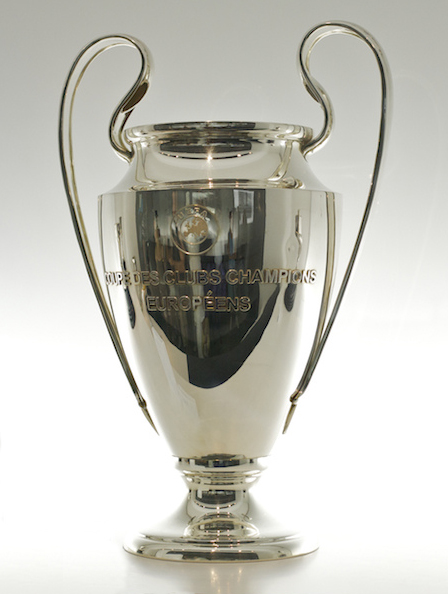2010.](/m/2026/11/-kRhBnLMyQP9NidV.jpg)
*Via Wikimedia Commons: [Trofeo UEFA Champions League](https://commons.wikimedia.org/wiki/File:Trofeo_UEFA_Champions_League.jpg) by David Flores, [CC BY 2.0](https://creativecommons.org/licenses/by/2.0).*
## Winners and records
### Most titles
As of 30 May 2026, UEFA.com listed Real Madrid as the most successful club, with 15 European Cup and Champions League titles from 18 finals, followed by AC Milan with 7 and Liverpool and Bayern München with 6 each.[5] Barcelona had 5, Ajax 4, and Inter and Manchester United 3 each.[5] Counting only the Champions League era since 1992/93, Real Madrid had 9 titles and Barcelona 4.[5] By country, UEFA.com listed Spanish clubs with 20 titles, English clubs with 15 and Italian clubs with 12.[5]
Some eras were dominated by one club or one country. Ajax and Bayern each won three in a row in the 1970s, and English clubs won six successive titles from 1977 to 1982: three for Liverpool, two for Nottingham Forest and one for Aston Villa.[1] [Manchester United F.C.](https://micwyn.com/t/3631/manchester-united-f-c) won their first title on 29 May 1968 at Wembley in London, beating Benfica 4-1 after extra time.[6]
### Heysel
On 29 May 1985, before the final between Liverpool and Juventus at the Heysel Stadium in Brussels, 39 Juventus supporters died; according to UEFA.com's account, they had been charged by Liverpool supporters and were crushed against, or fell through, a decaying retaining wall.[7] The match went ahead and Juventus won 1-0 through a penalty by Michel Platini.[7] UEFA.com's account records that English clubs were then banned from European competition.[7]
### Recent finals
Paris Saint-Germain won the 2025 final 5-0 against Inter, according to Euronews.[9] UEFA's 2024/25 financial report records that Paris Saint-Germain received €144m from UEFA for that season and Inter €137m.[14]
The 2025/26 final was played on 30 May 2026 at the Puskás Aréna in Budapest.[8] Euronews reported that it was the first time Hungary had hosted the final.[9] Kai Havertz put Arsenal ahead in the sixth minute and Ousmane Dembélé equalised for Paris Saint-Germain from the penalty spot in the 65th; the match finished 1-1 after extra time.[8] Paris won the shoot-out by scoring four of their five penalties, after Arsenal's Gabriel put the decisive kick over the bar.[8] UEFA.com reported that Paris were the first side to retain the trophy since Real Madrid in 2018, that it was the 12th European Cup or Champions League final settled on penalties, and that their coach, Luis Enrique, had won his third final as a coach.[8] Euronews counted it as the eighth final decided by a shoot-out since the 1992 change of name.[9]
### Player records
As of 25 November 2026, UEFA.com's all-time Champions League scoring list (not counting qualifying rounds) was headed by [Cristiano Ronaldo](https://micwyn.com/t/3534/cristiano-ronaldo) with 140 goals for Manchester United, Real Madrid and Juventus, followed by [Lionel Messi](https://micwyn.com/t/3496/lionel-messi) with 129 and Robert Lewandowski with 109.[10] As of 4 November 2026, UEFA.com listed Ronaldo as the player with the most Champions League appearances, 183, ahead of Iker Casillas with 177 and Manuel Neuer with 164.[11] In October 2020 UEFA.com recorded Paolo Maldini, who captained Milan to the 2007 title at the age of 38, as the oldest winner.[1]
## The 2026/27 season
As of 4 November 2026, UEFA.com described 2026/27 as the competition's 72nd season, its 35th under the Champions League name and its third with a league phase.[4] The 2026/27 edition kicked off on 7 July 2026, and its league phase runs over eight matchdays from 8-10 September 2026 to 27 January 2027.[4] UEFA.com's provisional list of league-phase clubs included five from England's [Premier League](https://micwyn.com/t/3611/premier-league): Arsenal, Aston Villa, Liverpool, Manchester City and Manchester United.[4] The final is scheduled for Saturday 5 June 2027 at the Estadio Metropolitano, Atlético de Madrid's ground, which also staged the 2019 final; UEFA.com noted that dates are subject to change.[4]
By 25 November 2026, five of the eight league-phase matchdays had been played; NBC Sports listed results for matchday 5 on 24 and 25 November, including Real Madrid 5-1 PSV Eindhoven and Sporting Lisbon 2-2 Manchester United.[12] Matchday 6 is set for 8-9 December 2026.[12]
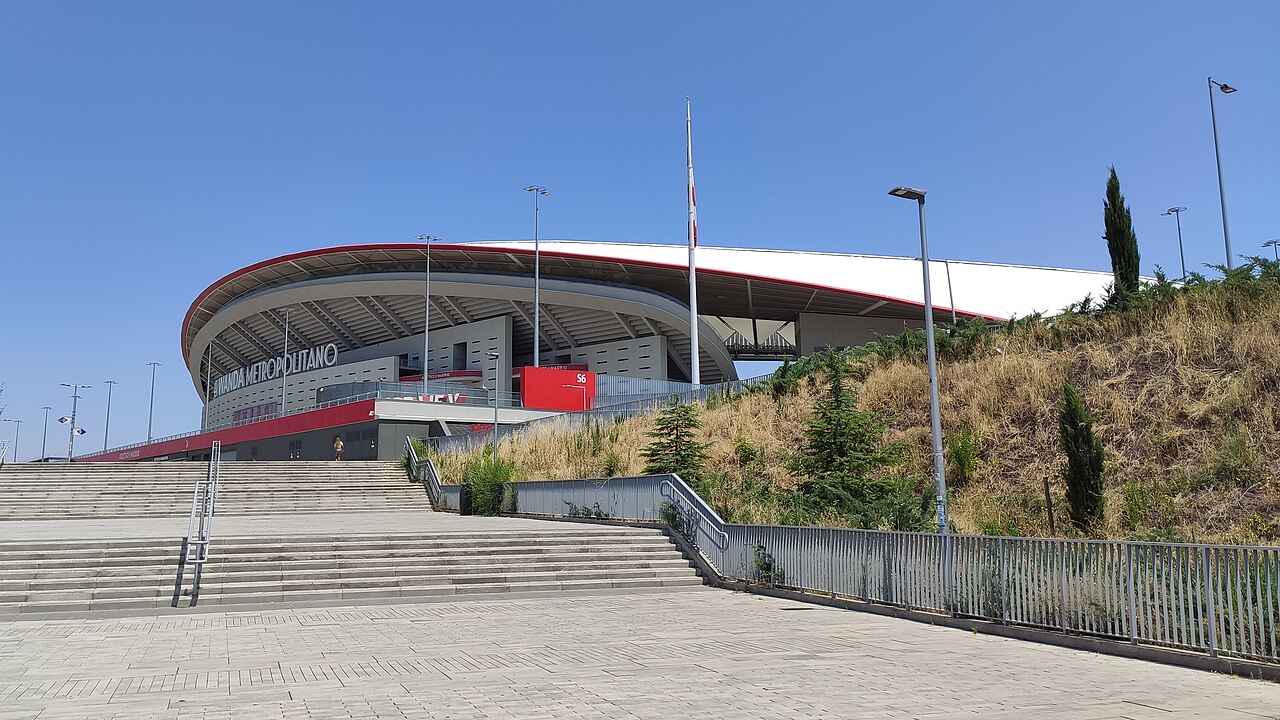
*Via Wikimedia Commons: [Estadio Metropolitano - Madrid 001](https://commons.wikimedia.org/wiki/File:Estadio_Metropolitano_-_Madrid_001.jpg) by Américo Toledano, [CC BY-SA 4.0](https://creativecommons.org/licenses/by-sa/4.0).*
## Money
### Distribution to clubs
UEFA shares most of the money from its club competitions with the clubs taking part, and pays "solidarity" money to clubs that do not take part, mainly for youth development.[13] Its projections for 2025/26, on a page last updated in August 2026, were €4.4bn in gross revenue across the Champions League, Europa League, Conference League and Super Cup, and €3.548bn in net revenue after deductions.[13] Of the net figure, 93.5% (€3.317bn) was set for clubs from the league phase on, with €2.467bn of it for the Champions League and Super Cup; UEFA keeps 6.5% for its own investment in European football.[13]
Within the Champions League, the projected 2025/26 figures were €670m in equal shares, or €18.62m for each of the 36 league-phase clubs, €914m in performance bonuses, and €853m in a third pool that UEFA calls the "value pillar".[13] A further €30m was set aside for clubs knocked out in the Champions League play-offs, and solidarity payments for non-participating clubs were put at €308m.[13] UEFA states that for 2019/20 to 2022/23, 97.5% of net revenue was shared across member associations and top-tier leagues, with more than three-quarters going to clubs, and projects the same 97.5% share for 2023/24 to 2026/27.[13]
### Results for 2024/25
UEFA's Financial Report 2024/25, covering the year to 30 June 2025, gives total UEFA revenue of €5,014.2 million.[14] It records gross revenue of €4,413.8 million from the men's club competitions, including €3,595.9 million from media rights and €726.8 million from commercial rights.[14]
## Broadcasting
Broadcasting rights to the competition are sold by UC3, a joint venture of UEFA and European Football Clubs, the body representing clubs, Reuters reported on 22 November 2025.[16] UEFA's list of media-rights licensees for 2024-27, last updated on 23 August 2024, named British Telecommunications and the BBC for the United Kingdom, CBS Broadcasting and Univision for the United States, Canal+ and Métropole Télévision for France, Sky Italia for Italy and Telefónica for Spain.[15] Reuters reported that TNT Sports, formerly BT Sport and a joint venture of BT Group and Warner Bros. Discovery, had shown Champions League matches in Britain since 2015-16.[16]
Reuters reported on 22 November 2025 that UC3 had announced Paramount+ as the winner of the rights to show most matches in Britain from 2027 to 2031, ahead of TNT Sports, while Amazon Prime Video kept first pick of Tuesday matches in Britain and two other European markets.[16] As of 25 November 2026, NBC Sports listed Paramount+ as the streaming service for 2026/27 matches in the United States, with selected games on CBS Sports Network.[12]
## The European Super League case
After a group of clubs planned a new competition called the Super League and FIFA and UEFA objected, a court in Madrid referred questions to the Court of Justice of the European Union.[17] In its judgment of 21 December 2023 in Case C-333/21, European Superleague Company, the Court held that FIFA and UEFA rules requiring prior approval of new club competitions, and barring clubs and players from unapproved ones, were contrary to EU competition law and the freedom to provide services, because they were not subject to criteria that were transparent, objective, non-discriminatory and proportionate.[17] The Court found that FIFA and UEFA were abusing a dominant position, but stated that this did not mean a competition such as the Super League project must necessarily be approved.[17] It also found that the rules giving FIFA and UEFA exclusive control of media rights could restrict competition, and left the Madrid court to decide the dispute in line with its ruling.[17]
## Sources
1. UEFA.com. "Sixty-five years of drama, passion and quality". UEFA, 20 October 2020. https://www.uefa.com/news-media/news/0262-10a7ede8c0c0-036f4bc7eb14-1000--sixty-five-years-of-drama-passion-and-quality/
2. UEFA.com. "Setting the standard for club football". UEFA, 20 April 2021. https://www.uefa.com/uefachampionsleague/news/0268-121578ca9f2b-3ebc8c09202b-1000--setting-the-standard-for-club-football/
3. "New format for Champions League post-2024: Everything you need to know". UEFA, 12 June 2024. https://www.uefa.com/uefachampionsleague/news/0268-12157d69ce2d-9f011c70f6fa-1000--new-format-for-champions-league-post-2024-everything-you-ne/
4. "2026/27 Champions League: Teams, dates, draws, format, final". UEFA, 4 November 2026. https://www.uefa.com/uefachampionsleague/news/02a6-20d57cfcd03e-407c22a7f465-1000--2026-27-champions-league-teams-dates-draws-format-final/
5. "Which teams have won the European Cup or Champions League?". UEFA, 30 May 2026. https://www.uefa.com/uefachampionsleague/news/0275-1541637ad1db-88aeeefefefd-1000--champions-league-winners-list-which-teams-have-won-the-eu/
6. "1967/68: Charlton leads United charge". UEFA, dated 29 May 1968 on the page (last updated 27 September 2014). https://www.uefa.com/uefachampionsleague/news/0253-0d7b1dd79a73-74a6f12936f7-1000--1967-68-charlton-leads-united-charge/
7. "1984/85: Football mourns Heysel victims". UEFA, dated 29 May 1985 on the page (last updated 9 July 2010). https://www.uefa.com/uefachampionsleague/news/0253-0d7b1e29a07a-96de9655acd4-1000--1984-85-football-mourns-heysel-victims/
8. Mark Pettit. "Paris retain Champions League: Holders edge Arsenal on penalties". UEFA, 30 May 2026. https://www.uefa.com/uefachampionsleague/news/02a5-20c02e59f219-15e92acdc717-1000--paris-retain-champions-league-holders-edge-arsenal-on-pena/
9. Sertac Aktan. "Paris Saint-Germain wins the Champions League after penalty shootout victory against Arsenal". Euronews, 30 May 2026 (updated 5 June 2026). https://www.euronews.com/2026/05/30/paris-saint-germain-wins-the-champions-league-after-penalty-shootout-victory-against-arsen
10. "Champions League all-time top scorers: Cristiano Ronaldo, Lionel Messi, Robert Lewandowski, Karim Benzema". UEFA, last updated 25 November 2026. https://www.uefa.com/uefachampionsleague/news/0257-0e910cf2494a-5185150de9d4-1000--champions-league-all-time-top-scorers-cristiano-ronaldo-/
11. "Champions League all-time appearances: Cristiano Ronaldo, Iker Casillas, Lionel Messi, Thomas Müller, Karim Benzema". UEFA, last updated 4 November 2026. https://www.uefa.com/uefachampionsleague/news/025a-0e9f8a3d1e40-d534e8b4a897-1000--champions-league-all-time-appearances-cristiano-ronaldo-iker/
12. Nicholas Mendola. "UEFA Champions League 2026-27: League phase schedule, scores, how to watch live". NBC Sports, 25 November 2026. https://www.nbcsports.com/soccer/news/uefa-champions-league-2026-27-league-phase-schedule-scores-how-to-watch-live
13. "Men's competitions" (financial distribution). UEFA, 6 April 2024 (last modified 4 August 2026). https://www.uefa.com/running-competitions/financial-distribution/mens-competitions/
14. "Financial Report 2024/25". UEFA. No date shown; accessed 28 November 2026. https://editorial.uefa.com/resources/02a1-1fcc539a26d9-78ac6793e755-1000/20260113_enclosure_04_financial_report_2024-25_en.pdf
15. "Media rights sales: 2024-27 UEFA Champions League". UEFA, last update 23 August 2024. https://editorial.uefa.com/resources/0290-1bad8483a851-29443de48d84-1000/2024-27_ucl_media_rights_sales_2024.23.08.pdf
16. Paul Sandle (Reuters). "Paramount wins UK rights for most Champions League matches from 2027". The Star, 22 November 2025. https://www.thestar.com.my/tech/tech-news/2025/11/22/paramount-wins-uk-rights-for-most-champions-league-matches-from-2027
17. Court of Justice of the European Union. "The FIFA and UEFA rules on prior approval of interclub football competitions, such as the Super League, are contrary to EU law" (Press release No 203/23, Judgment in Case C-333/21). 21 December 2023. https://curia.europa.eu/site/upload/docs/application/pdf/2023-12/cp230203en.pdf
