Compare versions
Version 1 → Version 2. Removed · Added. This shows the entry's text as it is written, including its formatting marks.
Version 1 · Version 2 · Version history
Side by side · Together
Version 1Version 2
4 unchanged paragraphs
Singapore is an island country in Southeast Asia, governed as a parliamentary republic, whose economy rests largely on international trade and finance.[1]
Singapore is an island country in Southeast Asia, governed as a parliamentary republic, whose economy rests largely on international trade and finance.[1]
## Geography
## Geography
Singapore lies in Southeast Asia, and its capital is also named Singapore.[1] The Singapore Department of Statistics (SingStat) gives the country's land area as 745.1 square kilometres as at June 2026 and 744.3 square kilometres as at December 2025.[2] Britannica's country summary gives a smaller figure of 704 square kilometres (272 square miles), so published measurements differ by source and date.[1] SingStat describes the climate as tropical, with relatively high and uniform temperatures, abundant rainfall and high humidity.[2]
Singapore lies in Southeast Asia, and its capital is also named Singapore.[1] The Singapore Department of Statistics (SingStat) gives the country's land area as 745.1 square kilometres as at June 2026 and 744.3 square kilometres as at December 2025.[2] Britannica's country summary gives a smaller figure of 704 square kilometres (272 square miles), so published measurements differ by source and date.[1] SingStat describes the climate as tropical, with relatively high and uniform temperatures, abundant rainfall and high humidity.[2]
The country's port is one of the largest in the world, according to Britannica.[1]
The country's port is one of the largest in the world, according to Britannica.[1]
25 unchanged paragraphs
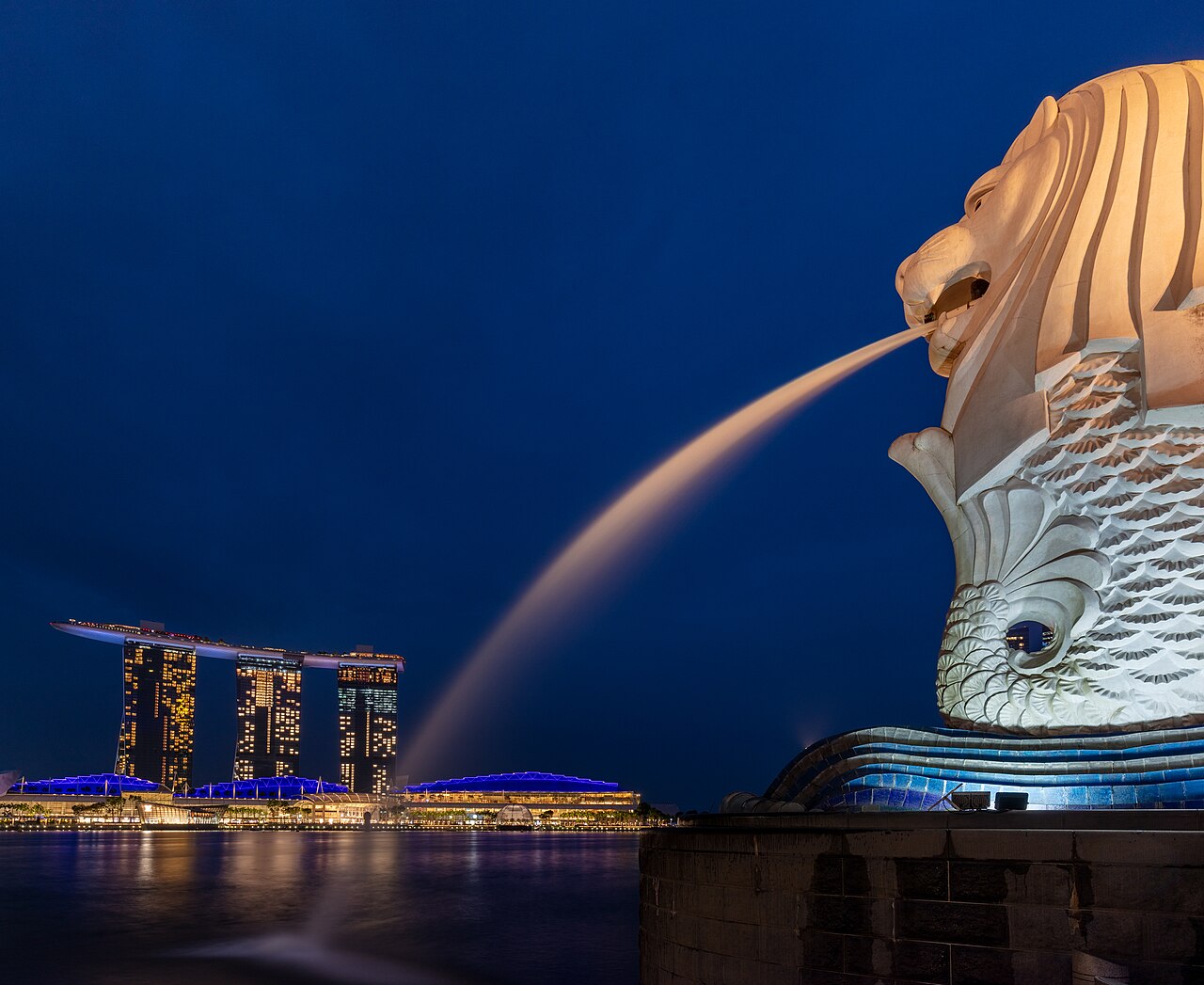
*Via Wikimedia Commons: [Merlión, Marina Bay, Singapur, 2023-08-18, DD 45-47 HDR](https://commons.wikimedia.org/wiki/File:Merli%C3%B3n,_Marina_Bay,_Singapur,_2023-08-18,_DD_45-47_HDR.jpg) by Diego Delso, [CC BY-SA 4.0](https://creativecommons.org/licenses/by-sa/4.0).*
*Via Wikimedia Commons: [Merlión, Marina Bay, Singapur, 2023-08-18, DD 45-47 HDR](https://commons.wikimedia.org/wiki/File:Merli%C3%B3n,_Marina_Bay,_Singapur,_2023-08-18,_DD_45-47_HDR.jpg) by Diego Delso, [CC BY-SA 4.0](https://creativecommons.org/licenses/by-sa/4.0).*
## People
## People
### Population
### Population
SingStat reported that Singapore's total population stood at 6.21 million at the end of June 2026, an increase of 1.6% on 2025.[3] Of that total, 4.23 million were residents, a group made up of 3.68 million citizens and 0.55 million permanent residents, and 1.98 million were non-residents, meaning people living in Singapore for work, study or family reasons without citizenship or permanent residence.[3] The National Population and Talent Division, a government office, said the non-resident population rose by 3.7% from June 2025, mostly because more work permit holders were employed in construction, including on projects such as Changi Airport's Terminal 5 and housing and transport infrastructure, as Bernama reported on 26 September 2026.[4]
SingStat reported that Singapore's total population stood at 6.21 million at the end of June 2026, an increase of 1.6% on 2025.[3] Of that total, 4.23 million were residents, a group made up of 3.68 million citizens and 0.55 million permanent residents, and 1.98 million were non-residents, meaning people living in Singapore for work, study or family reasons without citizenship or permanent residence.[3] The National Population and Talent Division, a government office, said the non-resident population rose by 3.7% from June 2025, mostly because more work permit holders were employed in construction, including on projects such as Changi Airport's Terminal 5 and housing and transport infrastructure, as Bernama reported on 26 September 2026.[4]
The population is ageing. SingStat's 2026 figures show that residents aged 65 and over made up 19.5% of the resident population, and that the old-age support ratio, the number of residents aged 20 to 64 for each resident aged 65 and over, fell from 5.4 in 2016 to 3.2 in 2026.[3] Citizen births in 2025 fell by 10.8% to 26,071, and the resident total fertility rate, the average number of children a woman would be expected to have over her lifetime at current birth rates, dropped to 0.87 in 2025 from 0.97 in 2024.[4]
The population is ageing. SingStat's 2026 figures show that residents aged 65 and over made up 19.5% of the resident population, and that the old-age support ratio, the number of residents aged 20 to 64 for each resident aged 65 and over, fell from 5.4 in 2016 to 3.2 in 2026.[3] Citizen births in 2025 fell by 10.8% to 26,071, and the resident total fertility rate, the average number of children a woman would be expected to have over her lifetime at current birth rates, dropped to 0.87 in 2025 from 0.97 in 2024.[4]
### Ethnic groups and religion
### Ethnic groups and religion
The Census of Population 2020, released by SingStat on 16 June 2021, recorded the resident population as 74.3% Chinese, 13.5% Malay and 9.0% Indian.[5] Among residents aged 15 and over, 31.1% identified as Buddhist, 18.9% as Christian, 15.6% as Muslim, 8.8% as Taoist and 5.0% as Hindu, while 20.0% reported no religious affiliation.[5] The share with no religious affiliation had risen from 17.0% in 2010.[5]
The Census of Population 2020, released by SingStat on 16 June 2021, recorded the resident population as 74.3% Chinese, 13.5% Malay and 9.0% Indian.[5] Among residents aged 15 and over, 31.1% identified as Buddhist, 18.9% as Christian, 15.6% as Muslim, 8.8% as Taoist and 5.0% as Hindu, while 20.0% reported no religious affiliation.[5] The share with no religious affiliation had risen from 17.0% in 2010.[5]
### Languages
### Languages
Article 153A of the Constitution names Malay, Mandarin, Tamil and English as Singapore's four official languages, and makes Malay, written in the Roman script, the national language.[6] An overview published by the University of Ottawa describes Malay's national status as largely symbolic, its main practical effect being that the national anthem is sung in Malay.[6] English is the dominant working language: according to the same overview, it is the only language used to draft and enact laws and the main language of the higher courts.[6] In the 2020 census, English was the language most frequently spoken at home by 48.3% of residents aged five and over, up from 32.3% in 2010.[5]
Article 153A of the Constitution names Malay, Mandarin, Tamil and English as Singapore's four official languages, and makes Malay, written in the Roman script, the national language.[6] An overview published by the University of Ottawa describes Malay's national status as largely symbolic, its main practical effect being that the national anthem is sung in Malay.[6] English is the dominant working language: according to the same overview, it is the only language used to draft and enact laws and the main language of the higher courts.[6] In the 2020 census, English was the language most frequently spoken at home by 48.3% of residents aged five and over, up from 32.3% in 2010.[5]
## History
## History
### Early history
### Early history
In its early history the island was an outpost of the Sumatran empire of Srivijaya, according to Britannica.[7] Chinese and Javanese records from the late 1300s call it Tumasik or Temasek; it suffered Chola raids in 1025 and 1068, and was later counted among the conquests of the Javanese empire of Majapahit.[7] By the end of the 1300s Temasek had declined and the port of Malacca (Melaka) had taken its place.[7]
In its early history the island was an outpost of the Sumatran empire of Srivijaya, according to Britannica.[7] Chinese and Javanese records from the late 1300s call it Tumasik or Temasek; it suffered Chola raids in 1025 and 1068, and was later counted among the conquests of the Javanese empire of Majapahit.[7] By the end of the 1300s Temasek had declined and the port of Malacca (Melaka) had taken its place.[7]
### British rule
### British rule
Sir Stamford Raffles of the East India Company landed at Singapore in January 1819 while looking for a site for a trading post.[7] Infopedia, the encyclopedia of Singapore's National Library Board, dates his arrival to 29 January 1819.[8] On 6 February 1819 he signed a treaty with Sultan Hussein and Temenggong Abdul Rahman that established a British settlement on the island.[8] The Dutch protested the arrangement, but an Anglo-Dutch treaty of 1824 placed Singapore in the British sphere, and in August of that year the whole island was ceded to the British for a payment.[7] Raffles died in England on 5 July 1826.[8]
Sir Stamford Raffles of the East India Company landed at Singapore in January 1819 while looking for a site for a trading post.[7] Infopedia, the encyclopedia of Singapore's National Library Board, dates his arrival to 29 January 1819.[8] On 6 February 1819 he signed a treaty with Sultan Hussein and Temenggong Abdul Rahman that established a British settlement on the island.[8] The Dutch protested the arrangement, but an Anglo-Dutch treaty of 1824 placed Singapore in the British sphere, and in August of that year the whole island was ceded to the British for a payment.[7] Raffles died in England on 5 July 1826.[8]
In 1826 Singapore was combined with Penang and Malacca to form the Straits Settlements, which in 1867 became a crown colony under the Colonial Office in London.[7]
In 1826 Singapore was combined with Penang and Malacca to form the Straits Settlements, which in 1867 became a crown colony under the Colonial Office in London.[7]
### Japanese occupation
### Japanese occupation
During the Second World War, Japanese forces crossed the Johor Strait on 8 February 1942, and the British surrendered the island about a week later.[7] Singapore remained under Japanese control until September 1945.[7]
During the Second World War, Japanese forces crossed the Johor Strait on 8 February 1942, and the British surrendered the island about a week later.[7] Singapore remained under Japanese control until September 1945.[7]
### Self-government, merger and independence
### Self-government, merger and independence
Singapore became self-governing in 1959, although Britain kept control of defence and foreign policy.[7] The Federation of Malaysia came into being on 16 September 1963, joining Malaya, Singapore, Sarawak and North Borneo (Sabah); its start had been put back from 31 August to allow a United Nations study of opinion in Borneo, according to Infopedia.[9] In Singapore's general election of 21 September 1963, the People's Action Party (PAP), led by Lee Kuan Yew, won 37 of the 51 seats it contested.[9]
Singapore became self-governing in 1959, although Britain kept control of defence and foreign policy.[7] The Federation of Malaysia came into being on 16 September 1963, joining Malaya, Singapore, Sarawak and North Borneo (Sabah); its start had been put back from 31 August to allow a United Nations study of opinion in Borneo, according to Infopedia.[9] In Singapore's general election of 21 September 1963, the People's Action Party (PAP), led by Lee Kuan Yew, won 37 of the 51 seats it contested.[9]
Infopedia traces the end of the merger to political and economic friction between the PAP and Malaysia's ruling Alliance government, including electoral rivalry, communal riots in Singapore on 21 July and 3 September 1964, and disputes over the federal budget.[9] A separation agreement was signed in Kuala Lumpur on 7 August 1965, and on 9 August 1965 Singapore left Malaysia and became an independent, sovereign state.[9] Britannica describes Singapore as having seceded at the invitation of the Malaysian government.[7]
Infopedia traces the end of the merger to political and economic friction between the PAP and Malaysia's ruling Alliance government, including electoral rivalry, communal riots in Singapore on 21 July and 3 September 1964, and disputes over the federal budget.[9] A separation agreement was signed in Kuala Lumpur on 7 August 1965, and on 9 August 1965 Singapore left Malaysia and became an independent, sovereign state.[9] Britannica describes Singapore as having seceded at the invitation of the Malaysian government.[7]
### Since independence
### Since independence
The PAP has won every general election since before independence, Reuters reported in May 2025.[10] Lee Kuan Yew stepped down as prime minister in 1990.[7] Lawrence Wong was sworn in on 15 May 2024 as Singapore's fourth prime minister, succeeding Lee Hsien Loong.[11]
The PAP has won every general election since before independence, Reuters reported in May 2025.[10] Lee Kuan Yew stepped down as prime minister in 1990.[7] Lawrence Wong was sworn in on 15 May 2024 as Singapore's fourth prime minister, succeeding Lee Hsien Loong.[11]
## Government and politics
## Government and politics
### Constitution and office holders
### Constitution and office holders
Singapore is a unitary parliamentary republic with a single legislative house; the president is head of state and the prime minister is head of government.[1] Tharman Shanmugaratnam was sworn in as the country's ninth president on 14 September 2023.[12] In the list of cabinet appointments that took effect on 27 July 2026, Lawrence Wong is named as prime minister and minister for finance, and Gan Kim Yong as deputy prime minister and minister for trade and industry.[13]
Singapore is a unitary parliamentary republic with a single legislative house; the president is head of state and the prime minister is head of government.[1] Tharman Shanmugaratnam was sworn in as the country's ninth president on 14 September 2023.[12] In the list of cabinet appointments that took effect on 27 July 2026, Lawrence Wong is named as prime minister and minister for finance, and Gan Kim Yong as deputy prime minister and minister for trade and industry.[13]

19 unchanged paragraphs
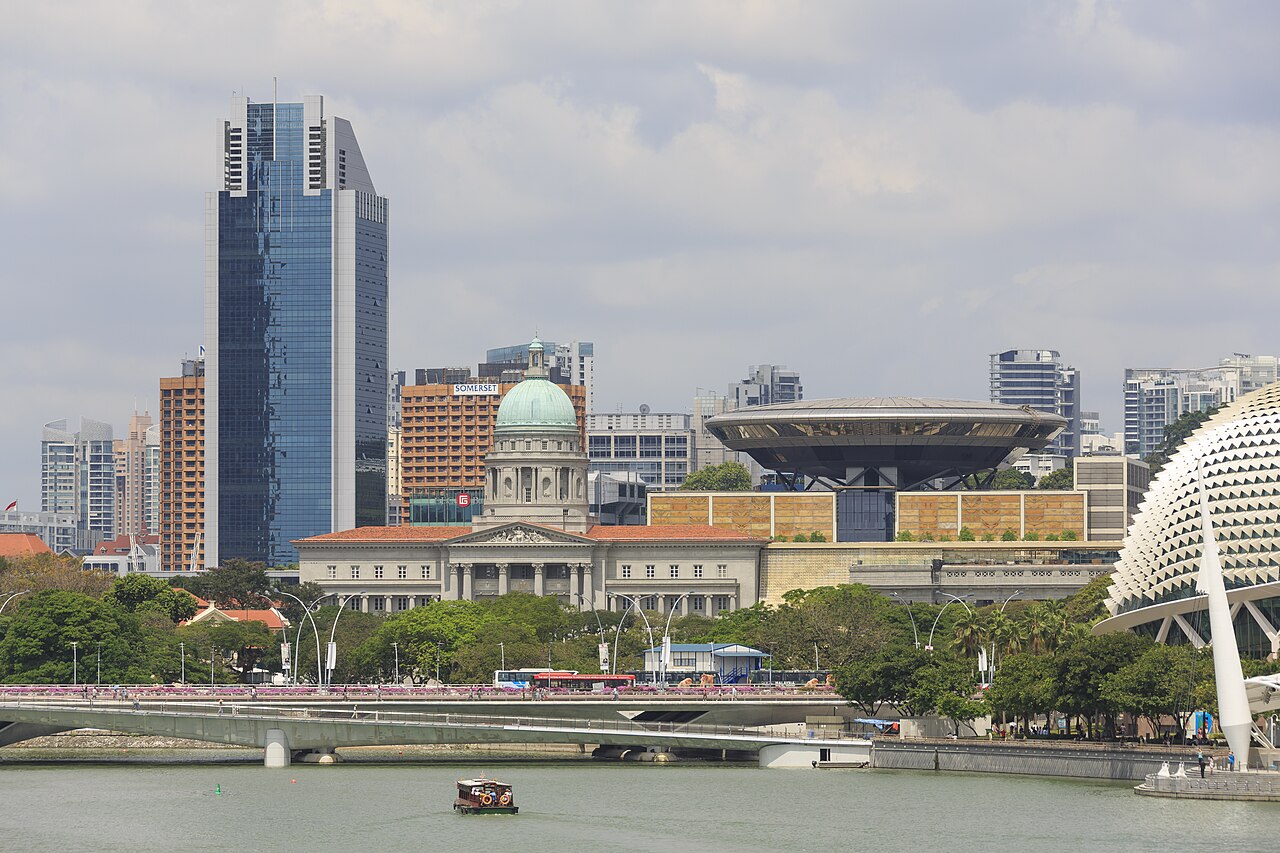
*Via Wikimedia Commons: [Singapore Old-Supreme-Court-Building-01](https://commons.wikimedia.org/wiki/File:Singapore_Old-Supreme-Court-Building-01.jpg) by CEphoto, Uwe Aranas, [CC BY-SA 3.0](https://creativecommons.org/licenses/by-sa/3.0).*
*Via Wikimedia Commons: [Singapore Old-Supreme-Court-Building-01](https://commons.wikimedia.org/wiki/File:Singapore_Old-Supreme-Court-Building-01.jpg) by CEphoto, Uwe Aranas, [CC BY-SA 3.0](https://creativecommons.org/licenses/by-sa/3.0).*
### Elections
### Elections
At the general election of 3 May 2025, the PAP won 87 of the 97 seats in Parliament, and the opposition Workers' Party won the other 10, Reuters reported.[10] The PAP stood in every seat and the Workers' Party in 26; local media gave the PAP's share of the vote as 65.57%, up from 61.2% in 2020.[10] Reuters quoted Mustafa Izzuddin of the National University of Singapore as saying voters had chosen "stability, for continuity, for certainty", and noted that the PAP has a large membership, influence in state institutions and far greater resources than its rivals.[10]
At the general election of 3 May 2025, the PAP won 87 of the 97 seats in Parliament, and the opposition Workers' Party won the other 10, Reuters reported.[10] The PAP stood in every seat and the Workers' Party in 26; local media gave the PAP's share of the vote as 65.57%, up from 61.2% in 2020.[10] Reuters quoted Mustafa Izzuddin of the National University of Singapore as saying voters had chosen "stability, for continuity, for certainty", and noted that the PAP has a large membership, influence in state institutions and far greater resources than its rivals.[10]
Assessments of how fair the elections are differ. Freedom House, a research and advocacy organisation, rated Singapore "Partly Free" in its Freedom in the World 2026 report, with 48 points out of 100 (19 of 40 for political rights and 29 of 60 for civil liberties).[14] It says the PAP's electoral and legal framework allows some political pluralism but constrains the growth of opposition parties and limits freedoms of expression, assembly and association.[14] In its 2024 report, Freedom House wrote that elections are "largely free of fraud or other irregularities" but unfair because of the advantages enjoyed by the PAP, and that the Elections Department is attached to the Prime Minister's Office rather than being an independent election commission.[15] The pages consulted for this entry did not include a Singapore government reply to these assessments.
Assessments of how fair the elections are differ. Freedom House, a research and advocacy organisation, rated Singapore "Partly Free" in its Freedom in the World 2026 report, with 48 points out of 100 (19 of 40 for political rights and 29 of 60 for civil liberties).[14] It says the PAP's electoral and legal framework allows some political pluralism but constrains the growth of opposition parties and limits freedoms of expression, assembly and association.[14] In its 2024 report, Freedom House wrote that elections are "largely free of fraud or other irregularities" but unfair because of the advantages enjoyed by the PAP, and that the Elections Department is attached to the Prime Minister's Office rather than being an independent election commission.[15] The pages consulted for this entry did not include a Singapore government reply to these assessments.
### Press and online speech
### Press and online speech
The press freedom organisation Reporters Without Borders (RSF) ranked Singapore 123rd of 180 countries in its 2026 World Press Freedom Index, with a score of 44.57; it had also been 123rd in 2025, with a score of 45.78.[16] RSF says there is little respect for press freedom and editorial independence, that state-controlled media dominate, and that the government can appoint board members and editors of major outlets and decide whether foreign media may publish or broadcast.[16] RSF also says the Foreign Interference (Countermeasures) Act has "overly broad wording" that could affect journalism.[16]
The press freedom organisation Reporters Without Borders (RSF) ranked Singapore 123rd of 180 countries in its 2026 World Press Freedom Index, with a score of 44.57; it had also been 123rd in 2025, with a score of 45.78.[16] RSF says there is little respect for press freedom and editorial independence, that state-controlled media dominate, and that the government can appoint board members and editors of major outlets and decide whether foreign media may publish or broadcast.[16] RSF also says the Foreign Interference (Countermeasures) Act has "overly broad wording" that could affect journalism.[16]
A central point of dispute is the Protection from Online Falsehoods and Manipulation Act (POFMA), which took effect in October 2019.[17] In a submission ahead of Singapore's United Nations Universal Periodic Review, a regular review of each country's human rights record, RSF said in October 2020 that the law lets members of the government "correct," delete or block online content.[17] The government's position, set out on its Factually website on 27 May 2020, is that POFMA applies only to factual statements that are false and not to opinions, that the courts are the final arbiters of whether a statement is false, and that it is untrue that the law outlaws all criticism of the government.[18]
A central point of dispute is the Protection from Online Falsehoods and Manipulation Act (POFMA), which took effect in October 2019.[17] In a submission ahead of Singapore's United Nations Universal Periodic Review, a regular review of each country's human rights record, RSF said in October 2020 that the law lets members of the government "correct," delete or block online content.[17] The government's position, set out on its Factually website on 27 May 2020, is that POFMA applies only to factual statements that are false and not to opinions, that the courts are the final arbiters of whether a statement is false, and that it is untrue that the law outlaws all criticism of the government.[18]
## Economy
## Economy
Britannica describes Singapore's economy as based largely on international trade and finance, with more than 100 commercial banks, most of them foreign, and a significant manufacturing sector, especially electronics; the country is also a leading petroleum refiner.[1] The currency is the Singapore dollar.[1]
Britannica describes Singapore's economy as based largely on international trade and finance, with more than 100 commercial banks, most of them foreign, and a significant manufacturing sector, especially electronics; the country is also a leading petroleum refiner.[1] The currency is the Singapore dollar.[1]
The Ministry of Trade and Industry (MTI) reported in February 2026 that the economy grew by 5% in 2025, above its January estimate of 4.8%, with growth driven mainly by manufacturing, helped by demand for electronics related to artificial intelligence, and by wholesale trade and by finance and insurance.[19] An official advance estimate released on 14 October 2026 put growth in the third quarter of 2026 at 5.4% compared with a year earlier, down from 6.2% in the second quarter; the estimate was based mainly on data for July and August and is subject to revision.[20]
The Ministry of Trade and Industry (MTI) reported in February 2026 that the economy grew by 5% in 2025, above its January estimate of 4.8%, with growth driven mainly by manufacturing, helped by demand for electronics related to artificial intelligence, and by wholesale trade and by finance and insurance.[19] An official advance estimate released on 14 October 2026 put growth in the third quarter of 2026 at 5.4% compared with a year earlier, down from 6.2% in the second quarter; the estimate was based mainly on data for July and August and is subject to revision.[20]
The Monetary Authority of Singapore (MAS) conducts monetary policy through the exchange rate rather than through interest rates.[21] MAS explains that trade in goods and services is more than 300% of gross domestic product and that almost 40 cents of every dollar spent in Singapore goes on imports, so the exchange rate has a much stronger effect on inflation than interest rates do.[21] It manages the Singapore dollar nominal effective exchange rate (S$NEER), a trade-weighted basket of currencies, within a policy band, with medium-term price stability as its sole final objective.[21]
The Monetary Authority of Singapore (MAS) conducts monetary policy through the exchange rate rather than through interest rates.[21] MAS explains that trade in goods and services is more than 300% of gross domestic product and that almost 40 cents of every dollar spent in Singapore goes on imports, so the exchange rate has a much stronger effect on inflation than interest rates do.[21] It manages the Singapore dollar nominal effective exchange rate (S$NEER), a trade-weighted basket of currencies, within a policy band, with medium-term price stability as its sole final objective.[21]
## Society
## Society
### Housing
### Housing
Public housing managed by the Housing & Development Board (HDB) is home to most residents.[22] HDB's key statistics for 2020/2021 estimate that 80% of the resident population lived in HDB flats in both the 2019/2020 and 2020/2021 financial years, and record 1,082,893 residential units under its management as at 31 March 2021.[22]
Public housing managed by the Housing & Development Board (HDB) is home to most residents.[22] HDB's key statistics for 2020/2021 estimate that 80% of the resident population lived in HDB flats in both the 2019/2020 and 2020/2021 financial years, and record 1,082,893 residential units under its management as at 31 March 2021.[22]
### Criminal law and the death penalty
### Criminal law and the death penalty
Singapore has a mandatory death sentence for trafficking drugs above set quantities, such as 500 grams of cannabis or 15 grams of heroin, Euronews reported on 22 April 2026.[23] The government defends the penalty; according to Euronews, officials say it has made Singapore "one of the world's safest cities".[23] The Ministry of Home Affairs (MHA) announced on 19 September 2024 that in its 2023 survey, 77.4% of respondents agreed or strongly agreed that the death penalty should be used for the most serious crimes, up from 73.7% in 2021, and 87.9% agreed or strongly agreed that it deters trafficking of significant amounts of drugs, up from 83.2% in 2021.[24]
Singapore has a mandatory death sentence for trafficking drugs above set quantities, such as 500 grams of cannabis or 15 grams of heroin, Euronews reported on 22 April 2026.[23] The government defends the penalty; according to Euronews, officials say it has made Singapore "one of the world's safest cities".[23] The Ministry of Home Affairs (MHA) announced on 19 September 2024 that in its 2023 survey, 77.4% of respondents agreed or strongly agreed that the death penalty should be used for the most serious crimes, up from 73.7% in 2021, and 87.9% agreed or strongly agreed that it deters trafficking of significant amounts of drugs, up from 83.2% in 2021.[24]
Critics include the United Nations human rights office and Amnesty International. Euronews reported on 22 April 2026 that the UN High Commissioner for Human Rights, Volker Türk, said Singapore is one of only a few countries that impose the death penalty for drug crimes not involving intentional killing, and called on it to adopt a moratorium on executions.[23] According to figures reported in that article, Singapore carried out 25 executions in 2023 and 2024, 24 of them reportedly for drug offences, and 17 in 2025, 15 of them for drug-related crimes; eight people had been executed for drug offences in 2026 by the time of the report.[23] On 22 August 2025, Amnesty International and three other organisations said that using the death penalty for drug offences violates international human rights law, and urged Singapore to establish a moratorium on all executions and commute existing death sentences.[25] The same statement noted that on 14 August 2025 President Tharman Shanmugaratnam had granted clemency in a death penalty case, the first such grant since 1998.[25]
Critics include the United Nations human rights office and Amnesty International. Euronews reported on 22 April 2026 that the UN High Commissioner for Human Rights, Volker Türk, said Singapore is one of only a few countries that impose the death penalty for drug crimes not involving intentional killing, and called on it to adopt a moratorium on executions.[23] According to figures reported in that article, Singapore carried out 25 executions in 2023 and 2024, 24 of them reportedly for drug offences, and 17 in 2025, 15 of them for drug-related crimes; eight people had been executed for drug offences in 2026 by the time of the report.[23] On 22 August 2025, Amnesty International and three other organisations said that using the death penalty for drug offences violates international human rights law, and urged Singapore to establish a moratorium on all executions and commute existing death sentences.[25] The same statement noted that on 14 August 2025 President Tharman Shanmugaratnam had granted clemency in a death penalty case, the first such grant since 1998.[25]
## Sources
## Sources
1. Encyclopaedia Britannica. "Singapore summary." Encyclopaedia Britannica. No date shown; accessed 28 November 2026. https://www.britannica.com/summary/Singapore
2. Singapore Department of Statistics. "Environment: Latest News and Data." SingStat. No date shown; accessed 28 November 2026. https://www.singstat.gov.sg/find-data/explore-data-themes/society/environment/latest-news-data
3. Singapore Department of Statistics. "Singapore Population 2026" (infographic, data as at end June 2026). SingStat. 2026; accessed 28 November 2026. https://www.singstat.gov.sg/files/ee585d3a-a0cd-4e8d-8821-08a1362126fb.pdf
4. Bernama. "Singapore population grows 1.6 pct to 6.21 mln in June 2026." The Star (Malaysia). 26 September 2026. https://www.thestar.com.my/aseanplus/2026/09/26/singapore-population-grows-16-pct-to-621-mln-in-june-2026
5. Singapore Department of Statistics. "Census of Population 2020 Statistical Release 1" (press release). SingStat. 16 June 2021. https://singstat.gov.sg/-/media/files/news/press16062021.ashx
6. University of Ottawa, Official Languages and Bilingualism Institute. "Singapore" (international perspective on language management). University of Ottawa. No date shown; accessed 28 November 2026. https://uottawa.ca/about-us/official-languages-bilingualism-institute/clmc/international-perspective/singapore
7. Encyclopaedia Britannica. "Singapore: History." Encyclopaedia Britannica. No date shown; accessed 28 November 2026. https://www.britannica.com/place/Singapore/History
8. National Library Board Singapore. "Sir Stamford Raffles's career and contributions to Singapore." Infopedia. Information valid as of 2014; accessed 28 November 2026. https://eresources.nlb.gov.sg/infopedia/articles/SIP_715_2004-12-15.html
9. Lim Tin Seng. "Separation of Singapore from Malaysia." Infopedia, National Library Board Singapore. Information valid as at August 2019; accessed 28 November 2026. https://eresources.nlb.gov.sg/infopedia/articles/SIP_2020-08-03_151233.html
10. Xinghui Kok and Jun Yuan Yong (Reuters). "Singapore's ruling party extends monopoly with decisive election win." The Star (Malaysia). 3 May 2025. https://www.thestar.com.my/news/world/2025/05/03/singapore039s-ruling-party-set-for-another-big-election-victory
11. Encyclopaedia Britannica. "Lawrence Wong." Encyclopaedia Britannica. No date shown; accessed 28 November 2026. https://www.britannica.com/biography/Lawrence-Wong
12. The Straits Times / Asia News Network. "Singapore's 9th president Tharman sworn in, reiterates plans to unite nation." The Star (Malaysia). 14 September 2023. https://thestar.com.my/aseanplus/aseanplus-news/2023/09/14/singapores-9th-president-tharman-sworn-in-reiterates-plans-to-unite-nation
13. Government of Singapore. "Annex: Cabinet Appointments 2026" (appointments effective 27 July 2026). No date shown; accessed 28 November 2026. https://isomer-user-content.by.gov.sg/157/97738d4f-208e-48ee-9470-1fe3ab1fed15/ANNEX%20Cabinet%20Appointments%202026.pdf
14. Freedom House. "Singapore: Freedom in the World 2026 Country Report." Freedom House. 2026; accessed 28 November 2026. https://freedomhouse.org/country/singapore/freedom-world/2026
15. Freedom House. "Singapore: Freedom in the World 2024 Country Report." Freedom House. 2024; accessed 28 November 2026. https://freedomhouse.org/country/singapore/freedom-world/2024
16. Reporters Without Borders (RSF). "Singapore" (country profile, World Press Freedom Index 2026). RSF. 2026; accessed 28 November 2026. https://rsf.org/en/country/singapore
17. Reporters Without Borders (RSF). "RSF's denounces Singapore's disregard of press freedom ahead of its Universal Periodic Review." RSF. 15 October 2020 (updated 19 October 2020). https://rsf.org/en/rsf-s-denounces-singapore-s-disregard-press-freedom-ahead-its-universal-periodic-review
18. Government of Singapore. Factually: corrections and clarifications regarding POFMA (Factually, 27 May 2020). Factually, gov.sg. 27 May 2020. https://www.factually.gov.sg/corrections-and-clarifications/factually270520/
19. Keith Heiw Sai Keat. "Full-year outlook up to 4% amid AI boost." The Star (Malaysia). 11 February 2026. https://www.thestar.com.my/business/business-news/2026/02/11/full-year-outlook-up-to-4-amid-ai-boost
20. Ministry of Trade and Industry / Singapore Department of Statistics. "Singapore's GDP Grew by 5.4 Per Cent in the Third Quarter of 2026" (advance estimates). SingStat. 14 October 2026. https://www.singstat.gov.sg/files/b310c1e5-f7cb-43b6-8125-fe67dfc0ac05.pdf
21. Monetary Authority of Singapore. "What is MAS' monetary policy framework and its rationale?" MAS. No date shown; accessed 28 November 2026. https://www.mas.gov.sg/monetary-policy/singapores-monetary-policy-framework/faqs/section-2
22. Housing & Development Board. "Key Statistics," HDB Annual Report 2020/2021. HDB. 2021; accessed 28 November 2026. https://assets.hdb.gov.sg/about-us/news-and-publications/annual-report/2021/assets/ebooks/key-statistics.pdf
23. Gavin Blackburn. "UN rights chief alarmed by number of drugs-related executions in Singapore." Euronews. 22 April 2026. https://euronews.com/2026/04/22/un-rights-chief-alarmed-by-number-of-drugs-related-executions-in-singapore
24. Ministry of Home Affairs. "More Singapore Residents Support the Use of the Death Penalty." MHA. 19 September 2024. https://www.mha.gov.sg/media-room/newsroom/more-singapore-residents-support-the-use-of-the-death-penalty/
25. Amnesty International. "Singapore: Call for death penalty moratorium renewed after first clemency since 1998 and third execution in three weeks" (ACT 50/0218/2025). Amnesty International. 22 August 2025. https://www.amnesty.org/en/documents/act50/0218/2025/en/
