English is a West Germanic language of the Indo-European family that originated in England and is the dominant or an official language of many countries.[1]
Classification and status
Encyclopaedia Britannica classifies English as a West Germanic language of the Indo-European language family and describes it as closely related to Frisian, German and Dutch (called Flemish in Belgium).[1] Britannica describes English as the dominant language of the United States, the United Kingdom, Canada and Australia, and as an official language of India, the Philippines, Singapore and many countries in sub-Saharan Africa, including South Africa.[1]
In the United States, a presidential executive order dated 1 March 2025 declared that "English is the official language of the United States" and revoked Executive Order 13166 of 11 August 2000.[2] The same order stated that agency heads were not required to stop producing documents or services offered in languages other than English.[2] In India, the Official Languages Act of 1963 (Act No. 19 of 1963, as amended in 1967) provides that English may continue to be used in addition to Hindi, including for business in Parliament; the Act's section 3 came into force on 26 January 1965.[3]
History
Origins and Old English
Britannica traces the language to the Jutes, Angles and Saxons, Germanic peoples who migrated to Britain from the Continent in the 5th and 6th centuries.[4] Their dialects became Old English.[5] According to Britannica, the West Saxon dialect, centred on Winchester, became the standard written form under King Alfred.[5] Old English was highly inflected, meaning that words changed their endings to show their role in a sentence; it also had grammatical gender and relatively free word order.[5]
Scholars divide the history of English into periods but place the boundaries differently. A University of Pennsylvania linguistics page dates Old English to about 700 to 1150, Middle English to about 1150 to 1500, Early Modern English to about 1500 to 1700, and Modern English from about 1650, and notes that the boundaries are blurry because change was gradual.[6] Britannica dates Middle English to about 1100 to 1500 and treats about 1400 to 1660 as a transition to Early Modern English.[7] Britannica's summary article states that Modern English is usually dated from 1500.[4]
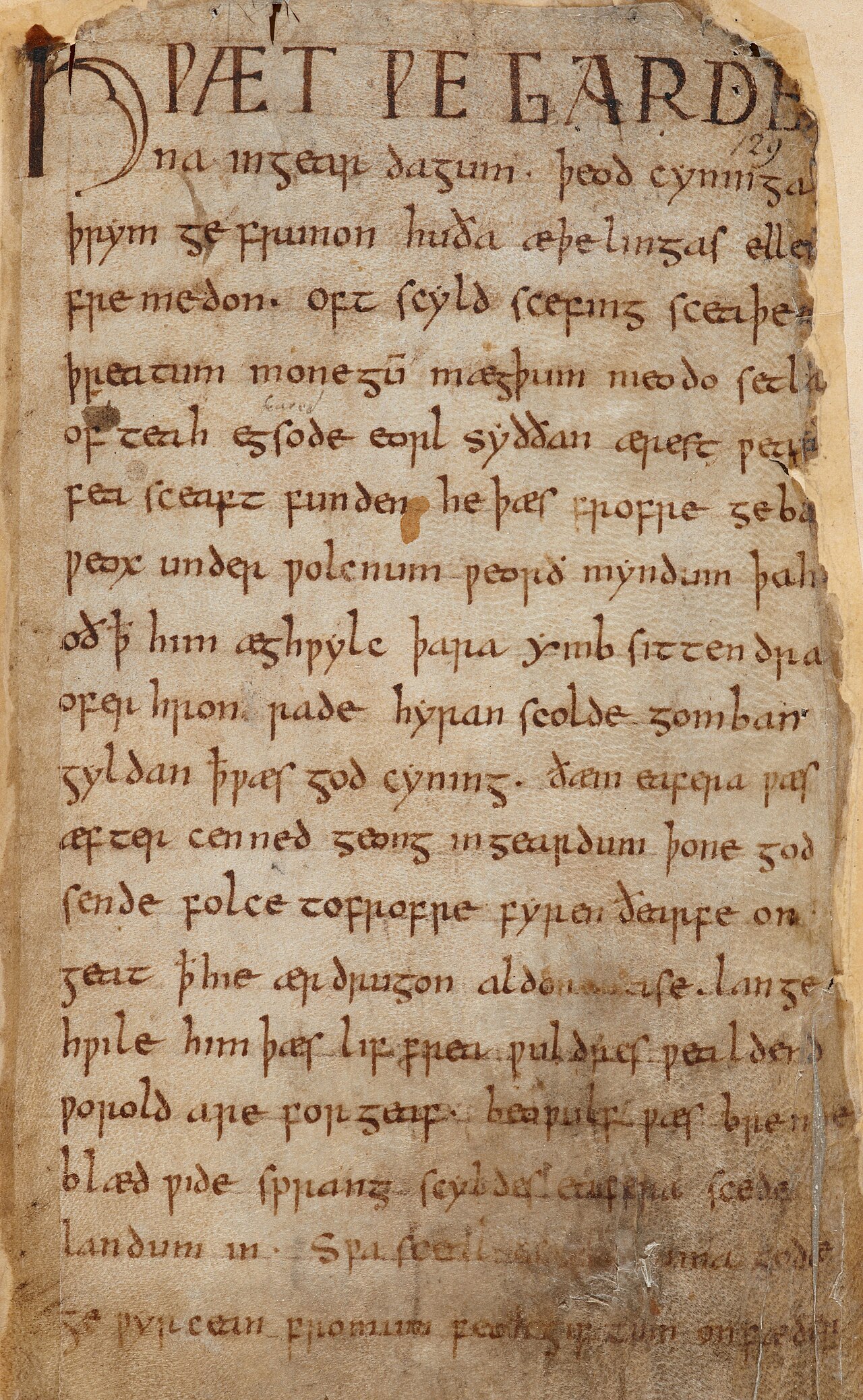
The British Library describes the poem Beowulf as "the greatest poem in the Old English language" and says the manuscript that contains it was made around the year 1000, most likely during the reign of King Æthelred the Unready (978–1016).[8] In its present state the poem has more than 3,000 lines; the manuscript was damaged by fire in 1731, although much of its text remains readable.[8]
The first folio of the Old English poem Beowulf, from the Cotton MS Vitellius A XV manuscript in the British Library, written about 975 to 1025.
According to Britannica, the Norman Conquest of 1066 put the Old English dialects roughly on a level with one another, and the centre of culture and learning gradually moved from Winchester to London.[7] The conquest brought many French words into English.[4] For three centuries, Britannica notes, literature in England was written in English, French and Latin.[7] The Pennsylvania page adds that the conquest sharply reduced the writing of English, and that everyday dialects returned to writing during the Middle English period.[6]
Britannica identifies five Middle English dialects: Northern, West Midland, East Midland, South Western and South Eastern.[7] Verb endings varied from dialect to dialect, with Scandinavian influence in the North.[7] Norman scribes also changed English spelling: Old English hūs came to be written "hous", and cwēn became "queen".[7]
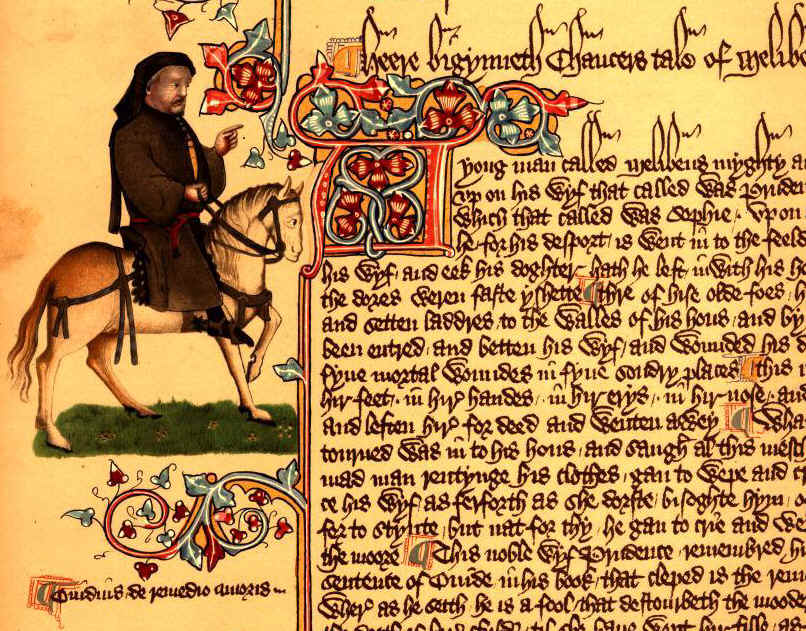
Britannica records that the Statute of Pleading of 1362 made English the language of proceedings in the law courts.[7] Geoffrey Chaucer, who spoke a mainly East Midland dialect, chose English for his literary work.[7] A history of English by Richard Barker, posted on a Purdue University Fort Wayne course site, notes that modern readers can read Chaucer with some difficulty but that his pronunciation would be almost completely unintelligible to a modern listener.[9] Toward the end of the Middle English period, according to the Pennsylvania page, the London dialect gained prestige and became the basis of standard Modern English, except in Scotland.[6]
Geoffrey Chaucer portrayed as a Canterbury pilgrim in the Ellesmere manuscript of The Canterbury Tales, early 15th century.
The Great Vowel Shift was a series of parallel changes in how English long vowels were pronounced, which Britannica dates to approximately the 15th to the 18th century.[10] In this chain of changes, vowels were pronounced with the tongue progressively higher in the mouth, and the Middle English high vowels /iː/ and /uː/ became diphthongs (vowel sounds that glide from one position to another within a syllable), /ai/ as in "bide" and /au/ as in "house".[10] The shift was first identified, and named, by the Danish linguist Otto Jespersen (1860–1943), and Britannica states that its exact causes are unknown.[10] Britannica connects the shift to London speech, where it changed the long vowels of words such as "name" and "house".[7]
William Caxton began printing in Westminster in 1476.[7] Printing, the Pennsylvania page notes, changed how literary texts survived, which is one reason the Middle English period is usually ended around 1500.[6] Renaissance scholars borrowed heavily from Latin and Greek, sometimes producing pairs of related words from the same root, such as "frail" and "fragile".[7] William Tyndale's translation of the New Testament strongly influenced the King James Bible of 1611, and Britannica describes the Tudor period as culminating in William Shakespeare.[7] Scientists and scholars long continued to write in Latin; Isaac Newton wrote his Principia in Latin but his Opticks in English.[7] By about 1700, according to the Pennsylvania page, English grammar was fully modern.[6]
Standardisation and dictionaries
In the 17th and 18th centuries, proposals to set up an academy to regulate English, like the one in France, came to nothing, according to Britannica.[5] Instead, Samuel Johnson's Dictionary of 1755 and Robert Lowth's grammar of 1761 helped to set standards.[5] Britannica notes that later grammarians were often prescriptive, meaning that they told people how they ought to speak and write rather than describing usage, and that some of their judgments, such as the condemnation of "you was", were disputed.[5]
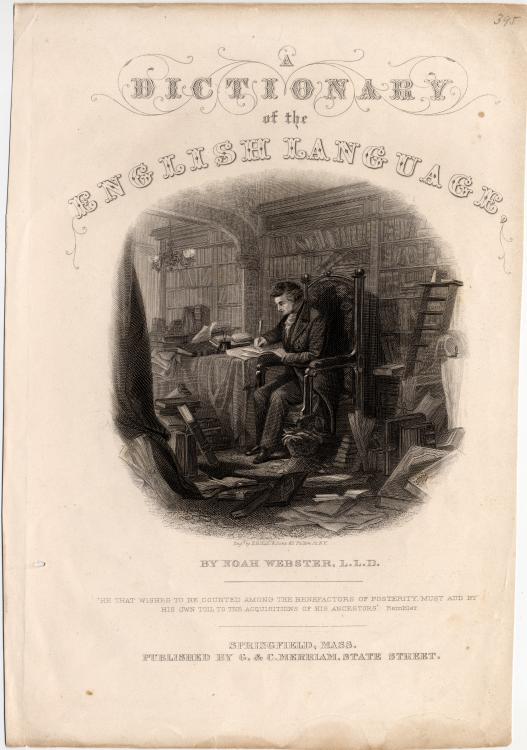
In the United States, Noah Webster, born in West Hartford, Connecticut, in 1758, aimed at a distinctive American language with its own idiom, pronunciation and style.[11] In 1806 he published A Compendious Dictionary of the English Language, which the publisher Merriam-Webster calls "the first truly American dictionary".[11] His An American Dictionary of the English Language, published in 1828, had 70,000 entries.[11] After Webster's death in 1843, the Merriam brothers bought the unsold copies and secured the rights to revised editions.[11]
Title page of A Dictionary of the English Language by Noah Webster, published by G. & C. Merriam in Springfield, Massachusetts, about 1845.
The Oxford English Dictionary began as A New English Dictionary on Historical Principles, first published in 1884.[5] Britannica records that it was completed in 12 volumes and revised in 1933 and 1989.[5]
Spread and speaker numbers
English spread far beyond England. The language reference Ethnologue attributes its reach first to the influence of the British Empire and later to the spread of American culture.[12] Ethnologue states that Mandarin Chinese has the most first-language speakers, while English is the largest language in the world when second-language and later-learned speakers are counted.[12] Its page, which shows no date, states that English is spoken in 146 countries, compared with 38 for Mandarin.[12]
Published estimates of the number of English speakers differ, and they count different groups:
The British Council's report The English Effect (2013) stated that English was spoken "at a useful level" by some 1.75 billion people, a quarter of the world's population.[13]
An article in the British Council's Voices magazine, published on 13 June 2014, gave estimates of 400 million people who speak English as a first language, "7-800 million" who speak it as a second language, and around a billion more who speak it as a foreign language.[14] By that estimate, the article said, there was one native speaker for every five non-native speakers.[14]
Britannica's main article on the language, which shows no date (accessed 28 November 2026), estimates that about a third of the world's population, some two billion people, use English.[1]
Britannica's summary article, also undated (accessed 28 November 2026), gives approximately 1.5 billion speakers, more than 350 million of them native speakers.[4]
National statistics give a narrower picture within particular countries. The US Census Bureau reported on 7 December 2023 that, in its 2018–2022 American Community Survey five-year estimates, 78.3% of people aged 5 and older spoke only English at home, down from 78.7% in 2013–2017.[15] In England and Wales, the Office for National Statistics reported on 29 November 2022 that in the 2021 census 91.1% (52.6 million) of usual residents aged three and over had English (English or Welsh in Wales) as a main language, down from 92.3% (49.8 million) in 2011.[16] A further 7.1% (4.1 million) were proficient in English without it being their main language.[16]
Major varieties
Linguists use the term "World Englishes" for the distinct forms of English that develop as speakers in different places adapt the language to their own needs, producing differences in vocabulary, spelling, pronunciation, grammar and meaning among American, British, Australian, Canadian, Indian and other varieties.[17] Purdue University's Online Writing Lab notes that the linguist Braj Kachru (1932–2016) argued in 1965, in "The Indianness in Indian English", that Indian English is a distinct variety, and that in 1984 he introduced the term "World Englishes".[17] Kachru's model of three concentric circles places countries where English is a primary language, such as the United States and the United Kingdom, in an inner circle; countries with a colonial history of English, such as India and Nigeria, in an outer circle; and countries where English is used without that history or official status, such as China and Japan, in an expanding circle.[17]
British and American English
Britannica's account of American pronunciation notes that an "r" after a vowel is preserved in words such as "door", "flower" and "harmony", whereas Received Pronunciation, the prestige accent of England, loses it.[18] In the same account, a "t" between vowels is voiced, so that "metal" and "matter" sound much like British "medal" and "madder", and American intonation is on the whole less singsong than British.[18]
Merriam-Webster counts among Webster's successful spellings "mold", "jail", "draft", "traveled", "magic" and "center", while Samuel Johnson's 1755 dictionary had included only "centre".[19] Other proposals failed, among them "soop" for soup, "spunge" for sponge, "wimmen" for women, "tung" for tongue, and "iz" and "waz" for is and was.[19]
Australian English
Bruce Moore of the Australian National Dictionary Centre at the Australian National University notes that the First Fleet arrived in 1788.[20] He writes that in the first 100 years of European settlement and exploration about 400 words were borrowed into Australian English from some 80 Aboriginal languages, almost exclusively nouns for things in the external world.[20] "Kangaroo" came from the language of the Guugu Yimidhirr people.[20] Moore also notes that about 200 words from various British dialects lost their dialect status in Australia and became part of the mainstream language, and that a few convict underworld terms also entered Australian English.[20]
Writing and spelling
Several historical developments shaped English spelling. The Norman scribes' spellings, such as "hous" and "queen", replaced Old English forms.[7] Richard Barker writes that when printing arrived, words were fixed on the printed page before teachers and writers had agreed on how to spell them, which helps to explain many inconsistencies.[9] Barker adds that while the spellings of some words changed to reflect the new pronunciations of the Great Vowel Shift, most did not.[9]
Dictionaries then helped to settle spellings: Johnson's of 1755 in Britain and Webster's of 1806 and 1828 in the United States.[5][11] Some of the differences between British and American spelling, such as "centre" and "center", go back to choices made in those dictionaries.[19] Despite such differences, the Pennsylvania page observes that written standard English varies little across English-speaking countries.[6]
Grammar
Old English, as noted above, was highly inflected.[5] In Modern English, Britannica states, nouns, pronouns, adjectives and verbs are inflected, while adverbs, prepositions, conjunctions and interjections do not change form.[18] Most nouns form the plural with -s or -es, which is pronounced differently in "cats", "dogs" and "horses"; seven nouns form the plural by changing an internal vowel (mutation, or umlaut).[18] Five of the seven personal pronouns have different forms as subject and as object.[18]
Verbs fall into two main types. Strong verbs have five forms ("ride", "rides", "rode", "riding", "ridden"), regular or weak verbs usually four ("walk", "walks", "walked", "walking"), and only the verb "to be" has eight forms.[18] English relies mainly on word order, usually subject–verb–object, to show how the words in a sentence relate to one another.[4]
Vocabulary
English has taken in words from many languages. Britannica estimates that the vocabulary of Modern English is about a quarter Germanic (Old English, Scandinavian, Dutch and German) and about two-thirds Italic or Romance (especially Latin, French, Spanish and Italian), with growing borrowing from Greek in science and technology and considerable borrowing from more than 300 other languages.[21]
Particular periods left their mark. The Norman Conquest brought many French words.[4] Renaissance scholars borrowed heavily from Latin and Greek.[7] As English spread to other continents, it continued to borrow, as the hundreds of Aboriginal words in Australian English show.[20]
Sources
Encyclopaedia Britannica, "English language". Encyclopaedia Britannica. No date shown; accessed 28 November 2026. britannica.com/topic/English-language
Encyclopaedia Britannica, "English language" (summary). Encyclopaedia Britannica. No date shown; accessed 28 November 2026. britannica.com/summary/English-language
Encyclopaedia Britannica, "Great Vowel Shift". Encyclopaedia Britannica. No date shown; accessed 28 November 2026. britannica.com/topic/Great-Vowel-Shift