Version 2 (current)
Nov 28, 2026. Version history
The Philippines is an island country in the western Pacific Ocean, off the southeast coast of Asia, whose capital is Manila.[1]
Geography
Britannica's summary article counts about 7,100 islands and names Luzon and Mindanao as the two largest.[2] Its fact page gives a total area of about 300,000 square kilometres (115,830 square miles).[3] The larger islands are usually grouped into three regions: Luzon in the north, the Visayas in the centre and Mindanao in the south.[1]
The highest peak is Mount Apo on Mindanao, at 2,954 metres (9,692 feet).[1] The Puerto Princesa Subterranean River on the island of Palawan is a UNESCO World Heritage site.[1]
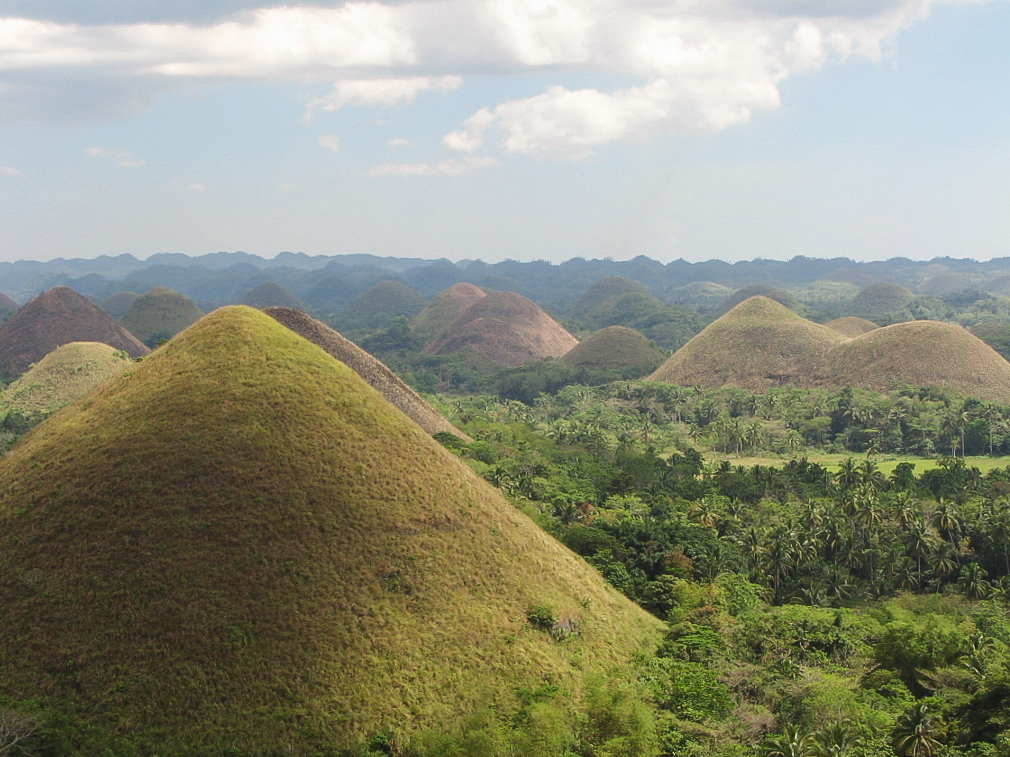
Via Wikimedia Commons: Chocolate Hills - edit by Ramir Borja derivative work: MrPanyGoff, CC BY-SA 3.0.
The climate is tropical and monsoonal, meaning that seasonal winds bring distinct wet and dry periods.[1] Southwest winds bring rain from about May to October, while northeast winds bring drier weather from about November to February.[1] Typhoons (the tropical cyclones of the western Pacific) usually strike between June and December, and Britannica names Samar, Leyte, south-central Luzon and the Batanes Islands as the areas hit hardest.[1] Super Typhoon Haiyan, which struck in November 2013, did its worst damage in the central Philippines.[4]
People and languages
Population
The official population count comes from the 2024 Census of Population carried out by the Philippine Statistics Authority (PSA).[5] As reported by The Philippine Star on 18 July 2025, the census counted 112.73 million people as of 1 July 2024, a figure President Ferdinand Marcos Jr. declared official through Proclamation No. 973, dated 11 July 2025.[5] This was 3.69 million more than the 109.04 million counted in 2020, and the annual growth rate slowed to 0.8 percent for 2020 to 2024, which the PSA linked to falling fertility and birth rates, higher mortality during the COVID-19 pandemic and weaker migration.[5] Calabarzon, south of Manila, was the most populous region at 16.93 million.[5] Britannica's fact page, which uses estimates rather than the census, gives a 2024 population of about 116.6 million.[3] Manila is the capital, but Quezon City is the most populous city.[1]
Languages and ethnic groups
Filipino and English are the official languages.[3] Filipino is based on Tagalog, the language of the largest cultural-linguistic group in the country, which Britannica describes as the mother tongue of about 19.55 million Filipinos and as being taught in all schools.[6] Tagalog is an Austronesian language.[6] Several other major languages are spoken across the islands.[2]
Religion
The country has no official religion.[3] Most Filipinos are Christian, mainly Roman Catholic, and there is a significant Muslim minority.[2] The Moro, the Muslim peoples of Mindanao, Palawan, the Sulu Archipelago and other southern islands, make up about 5 percent of the population, according to Britannica.[4]
History
Spanish rule
Britannica notes that the Philippines was the only country in Southeast Asia colonised by a Western power before it had developed a centralised government over a large territory or a single dominant culture.[4] Ferdinand Magellan reached the islands in 1521, and Spain later colonised them.[2]
Armed rebellion against Spanish rule broke out in 1896.[7] The writer José Rizal was shot for sedition on 30 December 1896, and his execution fuelled the revolution led by Emilio Aguinaldo.[7] On 12 June 1898 the revolutionaries declared independence and proclaimed a provisional republic with Aguinaldo as president.[7]
American rule
After the Spanish–American War, under the Treaty of Paris, signed in December 1898 and ratified by the United States Senate in February 1899, Spain ceded the Philippines, Puerto Rico and Guam to the United States.[4] Filipino leaders did not recognise American sovereignty, and fighting broke out near Manila on the night of 4 February 1899.[7] The Philippine–American War lasted from 1899 to 1902; an end to the insurrection was declared in 1902, but scattered fighting went on for several more years.[7]
Japanese occupation and independence
A Commonwealth was established in 1935, but full independence was delayed by the Second World War and the occupation of the islands by Japan.[2] Japanese forces landed on Luzon on 10 December 1941 and took Manila on 2 January 1942; the last American and Filipino positions, on Bataan and Corregidor, fell in May 1942.[4] United States forces retook the islands in 1944–45, and the Republic of the Philippines was proclaimed in 1946.[2]
The Marcos era
Ferdinand Marcos was elected president in 1965, declared martial law in 1972 and was driven from power in 1986, after which Corazon Aquino restored democratic rule.[2] Marcos fled the 1986 popular uprising and died in exile in Hawaii in 1989.[8]
Reuters reported in September 2022 that many historians describe his rule as one of Asia's worst kleptocracies (governments whose leaders use power to enrich themselves), and that critics accused the presidential campaign of his son, Ferdinand Marcos Jr., of trying to whitewash the corruption and authoritarianism of that period.[8] In his first interview after winning the presidency in May 2022, Marcos Jr. said martial law had been necessary because the government was fighting communist and separatist rebellions at the same time, and that his father had acted because the "government had to defend itself" rather than to stay in power; he also denied that his family was distorting history.[8] According to the same report, more than 11,000 victims of martial law had received reparations paid from recovered Marcos-era wealth.[8]
The "war on drugs" and the International Criminal Court
Rodrigo Duterte, president from 2016 to 2022, led a campaign against illegal drugs in which large numbers of people were killed.[9][10] Al Jazeera reported in March 2025 that police recorded about 7,000 deaths in police operations, while human rights advocates and the prosecutor of the International Criminal Court (ICC) estimated that some 30,000 people had been killed by police and unidentified attackers by the end of his term.[9] Duterte announced the country's withdrawal from the ICC after the court said in February 2018 that it would open a preliminary investigation; the withdrawal took effect in March 2019, but the court keeps jurisdiction over crimes committed while a country was a member.[9]
The ICC's Pre-Trial Chamber I issued a warrant for Duterte's arrest on 7 March 2025.[10] He was arrested in Manila on 11 March 2025 and flown to The Hague hours later; Marcos Jr. said the arrest complied with the country's commitments to Interpol, the international police organisation.[9] After his arrest, Duterte told police that if he had committed a sin he should be prosecuted in Philippine courts.[9] His defence challenged the court's jurisdiction. On 23 October 2025 the Pre-Trial Chamber rejected that challenge, finding that the court could exercise jurisdiction in the case, and on 22 April 2026 the Appeals Chamber confirmed the Pre-Trial Chamber's decision.[10] In a decision dated 23 April 2026, the Pre-Trial Chamber considered three counts of crimes against humanity, covering murders in Davao City while he was its mayor and murders and attempted murders across the country during his presidency.[10] Manila Bulletin reported that all three counts were confirmed.[11] At the confirmation stage the defence argued that the killings had taken place in armed confrontations, that the word "neutralise" used in the campaign meant lawful restraint, and that insider and hearsay evidence was unreliable; the chamber did not accept these arguments.[10] On 21 May 2026 the chamber refused the defence permission to appeal the confirmation decision.[11]
Trial Chamber III ruled on 28 September 2026 that Duterte was fit to stand trial, a decision made public on 8 October 2026.[12] As of 26 November 2026, GMA News reported that the trial was due to open on Monday 30 November 2026.[13] In a filing reported the same day, his lead defence counsel, Peter Haynes, again raised Duterte's cognitive impairment and said that, although Duterte was physically present, "his ability to contribute to his defense is virtually non-existent".[13] On 28 November 2026 Vice-President Sara Duterte said the family did not expect a fair trial from the ICC.[14]
Government and politics
The 1987 constitution declares the Philippines a democratic and republican state.[15] Executive power belongs to the president, who is both head of state and head of government.[15][2] The president and vice-president are elected by direct popular vote for six-year terms, and the president cannot be re-elected.[15] Legislative power belongs to a two-chamber Congress made up of a Senate of 24 senators elected nationwide and a House of Representatives, and judicial power belongs to a Supreme Court and lower courts.[15]
As of November 2026, the president is Ferdinand Marcos Jr., whose government chaired the Association of Southeast Asian Nations (ASEAN) during 2026.[16] The Asia Media Centre reported on 18 November 2026 that he closed the Philippine chairmanship at the 49th ASEAN Summit, handing over to Singapore, which takes the chair on 1 January 2027.[16] He named the ASEAN Digital Economy Framework Agreement as the main legacy of the Philippine year, and acknowledged that a code of conduct for the South China Sea was not completed during it.[16]
The vice-president is Sara Duterte.[17] The Marcos and Duterte camps, once allies, have fallen out, and the feud deepened after Rodrigo Duterte's transfer to ICC custody.[17] The House of Representatives impeached her on allegations of corruption, bribery and a plot to assassinate President Marcos, and her Senate trial opened on 6 July 2026; she denies wrongdoing, and her lawyers say the allegations have no basis.[17] Conviction requires a two-thirds vote of the 24-member Senate and would remove her from office and bar her permanently from elected office.[17] As of 27 November 2026 the trial was still under way, with the defence presenting its witnesses and no verdict reached.[18][19] Hearings set for 26 and 27 November 2026 were moved because defence witnesses were unavailable, and the presiding officer, Senator Francis Escudero, scheduled four trial dates from 1 to 4 December 2026, saying more could be added before 18 December.[19] On 27 November 2026 Sara Duterte said her office would accept whatever verdict the Senate reached and was "prepared for the worst".[18]
Contested territory and internal conflict
South China Sea
On 22 January 2013 the Philippines started arbitration proceedings against China under the United Nations Convention on the Law of the Sea, covering historic rights, the status of certain maritime features and the lawfulness of certain Chinese actions.[20] China did not accept or take part in the proceedings, and the tribunal, for which the Permanent Court of Arbitration acted as registry, issued its award on 12 July 2016.[20] The tribunal found "no legal basis for China to claim historic rights to resources" within China's "nine-dash line" claim.[21] China called the ruling "null and void", and President Xi Jinping said China would not accept any proposition or action based on the decision.[21]
Mindanao
In response to independence movements in the south, the national government established an autonomous region in Muslim Mindanao.[2] The Manila Times traces the peace process back to the 1976 Tripoli Agreement, signed under Marcos Sr.[22] The Bangsamoro region held parliamentary elections on 14 September 2026, and its parliament was due to open on 30 October 2026.[22] The newspaper reported on 13 October 2026 that, according to the civil society coalition Amana, about 14,000 former fighters of the Moro Islamic Liberation Front (MILF), the main former rebel group, were still awaiting decommissioning; it also reported that the MILF's chairman had asked to meet the president, and that Marcos had met other Bangsamoro leaders since the election.[22]
Economy
Britannica describes a mainly market economy based on agriculture, light industry and services, with the peso as its currency.[2] Its fact page gives a gross national income of about US$496.2 billion for 2023, or US$4,230 per person.[3]
The central bank, the Bangko Sentral ng Pilipinas, reported in February 2026 that cash remittances from overseas Filipinos reached a record US$35.634 billion in 2025, up 3.3 percent from US$34.49 billion in 2024.[23]
On 9 November 2026 the PSA reported that gross domestic product grew 2.1 percent year on year in the third quarter of 2026, down from a revised 2.4 percent in the second quarter, and 2.5 percent over the first nine months of the year.[24] Arsenio Balisacan, secretary of the Department of Economy, Planning and Development, attributed the weakness to high food and energy prices, disruptions to farming and weak investment.[24] GMA News reported that inflation reached 7.8 percent in October 2026.[24] Exports grew 8.6 percent in the quarter, with electronics exports up 19.4 percent on demand for products linked to artificial intelligence.[24]
Culture
Britannica describes Philippine culture as a blend in which nearly four centuries of Western rule brought Western culture and helped build a sense of national unity, while extended families, the barangay (the smallest unit of local government) and renewed interest in Asian history keep Asian traditions alive.[25] Meals are usually built around rice or rice noodles.[25]
Indigenous arts include wood carving and music played on gongs and flutes, and the kulintang ensemble remains important in Muslim communities.[25] Philippine literature has roots in Rizal's political novels and shifted over time from Spanish to English and, more recently, to Filipino and Tagalog; regional oral epics such as the Darangen and Biag ni Lam-ang preserve older lore.[25] Spanish-era churches, the colonial town of Vigan and the rice terraces of northern Luzon are among the country's UNESCO World Heritage sites.[25]
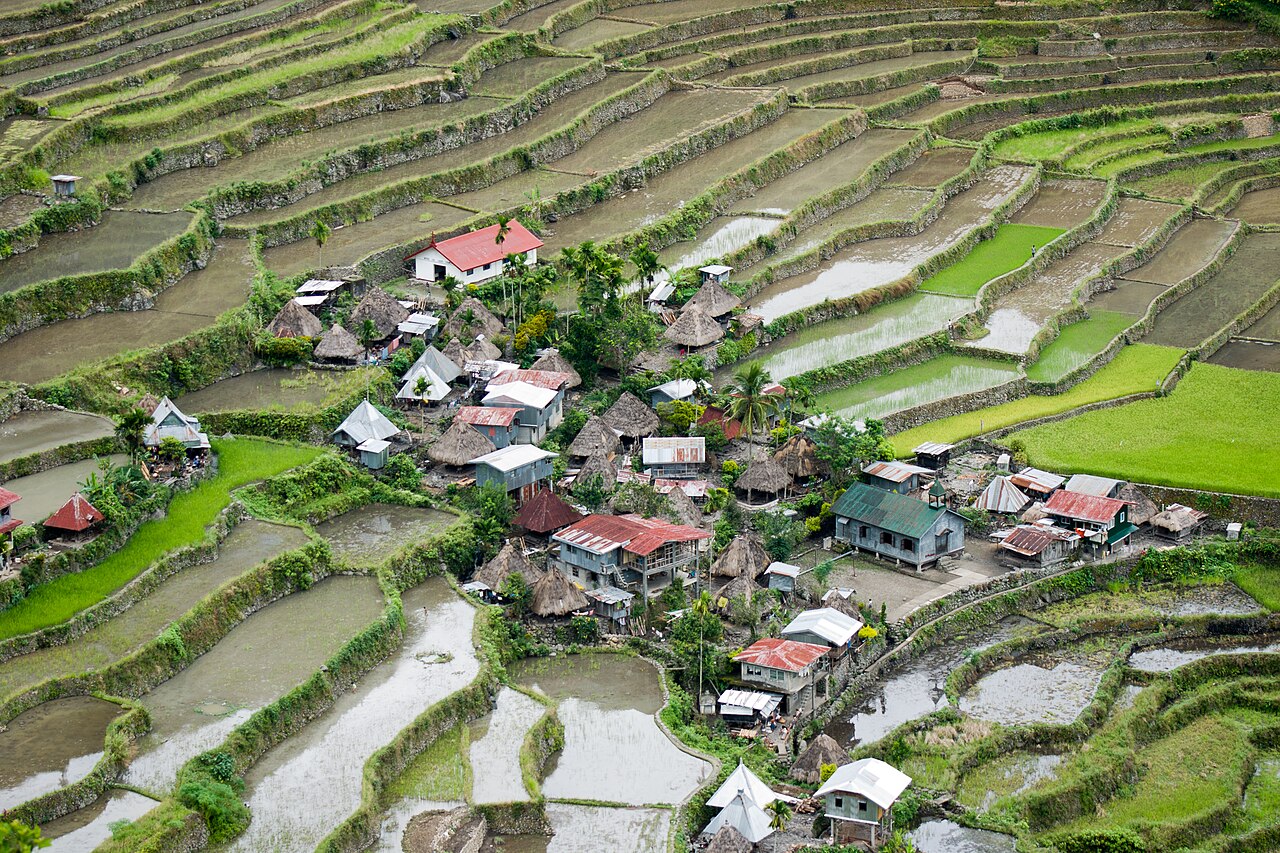
Via Wikimedia Commons: Banaue Philippines Batad-Rice-Terraces-02 by CEphoto, Uwe Aranas, CC BY-SA 4.0.
UNESCO describes the Rice Terraces of the Philippine Cordilleras, built by the Ifugao people about 2,000 years ago, as a living cultural landscape still maintained through cooperative, traditional practices.[26] UNESCO placed them on its List of World Heritage in Danger in 2001.[26]
Boxing has a long following: Flash Elorde held a world junior-lightweight title from 1960 to 1967, and the boxing match known as the "Thrilla in Manila" took place on 1 October 1975.[4]
Sources
- "Philippines". Encyclopaedia Britannica. No date shown; accessed 28 November 2026. britannica.com/place/Philippines
- "Geography and history of the establishment of the Philippines" (summary article). Encyclopaedia Britannica. No date shown; accessed 28 November 2026. britannica.com/summary/Philippines
- "Philippines Facts". Encyclopaedia Britannica. No date shown; accessed 28 November 2026. britannica.com/facts/Philippines
- "History of the Philippines". Encyclopaedia Britannica. No date shown; accessed 28 November 2026. britannica.com/topic/history-of-Philippines
- Louella Desiderio. "Philippines population reached 112.7 million in 2024 – PSA". The Philippine Star, 18 July 2025. philstar.com/headlines/2025/07/18/2458844/philippines-population-re…
- "Tagalog". Encyclopaedia Britannica. No date shown; accessed 28 November 2026. britannica.com/topic/Tagalog
- "Philippine-American War". Encyclopaedia Britannica. No date shown; accessed 28 November 2026. britannica.com/event/Philippine-American-War
- Reuters. "Philippines president Marcos defends father's martial law legacy". Malay Mail, 13 September 2022. malaymail.com/news/world/2022/09/13/philippines-president-marcos-de…
- Ted Regencia. "Arrested on ICC warrant: What was Duterte's 'war on drugs'?". Al Jazeera, 11 March 2025. aljazeera.com/news/2025/3/11/arrested-on-icc-warrant-what-was-duter…
- International Criminal Court, Pre-Trial Chamber I. "Decision on the confirmation of charges against Mr Rodrigo Roa Duterte" (ICC-01/21-01/25), 23 April 2026; copy published by Courthouse News Service. courthousenews.com/wp-content/uploads/2026/04/decision-on-the-confi…
- "ICC rejects Duterte's latest appeal over confirmation of charges". Manila Bulletin, 22 May 2026. mb.com.ph/2026/05/22/icc-rejects-dutertes-latest-appeal-over-confir…
- Andy Peñafuerte III and Jay-vee Marasigan Pangan. "Rodrigo Duterte fit to stand trial, says ICC Trial Chamber". GMA News, 8 October 2026. gmanetwork.com/news/topstories/nation/1005280/rodrigo-duterte-fit-t…
- Andy Peñafuerte. "Defense lawyer brings up Duterte's 'cognitive impairment' anew ahead of ICC trial". GMA News, 26 November 2026. gmanetwork.com/news/topstories/nation/1010854/defense-lawyer-brings…
- Kristine Daguno-Bersamina. "Sara Duterte doubts fairness of father's ICC trial, says court wants to 'make a statement'". Philstar.com, 28 November 2026. philstar.com/headlines/2026/11/28/2573235/sara-duterte-doubts-fairn…
- "Philippines 1987" (Constitution of the Republic of the Philippines). Constitute Project (Comparative Constitutions Project). Generated 30 September 2025; accessed 28 November 2026. constituteproject.org/constitution/Philippines_1987.pdf
- Carla Teng-Westergaard. "Full Sail, Then a Fast Exit: Marcos Closes the Philippines' ASEAN Year". Asia Media Centre, 18 November 2026. asiamediacentre.org.nz/full-sail-then-a-fast-exit-marcos-closes-the…
- Al Jazeera Staff, AFP and Reuters. "Impeachment trial of Philippine Vice President Sara Duterte begins". Al Jazeera, 6 July 2026. aljazeera.com/news/2026/7/6/impeachment-trial-of-philippine-vice-pr…
- Alyana Uy. "VP Sara Duterte: We will accept whatever impeachment verdict". Philstar.com, 27 November 2026. philstar.com/headlines/2026/11/27/2573060/vp-sara-duterte-we-will-a…
- Jean Mangaluz. "Sara Duterte trial dates on Nov. 26 and 27 reset over defense witnesses' unavailability". GMA News, 20 November 2026. gmanetwork.com/news/topstories/nation/1010235/sara-duterte-trial-da…
- "The South China Sea Arbitration (The Republic of Philippines v. The People's Republic of China)", PCA Case No. 2013-19. Permanent Court of Arbitration. No date shown; accessed 28 November 2026. pca-cpa.org/en/cases/7/
- Clifford Coonan. "Beijing angrily rejects Hague ruling on South China Sea". The Irish Times, 13 July 2016. irishtimes.com/news/world/asia-pacific/beijing-angrily-rejects-hagu…
