Compare versions
Version 1 → Version 2 (current). Removed · Added. This shows the entry's text as it is written, including its formatting marks.
Version 1 · Version 2 (current) · Version history
Side by side · Together
Version 1Version 2 (current)
5 unchanged paragraphs
Influenza, commonly called flu, is a contagious respiratory illness caused by influenza viruses, which circulate worldwide and cause seasonal epidemics and, occasionally, pandemics.[1][2]
Influenza, commonly called flu, is a contagious respiratory illness caused by influenza viruses, which circulate worldwide and cause seasonal epidemics and, occasionally, pandemics.[1][2]
## Burden and risk groups
## Burden and risk groups
The World Health Organization (WHO), in a fact sheet dated 28 February 2025, estimates that seasonal influenza causes about a billion cases a year worldwide, including 3 to 5 million cases of severe illness, and 290,000 to 650,000 respiratory deaths a year.[1] WHO identifies pregnant women, young children, older adults, people with chronic or immunosuppressive conditions, and health workers as groups at higher risk.[1]
The World Health Organization (WHO), in a fact sheet dated 28 February 2025, estimates that seasonal influenza causes about a billion cases a year worldwide, including 3 to 5 million cases of severe illness, and 290,000 to 650,000 respiratory deaths a year.[1] WHO identifies pregnant women, young children, older adults, people with chronic or immunosuppressive conditions, and health workers as groups at higher risk.[1]
## The viruses
## The viruses
Influenza viruses are single-stranded RNA viruses of the orthomyxovirus family, according to the "Pink Book", a reference text on vaccine-preventable diseases published by the US Centers for Disease Control and Prevention (CDC) and updated 1 April 2024.[3] It records that influenza A virus was first isolated, in ferrets, in 1933.[3]
Influenza viruses are single-stranded RNA viruses of the orthomyxovirus family, according to the "Pink Book", a reference text on vaccine-preventable diseases published by the US Centers for Disease Control and Prevention (CDC) and updated 1 April 2024.[3] It records that influenza A virus was first isolated, in ferrets, in 1933.[3]
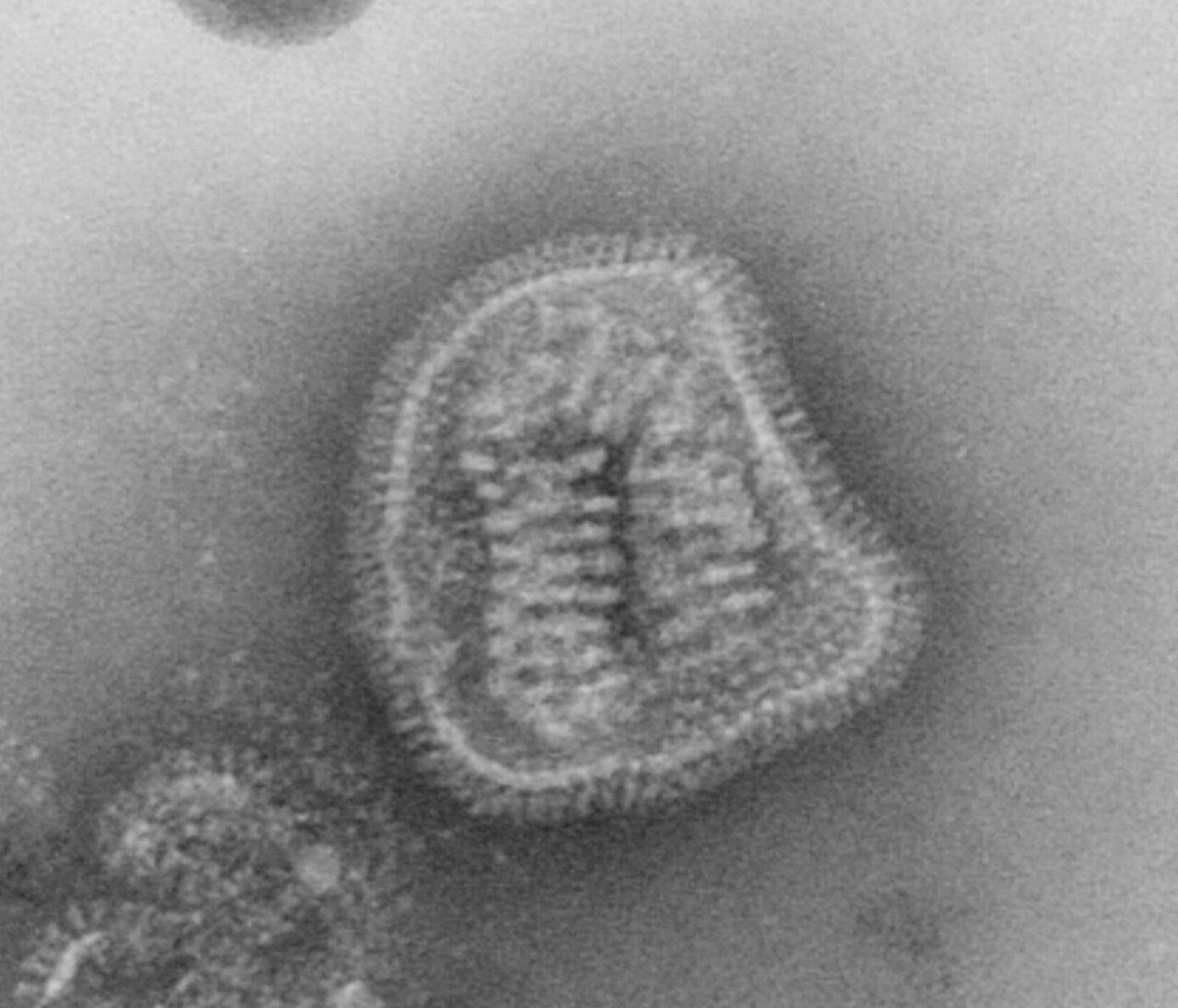
 by Photo Credit: Cynthia Goldsmith Content Providers(s): CDC/ D, public domain.*
*Via Wikimedia Commons: [Influenza virus particle 8430 lores](https://commons.wikimedia.org/wiki/File:Influenza_virus_particle_8430_lores.jpg) by Photo Credit: Cynthia Goldsmith Content Providers(s): CDC/ D, public domain.*
### Types A, B, C and D
### Types A, B, C and D
A CDC page last updated on 26 September 2025 describes four types of influenza virus: A, B, C and D.[2] Types A and B cause the seasonal epidemics seen in people nearly every winter in the United States.[2] Type C usually causes mild illness and is not thought to cause human epidemics, and type D mainly affects cattle and is not known to make people ill.[2][1] Only type A viruses are known to have caused flu pandemics.[2][1]
A CDC page last updated on 26 September 2025 describes four types of influenza virus: A, B, C and D.[2] Types A and B cause the seasonal epidemics seen in people nearly every winter in the United States.[2] Type C usually causes mild illness and is not thought to cause human epidemics, and type D mainly affects cattle and is not known to make people ill.[2][1] Only type A viruses are known to have caused flu pandemics.[2][1]
### Subtypes, lineages and naming
### Subtypes, lineages and naming
Influenza A viruses are divided into subtypes according to two proteins on the virus surface, hemagglutinin (H) and neuraminidase (N); the CDC lists 18 hemagglutinin and 11 neuraminidase subtypes.[2] A(H1N1) and A(H3N2) are the influenza A subtypes that routinely circulate in people.[2] Influenza B viruses have no subtypes and are grouped into two lineages, B/Victoria and B/Yamagata, and the CDC states that B/Yamagata viruses have not been detected since March 2020.[2] Each virus is named under an international convention that records the type, the host of origin (left out for human viruses), the place where it was found, a strain number, the year and, for type A, the subtype.[2]
Influenza A viruses are divided into subtypes according to two proteins on the virus surface, hemagglutinin (H) and neuraminidase (N); the CDC lists 18 hemagglutinin and 11 neuraminidase subtypes.[2] A(H1N1) and A(H3N2) are the influenza A subtypes that routinely circulate in people.[2] Influenza B viruses have no subtypes and are grouped into two lineages, B/Victoria and B/Yamagata, and the CDC states that B/Yamagata viruses have not been detected since March 2020.[2] Each virus is named under an international convention that records the type, the host of origin (left out for human viruses), the place where it was found, a strain number, the year and, for type A, the subtype.[2]
### Drift and shift
### Drift and shift
In the Pink Book's description, antigenic drift is the build-up of small genetic mutations that alter hemagglutinin and neuraminidase over time, and it occurs in influenza types A, B and C.[3] Antigenic shift is an abrupt, major change in one or both surface proteins, which the Pink Book attributes to an exchange of gene segments between influenza A viruses that infect humans and/or animals.[3] The CDC states that a pandemic occurs when a new influenza A virus emerges that spreads easily among people and against which people have little or no immunity.[2]
In the Pink Book's description, antigenic drift is the build-up of small genetic mutations that alter hemagglutinin and neuraminidase over time, and it occurs in influenza types A, B and C.[3] Antigenic shift is an abrupt, major change in one or both surface proteins, which the Pink Book attributes to an exchange of gene segments between influenza A viruses that infect humans and/or animals.[3] The CDC states that a pandemic occurs when a new influenza A virus emerges that spreads easily among people and against which people have little or no immunity.[2]
## How it spreads
## How it spreads
According to a CDC page last updated on 17 September 2024, most experts think influenza viruses spread mainly in droplets produced when people with flu cough, sneeze or talk; less often, a person may be infected after touching a contaminated surface and then the mouth, nose or possibly the eyes.[4] The virus can be detected in most infected people from one day before symptoms begin until five to seven days after they fall ill, and people are most contagious during the first three days of illness.[4] Young children and people with weakened immune systems may be contagious for longer, and people without symptoms may still pass the virus on.[4]
According to a CDC page last updated on 17 September 2024, most experts think influenza viruses spread mainly in droplets produced when people with flu cough, sneeze or talk; less often, a person may be infected after touching a contaminated surface and then the mouth, nose or possibly the eyes.[4] The virus can be detected in most infected people from one day before symptoms begin until five to seven days after they fall ill, and people are most contagious during the first three days of illness.[4] Young children and people with weakened immune systems may be contagious for longer, and people without symptoms may still pass the virus on.[4]
## Seasonality
## Seasonality
WHO states that in temperate climates seasonal epidemics occur mainly in winter, while in tropical regions influenza can occur throughout the year.[1] The CDC's weekly US surveillance report published on 20 November 2026 said seasonal flu activity was continuing to increase nationally.[10]
WHO states that in temperate climates seasonal epidemics occur mainly in winter, while in tropical regions influenza can occur throughout the year.[1] The CDC's weekly US surveillance report published on 20 November 2026 said seasonal flu activity was continuing to increase nationally.[10]
## Typical course
## Typical course
WHO describes symptoms as beginning one to four days after infection and usually lasting about a week; they include fever, dry cough, headache, muscle pain, tiredness and sore throat, and the cough can last two weeks or more.[1] The CDC states that not everyone with flu has a fever, that some people have vomiting and diarrhea, more often children than adults, and that most people recover in a few days to less than two weeks.[5]
WHO describes symptoms as beginning one to four days after infection and usually lasting about a week; they include fever, dry cough, headache, muscle pain, tiredness and sore throat, and the cough can last two weeks or more.[1] The CDC states that not everyone with flu has a fever, that some people have vomiting and diarrhea, more often children than adults, and that most people recover in a few days to less than two weeks.[5]
Complications listed by the CDC include sinus and ear infections, pneumonia, inflammation of the heart (myocarditis), brain (encephalitis) or muscle tissue, and failure of several organs.[5] The CDC also states that secondary bacterial infections are more common with influenza than with COVID-19.[6]
Complications listed by the CDC include sinus and ear infections, pneumonia, inflammation of the heart (myocarditis), brain (encephalitis) or muscle tissue, and failure of several organs.[5] The CDC also states that secondary bacterial infections are more common with influenza than with COVID-19.[6]
## Diagnosis
## Diagnosis
A CDC page for clinicians last updated on 19 December 2025 divides the tests used in clinical settings into molecular assays, which detect influenza viral RNA or nucleic acids and include rapid molecular assays and reverse transcription polymerase chain reaction (RT-PCR), and antigen detection tests, which detect viral antigens and include rapid influenza diagnostic tests.[7] The page gives rapid molecular assays a result time of about 15 to 30 minutes with high sensitivity (90–95%), and rapid antigen tests 10 to 15 minutes with moderate sensitivity (50–70%).[7] It states that testing is not required for a clinical diagnosis of influenza in outpatients, particularly when influenza activity is high.[7]
A CDC page for clinicians last updated on 19 December 2025 divides the tests used in clinical settings into molecular assays, which detect influenza viral RNA or nucleic acids and include rapid molecular assays and reverse transcription polymerase chain reaction (RT-PCR), and antigen detection tests, which detect viral antigens and include rapid influenza diagnostic tests.[7] The page gives rapid molecular assays a result time of about 15 to 30 minutes with high sensitivity (90–95%), and rapid antigen tests 10 to 15 minutes with moderate sensitivity (50–70%).[7] It states that testing is not required for a clinical diagnosis of influenza in outpatients, particularly when influenza activity is high.[7]
## Antiviral medicines
## Antiviral medicines
A CDC clinical summary updated on 10 March 2026 lists four antiviral medicines approved by the US Food and Drug Administration (FDA) and recommended for influenza: oral oseltamivir, inhaled zanamivir, intravenous peramivir and oral baloxavir.[8] The first three block the viral neuraminidase enzyme and are active against influenza A and B; baloxavir instead interferes with viral RNA transcription.[8] The summary states that clinical benefit is greatest when treatment begins early, especially within 48 hours, and recommends prompt treatment for patients with suspected or confirmed influenza who are in hospital, who have severe, complicated or progressive illness, or who are at higher risk of complications.[8] WHO's fact sheet states that most people recover on their own and that antivirals may be given to people in high-risk groups or with severe symptoms.[1]
A CDC clinical summary updated on 10 March 2026 lists four antiviral medicines approved by the US Food and Drug Administration (FDA) and recommended for influenza: oral oseltamivir, inhaled zanamivir, intravenous peramivir and oral baloxavir.[8] The first three block the viral neuraminidase enzyme and are active against influenza A and B; baloxavir instead interferes with viral RNA transcription.[8] The summary states that clinical benefit is greatest when treatment begins early, especially within 48 hours, and recommends prompt treatment for patients with suspected or confirmed influenza who are in hospital, who have severe, complicated or progressive illness, or who are at higher risk of complications.[8] WHO's fact sheet states that most people recover on their own and that antivirals may be given to people in high-risk groups or with severe symptoms.[1]
## Vaccines
## Vaccines
WHO describes annual vaccination as the main means of preventing influenza.[1] WHO recommends the composition of flu vaccines twice a year, once for each hemisphere.[15] On 27 February 2026, after a four-day consultation, it announced its choice for the 2026–27 northern hemisphere season: one A(H1N1)pdm09, one A(H3N2) and one B/Victoria-lineage virus, with different H3N2 and B strains for egg-based and other vaccines.[15]
WHO describes annual vaccination as the main means of preventing influenza.[1] WHO recommends the composition of flu vaccines twice a year, once for each hemisphere.[15] On 27 February 2026, after a four-day consultation, it announced its choice for the 2026–27 northern hemisphere season: one A(H1N1)pdm09, one A(H3N2) and one B/Victoria-lineage virus, with different H3N2 and B strains for egg-based and other vaccines.[15]
The FDA lists MFLUSIVA (Influenza Vaccine, mRNA), made by ModernaTX, with an approval letter dated 5 August 2026, as approved for use in persons 50 years of age and older.[12] A letter from Wisconsin's state health department dated 9 September 2026 stated that all US seasonal flu vaccines for the 2026–27 season are trivalent, that is, made against three viruses, and listed mRNA vaccine among the kinds available.[11]
The FDA lists MFLUSIVA (Influenza Vaccine, mRNA), made by ModernaTX, with an approval letter dated 5 August 2026, as approved for use in persons 50 years of age and older.[12] A letter from Wisconsin's state health department dated 9 September 2026 stated that all US seasonal flu vaccines for the 2026–27 season are trivalent, that is, made against three viruses, and listed mRNA vaccine among the kinds available.[11]
### How recommendations differ
### How recommendations differ
- **United States.** The Advisory Committee on Immunization Practices (ACIP) recommendations for the 2025–26 season, published by the CDC on 28 August 2025, recommended routine annual flu vaccination for all persons aged 6 months and older without a contraindication, ideally during September or October for most groups.[9] Wisconsin's health department stated on 9 September 2026 that ACIP was inactive and that the CDC had kept its July 2025 immunization schedule in effect for the 2026–27 season.[11] The CDC's surveillance report of 20 November 2026 stated that flu vaccination is recommended for everyone aged 6 months and older who has not yet been vaccinated.[10]
- **England.** The UK Health Security Agency (UKHSA) and NHS England, in their annual flu letter of 26 February 2026, offer vaccination to defined groups rather than to everyone.[13] From 1 September 2026 these include pregnant women, children aged 2 or 3, and school-aged children from reception to year 11, and from 1 October 2026 people aged 65 and over, adults in clinical risk groups, care home residents and certain carers.[13]
- **European Union.** The European Centre for Disease Prevention and Control (ECDC), in a statement of 29 October 2024, called for higher flu vaccination coverage among high-risk groups such as the elderly and people with weakened immune systems and underlying conditions.[14] It reported that coverage among people aged 65 and over in the 2023–24 season ranged from 12% to 78% between countries.[14]
## Surveillance
## Surveillance
Global influenza surveillance has run through WHO's Global Influenza Surveillance and Response System (GISRS) since 1952, which WHO describes as the longest-standing global platform for systematic disease surveillance.[15]
Global influenza surveillance has run through WHO's Global Influenza Surveillance and Response System (GISRS) since 1952, which WHO describes as the longest-standing global platform for systematic disease surveillance.[15]
In the United States, the CDC collects influenza data year-round with state, local and territorial health departments, combining laboratory, outpatient, hospital and death data and surveillance for novel influenza A viruses, according to a CDC page last updated on 2 December 2025.[16] The weekly FluView report for the week ending 14 November 2026 estimated at least 3,700,000 illnesses, 50,000 hospitalizations and 2,800 deaths associated with flu in the 2026–27 season up to that point, reported seven influenza-associated child deaths, and classified severity at that point as low across all age groups.[10] Of influenza A viruses subtyped by public health laboratories since 4 October 2026, 98.3% were A(H1N1)pdm09.[10]
In the United States, the CDC collects influenza data year-round with state, local and territorial health departments, combining laboratory, outpatient, hospital and death data and surveillance for novel influenza A viruses, according to a CDC page last updated on 2 December 2025.[16] The weekly FluView report for the week ending 14 November 2026 estimated at least 3,700,000 illnesses, 50,000 hospitalizations and 2,800 deaths associated with flu in the 2026–27 season up to that point, reported seven influenza-associated child deaths, and classified severity at that point as low across all age groups.[10] Of influenza A viruses subtyped by public health laboratories since 4 October 2026, 98.3% were A(H1N1)pdm09.[10]
## Pandemics
## Pandemics
CDC historical pages give the following estimates for four influenza pandemics.[17][18][19][20]
CDC historical pages give the following estimates for four influenza pandemics.[17][18][19][20]
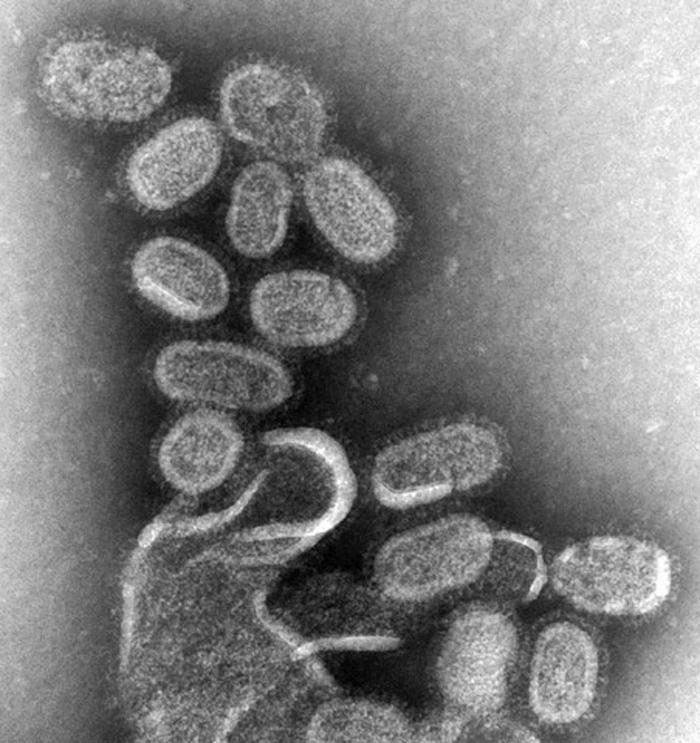
 by Photo Credit: Cynthia Goldsmith Content Providers(s): CDC/ D, public domain.*
*Via Wikimedia Commons: [EM of influenza virus](https://commons.wikimedia.org/wiki/File:EM_of_influenza_virus.jpg) by Photo Credit: Cynthia Goldsmith Content Providers(s): CDC/ D, public domain.*
- **1918.** The pandemic was caused by an H1N1 virus with genes of avian origin.[17] The CDC estimates that about 500 million people, one-third of the world's population, were infected, and that at least 50 million died worldwide, about 675,000 of them in the United States.[17]
- **1957–58.** In February 1957 a new influenza A (H2N2) virus emerged in East Asia, causing the pandemic known as "Asian flu".[18] The CDC gives an estimated 1.1 million deaths worldwide and 116,000 in the United States.[18]
- **1968.** The pandemic was caused by an influenza A (H3N2) virus that carried a new H3 hemagglutinin from an avian virus and the N2 neuraminidase of the 1957 virus.[19] The CDC estimates about 1 million deaths worldwide and about 100,000 in the United States.[19]
- **2009.** A new influenza A (H1N1) virus emerged in spring 2009.[20] For 12 April 2009 to 10 April 2010, the CDC estimated 60.8 million cases (range 43.3–89.3 million), 274,304 hospitalizations (range 195,086–402,719) and 12,469 deaths (range 8,868–18,306) in the United States, and 151,700 to 575,400 deaths worldwide in the virus's first year of circulation.[20] WHO declared the pandemic over on 10 August 2010.[20]
## Avian influenza
## Avian influenza
Avian influenza, covered in the entry Bird flu, is caused by influenza A viruses that usually spread among birds rather than people, according to a CDC page last updated on 26 March 2025.[22] WHO, in a fact sheet dated 21 January 2026, states that animal influenza viruses are distinct from human influenza viruses and do not easily transmit to and among humans, that contact with infected animals is the main risk for human infection, and that circulating animal influenza viruses have not shown sustained human-to-human transmission.[21] It adds that the reported case fatality rate for human A(H5) and A(H7N9) infections has been higher than for seasonal influenza.[21] The CDC states that most US cases of H5 bird flu have followed job-related or recreational exposure and that no person-to-person spread has been identified in the United States, though very rare, limited spread has occurred elsewhere.[22] Seasonal flu, by contrast, is caused by the A(H1N1) and A(H3N2) subtypes and influenza B viruses that routinely circulate in people, and the CDC states that seasonal flu vaccines do not protect against influenza viruses of animal origin.[2]
Avian influenza, covered in the entry Bird flu, is caused by influenza A viruses that usually spread among birds rather than people, according to a CDC page last updated on 26 March 2025.[22] WHO, in a fact sheet dated 21 January 2026, states that animal influenza viruses are distinct from human influenza viruses and do not easily transmit to and among humans, that contact with infected animals is the main risk for human infection, and that circulating animal influenza viruses have not shown sustained human-to-human transmission.[21] It adds that the reported case fatality rate for human A(H5) and A(H7N9) infections has been higher than for seasonal influenza.[21] The CDC states that most US cases of H5 bird flu have followed job-related or recreational exposure and that no person-to-person spread has been identified in the United States, though very rare, limited spread has occurred elsewhere.[22] Seasonal flu, by contrast, is caused by the A(H1N1) and A(H3N2) subtypes and influenza B viruses that routinely circulate in people, and the CDC states that seasonal flu vaccines do not protect against influenza viruses of animal origin.[2]
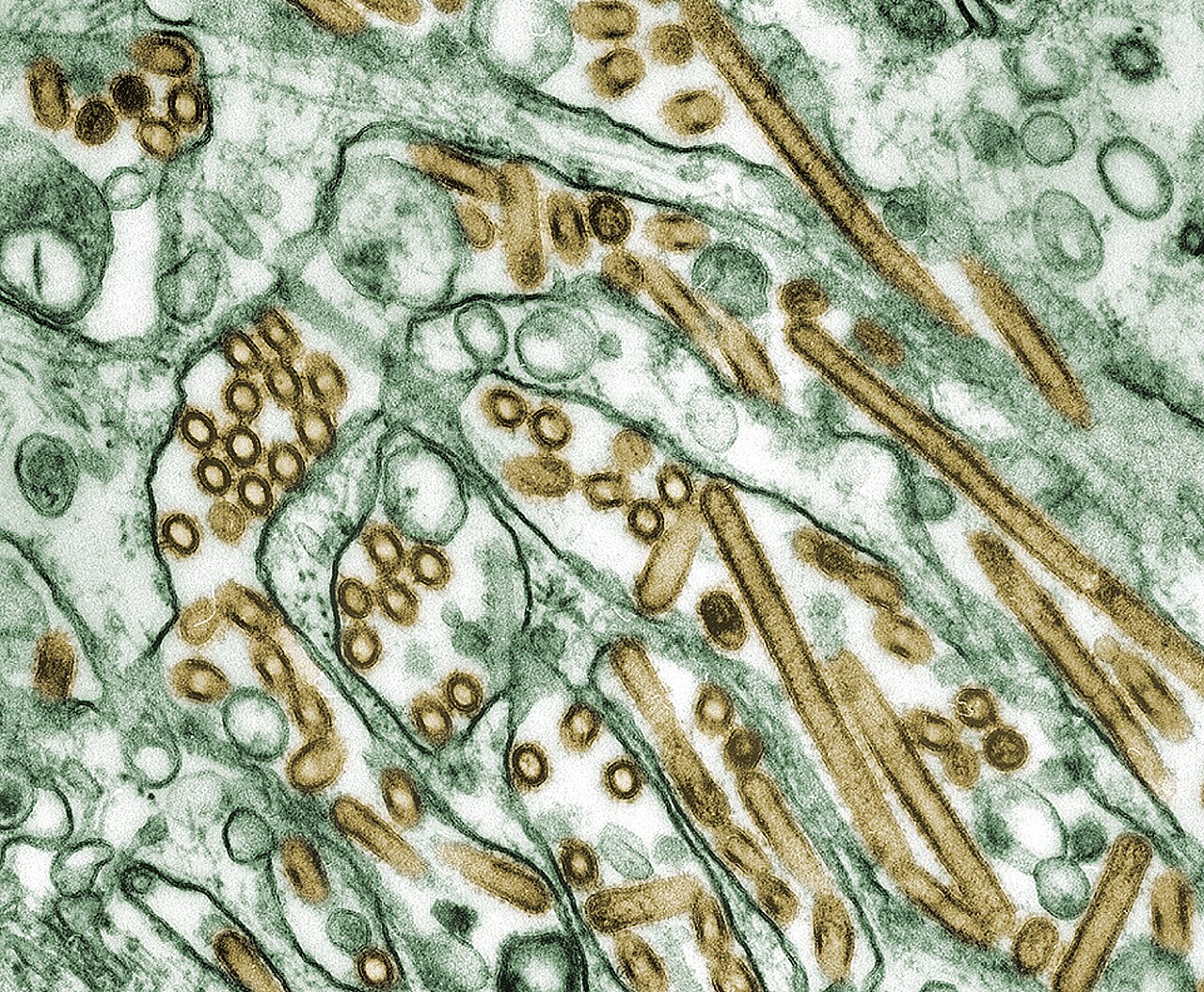
 by Photo Credit: Cynthia Goldsmith Content Providers: CDC/ Cour, public domain.*
*Via Wikimedia Commons: [Colorized transmission electron micrograph of Avian influenza A H5N1 v](https://commons.wikimedia.org/wiki/File:Colorized_transmission_electron_micrograph_of_Avian_influenza_A_H5N1_viruses.jpg) by Photo Credit: Cynthia Goldsmith Content Providers: CDC/ Cour, public domain.*
## How it differs from similar illnesses
## How it differs from similar illnesses
The CDC describes flu and COVID-19 as contagious respiratory illnesses caused by different viruses, influenza viruses and the coronavirus SARS-CoV-2, whose symptoms overlap so much that they cannot be told apart by symptoms alone.[6] On a page last updated on 17 September 2024, it states that COVID-19 generally spreads more easily, that flu symptoms typically appear one to four days after infection against two to five and up to 14 days for COVID-19, that flu seems to cause more severe illness in young children, and that Long COVID can follow even mild COVID-19.[6] A CDC page last updated on 8 August 2024 states that flu is generally worse than the common cold, with more intense symptoms that begin more abruptly, that colds generally do not lead to serious problems such as pneumonia, and that the two can be difficult or impossible to tell apart by symptoms alone.[23] The CDC states that respiratory syncytial virus most commonly causes a cold-like illness in infants and young children, that adult symptoms usually resemble an upper respiratory tract infection, and that severe disease most often occurs in very young infants.[24] These illnesses are covered in the entries COVID-19 and Respiratory syncytial virus (RSV).
The CDC describes flu and COVID-19 as contagious respiratory illnesses caused by different viruses, influenza viruses and the coronavirus SARS-CoV-2, whose symptoms overlap so much that they cannot be told apart by symptoms alone.[6] On a page last updated on 17 September 2024, it states that COVID-19 generally spreads more easily, that flu symptoms typically appear one to four days after infection against two to five and up to 14 days for COVID-19, that flu seems to cause more severe illness in young children, and that Long COVID can follow even mild COVID-19.[6] A CDC page last updated on 8 August 2024 states that flu is generally worse than the common cold, with more intense symptoms that begin more abruptly, that colds generally do not lead to serious problems such as pneumonia, and that the two can be difficult or impossible to tell apart by symptoms alone.[23] The CDC states that respiratory syncytial virus most commonly causes a cold-like illness in infants and young children, that adult symptoms usually resemble an upper respiratory tract infection, and that severe disease most often occurs in very young infants.[24] These illnesses are covered in the entries COVID-19 and Respiratory syncytial virus (RSV).
## Sources
## Sources
1. World Health Organization. "Influenza (seasonal)" (fact sheet). WHO, 28 February 2025. https://www.who.int/news-room/fact-sheets/detail/influenza-(seasonal)
2. Centers for Disease Control and Prevention. "Types of Influenza Viruses." CDC, last updated 26 September 2025. https://www.cdc.gov/flu/about/viruses-types.html
3. Elisha Hall. "Chapter 12: Influenza," in Epidemiology and Prevention of Vaccine-Preventable Diseases (Pink Book). CDC, updated 1 April 2024. https://www.cdc.gov/pinkbook/hcp/table-of-contents/chapter-12-influenza.html
4. Centers for Disease Control and Prevention. "How Flu Spreads." CDC, last updated 17 September 2024. https://www.cdc.gov/flu/spread/index.html
5. Centers for Disease Control and Prevention. "Signs and Symptoms of Flu." CDC, 26 August 2024. https://www.cdc.gov/flu/signs-symptoms/index.html
6. Centers for Disease Control and Prevention. "Similarities and Differences between Flu and COVID-19." CDC, last updated 17 September 2024. https://www.cdc.gov/flu/about/flu-vs-covid19.html
7. Centers for Disease Control and Prevention. "Overview of Influenza Testing Methods." CDC, last updated 19 December 2025. https://www.cdc.gov/flu/hcp/testing-methods/index.html
8. Centers for Disease Control and Prevention. "Influenza Antiviral Medications: Summary for Clinicians." CDC, updated 10 March 2026. https://www.cdc.gov/flu/professionals/antivirals/summary-clinicians.htm
9. Lisa A. Grohskopf, Lenee H. Blanton, Jill M. Ferdinands, et al. "Prevention and Control of Seasonal Influenza with Vaccines: Recommendations of the Advisory Committee on Immunization Practices — United States, 2025–26 Influenza Season." Morbidity and Mortality Weekly Report 74(32). CDC, 28 August 2025. https://www.cdc.gov/mmwr/volumes/74/wr/mm7432a2.htm
10. Centers for Disease Control and Prevention. "Weekly US Influenza Surveillance Report: Key Updates for Week 45, ending November 14, 2026" (FluView). CDC, 20 November 2026. https://www.cdc.gov/fluview/surveillance/2026-week-45.html
11. Wisconsin Department of Health Services. Influenza vaccination letter for the 2026–2027 season. Wisconsin DHS, 9 September 2026. https://www.dhs.wisconsin.gov/immunization/flu-letter-2026.pdf
12. US Food and Drug Administration. "MFLUSIVA." FDA, content current as of 2 September 2026. https://www.fda.gov/vaccines-blood-biologics/vaccines/mflusiva
13. UK Health Security Agency and NHS England. "National flu immunisation programme 2026 to 2027 letter." GOV.UK, 26 February 2026. https://www.gov.uk/government/publications/national-flu-immunisation-programme-plan-2026-to-2027/national-flu-immunisation-programme-2026-to-2027-letter
14. European Centre for Disease Prevention and Control. "Increased flu and COVID-19 vaccination coverage recommended for risk groups in EU/EEA ahead of winter season." ECDC, 29 October 2024. https://www.ecdc.europa.eu/en/news-events/increased-flu-and-covid-19-vaccination-coverage-recommended-risk-groups-eueea-ahead
15. World Health Organization. "Recommendations for influenza vaccine composition for the 2026-2027 northern hemisphere season." WHO, 27 February 2026. https://www.who.int/news/item/27-02-2026-recommendations-for-influenza-vaccine-composition-for-the-2026-2027-northern-hemisphere-season
16. Centers for Disease Control and Prevention. "U.S. Influenza Surveillance: Purpose and Methods." CDC, last updated 2 December 2025. https://www.cdc.gov/fluview/overview/index.html
17. Centers for Disease Control and Prevention. "1918 Pandemic (H1N1 virus)." CDC archive, last reviewed 20 March 2019. https://archive.cdc.gov/www_cdc_gov/flu/pandemic-resources/1918-pandemic-h1n1.html
18. Centers for Disease Control and Prevention. "1957-1958 Pandemic (H2N2 virus)." CDC archive, last reviewed 2 January 2019. https://archive.cdc.gov/www_cdc_gov/flu/pandemic-resources/1957-1958-pandemic.html
19. Centers for Disease Control and Prevention. "1968 Pandemic (H3N2 virus)." CDC archive, last reviewed 2 January 2019. https://archive.cdc.gov/www_cdc_gov/flu/pandemic-resources/1968-pandemic.html
20. Centers for Disease Control and Prevention. "2009 H1N1 Pandemic (H1N1pdm09 virus)." CDC archive, no date shown; accessed 28 November 2026. https://archive.cdc.gov/www_cdc_gov/flu/pandemic-resources/2009-h1n1-pandemic.html
21. World Health Organization. "Influenza (avian and other zoonotic)" (fact sheet). WHO, 21 January 2026. https://www.who.int/news-room/fact-sheets/detail/influenza-(avian-and-other-zoonotic)
22. Centers for Disease Control and Prevention. "Bird Flu: Causes and How It Spreads." CDC, last updated 26 March 2025. https://www.cdc.gov/bird-flu/virus-transmission/index.html
23. Centers for Disease Control and Prevention. "Cold Versus Flu." CDC, last updated 8 August 2024. https://www.cdc.gov/flu/about/coldflu.html
24. Centers for Disease Control and Prevention. "Clinical Overview of RSV." CDC, last updated 18 August 2025. https://www.cdc.gov/rsv/hcp/clinical-overview/index.html
