Version 3 (current)
Nov 29, 2026. Version history
A tariff is a tax on goods that are brought into a country, collected by the government as they cross the border.[1][3]
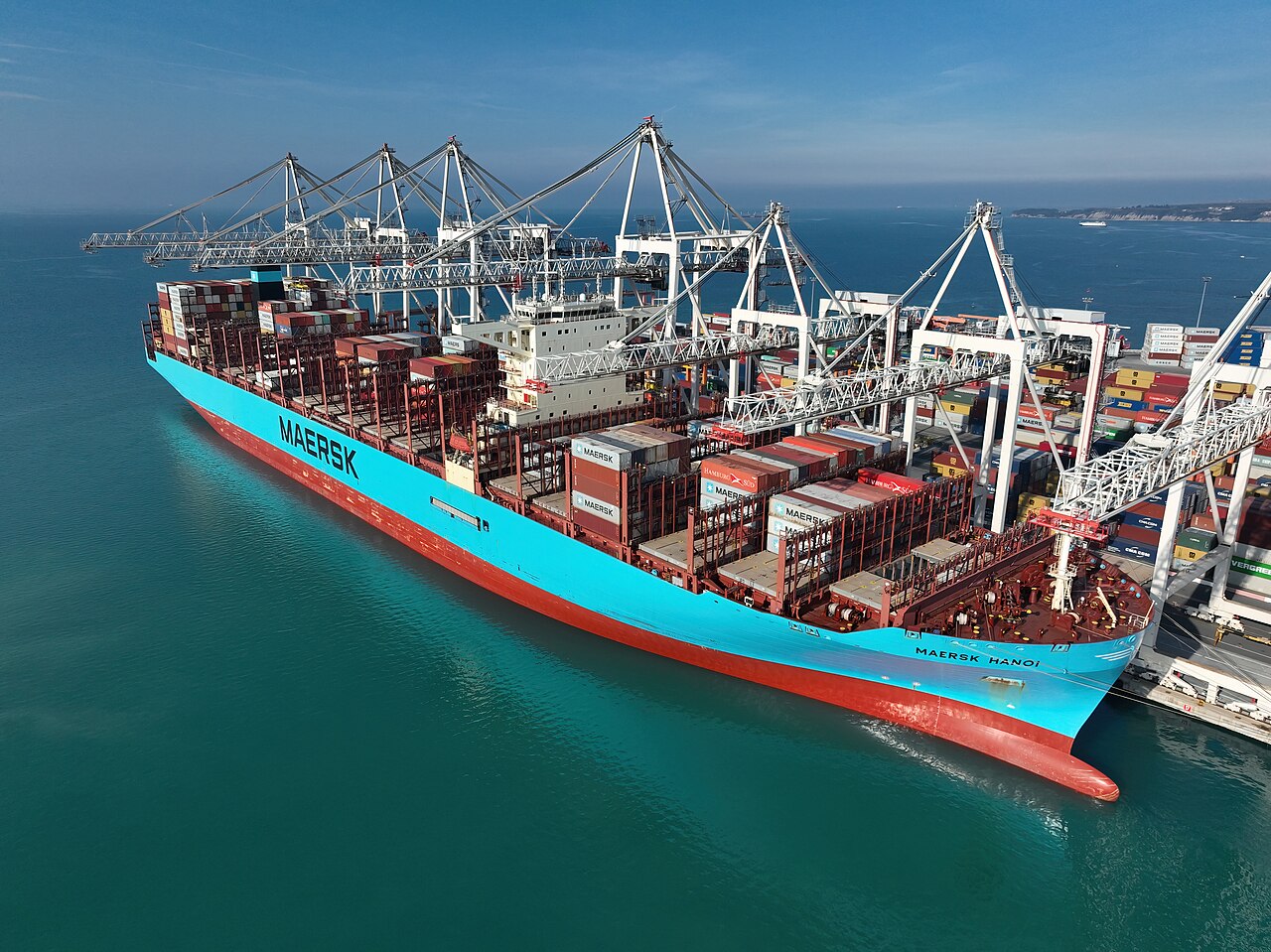
Via Wikimedia Commons: MAERSK HANOI Container Ship (Port Koper SIKOP, 2023) by Petar Milošević, CC BY-SA 4.0.
How a tariff works
A tariff is also called a customs duty.[3] It can be worked out in two ways. An ad valorem tariff is a percentage of the value of the import, so a 25% tariff on a truck valued at a given price is a quarter of that value; a specific tariff is a fixed rate based on the quantity of the import.[2]
In the United States the rates are listed in the Harmonized Tariff Schedule, a compendium of tariff rates built on a globally standardized system of product names and codes, which the U.S. International Trade Commission maintains.[1][2] Importers classify their own goods and declare their value or quantity; U.S. Customs and Border Protection collects the duties at ports of entry and deposits the revenue in the Treasury's General Fund.[1]
The World Trade Organization (WTO) describes two effects of a tariff: it gives locally produced goods a price advantage over similar imported goods, and it raises government revenue.[3]
How much money they raise
As of the Congressional Research Service's January 2025 overview, tariffs had not, over the previous 70 years, accounted for much more than 2% of total U.S. federal revenue.[1] In fiscal year 2024 Customs and Border Protection collected $77 billion in tariffs, about 1.57% of federal revenue.[1]
Who bears the cost
The party that pays a tariff at the border and the party that ends up poorer are not necessarily the same. Importers pay the duty, but how the cost is shared depends on how prices move: if the foreign seller lowers its price, part of the burden falls on the seller.[7] The New York Fed's economists give an example: on a $100 good with a 25% tariff, an importer faces the whole burden if the price does not change, while an exporter that cuts its price to $80 takes it instead.[7]
Mary Amiti, Chris Flanagan, Sebastian Heise and David Weinstein of the Federal Reserve Bank of New York studied the tariffs the United States imposed in 2025, using monthly Census Bureau import data through November 2025. In their post of 12 February 2026 they estimate that nearly 90 percent of the economic burden of those tariffs fell on U.S. firms and consumers, a group their measure does not split further.[7] They put the foreign exporters' share of the incidence at 6 percent for January to August 2025 and at 14 percent for November, so that U.S. importers bore 94 percent and then 86 percent.[7] These are one study's estimates of one episode, made from import prices rather than retail prices, and other studies and later data may differ.[7]
Who may set them in the United States
The Constitution gives Congress the power to lay and collect duties and to regulate commerce with foreign nations.[1] Over the twentieth century Congress delegated parts of that power to the President, and several laws now authorise tariff action:[1][2]
- Section 232 of the Trade Expansion Act of 1962 lets the President adjust imports after the Department of Commerce finds that they threaten to impair national security.[2]
- Section 201 of the Trade Act of 1974 lets the President impose temporary duties after the International Trade Commission finds that a surge in imports seriously injures, or threatens to injure, a U.S. industry.[2]
- Section 301 of the same Act lets the U.S. Trade Representative, at the President's direction, suspend trade-agreement concessions or restrict imports when a foreign country's practices violate trade agreements or unreasonably burden U.S. commerce.[2]
- The Trading with the Enemy Act and the International Emergency Economic Powers Act (IEEPA) empower the President in a time of war or national emergency to regulate imports.[1]
The first tariff act, 1789
Tariffs were among the first laws of the United States under its Constitution. The act "for laying a Duty on Goods, Wares, and Merchandises imported into the United States" was approved on 4 July 1789.[6] Its preamble gives three reasons for the duties: the support of government, the discharge of the debts of the United States, and the encouragement and protection of manufactures.[6] Goods not named in the act paid a flat 5 percent of their value at the time and place of importation, while listed goods paid specific rates, such as two and a half cents per gallon of molasses or six cents per bushel of salt.[6] The preamble's mix of revenue and protection is an early example of the two purposes the WTO describes today.[3][6]
History in the United States
The Congressional Research Service traces the main turning points. The Underwood Tariff Act of 1913 lowered rates from roughly 40% to 25% and restored the federal income tax.[1] The Tariff Act of 1930, known as Smoot-Hawley, raised U.S. tariffs to their highest levels since 1828 and was the last tariff act in which Congress set the rates.[1] The Senate passed it on 13 June 1930 and President Herbert Hoover signed it on 17 June 1930, despite a petition from a thousand economists asking him to veto it.[4]
The effects are described differently by different sources. The Senate's historical office says trading partners retaliated by raising their own rates and that this froze international trade.[4] The State Department's Office of the Historian notes that world trade fell by some 66% between 1929 and 1934, but adds that scholars disagree on whether the tariff provoked a wave of foreign retaliation that deepened the Great Depression.[5]
In 1934 the Reciprocal Tariff Act delegated to the President the power to negotiate reciprocal trade agreements.[1] In 1947 the United States and 23 other countries entered the General Agreement on Tariffs and Trade (GATT) to lower tariffs and other trade barriers, and the United States joined the WTO in 1995, the last time members multilaterally agreed to major cuts in tariff rates.[1]
Tariffs under WTO rules
WTO members list their tariff commitments in schedules of goods rather than under one agreement that sets reduction targets.[3] A "bound" rate is the ceiling a member has committed to in its schedule, the highest rate it may charge under its WTO commitments; the "applied" rate is what it actually charges, and can be lower than the bound rate.[3] Members' commitments to cut tariffs and to bind their rates at levels that are hard to raise were a result of the Uruguay Round of trade talks.[3]
Sources
- Congressional Research Service, U.S. Tariff Policy: Overview (In Focus IF11030), updated 31 January 2025. everycrsreport.com/reports/IF11030.html
- Congressional Research Service, Trump Administration Tariff Actions (Sections 201, 232, and 301): Frequently Asked Questions (R45529), 22 February 2019. everycrsreport.com/files/20190222_R45529_163aa8a8812e769caf6be5076c…
- World Trade Organization, "Tariffs" (read November 2026). wto.org/English/Tratop_e/tariffs_e/tariffs_e.htm
- U.S. Senate, "Senate Passes Smoot-Hawley Tariff", Historical Office (read November 2026). senate.gov/artandhistory/history/minute/Senate_Passes_Smoot_Hawley_…
- Office of the Historian, U.S. Department of State, "Protectionism in the Interwar Period" (read November 2026). history.state.gov/milestones/1921-1936/protectionism
- United States Statutes at Large, vol. 1, 1st Congress, 1st Session, chapter 2, "An Act for laying a Duty on Goods, Wares, and Merchandises imported into the United States", approved 4 July 1789 (Wikisource transcription, read November 2026). en.wikisource.org/wiki/United_States_Statutes_at_Large/Volume_1/1st…
- Mary Amiti, Chris Flanagan, Sebastian Heise and David E. Weinstein, "Who Is Paying for the 2025 U.S. Tariffs?", Liberty Street Economics, Federal Reserve Bank of New York, 12 February 2026. libertystreeteconomics.newyorkfed.org/2026/02/who-is-paying-for-the…
