Version 2 (current)
Nov 29, 2026. Version history
Coca-Cola is a carbonated soft drink first sold at a pharmacy soda fountain in Atlanta, Georgia, in 1886, and a brand of The Coca-Cola Company, an American beverage company whose products are sold in more than 200 countries and territories.[1][2]
Invention and early history
John Pemberton and the first sale
The drink was created by John Stith Pemberton (1831–1888), an Atlanta pharmacist.[3] According to the New Georgia Encyclopedia, Pemberton moved to Atlanta in 1869 and began experimenting with extracts of the coca leaf and the kola nut, first selling a moderately successful health drink he called "French Wine Coca".[4] The Coca-Cola Company dates the first serving of Coca-Cola to 8 May 1886, when Pemberton took his syrup to Jacobs' Pharmacy in downtown Atlanta, where it was sold at the soda fountain for five cents a glass.[1]
Frank M. Robinson, Pemberton's partner and bookkeeper, suggested the name and wrote it out in the flowing script that became the trademark, reasoning, in the company's account, that the two capital Cs would look good in advertising.[1] The New Georgia Encyclopedia describes Robinson as one of four partners and says the name was taken from the drink's central ingredients.[4] The first newspaper advertisement appeared in The Atlanta Journal, and painted oilcloth signs were hung on store awnings; the company says sales in the first year averaged about nine drinks a day.[1]
The question of cocaine in the early drink is described differently by different sources. The New Georgia Encyclopedia states that the original formula contained cocaine and that it was removed before the Pure Food and Drugs Act of 1906.[4] The company's own question-and-answer page states that Coca-Cola does not contain cocaine and that cocaine "has never been an added ingredient".[5]
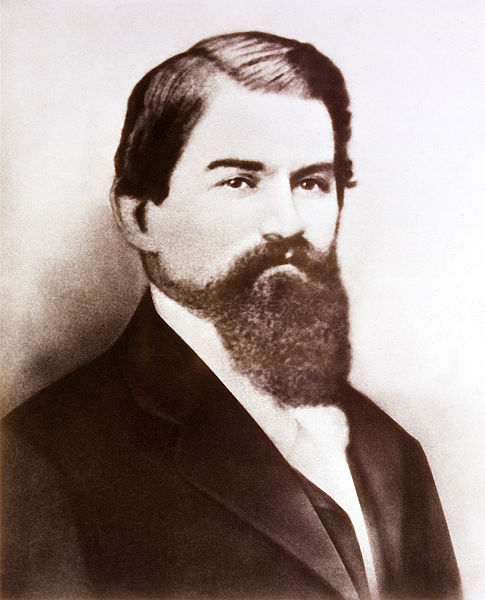
Via Wikimedia Commons: John Pemberton by Unknown author Unknown author, public domain.
Asa Candler and incorporation
Pemberton sold parts of the business over time, and shortly before his death in 1888 he sold his remaining interest to Asa G. Candler, who went on to acquire further rights and take full control.[1] Britannica gives Candler's dates as 1851–1929, says he had gained full ownership by 1891, and records that he incorporated the Coca-Cola Company in 1892 and registered the trademark in 1893.[3] The New Georgia Encyclopedia places Candler's acquisition between 1889 and 1891 and says he concentrated on selling syrup to soda fountains.[4] Britannica reports that syrup sales grew from about 9,000 gallons in 1890 to 370,877 gallons in 1900.[3]
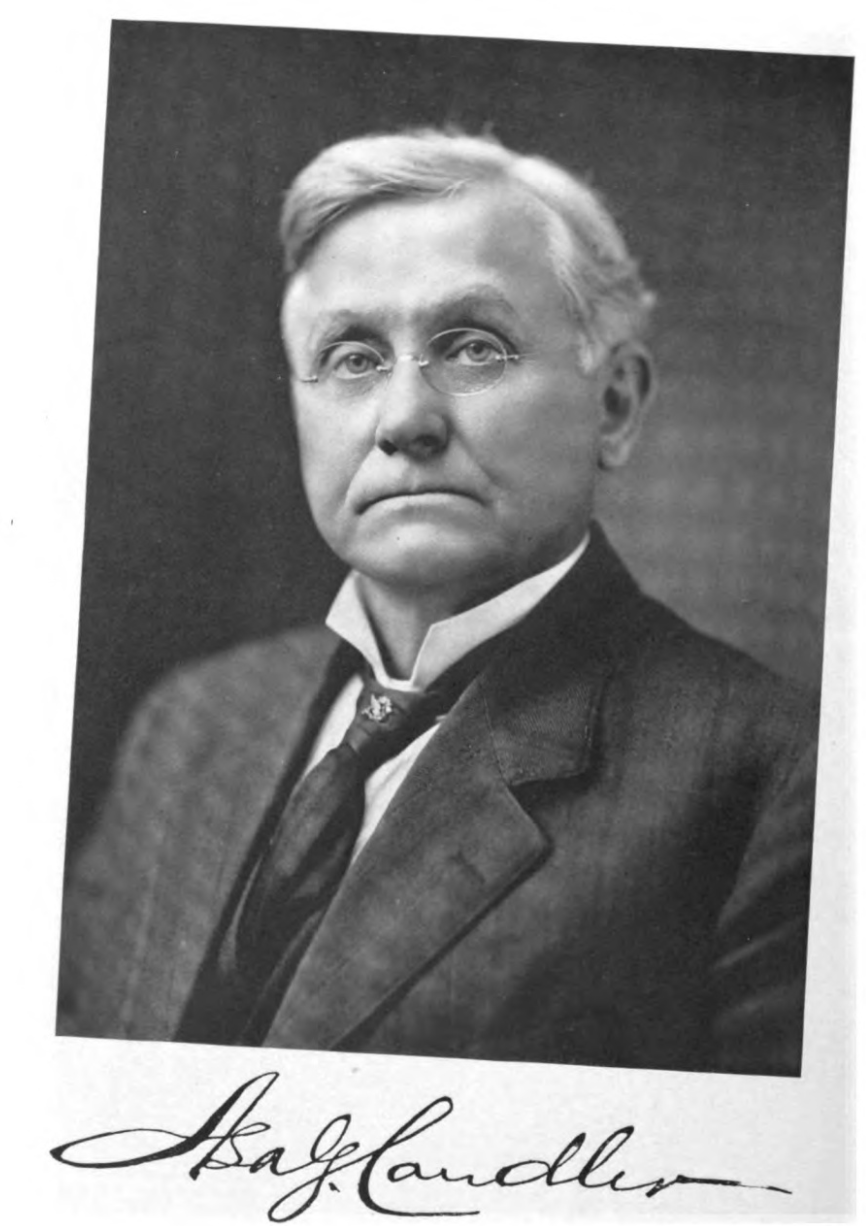
Via Wikimedia Commons: Asa Griggs Candler 1851-1929 with signature by Lucian Lamar Knight (1868-1933), public domain.
The Woodruff era
In 1919 a group of investors led by the Atlanta businessman Ernest Woodruff bought the company for $25 million, according to both Britannica and the New Georgia Encyclopedia.[3][4] The company's annual report states that The Coca-Cola Company was incorporated in Delaware in September 1919.[6]
Ernest Woodruff's son, Robert Winship Woodruff, led the company from 1923 to 1955.[3] The New Georgia Encyclopedia credits him with driving the drink's spread abroad, including through the Coca-Cola Export Corporation, set up in 1930, and with the wartime pledge to supply service members during the Second World War.[4] It also notes that the Candler and Woodruff families gave large sums to Emory University and other Atlanta institutions.[4]
The company and its bottling system
How the system works
The company's business rests on a division of work with bottlers. Its annual report for 2025 explains that the company earns much of its revenue by selling beverage concentrates (flavour bases) and syrups, and that its bottling partners combine these with still or sparkling water and sweeteners.[6] The report states that the bottlers are independent contractors and not agents of the company.[6]
Origins of bottling
Bottling began as a separate business. In 1899 two lawyers from Chattanooga, Tennessee, Benjamin Thomas and Joseph Whitehead, negotiated the right to bottle Coca-Cola, according to the company.[7] The New Georgia Encyclopedia says they obtained nationwide bottling rights and that this led to a network of independent, franchised bottlers, and Britannica describes the 1899 agreement as the basis of the company's licensed distribution system.[4][3] The company says more than 1,200 Coca-Cola bottling operations had been set up by 1920.[7]
In 1986 the company formed Coca-Cola Enterprises to buy up bottling operations, according to the New Georgia Encyclopedia.[4] The 2025 annual report describes the company's own consolidated bottling and distribution operations as a separate operating segment, Bottling Investments, and states that the company may periodically consider selling or reducing its stakes in bottlers it controls.[6]
The largest bottlers
The annual report lists the five largest independent bottling partners by 2025 unit case volume as Coca-Cola FEMSA, Coca-Cola Europacific Partners, Coca-Cola HBC, Arca Continental and Swire Coca-Cola, and states that together they represented 44% of the company's worldwide unit case volume in 2025.[6] A unit case, the measure the company uses for volume, is defined in its results as 192 US fluid ounces of finished drink, or 24 servings of eight ounces.[2]
The contour bottle
The company's distinctive glass bottle came out of the bottling system. According to the company, bottlers proposed a distinctive package in 1912 to protect the brand from imitators, and on 26 April 1915 the trustees of the Coca-Cola Bottling Association voted to spend up to $500 on developing one.[7] The design chosen came from the Root Glass Company of Terre Haute, Indiana; a patent was granted on 16 November 1915, and the company says most bottlers were using the bottle by 1920.[7] The bottle's shape was recognised as a trademark on 12 April 1961.[7]
Products
Coca-Cola and related brands
Britannica dates the registration of "Coke" as a trademark to 1945 and lists other drinks the company added after the Second World War, including Fanta (acquired in 1946), Minute Maid (1960), Sprite (1961), Tab (1963) and Fresca (1966).[3] Later acquisitions it lists include Glacéau (2007), Honest Tea (2011), ZICO coconut water (2013) and the coffee business Costa Limited (2019).[3] In its 2025 annual report the company names Coca-Cola, Sprite, Coca-Cola Zero Sugar, Fanta and Diet Coke/Coca-Cola Light among several of the world's largest non-alcoholic sparkling soft drink brands that it owns, and lists other brands including BODYARMOR, Costa and Dasani.[6] The report states that sparkling soft drinks made up 69% of the company's worldwide unit case volume in both 2024 and 2025.[6]
The company has kept the Coca-Cola formula unpublished. When it moved the written formula to its World of Coca-Cola visitor attraction in Atlanta in December 2011, the company's announcement said the formula "was kept a close secret, only shared with a small group and not written down", and called it "the most closely guarded trade secret in history".[8] The release said the formula had not been moved in 86 years.[8]
Diet Coke
Diet Coke was introduced in 1982, according to Britannica.[3] The 2025 annual report lists it, under the names Diet Coke and Coca-Cola Light, among the company's largest sparkling brands.[6]
New Coke
In April 1985 the company changed the formula of its main drink; the new version became known as New Coke.[3][4] The change was poorly received, and in July 1985 the original formula returned under the name Coca-Cola Classic.[3] The New Georgia Encyclopedia notes that the change came shortly after Robert Woodruff's death in 1985 and that the company reversed course after a public backlash.[4] The same source describes Roberto Goizueta as Woodruff's handpicked successor.[4]
Coca-Cola Zero and Coca-Cola Zero Sugar
Coca-Cola Zero was launched in 2005, according to Britannica.[3] On 26 July 2017 the company announced that, in the United States, the drink would be given a new recipe and renamed Coca-Cola Zero Sugar, with the new version on sale nationwide from August 2017.[9] The announcement said Coca-Cola Zero was then sold in nearly 160 countries, and that the Zero Sugar version had already been launched in Great Britain, Mexico and more than 25 other markets.[9]
Sweeteners in the United States
The Atlanta Journal-Constitution reported on 22 October 2025 that Coca-Cola had used high-fructose corn syrup in some of its US-made sodas since the 1980s and would continue to do so in its main Coca-Cola.[10] The newspaper reported that, days after a social media post by President Donald Trump on the subject in July 2025, the company confirmed plans for a version made with US cane sugar, and that in October 2025 it introduced this in a 12-ounce glass bottle in selected US markets, with plans to expand in 2026.[10]
Advertising and cultural place
Early advertising and the bottle in art
Advertising was part of Coca-Cola from its first year, beginning with the newspaper notice and awning signs of 1886.[1] The contour bottle itself became an advertising image: the company says it was nicknamed the "hobbleskirt" and "Mae West" bottle, and that it appeared in Salvador Dalí's 1943 painting Poetry of America and in Andy Warhol's 1962 show The Grocery Store.[7] The industrial designer Raymond Loewy was part of the team that updated the bottle when larger "King" and "Family" sizes were introduced in 1955.[7]
Santa Claus
From 1931, Coca-Cola's Christmas advertising used paintings of Santa Claus by the Michigan-born illustrator Haddon Sundblom, commissioned through the D'Arcy Advertising Agency; the first appeared in The Saturday Evening Post, and Sundblom painted his last version for the company in 1964.[11] The company states that it helped shape the modern image of Santa but did not invent him, noting that Santa was shown in many forms before 1931 and appeared in a red coat before Sundblom painted him, including in drawings by Thomas Nast for Harper's Weekly from 1862.[11]
"Hilltop"
The company traces its 1971 television commercial known as "Hilltop" to 18 January 1971, when fog in London forced a flight carrying Bill Backer, an advertising executive at McCann Erickson, to land at Shannon, Ireland, where he saw stranded passengers bonding over Coca-Cola.[12] Backer worked with the music director Billy Davis and the British songwriters Roger Cook and Roger Greenaway; the commercial, "I'd Like to Buy the World a Coke", was filmed in Rome with a chorus of 500 young people, and the commercial was first shown in the United States in July 1971.[12] The company says it and its bottlers received more than 100,000 letters about it, that a version recorded by the New Seekers as "I'd Like to Teach the World to Sing (In Perfect Harmony)" became a Top 10 pop hit, and that the company gave the first $80,000 of royalties to UNICEF.[12]
Partnerships and the visitor attraction
Britannica lists the company's partnership with McDonald's, begun in 1955, among its post-war milestones.[3] Since December 2011 the written formula has been kept at the company's World of Coca-Cola attraction in Atlanta.[8] The company's headquarters address, as given in its annual report, is One Coca-Cola Plaza, Atlanta, Georgia.[6]
Ownership and leadership
The Coca-Cola Company's shares are listed on the New York Stock Exchange under the symbol KO.[2] Its chief executives since 2000, according to Britannica, have been Douglas N. Daft (2000–2004), E. Neville Isdell (2004–2008), Muhtar Kent (2008–2017) and James Quincey (from 2017).[3]
The Atlanta Journal-Constitution reported in December 2025 that the company had named Henrique Braun to become chief executive on 31 March 2026, with Quincey, who had spent nearly nine years as chief executive, moving to the role of executive chairman.[13] The company's third-quarter results release of 27 October 2026 names Braun as CEO of The Coca-Cola Company.[2]
Controversies and court cases
The company has faced lawsuits, government action and criticism over taxes, employment, bottlers abroad, water use in India and its funding of health research.
Tax dispute with the IRS
In 2015 the US Internal Revenue Service (IRS) sought about $3.3 billion in additional federal tax for 2007 to 2009, aiming to reallocate more than $9 billion of income from foreign affiliates to the US parent company.[14] The dispute concerns transfer pricing, the prices that companies within one group charge each other.[14][15] The US Tax Court largely sided with the IRS in opinions issued in November 2020 and November 2023.[14] On 2 August 2024 it entered a decision reflecting a liability of about $2.7 billion, or about $6.0 billion with interest.[14] The company said the IRS and the court had "misinterpreted and misapplied the applicable regulations", announced an appeal to the US Court of Appeals for the Eleventh Circuit, and said it would pay the liability and interest as part of that process.[14] Before the appeals court, the company called the IRS's change of method a "classic bait and switch", while the government argued that each tax year "stands on its own".[15] In March 2026 both sides were still filing arguments with the court over whether an appeals-court ruling in a tax case involving the company 3M applied to the dispute.[16]
Racial discrimination class action
In April 1999 Black salaried employees filed a class action (a lawsuit on behalf of a whole group) in federal court, claiming that the company discriminated against them in pay, promotions and evaluations.[17] The company denied the claims.[17][18] On 16 November 2000 it agreed to pay $192.5 million to settle the case, including $113 million in cash, $43.5 million to adjust salaries and $36 million for oversight.[18] A US district judge approved the settlement.[17][18] The settlement also created a seven-member task force to examine the company's hiring, pay and other employment practices.[17][18]
Colombian bottlers
A Colombian trade union, the estate of a union leader allegedly murdered by paramilitaries, and others brought four lawsuits in the United States under the Alien Tort Statute and the Torture Victim Protection Act, laws that allow certain claims over abuses abroad to be heard in US courts.[19] They alleged that managers at Coca-Cola bottling plants in Colombia had conspired with paramilitary forces that murdered, tortured and intimidated union leaders.[19] A federal district court dismissed the claims against the company's US and Colombian units in 2003 and the remaining claims in 2006.[19] On 11 August 2009 the Eleventh Circuit upheld the dismissal of the claims, finding the allegations too conclusory and vague to be plausible.[19] The company has repeatedly denied the allegations and has stated that those involving its operations in Colombia are false.[20]
Plachimada plant, India
A plant run by the company's Indian subsidiary at Plachimada, Kerala, closed in 2004 after protests by local Adivasi (Indigenous) residents.[21] A member of India's Parliament later told the Lok Sabha that the plant had drawn over five lakh litres (a lakh is 100,000) of water a day from wells on its premises, and that solid waste it gave to farmers as fertiliser had harmed farmland.[22] In July 2010 the Kerala cabinet approved a state committee's report recommending compensation of Rs 216.25 crore (a crore is 10 million rupees), mainly for farmers, and decided to set up a tribunal to award it.[23] The subsidiary said the committee had started from "the pre-determined and unproven conclusion" that its operations caused the losses, and that independent experts and the state's own studies showed the plant was not the cause of local water problems.[23][24] A bill creating the tribunal, passed unanimously by the Kerala Assembly, was returned by the President of India without assent in February 2016.[25] In July 2017 the subsidiary told India's Supreme Court that it would not resume operations at the plant.[26] As of October 2022, no compensation had been paid.[21]
Funding of obesity research
In August 2015 The New York Times reported on the company's funding of the Global Energy Balance Network, a non-profit group set up to combat obesity.[27] The group had called the money an "unrestricted gift" over which the company had "no input", but emails reported by the Associated Press showed that the company had helped select its leaders, edited its mission statement and suggested content for its website.[27] In November 2015 the University of Colorado said it would return a $1 million donation from the company, and by 1 December 2015 the group had announced that it was ending operations.[27] The company's chief executive said there had not been enough transparency about its involvement, and the company stopped working with the group.[27] In September 2015 the company disclosed spending of $118.6 million on health research and partnerships from 2010 to 2015, revised the figure in March 2016 to $132.8 million, and said it would disclose all such US spending.[28]
Where it is sold
As of its results releases of February and October 2026, the company describes itself as "a total beverage company with products sold in more than 200 countries and territories".[29][2] Its 2025 annual report divides its operations into four geographic operating segments, EMEA (Europe, Middle East and Africa), Latin America, North America and Asia Pacific, plus the Bottling Investments segment.[6] According to the report, the United States accounted for 16% of the company's worldwide unit case volume in 2025.[6]
Business figures
Full year 2025
The company reported on 10 February 2026 that, for the full year 2025, net revenues grew 2% to $47.9 billion and organic revenues, a non-GAAP measure (one not defined by US generally accepted accounting principles), grew 5%.[29] Unit case volume for the year was even with 2024, and earnings per share grew 23% to $3.04.[29] Its annual report for 2025 states that the Coca-Cola system sold 33.8 billion unit cases in 2025, compared with 33.7 billion in 2024.[6] The company had approximately 65,900 employees at the end of 2025, compared with 69,700 a year earlier; the report attributes the decrease mainly to divestitures during 2025.[6]
Third quarter 2026
On 27 October 2026 the company reported results for the three months ended 2 October 2026: net revenues grew 7% to $13.4 billion, and unit case volume grew 5%, led by India, China, Mexico and Brazil.[2] Operating margin was 33.4%, against 32.0% a year earlier, and earnings per share grew 8% to $0.93.[2]
Sources
- "The Birth of a Refreshing Idea". The Coca-Cola Company. Page dated 20 July 2026 in its metadata; accessed 28 November 2026. coca-colacompany.com/about-us/history/the-birth-of-a-refreshing-idea
- "Coca-Cola Reports Third Quarter 2026 Results and Raises Full Year Guidance". The Coca-Cola Company, Exhibit 99.1 to Form 8-K. US Securities and Exchange Commission (EDGAR). 27 October 2026. sec.gov/Archives/edgar/data/0000021344/000162828026067403/a2026q3ea…
- The Editors of Encyclopaedia Britannica (revised by Rick Livingston). "The Coca-Cola Company". Encyclopaedia Britannica. No update date shown; accessed 28 November 2026
