Jägermeister is a German herbal liqueur, first sold in 1935, that the family-owned company Mast-Jägermeister SE makes in Wolfenbüttel, Lower Saxony, from a recipe of 56 herbs, blossoms, roots and fruits.[1][2][9]
Origin
Wilhelm Mast's vinegar business
The company traces its beginnings to Wilhelm Mast (1846–1918), who was born in Wieda in the southern Harz region and moved to Wolfenbüttel in 1865.[2] On 23 July 1878 he bought a building at Großer Zimmerhof 26 in the town, the purchase the company treats as its founding.[2] According to the company's history, the business at first produced vinegar, supplying the local canning industry and mining operations in the nearby Harz.[3]
Curt Mast and the recipe
Wilhelm's son Curt Mast (1897–1970) joined the firm at the age of 16.[2] He took over the business from his father in 1917, added the wine trade, and ended vinegar production in 1922 so that the company could concentrate on wine and spirits.[3][4] The company describes Curt Mast as a keen hunter who spent years working on an herbal liqueur and settled on its recipe in 1934.[4][2] Jägermeister went on sale in 1935.[4][2] The company states that about 35,000 bottles were sold in 1935, when it had about 21 employees.[4] By 1936 the firm offered close to 20 different spirits, but in 1964 it cut its range down to a single product, Jägermeister.[3]
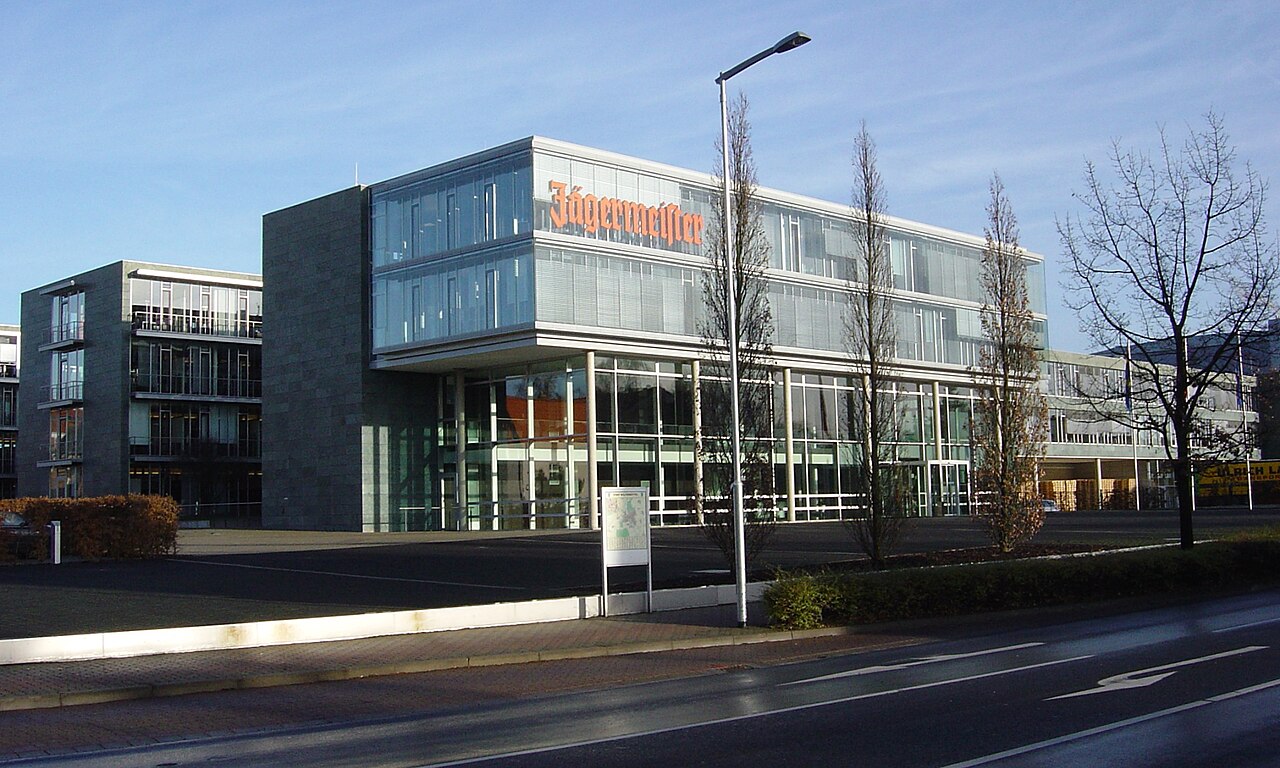
The Mast-Jägermeister building at Jägermeisterstraße 7 in Wolfenbüttel, Germany, photographed on 7 December 2009.
In 1958 the company moved into a new building on a Wolfenbüttel street then named Hermann-Korb-Straße; the street was renamed Jägermeisterstraße in 1967, on Curt Mast's 70th birthday.[3] In 1970 the firm took the name W. Mast Kommanditgesellschaft Jägermeister-Spirituosenfabrik, a Kommanditgesellschaft (KG) being a German limited partnership.[3] After Curt Mast's death that year, the company was led by his nephew Günter Mast, who had joined the firm in 1952, together with Dr. Günther Findel, who had married Curt Mast's daughter Annemarie in 1947 and took over technical management in 1970.[3][2] Curt Mast's daughter, Annemarie Findel-Mast (1921–2010), was the company's main shareholder for almost four decades after her father's death.[2]
In 1987 the business was restructured as a stock corporation, Mast-Jägermeister AG; the company's history states that the shares have stayed with the Mast family.[3] It later became Mast-Jägermeister SE, a Societas Europaea, the form of public limited company available under European Union law.[3] The company describes itself as being in its fifth generation of family ownership.[6]
Plants and subsidiaries
The company's history lists a series of expansions.[3] A bottling plant opened in Kamenz, Saxony, in 1996, mainly to supply markets in Eastern Europe.[3] In 2000, sales abroad were larger than sales in Germany for the first time.[3] In 2006 the company invested about 50 million euros in Wolfenbüttel, including a new administration building and the conversion of a warehouse at its Linden site into a filling plant, and in 2017 bottling moved from the headquarters to the Linden plant.[3]
Its first subsidiary outside Germany, Mast-Jägermeister UK, opened in Camberley, England, in 2014.[3] In 2015 it bought its American importer, Sidney Frank Importing Company, and set up Mast-Jägermeister US, so that it ran its largest markets, the United States, Germany and the United Kingdom, itself.[3] In 2018 it created a German sales subsidiary and set up an innovation unit, M-Venture, and in 2019 it took over distribution units in the Czech Republic and Slovakia from Rémy Cointreau.[3]
In March 2026 the company announced that it was investing more than 17 million euros in a new barrel store at Kamenz, which it described as carbon-dioxide-neutral.[1]
Ownership and leadership
In a press release of February 2026, Mast-Jägermeister described itself as a family company and named Florian Rehm as chairman of its supervisory board and majority shareholder.[7] The company's family page names Rehm as the spokesman of the Mast family.[6]
Besides the supervisory board, which oversees the company, Mast-Jägermeister has an executive board that manages it. As of November 2026, the company's executive board page, last updated on 4 May 2026, lists Michael Volke as chairman of the executive board, responsible for strategy, marketing, global travel retail, human resources and communications, and the German market.[8] The same page lists Berndt Kodden as the board member responsible for global markets and the United States, and Carmen Schmidt as the board member in charge of finance, production and administration.[8] Schmidt joined the executive board on 1 May 2026, succeeding Christopher Ratsch, who had left the company the previous year.[7]
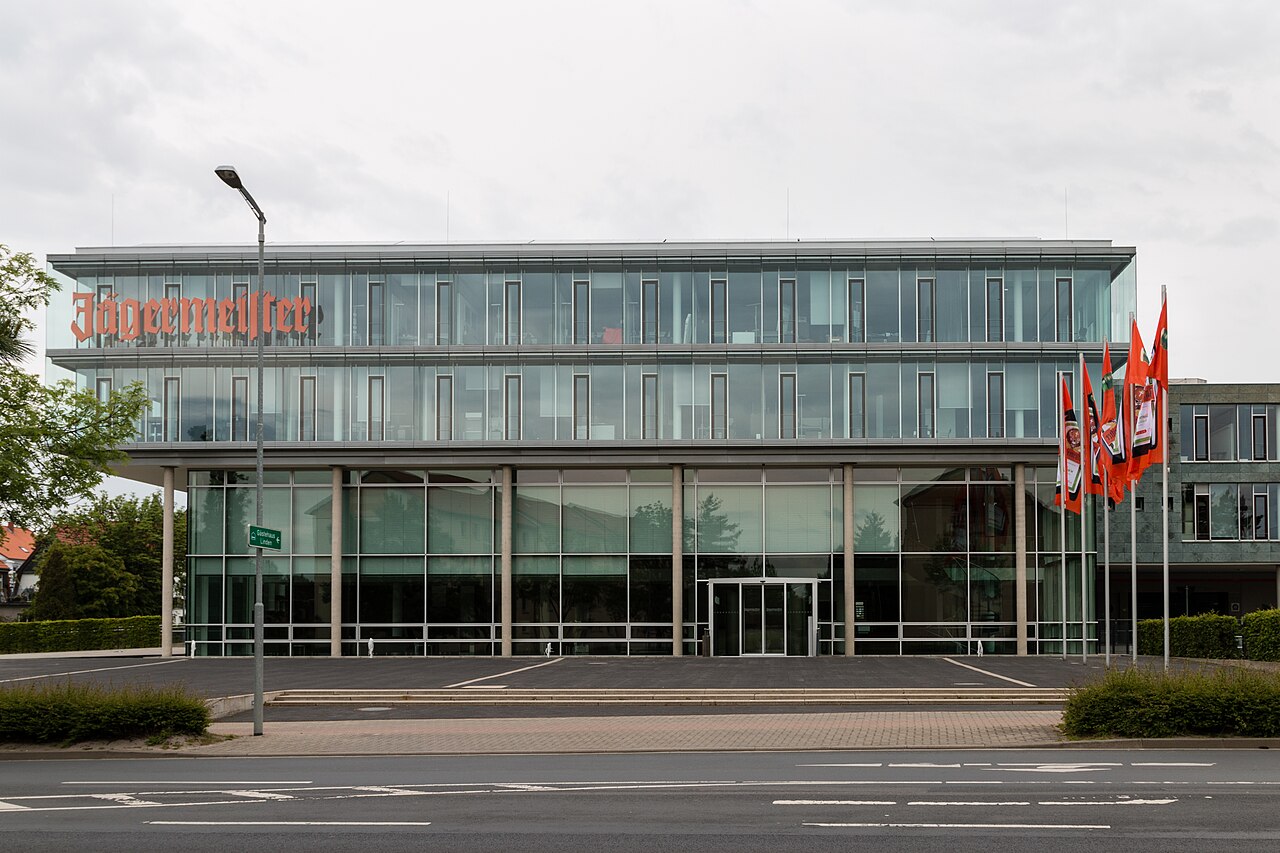
The headquarters of Mast-Jägermeister SE in Wolfenbüttel, Germany, photographed on 18 May 2014.
Mast-Jägermeister states that the recipe has stayed a closely guarded secret since its creation and that it is unchanged.[9][1] What the company does disclose is the following.
Ingredients. According to the maker, 56 herbs, blossoms, roots and fruits from around the world are used, among them star anise, cinnamon and ginger root, alongside a blend of herbs it keeps secret.[9]
Alcohol content. The company's press material states that Curt Mast's 1934 recipe combined these ingredients with 35% alcohol.[10]
Steeping. The company says that its master distillers weigh and grind the ingredients and steep them for several weeks in a mixture of alcohol and water; the extracts are then combined into a base whose alcohol content at that stage is over 50%.[9]
Ageing. The base matures for around a year in large oak casks, about 400 of them at the Wolfenbüttel headquarters and around 80 at Kamenz.[9] According to the company, some of the casks are more than 100 years old and all were made by hand from wood from the Palatinate Forest (Pfälzer Wald).[9]
Finishing. After maturing, the base is mixed with water, alcohol, caramelised sugar and liquid sugar.[9]
Checks. The company states that 383 quality checks are carried out before a bottle is filled.[9]
The company also addresses rumours about the recipe.[9] It states that ginseng, poppy seeds and juniper, often assumed to be ingredients, are not used at all, and that the liqueur is made only from natural ingredients and is therefore vegan.[9]
The bottle's angular shape has its own company story: Curt Mast is said to have dropped differently shaped bottles onto his oak floorboards in a breakage test and chosen the shape that held up.[11]
The label and the Hubertus legend
The label shows a stag's head with a glowing cross between its antlers.[12][5] The company says Curt Mast designed the label together with the graphic artist Günther Clausen.[4]
The image refers to the legend of Saint Hubertus as the company tells it.[12] In that telling, the young Hubertus was a reckless hunter who went into the forest even on days when hunting was forbidden.[12] One day a huge white stag with a glowing cross between its antlers came out of the forest; Hubertus, not yet a believer, took it as a sign from God, changed his ways and became a missionary for the church.[12] Over the centuries he came to be honoured as Saint Hubertus, the patron saint of hunters.[12]
The label also carries the opening lines of a poem by Oskar von Riesenthal (1830–1898), which the company presents as another sign of Curt Mast's passion for hunting.[4][11]
Marketing history
The company credits much of the brand's fame in Germany to Günter Mast (1926–2011), the nephew who joined in 1952.[3][2] The company's own portrait says that he "loved to provoke and polarise" and attributes to him its advertising campaigns, the Jägermeister Racing Team and the first shirt sponsorship in the history of the German Bundesliga.[2]
"Ich trinke Jägermeister, weil …"
From 1973 the company ran an advertising campaign under the line "Ich trinke Jägermeister, weil …" ("I drink Jägermeister because …"), with more than 3,500 different images.[4] The campaign ran for 15 years until 1988 and returned briefly from 1996.[4]
Football shirt sponsorship
Jägermeister was the first company to sponsor the shirts of a club in the Bundesliga, Germany's top football league.[4][13] The German football association, the DFB, did not yet allow advertising on shirts, so the club Eintracht Braunschweig changed its crest instead, replacing the Braunschweig lion with the brand's stag in return for 100,000 marks, at first against the DFB's opposition.[13] The Bundesliga's official website reports that the sponsorship made its debut in a 1–1 draw against Schalke on 24 March 1973, and that the DFB formally allowed shirt advertising at its assembly in October 1973.[13] According to the company, Eintracht Braunschweig's players wore the stag's head on their chests from 1973 to 1987.[4]
Motor racing
According to the company, orange Jägermeister racing cars appeared in various classes of motor sport between 1972 and 2000.[4] Porsche's own history site traces the start to a Porsche 914/6 that Günter Mast's cousin, a racing driver, raced in 1972 with Jägermeister's backing.[14] Porsche reports that the car was first painted dark green, but after two races Günter Mast judged it not eye-catching enough, and it was repainted orange to match the brand's logo.[14] According to the same account, from 1972 a long list of well-known drivers raced for Jägermeister.[14]
The United States and Sidney Frank
In the United States the brand was built up by the importer Sidney Frank (1919–2006).[2] Accounts of the start differ. The company states that Frank signed his first distribution agreement with Jägermeister in 1975.[3][2] Wine Spectator, in its report on Frank's death in January 2006, wrote that he noticed the liqueur attracting attention in bars in New York's Yorkville neighbourhood in 1973 and flew to Germany, where he obtained the American rights, and that 1974 was the brand's first full year with him.[15]
Wine Spectator reported that Frank avoided conventional advertising and instead promoted the brand in bars with a campaign featuring the "Jägerettes", and credited him with making Jägermeister one of the best-performing spirits brands in the American market.[15] The company's brand site says that a music programme which began with rock and metal bands in the United States in the early 1990s grew into the Jägermeister Music Tour.[11] Since buying Frank's former company in 2015, Mast-Jägermeister has run the American business through its subsidiary Mast-Jägermeister US.[3] The company describes the United States as one of the most important Jägermeister markets in the world.[2]
Other products and brands
For decades the company sold only the original liqueur.[3] In 2013 it added new products under the Jägermeister name for the first time since the 1960s, all based on the original recipe.[3] In 2024 it launched Jägermeister Orange, a variant that the company said in March 2026 had passed five million bottles sold.[16][1]
Beyond Jägermeister, the company's portfolio includes GIN SUL, a gin made in Hamburg that has belonged to the group since 2018, and Teremana, a tequila brand for which Mast-Jägermeister became the worldwide exclusive distributor in 2020.[1][3] The company reported that Teremana entered more than 20 additional countries in 2025, while in the United States a shrinking market and continued inventory reduction weighed on the brand's performance.[1]
Where it is sold and business figures
Jägermeister is made in Wolfenbüttel and exported from there.[1] In March 2026 the company stated that the brand is sold in more than 150 markets and that 85% of its sales volume is outside Germany.[1] It employs about 1,000 people worldwide.[1]
In its press release of May 2025 on the 2024 financial year, the company reported net sales, excluding excise tax, of €866 million, down from €961.7 million the year before, and said shipments of the core Jägermeister brand fell from 118.4 million to 109.5 million bottles of 0.7 litres.[16]
In its press release of March 2026 on the 2025 financial year, the company reported that the sales volume of Jägermeister rose by 7.7% to 117.6 million bottles of 0.7 litres, and that the company's total revenue rose to €882 million.[1] For comparison, the company's history factsheet of June 2025 gives sales of 120.7 million 0.7-litre bottles for 2022.[4]