Compare versions
Version 1 → Version 3 (current). Removed · Added. This shows the entry's text as it is written, including its formatting marks.
Version 1 · Version 3 (current) · Version history
Side by side · Together
Guinness is a dark Irish stout that traces its origin to 1759, when Arthur Guinness took a 9,000-year lease on the St James's Gate brewery in Dublin; as of November 2026 it is a brand of the drinks company Diageo.[1][2]
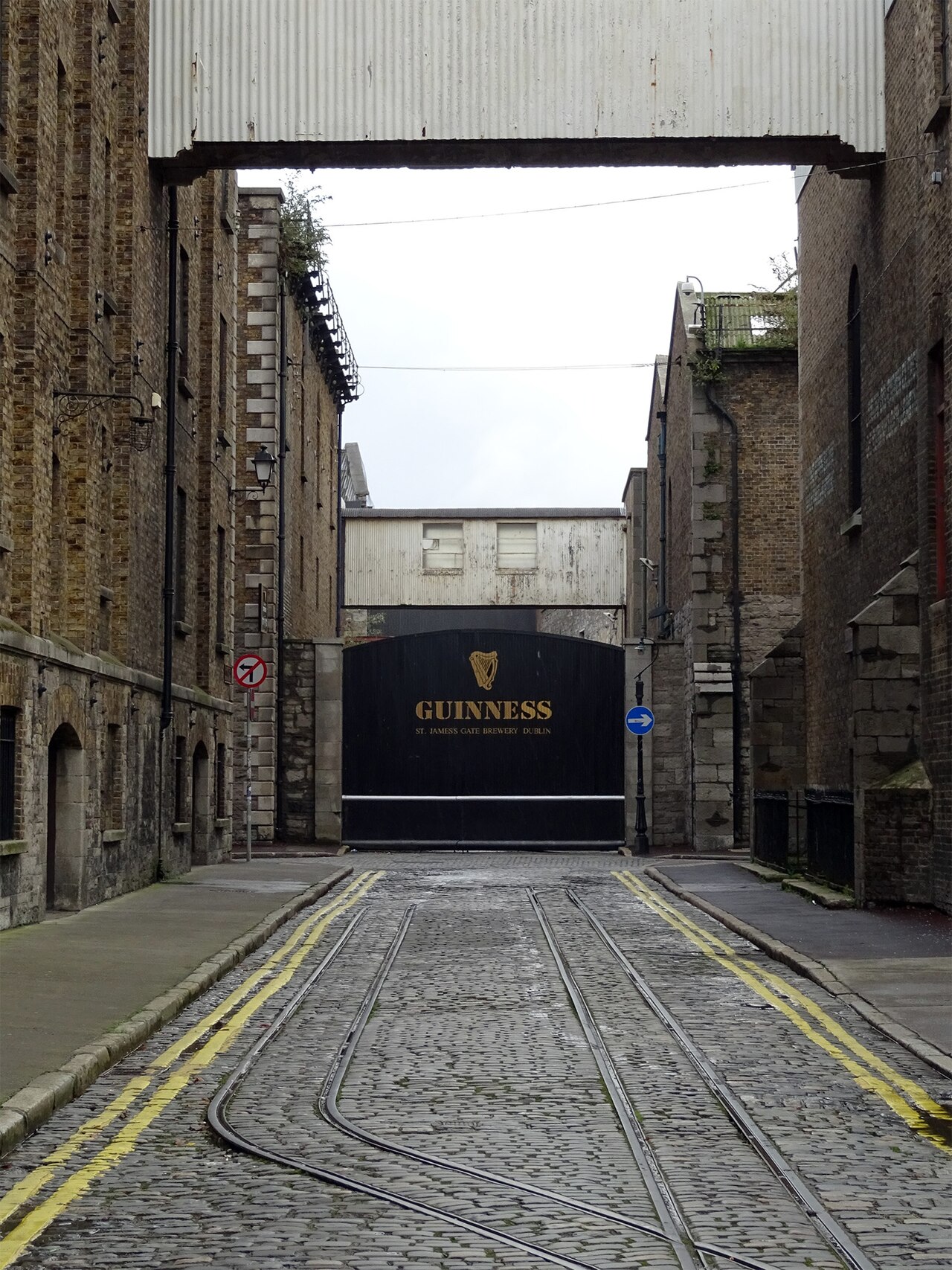
*Via Wikimedia Commons: [Guinness Storehouse St James's Gate Ushers Dublin 8 Ireland](https://commons.wikimedia.org/wiki/File:Guinness_Storehouse_St_James%27s_Gate_Ushers_Dublin_8_Ireland.jpg) by Spudgun67, [CC BY-SA 4.0](https://creativecommons.org/licenses/by-sa/4.0).*
## Arthur Guinness and St James's Gate
The Irish Times, in a brewery timeline published in April 2004, records that in 1759 Arthur Guinness signed a 9,000-year lease on a disused brewery at St James's Gate, Dublin, at an annual rent of £45.[3] The site then covered four acres and included a mill, two malthouses, stabling for twelve horses and a hay loft.[3] In 1775 he had to defend against Dublin Corporation the water rights that the lease had granted him.[3] The Guinness Storehouse, the visitor attraction at the brewery, states that the original lease gave access to the Dublin city watercourse.[6]
Accounts of the shift from ale to dark beer differ in their dates. Britannica's article on the brewery says Arthur Guinness, who began as an ale brewer, added a dry stout modelled on the porter then popular in London in 1778, and that ale was dropped within a few years.[4] Britannica's company article says the brewery first made a range of ales and beers and turned exclusively to porter, the dark beer later known as stout, in 1799.[2] In 1801 the brewery first made "West Indies Porter", a stronger beer meant to survive long sea voyages, according to the Irish Times timeline.[3]
Arthur Guinness died in 1803, and his son, also named Arthur, expanded sales to Great Britain.[2] By 1833 Guinness was the largest brewery in Ireland.[2][3] In 1855 Benjamin Lee Guinness took over on his father's death and spread the beer's reputation abroad.[2] In 1873, under Edward Cecil Guinness, the site doubled in size, reaching north of James's Street to the River Liffey.[3] Britannica says Guinness was the world's largest brewery by 1883, while the Irish Times timeline records that in 1886 it produced 1.2 million barrels a year and was described as the biggest brewery in the world.[2][3] The business was incorporated in 1886 as Arthur Guinness Son & Co. Ltd.[2]
The brewery was a major Dublin employer. The Irish Times timeline gives a workforce of more than 3,200 in 1906, with about 10,000 people depending on the brewery, and Britannica says about 5,000 people worked there in the 1930s.[3][4] The last wooden keg was filled in 1963, after which only metal kegs were used.[3]
The Guinness Storehouse opened in 2000 in a former fermentation plant at the brewery.[3][4] Britannica describes it as Dublin's biggest tourist attraction and notes a glass-walled bar at the top of the building and a gallery devoted to the artist John Gilroy.[4]
## The beer and how it is made
The Guinness Storehouse describes the beer as made from four ingredients: barley, water, hops and yeast.[6] Its question-and-answer page names a mix of raw, malted and roasted barley.[5] The same page says the dark colour comes mainly from roasted barley and that the beer looks black but shows a ruby-red tint against light.[5] Hops add bitterness and act as a preservative, and yeast turns sugars from the barley into alcohol.[5][6]
As of November 2026, the Storehouse states that the brewing water comes from the Wicklow Mountains, about 40 km away, and has never been drawn from the River Liffey.[6] It says Guinness buys about two-thirds of the malting barley grown on the island of Ireland each year, and that the yeast in use dates back to at least 1903, when a yeast library was set up at St James's Gate.[6] It also cites an 1801 brewer's diary entry recording the recipe for the first export beer, brewed with extra hops to keep it fresh at sea.[6]
The Storehouse summarises the process in steps: milled barley is mashed with hot water, boiled with hops, and cooled into wort, the liquid whose sugars the yeast then ferments; the wort is fermented with yeast, matured, and nitrogenated before packaging.[5] Guinness mixes nitrogen with carbon dioxide; according to the Storehouse, nitrogen forms finer bubbles, which give the creamy head and the "surge" seen when the beer settles in the glass.[5] The same page states that Guinness Draught has been vegan-friendly since 2017, when the brewery stopped using isinglass, a fish-derived clarifying agent.[5]
Diageo's brand page lists the main products as of November 2026.[1] Guinness Draught in cans uses "The Widget", a device inside the can that Diageo says took five years of development and gives a draught-style pour.[1] Foreign Extra Stout is described as brewed with extra hops to survive long voyages, and Guinness 0.0 is an alcohol-free version that Diageo says took four years to develop.[1] The page also lists NITROSURGE, a home device that uses ultrasonic technology, and MicroDraught, a dispense system for venues without draught lines.[1]
## Where it is brewed and sold
Diageo said in its press release of 12 June 2024 that Guinness was brewed in 49 countries and sold in more than 120.[10] As of November 2026, Diageo's brand page says the beer is brewed in over 50 countries and enjoyed in around 150.[1]
At Diageo's Guinness Investor and Analyst Event in 2025, held at St James's Gate, the company's supply-chain presentation stated that brewing is centralised at St James's Gate and that the brewery's capacity utilisation was well over 90%.[1][7] Outside Ireland, the presentation said, Guinness is brewed through long-standing third-party partnerships using Guinness Flavour Extract shipped from St James's Gate.[7] Britannica's brewery article says the Dublin brewery produces all Guinness sold in the United Kingdom and Ireland.[4]
To add capacity, Diageo built a 2.0 million hectolitre brewery at Littleconnell, near Newbridge in County Kildare, which the 2025 presentation said would raise brewing capacity by 25% and take over Diageo's other beers so that St James's Gate could brew only Guinness.[7] Alliance News, carrying a Press Association report, said on 11 May 2026 that the Taoiseach and Diageo's chief executive had opened the Littleconnell brewery that day, that it brews Rockshore, Harp and Smithwick's and some licensed beers, and that Diageo had planning permission for a second brewery on the site, dedicated to Guinness and Guinness 0.0, as part of a €400 million investment that would double the site's capacity.[17] The same report said Diageo expected to invest nearly €1 billion across the island of Ireland between 2020 and 2029.[17]
Diageo has also opened Open Gate breweries for visitors: its brand page lists one in Chicago that opened in September 2023 and one in Covent Garden, [London](https://micwyn.com/t/3643/london).[1]
## Ownership and business
Britannica records that Guinness bought the Scotch whisky distiller Arthur Bell & Sons in 1985 and The Distillers Company, then the world's largest Scotch distiller, in 1986.[2] In 1997 Guinness PLC merged with Grand Metropolitan PLC to form Diageo PLC, headquartered in London; Guinness continued as a Diageo brand.[2] Earlier, Guinness had opened a brewery at Park Royal in London in 1936 and began producing Harp lager in the 1950s.[2]
The figures below belong to Diageo as a whole unless marked as Guinness. Diageo announced its preliminary results for the year ended 30 June 2026 on 6 August 2026, with Sir Dave Lewis as chief executive.[16] It named Guinness among its "standout performers".[16] Diageo's Form 20-F for fiscal 2026 reports group net sales of $19,643 million, down 3.0% on fiscal 2025, and says its products are sold in nearly 180 countries.[15]
For Guinness itself, Diageo's Annual Report 2026 gives, for the year to 30 June 2026, organic volume up 7%, organic net sales up 12% and reported net sales up 11%, using Diageo's own "organic" and "reported" measures.[14] The same report shows beer as 18% of Diageo's reported net sales and says Guinness 0.0 grew volume and net sales by double digits.[14] The 20-F says Great Britain net sales grew 2.9%, "driven primarily by double-digit growth in Guinness", and Ireland net sales grew 3.2%, with continued growth in Guinness.[15]
Diageo has been selling its stakes in African brewing companies that make Guinness.[14][18] Its Annual Report 2026 refers to the sales of Guinness Ghana Breweries PLC, Guinness Nigeria PLC and Seychelles Breweries Limited.[14] On 17 December 2025 RTÉ, carrying a Reuters report, said Diageo had agreed to sell its 65% stake in East African Breweries (EABL) to Japan's Asahi for $2.3 billion, and that EABL would sign new agreements with Diageo to produce Guinness.[18] Diageo's Annual Report 2026 states that the sale remains on track to complete in the second half of calendar 2026.[14]
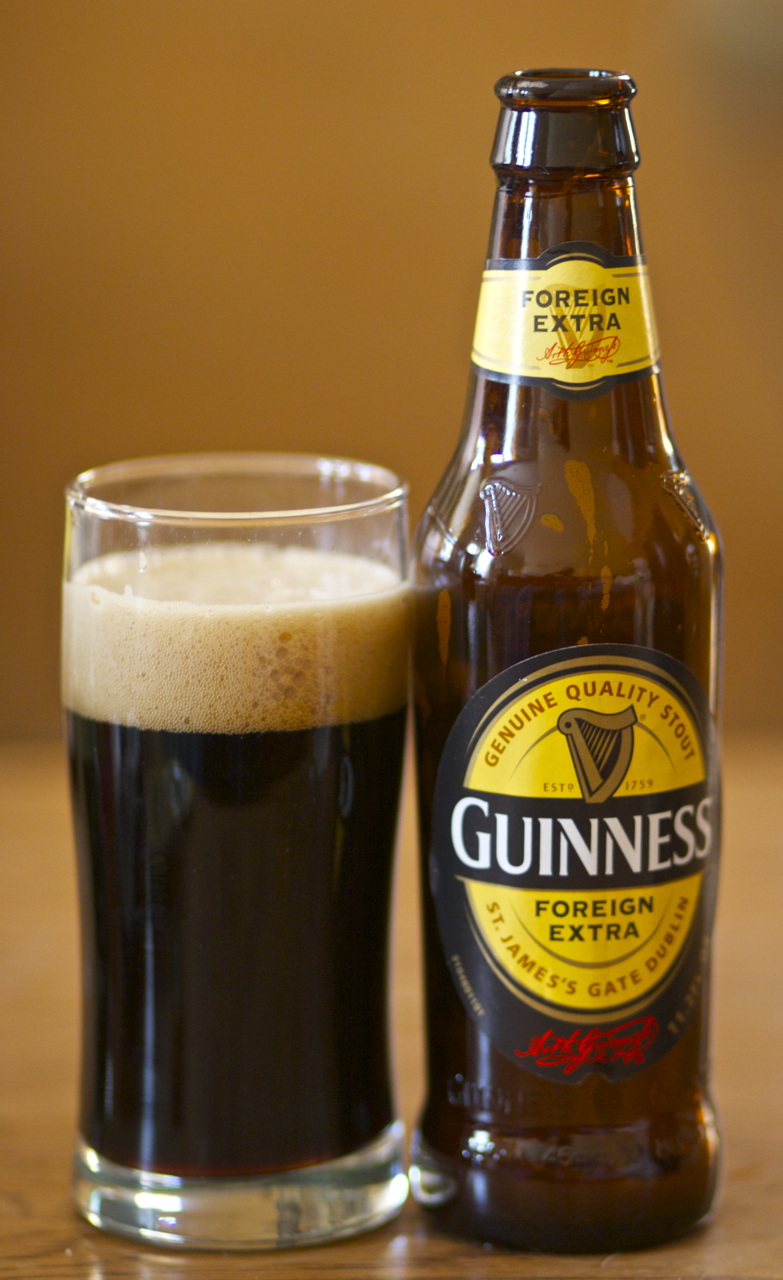
*Via Wikimedia Commons: [Guinness Foreign Extra](https://commons.wikimedia.org/wiki/File:Guinness_Foreign_Extra.jpg) by Mars5, [CC0](http://creativecommons.org/publicdomain/zero/1.0/deed.en).*
## Advertising
The Guinness Storehouse states that the company did not advertise for its first 170 years, and that its first campaign ran in 1929 in The Daily Chronicle under the slogan "Guinness is Good for You".[8] The Irish Times reported in 2004 that the first advertisement ran only in England, as Guinness's position in Ireland was seen as making advertising unnecessary there, and observed that the company probably could not make such claims 75 years later.[9] The same article noted growing restrictions on alcohol advertising, including on health claims.[9]
The agency S.H. Benson handled Guinness advertising for about 40 years.[8] Its artist John Gilroy produced the best-known posters, including "Guinness for Strength", first seen in 1934, and the "My Goodness, My Guinness" zookeeper series featuring a toucan and other animals.[8] Variants were made for other markets, such as "Guinness for Power" in Africa.[8]
The Storehouse records that a Guinness advertisement ran on the first night of commercial television in the UK in 1955.[8] "Surfer", launched in Great Britain on St Patrick's Day 1999, won a Gold Lion at Cannes in June 1999 and was voted the greatest TV commercial in Channel 4's "The 100 Greatest TV Ads" in April 2000.[8] Later advertisements included "Christmas Card" (2005) and "Sapeurs" (2014).[8]
In sport, Diageo announced on 12 June 2024 a four-year agreement making Guinness the official beer of the [Premier League](https://micwyn.com/t/3611/premier-league) from the 2024/25 season, its first global football partnership.[10] Diageo's brand page also lists a Six Nations rugby partnership announced in December 2023.[1] Diageo's fiscal 2026 report describes a campaign that used one of the brand's best-known assets to invite people to share their own "Pint of View".[15]
## Guinness World Records
The book now called Guinness World Records began as a Guinness promotion.[11] According to Guinness World Records, Sir Hugh Beaver (1890–1967), managing director of the Guinness Brewery, joined a shooting party in County Wexford in the early 1950s where an argument about Europe's fastest game bird could not be settled from any reference book.[11] In 1954 he had the idea for a book of facts to settle pub arguments and invited the twins Norris (1925–2004) and Ross McWhirter (1925–75), fact researchers from London's Fleet Street, to compile it.[11] Guinness Superlatives was incorporated on 30 November to publish it, with an office at 107 Fleet Street.[11]
Britannica says Guinness Superlatives was founded in November 1954 and that the first edition appeared a year later, with 198 pages and about 4,000 entries; it became a best seller in England within four months.[12] Britannica adds that the book has been translated into more than 40 languages and has sold more than 150 million copies since 1955.[12]
The records business later left the brewer. Britannica's Guinness company article says the property was sold in 2001.[2] Marketing magazine, carrying a Canadian Press report on 15 February 2008, said a subsidiary of Canada's Jim Pattison Group had bought Guinness World Records from HIT Entertainment for an undisclosed price.[13] As of November 2026, the organisation describes itself as a global brand, "originally the Guinness Book of Records", with offices in London, New York, Beijing, Tokyo and Dubai.[11]
## Controversies, recalls and court cases
**Distillers takeover share-trading case.** Britannica describes the use of secret and apparently illegal share dealings during Guinness's 1986 takeover of Distillers as a major corporate scandal.[2] In 1990, at the Old Bailey in London, four businessmen, among them the company's former chief executive, were convicted over a scheme to drive up the Guinness share price during the £2.6 billion takeover.[21] In September 2000, the European Court of Human Rights found that three of the men had not had a fair trial, because evidence they had been compelled to give to Department of Trade and Industry inspectors was used against them, in breach of Article 6 of the European Convention on Human Rights; it made no award and did not say they should have been acquitted, the Irish Times reported on 20 September 2000.[20] On 21 December 2001 the Court of Appeal in London dismissed a renewed appeal by all four and upheld the convictions.[21]
**Guinness 0.0 recall.** In November 2020, about three weeks after launching Guinness 0.0 in Britain, Diageo recalled the alcohol-free stout after finding microbiological contamination that it said "may make some cans of Guinness 0.0 unsafe to consume".[19] Diageo called the recall a precautionary measure, and a spokeswoman said the issue "does not impact any other Guinness variants or brands", the Irish Times reported on 11 November 2020.[19]
## Sources
1. Diageo. "Guinness: Iconic Stout Since 1759". Diageo. No date shown; accessed 28 November 2026. https://www.diageo.com/en/our-brands/beer/guinness
2. Britannica Money. "Guinness". Encyclopaedia Britannica. No date shown; accessed 28 November 2026. https://www.britannica.com/money/Guinness
3. "St James's Gate: a brief history". The Irish Times. 16 April 2004; accessed 28 November 2026. https://www.irishtimes.com/business/st-james-s-gate-a-brief-history-1.1308346
4. "Guinness Brewery". Encyclopaedia Britannica (print version). No date shown; accessed 28 November 2026. https://www.britannica.com/print/article/2241299
5. Guinness Storehouse. "The 9 Most Commonly Asked Questions About Guinness". Guinness Storehouse (Diageo). No date shown; accessed 28 November 2026. https://www.guinness-storehouse.com/en/whats-hoppening/most-popular-questions-about-guinness
6. Guinness Storehouse. "Guinness Ingredients Experience". Guinness Storehouse (Diageo). No date shown; accessed 28 November 2026. https://www.guinness-storehouse.com/en/guinness-ingredients-experience
7. Ewan Andrew (Diageo). "An efficient and resilient supply chain fit for future growth" (script), Guinness Investor and Analyst Event 2025. Diageo. 2025; accessed 28 November 2026. https://www.diageo.com/~/media/Files/D/Diageo-V2/Diageo-Corp/investors/results-reports-and-events/ewan-andrew-an-efficient-and-resilient-supply-chain-fit-for-future-growth-script.pdf
8. Guinness Storehouse. "Lovely Day for a Guinness". Guinness Storehouse (Diageo). No date shown; accessed 28 November 2026. https://www.guinness-storehouse.com/en/discover/lovely-day-for-a-guinness
9. Shane Hegarty. "Adverts are good for you". The Irish Times. 7 February 2004; accessed 28 November 2026. https://www.irishtimes.com/news/adverts-are-good-for-you-1.1133020
10. Diageo. "Guinness announces first-ever global partnership in football as the official beer of the Premier League" (press release). Diageo. 12 June 2024; accessed 28 November 2026. https://www.diageo.com/~/media/Files/D/Diageo-V2/Diageo-Corp/press-release/2024/guinness-announces-first-ever-global-partnership-in-football-as-the-official-beer-of-the-premier.pdf
11. Guinness World Records. "Our story". Guinness World Records. No date shown; accessed 28 November 2026. https://www.guinnessworldrecords.com/about-us/our-story/index.html
12. "The Guinness Book of World Records". Encyclopaedia Britannica (print version), revised by John P. Rafferty. No date shown; accessed 28 November 2026. https://www.britannica.com/print/article/248945
13. Canadian Press. "Pattison makes World Records buy". Marketing. 15 February 2008; accessed 28 November 2026. https://marketingmag.ca/news/media-news/pattison-makes-world-records-buy-13316
14. Diageo plc. Annual Report 2026 (furnished on Form 6-K, fiscal year ended 30 June 2026). U.S. Securities and Exchange Commission. No date shown; accessed 28 November 2026. https://www.sec.gov/Archives/edgar/data/0000835403/000162828026057527/dia045-arax2026annualrep.htm
15. Diageo plc. Form 20-F for the fiscal year ended 30 June 2026. U.S. Securities and Exchange Commission. No date shown; accessed 28 November 2026. https://www.sec.gov/Archives/edgar/data/0000835403/000162828026057529/deo-20260630.htm
16. Diageo. "2026 preliminary results". Diageo. 6 August 2026; accessed 28 November 2026. https://www.diageo.com/en/investors/results-reports-and-events/2026-preliminary-results
17. Cillian Sherlock (Press Association). "Diageo to invest further EUR400 million in Kildare brewery in Ireland". Alliance News, via Morningstar UK. 11 May 2026; accessed 28 November 2026. https://www.morningstar.co.uk/uk/news/AN_1778483509675721000/diageo-to-invest-further-eur400-million-in-kildare-brewery-in-ireland.aspx
18. Reuters. "Diageo sells East African Breweries stake". RTÉ News. 17 December 2025; accessed 28 November 2026. https://www.rte.ie/news/business/2025/1217/1549487-diageo-sells-east-african-breweries-stake
19. Conor Pope. "Guinness recalls new non-alcoholic stout in 'precautionary' move". The Irish Times. 11 November 2020; accessed 28 November 2026. https://www.irishtimes.com/life-and-style/food-and-drink/guinness-recalls-new-non-alcoholic-stout-in-precautionary-move-1.4406226
20. "UK Guinness trial judged 'unfair'". The Irish Times. 20 September 2000; accessed 28 November 2026. https://www.irishtimes.com/business/uk-guinness-trial-judged-unfair-1.1123430
21. "'Guinness Four' lose appeal against convictions". The Irish Times. 21 December 2001; accessed 28 November 2026. https://www.irishtimes.com/news/guinness-four-lose-appeal-against-convictions-1.408181
