Compare versions
Version 3 → Version 4. Removed · Added. This shows the entry's text as it is written, including its formatting marks.
Version 3 · Version 4 · Version history
Side by side · Together
Tesla, Inc. is an American company, headquartered in Austin, Texas, that designs, manufactures, sells and leases electric vehicles and energy generation and storage systems, and that describes its aim as bringing artificial intelligence into the real world.[1]
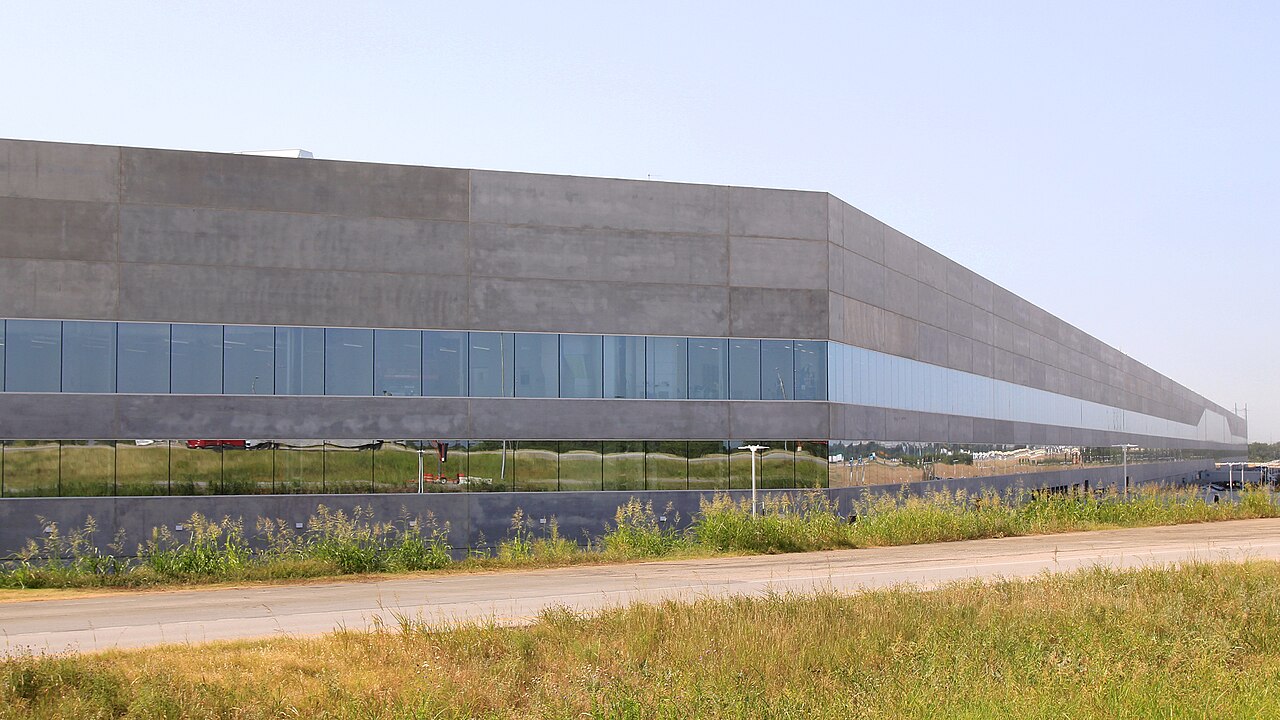
*Via Wikimedia Commons: [Gigafactory Texas Building 1 June 2022](https://commons.wikimedia.org/wiki/File:Gigafactory_Texas_Building_1_June_2022.jpg) by Larry D. Moore, [CC BY 4.0](https://creativecommons.org/licenses/by/4.0).*
## What the company is
Tesla was incorporated in the State of Delaware on 1 July 2003 and converted to a Texas corporation on 13 June 2024, according to its annual report on Form 10-K for 2025.[1] The same filing describes the company as focused on "bringing artificial intelligence ("AI") into the real world", through products such as Full Self-Driving (Supervised) and its Robotaxi service, and through work on humanoid robots, including one called Optimus.[1] It reports two segments, automotive and energy generation and storage.[1]
As of 31 December 2025, Tesla's employee headcount worldwide was 134,785.[1]
## Products and services
As of the 10-K for 2025, Tesla manufactures five consumer vehicles: the Model 3 (a four-door mid-size sedan), Model Y (a compact sport utility vehicle built on the Model 3 platform), Model S (a full-size sedan), Model X (a mid-size SUV) and the Cybertruck (a full-size electric pickup truck).[1] It also began early production and deliveries of a commercial electric vehicle, the Tesla Semi, in 2022.[1] The company launched its Robotaxi service, an autonomous ride-hailing platform, in June 2025; the filing says it operates with Model Y vehicles and is expected in time to include Cybercab, a purpose-built autonomous vehicle.[1]
The energy business sells Powerwall, a battery for homes or small commercial sites, and Megapack, a larger battery system for commercial, industrial and utility customers, along with solar panels and Solar Roof.[1]
In 2025 Tesla produced approximately 1.66 million consumer vehicles and delivered approximately 1.64 million.[1] Its total revenues were $94,827 million in 2025, against $97,690 million in 2024 and $96,773 million in 2023; energy generation and storage sales were $12,270 million in 2025, up from $9,564 million in 2024.[1]
## Manufacturing
The 10-K lists the company's primary manufacturing facilities as Gigafactory Texas (Austin, Texas), the Fremont Factory (Fremont, California), Gigafactory Nevada (Sparks, Nevada), Gigafactory Berlin-Brandenburg (Grünheide, Germany), Gigafactory Shanghai and Megafactory Shanghai (both in Shanghai, China), Gigafactory New York (Buffalo, New York) and Megafactory Lathrop (Lathrop, California).[1]
## Vehicle history
Tesla's 2016 annual report says the company commenced deliveries of the Model S in June 2012 and of the Model X in the third quarter of 2015.[4] Its 2017 annual report says deliveries of the Model 3, described as a lower-priced sedan designed for the mass market, began in July 2017.[5] In the 2016 report the company had said it intended to begin volume production and deliveries of the Model 3 in the second half of 2017.[4]
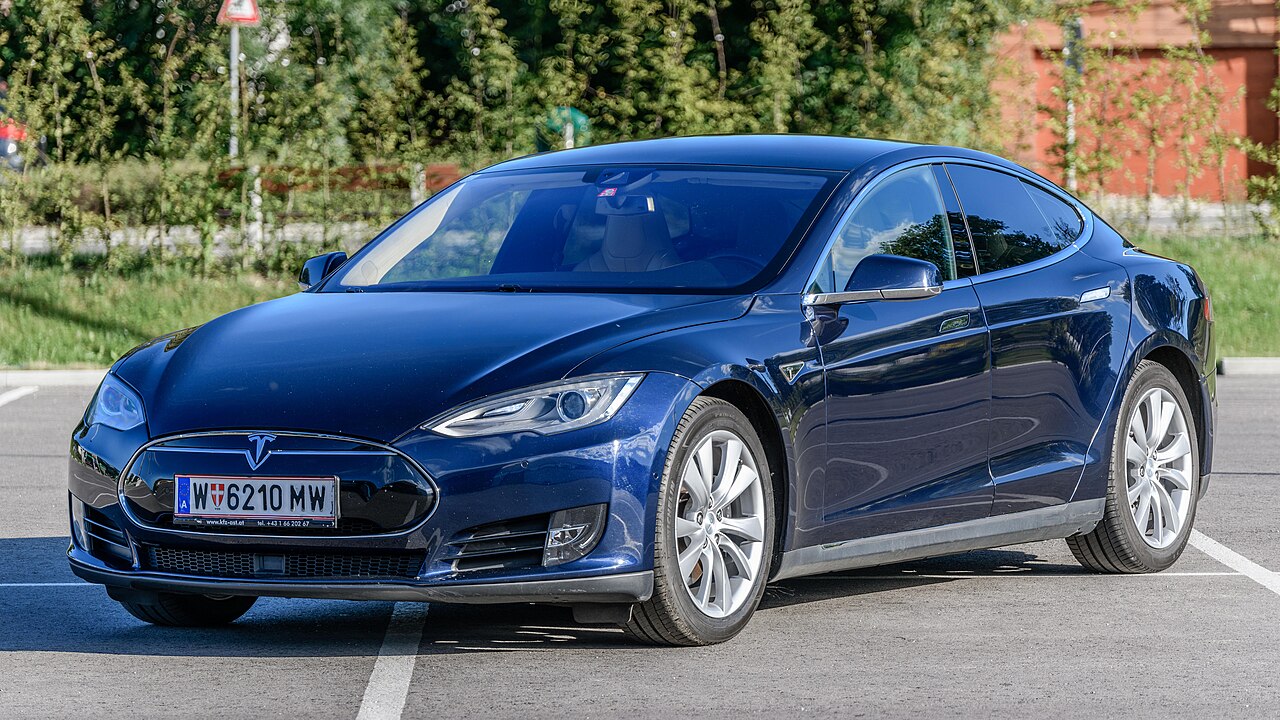
*Via Wikimedia Commons: [20180630 Tesla Model S 70D 2015 midnight blue left front](https://commons.wikimedia.org/wiki/File:20180630_Tesla_Model_S_70D_2015_midnight_blue_left_front.jpg) by Granada, [CC BY-SA 4.0](https://creativecommons.org/licenses/by-sa/4.0).*
## The Model 3 production ramp
In its annual report for 2017, Tesla said it had begun production and first customer deliveries of the Model 3 in July 2017 and was targeting a production rate of 5,000 Model 3 vehicles per week by the end of the second quarter of 2018.[5] It added that Model 3 volume production had been lower than it first expected because of production bottlenecks, with the battery module assembly line at Gigafactory 1 named as the main constraint so far.[5] The filing also stated that the ramp relied on a higher degree of automation than the company had used before, and that some interim, semi-automated lines would add labour cost until fully automated processes came online.[5] Tesla set an interim target of 2,500 vehicles per week by the end of the first quarter of 2018, and cautioned that its experience had "demonstrated the difficulty of accurately forecasting specific production rates at specific points in time".[5]
## Gigafactory 1 and the SolarCity acquisition
According to the 2016 annual report, Tesla broke ground on Gigafactory 1 outside Reno, Nevada, in June 2014, began assembling energy storage products there in the fourth quarter of 2015, and began producing lithium-ion battery cells for its energy storage products in the first quarter of 2017.[4] The company described Gigafactory 1 as built in phases, with Panasonic partnering to invest in the equipment that would make battery cells for Tesla.[4]
Tesla completed its acquisition of SolarCity on 21 November 2016. Each SolarCity share was converted into 0.110 shares of Tesla common stock, and the filing puts the fair value of the consideration transferred at $2.1 billion, based on 11,124,497 Tesla shares issued at $185.04 per share plus replacement equity awards.[4] The filing notes that Tesla's chief executive was, at that date, the chair of SolarCity's board.[4] Stockholder lawsuits challenging the acquisition were pending when the 2016 report was filed.[4]
## Charging
Tesla operates its own network of Superchargers, which its 2017 annual report described as industrial-grade, high-speed chargers placed along well-travelled routes to support long-distance travel, with use either free or for a small fee.[5] According to the 2025 annual report, stations are now placed both along major routes and in and around dense city centres, and the network is open to non-Tesla vehicles in certain markets, with all major automakers having announced adoption of the North American Charging Standard (NACS).[1] The same report says third parties can buy and install Superchargers and set the charging price through a Supercharger for Business programme, with Tesla remaining responsible for software updates, network operations, maintenance and driver support, and that Tesla opened its first Tesla Diner, which offers Supercharging alongside food and merchandise, in California in 2025.[1]
## Public listing and leadership
Tesla, then named Tesla Motors, priced its initial public offering on 29 June 2010: 13.3 million shares at $17.00, above the range of $14.00 to $16.00 first proposed, raising $226 million, with the shares listed on the NASDAQ under the ticker TSLA.[2] CNBC reported in 2025 that at the time of the offering the Roadster, a two-seat electric sports car, was the only car Tesla had for sale, and the Model S sedan was still two years from reaching the market.[3]
CNBC also reports that Elon Musk did not start Tesla but invested early, and that he took over as chief executive in October 2008 after a board revolt against the founding chief executive, Martin Eberhard.[3] See also [Elon Musk](/t/3537/elon-musk).
## Sources
- Tesla, Inc., Annual Report on Form 10-K for the fiscal year ended 31 December 2025, filed with the U.S. Securities and Exchange Commission, 2026. https://ir.tesla.com/_flysystem/s3/sec/000162828026003952/tsla-20251231-gen.pdf
- Renaissance Capital, "Tesla Motors prices IPO at $17.00, above the range", 29 June 2010. https://www.renaissancecapital.com/IPO-Center/News/8215/tesla-motors-prices-ipo-at-17.00-above-the-range
- L. Kolodny and A. Levy, "Tesla's IPO was 15 years ago. The stock is up almost 300-fold since then", CNBC (republished by NBC 7 San Diego), 29 June 2025. https://www.nbcsandiego.com/news/business/money-report/teslas-ipo-was-15-years-ago-the-stock-is-up-almost-300-fold-since-then/3858300
- Tesla, Inc., Annual Report on Form 10-K for the fiscal year ended 31 December 2016, filed with the U.S. Securities and Exchange Commission, 2017. https://ir.tesla.com/_flysystem/s3/sec/000156459017003118/tsla-10k_20161231-gen_0.pdf
- Tesla, Inc., Annual Report on Form 10-K for the fiscal year ended 31 December 2017, filed with the U.S. Securities and Exchange Commission, 2018. https://ir.tesla.com/_flysystem/s3/sec/000156459018002956/tsla-10k_20171231-gen.pdf
