Compare versions
Version 1 → Version 2 (current). Removed · Added. This shows the entry's text as it is written, including its formatting marks.
Version 1 · Version 2 (current) · Version history
Side by side · Together
Spam is a brand of canned, cooked meat made mainly from ground pork and ham, introduced in 1937 by the Minnesota company now called Hormel Foods Corporation.[1][6]
## Origin at Hormel
Hormel Foods began in 1891 in Austin, Minnesota, as Geo. A. Hormel & Company, a meatpacking and food-processing business that Britannica describes as central to the economy of that city.[2] According to Britannica, the canned product that became Spam made use of pork shoulder, a cut for which there was little demand at the time.[2]
An article from 2017, reposted in Hormel's own newsroom, credits the idea to Jay Hormel and quotes a Hormel vice president as saying Jay Hormel had in mind a convenient meat item.[3] The same article says the first can came off the production line in Austin on 5 July 1937.[3] Hormel's brand website calls Austin the birthplace of the brand and the home of the SPAM Museum.[4] The brand site says museums devoted to the company and the product opened in Austin in 1991, 2001 and 2016.[6]
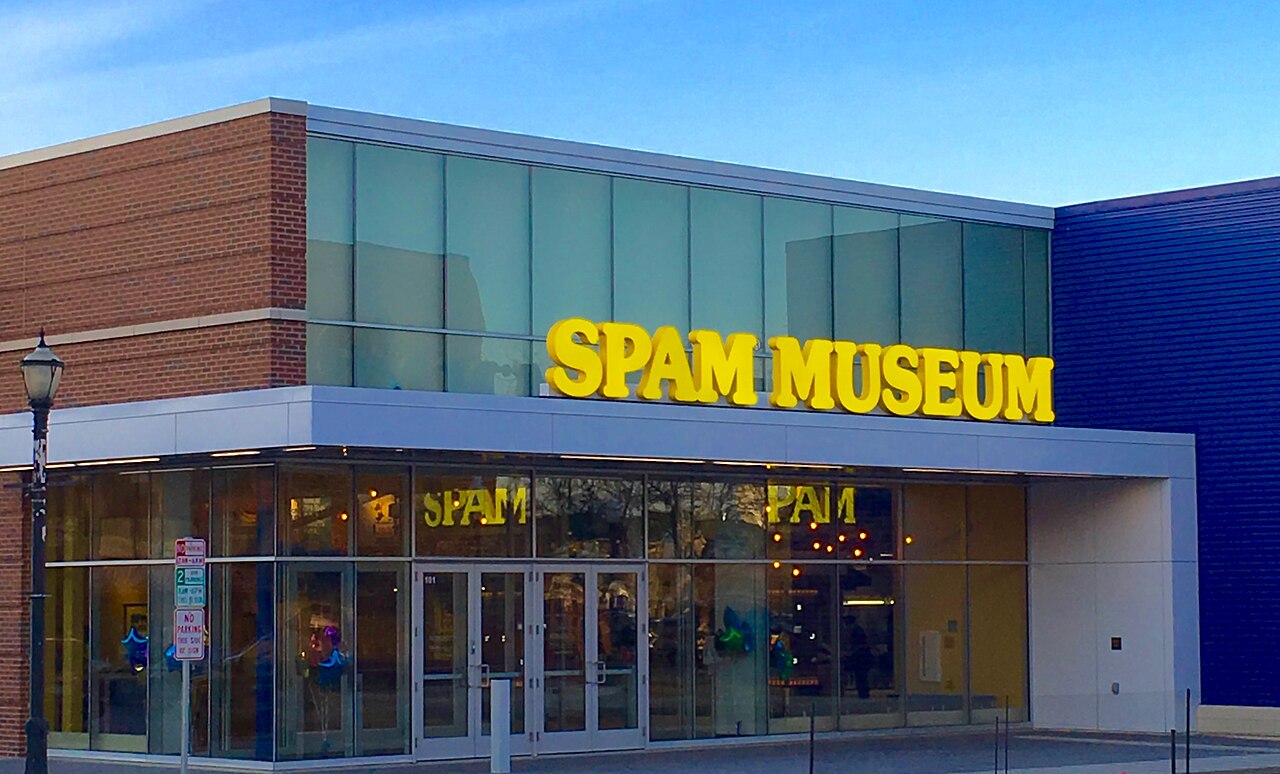
*Via Wikimedia Commons: [Spam Museum in evening](https://commons.wikimedia.org/wiki/File:Spam_Museum_in_evening.jpg) by Darb02, [CC BY-SA 4.0](https://creativecommons.org/licenses/by-sa/4.0).*
## The name
The name came from a contest. The 2017 article says Jay Hormel did not at first know what to call the product and held a naming contest at a New Year's party in 1936, with a prize of 100 dollars, which was won by an actor friend who suggested "Spam".[3] Britannica identifies the winner as Ken Daigneau, a New York actor whose brother was a Hormel executive, and describes the name as a blend of "spiced" and "ham".[1] Britannica's entry on the company adds that the name existed before the product did, and that the product was quickly trademarked.[2]
Hormel itself does not confirm the "spiced ham" explanation. Its frequently asked questions page, viewed in November 2026, calls that a popular belief and says the real meaning of the name is known only to a small circle of former Hormel executives.[4]
## Ingredients and production
As of November 2026, Hormel's website lists the ingredients of Spam Classic, the original variety, as pork with ham, salt, water, modified potato starch, sugar and sodium nitrite.[5] The product page presents Classic as the variety that dates back to 1937.[5]
The brand site describes production as follows: the pork and ham are ground and mixed with the other ingredients, the mixture is filled into 12-ounce cans, the cans are sealed under vacuum, and they are then cooked and cooled for about three hours before labels are applied.[6] Hormel's frequently asked questions page likewise says the process begins with pre-ground pork and ham, to which salt, sugar and the other ingredients are added and mixed.[4]
Hormel has added many varieties over the decades. Its brand site lists, among others, Hickory Smoke, Less Sodium, Lite and Hot & Spicy versions and versions with bacon, introduced between the 1970s and the 2000s, followed in the 2010s and 2020s by flavours such as Tocino, Portuguese Sausage, Pumpkin Spice, Figgy Pudding and Maple.[6] The brand site, viewed in November 2026, says Spam comes in 11 varieties sold in about 50 countries, while the frequently asked questions page says over a dozen varieties are sold in more than 50 countries.[6][4]
## Second World War
Spam became widely known through the Second World War. Hormel says that in the 1940s more than 100 million pounds of Spam were shipped overseas to help feed Allied troops.[6] An article by the marketing scholar Ayalla A. Ruvio of Michigan State University, first published by The Conversation and republished by Smithsonian magazine, gives a higher figure, saying over 150 million pounds were used in the war effort and that Spam became a basic part of soldiers' diets.[7] The same article says soldiers also used its grease to lubricate guns and waterproof boots, and that American troops introduced the product to local people in each country where they were based.[7]
A separate Smithsonian magazine article on Spam in Asian cooking says the United States sent about 15 million cans a week to its forces, and that soldiers grew tired of eating it.[8]
After the war, Hormel promoted the product with the Hormel Girls, a musical troupe of women who had served in the Second World War. According to Ruvio's article, the group toured the United States promoting Spam and starred in a highly rated radio show carried on three national networks.[7]
## Popularity in Hawaii and Guam
Hormel's frequently asked questions page says people in Hawaii buy about 7 million cans a year and that people in Guam average 16 cans per person a year.[4] In a press release of 28 April 2023, Hormel said almost 7 million cans of Spam products were eaten every year in Hawaii, more per person than in any other US state.[9] That release announced the return of the SPAM JAM festival in Waikiki, a celebration of the brand.[9]
Smithsonian magazine likewise reports that about 7 million cans are eaten in Hawaii each year, and that dishes such as Spam musubi and Spam breakfast plates are common there.[8]
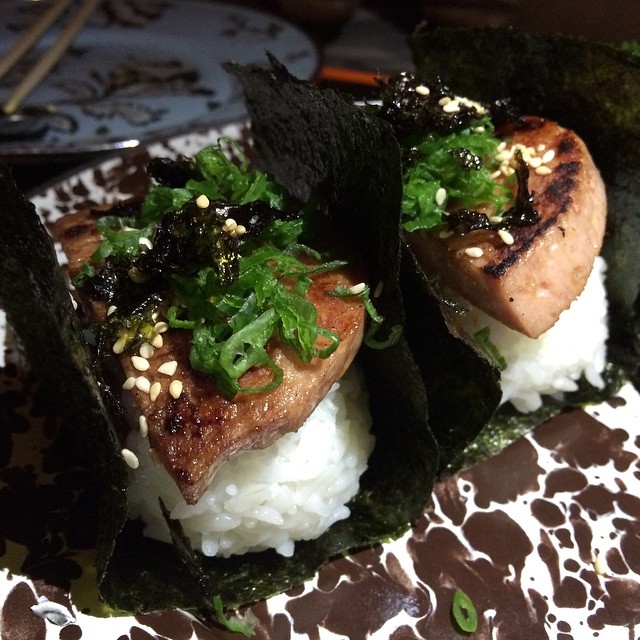
*Via Wikimedia Commons: [Homemade SPAM Musubi (16185782444)](https://commons.wikimedia.org/wiki/File:Homemade_SPAM_Musubi_(16185782444).jpg) by Arnold Gatilao from Oakland, CA, USA, [CC BY 2.0](https://creativecommons.org/licenses/by/2.0).*
## Popularity in Asia
Smithsonian magazine traces Spam's spread in Asia to American forces in the Korean War, the Vietnam War and other Cold War conflicts, when troops left cans behind in places including South Korea and the Philippines.[8] The article also describes how cooks in Okinawa, the Japanese prefecture where it says about 75 percent of United States military facilities in Japan are located, worked Spam into local dishes.[8]
South Korea has become one of the largest markets. The Korea Herald reported in January 2023 that Spam is produced and sold in South Korea by the food company CJ CheilJedang under a licence agreement with Hormel, and that CJ first brought the product to the Korean market in 1987.[10] The paper reported that annual Spam sales in Korea passed 100 billion won in 2007 and reached 490 billion won in 2021, and that gift sets accounted for 60 percent of annual Spam sales there.[10]
A South China Morning Post article reposted in Hormel's newsroom in September 2018 said that, according to Hormel, South Korea was the second-largest consumer of Spam after the United States.[11] That article said American forces brought Spam to the Korean peninsula during the Korean War in the 1950s, when civilian food was scarce, and that Koreans later created budae jjigae ("army stew"), which combines Spam with ingredients such as canned beans, cheese and kimchi.[11] It said Spam gift sets became popular during the Asian financial crisis of the late 1990s as a cheaper alternative to fruit baskets and beef sets.[11] The Korea Herald dated Spam's popularity as a holiday gift to the 2000s.[10]
## The Monty Python sketch and email "spam"
In 1970 the British comedy series Monty Python's Flying Circus broadcast a sketch set in a diner full of Vikings, who chant the product's name so loudly and so often that it drowns out the other dialogue, according to Merriam-Webster.[12] The dictionary publisher says that in the 1990s, users of the Usenet online discussion groups were reminded of the sketch by repetitive, unwanted posts, and that a 1994 article in Network World describing a "spam attack" brought the term to a wider audience; from there "spam" came to mean unwanted bulk messages such as junk email.[12]
Hormel has generally made light of the association. Food Dive, in an article reposted in Hormel's newsroom in September 2018, reported that the company had at first been seriously concerned about the link with junk email and later chose to laugh at itself rather than resist.[13] Merriam-Webster notes that in 2005 Hormel helped promote the Broadway musical Spamalot, written by Eric Idle, and Hormel's brand site describes the show as inspired by Monty Python.[12][6]
## Sales and production figures
Hormel has announced a series of production and sales milestones. Its brand site says the one-billionth can was produced in 1959 and the two-billionth in 1970, and its frequently asked questions page says the eight-billionth can was produced in 2012.[6][4]
On 5 July 2022, the brand's 85th anniversary, Hormel said that more than 9 billion units had been sold across 48 countries, that 12.8 cans of Spam products were eaten every second, and that the brand had achieved seven consecutive years of record sales.[14] In its press release of 28 April 2023, Hormel said the brand had enjoyed eight consecutive years of record sales growth.[9]
Food Dive, in its article reposted by Hormel on 6 September 2018, reported Spam sales of about 217 million dollars for the 52 weeks ended 15 July, citing data from the market research firm IRI.[13]
Spam's results are reported inside those of its parent company, Hormel Foods. On 4 December 2025, Hormel reported net sales of 12.1 billion dollars for the fiscal year ended 26 October 2025, and said that in the fourth quarter its International segment's volume and sales growth for Spam luncheon meat had been more than offset by declines in fresh pork exports and competition in Brazil.[15] On 27 August 2026, Hormel reported net sales of 2.96 billion dollars for the third quarter of its 2026 fiscal year, ended 26 July 2026.[16] In that report Hormel named the Spam family of products among the brands that grew in its Retail segment, and said that the recognition of certain Spam export sales had been held back by a one-time transition between legal entities.[16]
## Controversies, recalls and court cases
### The 1985–86 Austin strike
The Austin plant where Spam was first made was the scene of a long strike in the 1980s. In 1985 Hormel sought a 23 percent wage cut, and in August about 1,500 workers belonging to Local P-9 of the United Food and Commercial Workers union walked off the job, MPR News reported in a 2010 history of the strike.[17] After six months the national union ordered the local to end the strike; when Austin members refused, the national union placed the local in receivership and took it over.[17] The strike lasted 10 months, and National Guard soldiers patrolled the city during it.[17] MPR News reported that after the strike Hormel hired new workers at lower wages, and in 1989 leased part of the Austin plant to Quality Pork Processors, which took over the slaughter and cutting work.[17]
In a statement given to the Austin Daily Herald and published on 14 August 2010, Hormel's vice president of corporate communications, Julie H. Craven, said the events of 1985 had helped shape the company and that Hormel gives its employees competitive wages and benefits for the work they do.[18]
### Trademark disputes over "spam"
Hormel has lost trademark disputes in Europe and the United States over the use of "spam" by others. On 4 October 2006, The Register reported that the Second Board of Appeal of the Office for Harmonisation in the Internal Market (OHIM), the European trademark office, had dismissed Hormel's appeal over applications to register "spam" for services including ones to avoid or suppress unsolicited email, after finding the word descriptive and not distinctive for those services.[19] The Register reported that Hormel had previously tolerated the use of "spam" for junk email as long as its own mark appeared in capitals as SPAM.[19]
In the United States, the Trademark Trial and Appeal Board of the US Patent and Trademark Office decided Hormel Foods Corporation and Hormel Foods, LLC v. Spam Arrest, LLC on 21 November 2007.[20] The board dismissed Hormel's petition to cancel the SPAM ARREST registration for email-filtering software, finding that Hormel had not proved likely confusion or dilution of its mark, and stating that "spam" is a recognised generic term for unsolicited commercial email.[20] Hormel spokeswoman Julie Craven told the Star Tribune that the company had created the Spam brand more than 70 years earlier and had invested heavily to build, support and protect it, and that it was reviewing its options, including an appeal.[21]
### Recalls and regulator alerts
On 26 May 2018, the US Department of Agriculture's Food Safety and Inspection Service (FSIS) announced that Hormel was recalling about 228,614 pounds of canned pork and chicken products, including 12-ounce cans of Spam Classic made at its Fremont, Nebraska, plant from 8 to 10 February 2018, because they might contain pieces of metal.[22] FSIS said the company had received four consumer complaints about metal objects in the cans and that there were reports of minor mouth injuries.[22]
On 16 September 2023, FSIS issued a public health alert for one lot of 12-ounce Spam Classic cans produced at the Austin plant on 17 August 2023 and shipped only to H-E-B stores in Texas, after the company reported that it had inadvertently shipped product that might not have been processed enough to be commercially sterile.[23] FSIS did not ask for a recall because it believed the product was no longer available for sale.[23]
## Sources
1. Gregory Lewis McNamee. "SPAM". Encyclopaedia Britannica. Last updated 12 September 2026; accessed 28 November 2026. https://www.britannica.com/topic/SPAM-food
2. "Hormel Foods Corporation". Encyclopaedia Britannica. No date shown; accessed 28 November 2026. https://www.britannica.com/topic/Hormel-Foods-Corporation
3. "Origins of SPAM: Celebrating 80 Years of the Canned Meat". Hormel Foods newsroom (reposted from Fox News). 23 November 2017; accessed 28 November 2026. https://www.hormelfoods.com/newsroom/news/origins-spam-celebrating-80-years-canned-meat/
4. "SPAM® Frequently Asked Questions". SPAM brand website, Hormel Foods. No date shown; accessed 28 November 2026. https://www.spam.com/faq
5. "SPAM® Classic". SPAM brand website, Hormel Foods. No date shown; accessed 28 November 2026. https://www.spam.com/varieties/spam-classic
6. "What is SPAM® Brand?". SPAM brand website, Hormel Foods. No date shown; accessed 28 November 2026. https://www.spam.com/what-is-spam-brand
7. Ayalla A. Ruvio. "How Spam Went from Canned Necessity to American Icon". Smithsonian magazine (republished from The Conversation). No date shown; accessed 28 November 2026. https://www.smithsonianmag.com/food/how-spam-went-canned-necessity-american-icon-180963916/
8. "How Spam Became a Staple of Asian Cuisine". Smithsonian magazine. No date shown; accessed 28 November 2026. https://www.smithsonianmag.com/arts-culture/how-spam-became-an-asian-staple-180982347/
9. "Global Fans to Celebrate Iconic SPAM® Brand in Waikiki as Beloved SPAM JAM® Festival Returns". Hormel Foods press release. 28 April 2023; accessed 28 November 2026. https://www.hormelfoods.com/newsroom/press-releases/global-fans-to-celebrate-iconic-spam-brand-in-waikiki-as-beloved-spam-jam-festival-returns/
10. Choi Jae-hee. "Once US military rations, canned meat has become an everyday staple and go-to gift item during major holidays". The Korea Herald. 20 January 2023; accessed 28 November 2026. https://www.koreaherald.com/view.php?ud=20230120000596
11. "Why cans of Spam are a popular gift for Chuseok, the 'Korean Thanksgiving'". Hormel Foods newsroom (reposted from the South China Morning Post). 23 September 2018; accessed 28 November 2026. https://www.hormelfoods.com/newsroom/news/why-cans-of-spam-are-a-popular-gift-for-chuseok-the-korean-thanksgiving
12. "How Junk Email Came to Be Called 'Spam'". Merriam-Webster, Wordplay. No date shown; accessed 28 November 2026. https://merriam-webster.com/wordplay/how-junk-email-came-to-be-called-spam
13. "Consumers Can't Get Enough of the Mercilessly Mocked Meat". Hormel Foods newsroom (reposted from Food Dive). 6 September 2018; accessed 28 November 2026. https://www.hormelfoods.com/newsroom/news/consumers-cant-get-enough-of-the-mercilessly-mocked-meat/
14. "Beloved SPAM® Brand Celebrates 85th Birthday". Hormel Foods press release. 5 July 2022; accessed 28 November 2026. https://www.hormelfoods.com/newsroom/press-releases/beloved-spam-brand-celebrates-85th-birthday/
15. "Hormel Foods Reports Fourth Quarter and Full Year Fiscal 2025 Results". Hormel Foods Corporation, Form 8-K exhibit, US Securities and Exchange Commission. 4 December 2025; accessed 28 November 2026. https://www.sec.gov/Archives/edgar/data/48465/000004846525000056/hrlearningsrelease2025q4.htm
16. "Hormel Foods Reports Third Quarter Fiscal 2026 Results". Hormel Foods Corporation, Form 8-K exhibit, US Securities and Exchange Commission. 27 August 2026; accessed 28 November 2026. https://www.sec.gov/Archives/edgar/data/0000048465/000004846526000053/hormelearningsreleaseq32026.htm
17. Elizabeth Baier. "History of the Hormel meatpackers strike". MPR News. 9 August 2010; accessed 28 November 2026. https://www.mprnews.org/2010/08/09/hormel-strike-summary/
18. "P-9, Hormel reflect on strike". Austin Daily Herald. 14 August 2010; accessed 28 November 2026. https://www.austindailyherald.com/?p=20365
19. OUT-LAW.COM. "Hormel loses Spam trademark appeal". The Register. 4 October 2006; accessed 28 November 2026. https://www.theregister.com/2006/10/04/hormel_loses_spam_trademark_appeal/
20. Trademark Trial and Appeal Board, US Patent and Trademark Office. "Hormel Foods Corporation and Hormel Foods, LLC v. Spam Arrest, LLC, Cancellation No. 92042134" (decision). 21 November 2007; accessed 28 November 2026. https://ttabvue.uspto.gov/ttabvue/ttabvue-92042134-CAN-55.pdf
21. Steve Alexander. "Spam lawsuit's last laugh is at Hormel's expense". Star Tribune. 29 November 2007; accessed 28 November 2026. https://www.startribune.com/spam-lawsuit-s-last-laugh-is-at-hormel-s-expense/11904166
22. "Hormel Foods Corporation Recalls Canned Pork and Chicken Products due to Possible Foreign Matter Contamination". Food Safety and Inspection Service, US Department of Agriculture. 26 May 2018; accessed 28 November 2026. https://www.fsis.usda.gov/recalls-alerts/hormel-foods-corporation-recalls-canned-pork-and-chicken-products-due-possible
23. "FSIS Issues Public Health Alert for Canned Meat Product Due to Possible Under Processing". Food Safety and Inspection Service, US Department of Agriculture. 16 September 2023; accessed 28 November 2026. https://www.fsis.usda.gov/recalls-alerts/fsis-issues-public-health-alert-canned-meat-product-due-possible-under-processing
