Mars, Incorporated is a privately held, family-owned American company, based in McLean, Virginia, that makes confectionery, snacks, food and pet-care products and runs veterinary hospitals.[1][2]
Overview
Mars describes itself as a business that has been owned by the Mars family for more than a century, and it states that the family reinvests about 90 percent of profits back into the company.[2] On its history page, viewed in November 2026, the company says it had more than $65 billion in annual sales in 2025, a figure it bases on the combined 2025 net sales of Mars and Kellanova, the snack maker it bought in December 2025.[1][9] In a release dated 13 January 2026, Mars described itself as a family-owned business of $65 billion or more with more than 170,000 Associates, the company's term for its staff.[3] Its corporate page, viewed in November 2026, gives the same figure of more than 170,000 Associates and says about 70,000 of them work in the United States.[2]
The company is organised into three segments that it calls Mars Petcare, Mars Snacking, and Mars Food & Nutrition.[2] As of November 2026, the company's global leadership team was headed by Poul Weihrauch, listed as CEO and Office of the President, with Andrew Clarke as Global President of Mars Snacking, Shaid Shah as Global President of Mars Food & Nutrition, Multisales & Global Customer, and Marc Carena as Global President of Mars Petcare.[15] Mars says it has been led by managers from outside the family since 2001.[1]
History
Frank C. Mars and the first bars
According to the company, Frank C. Mars, born in Minnesota in 1883, began making and selling butter cream candy from his kitchen in Tacoma, Washington, in 1911.[1] He started a business selling candies in Minneapolis in 1920, and in 1922 introduced the Mar-O-Bar, at a time when the company says its annual business was less than $100,000.[1] The Milky Way bar followed in 1923.[1] In 1929 the company moved to Chicago, taking close to 200 Associates with it, and it launched Snickers in 1930 and 3 Musketeers in 1932.[1] Frank C. Mars died in 1934.[1]
Forrest Mars Sr. and expansion abroad
Frank's son, Forrest E. Mars Sr., moved to the United Kingdom in 1932, where, in the company's account, he set out to build a business on the idea of a "mutuality of benefits" for all its stakeholders.[1] The company entered pet food in 1935 by buying Chappel Brothers, maker of Chappie dog food, and Maltesers appeared in Europe in 1936.[1] In 1940 Forrest Mars Sr. set up M&M Limited in Newark, New Jersey; M&M's were first made for the United States military in 1941 and went on general sale in 1945, and the printed "M" was added in 1950.[1] Mars entered the rice business in Houston, Texas, in 1942.[1]
Pet food grew in the decades that followed: Mars lists the launch of Pal dog food in the United Kingdom in 1954 and Whiskas cat food there in 1958, the founding of the Waltham Centre for Pet Nutrition in 1965, and the purchase of Kal Kan Foods of Los Angeles in 1968.[1] The company opened its first confectionery plant in Veghel, in the Netherlands, in 1962.[1]
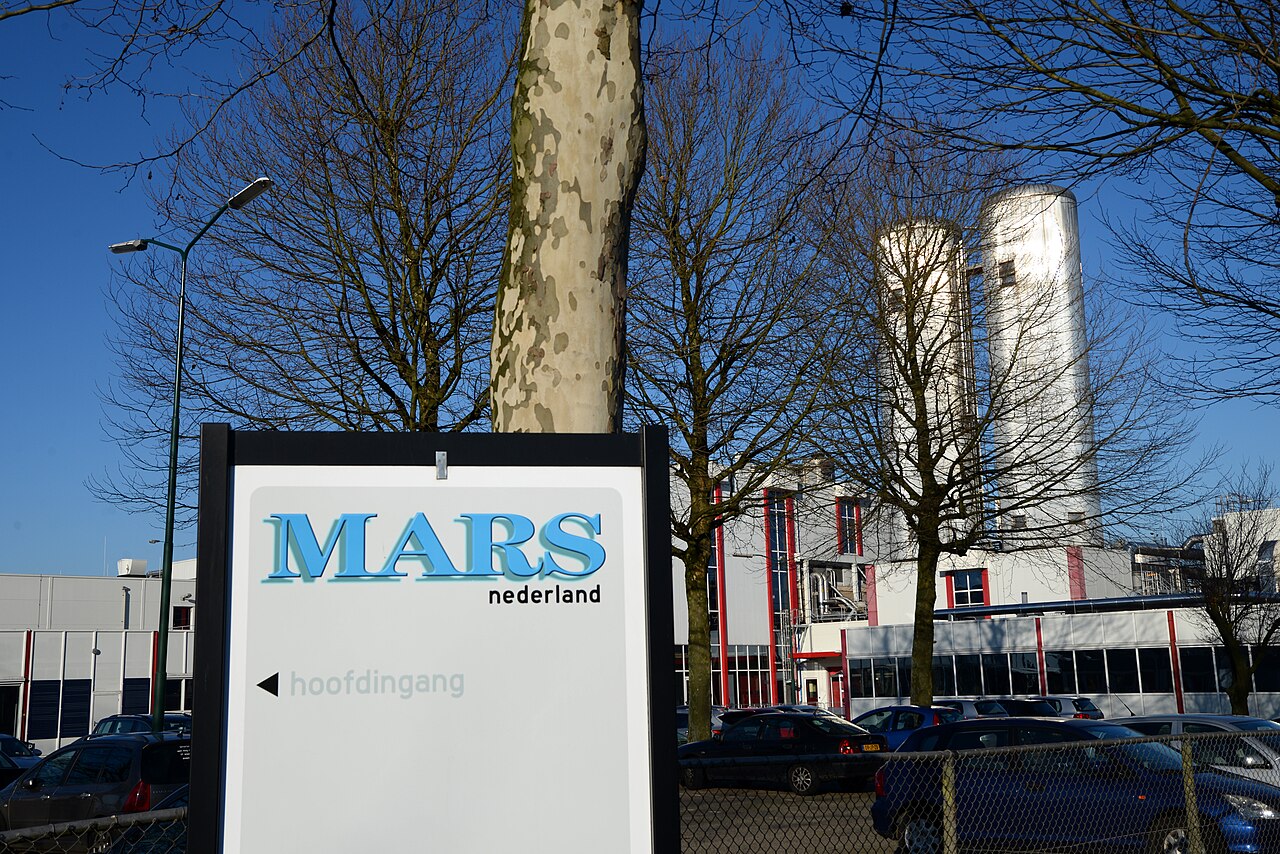
The Mars factory in Veghel, North Brabant, the Netherlands, with a Mars Nederland sign at its entrance, photographed on 13 January 2013.
Forrest Mars Sr. retired in 1969 and died in 1999 at the age of 96.[1] The company credits the next generation of the family, Forrest E. Mars Jr., John F. Mars and Jacqueline Badger Mars, with leading its spread around the world.[1] Its headquarters moved to Washington, D.C., in 1959 and to McLean, Virginia, in 1984.[1] In 1983 Mars published its first booklet on what it calls the Five Principles, the statement of values it still cites.[1]
Since 2001
After non-family management took over in 2001, Mars bought Royal Canin in 2002 and Nutro Products in 2007, and took an ownership stake in Banfield Pet Hospital in 2007 after a first investment in 1994.[1] In 2007 it also adopted a marketing code under which it says it stopped advertising food and snacks to children under 12.[1] In 2008 it bought the William Wrigley Jr. Company.[1]
Confectionery and snacking
Before the Kellanova purchase, the brands Mars listed for its Mars Snacking business included Snickers, M&M's, Twix, Skittles, Extra and Kind.[8] Older Mars brands named in its history include Milky Way, 3 Musketeers, Maltesers and Skittles, which Mars began manufacturing in the United States in 1981.[1]
Wrigley
The Wrigley chewing-gum business, which Mars now owns, traces its roots to William Wrigley Jr.'s arrival in Chicago in 1891; Juicy Fruit and Spearmint gums followed in 1893 and Doublemint in 1914, and the company launched Extra, its first sugar-free gum in the United States, in 1984.[1] Construction of the Wrigley Building in Chicago began in 1920.[1]
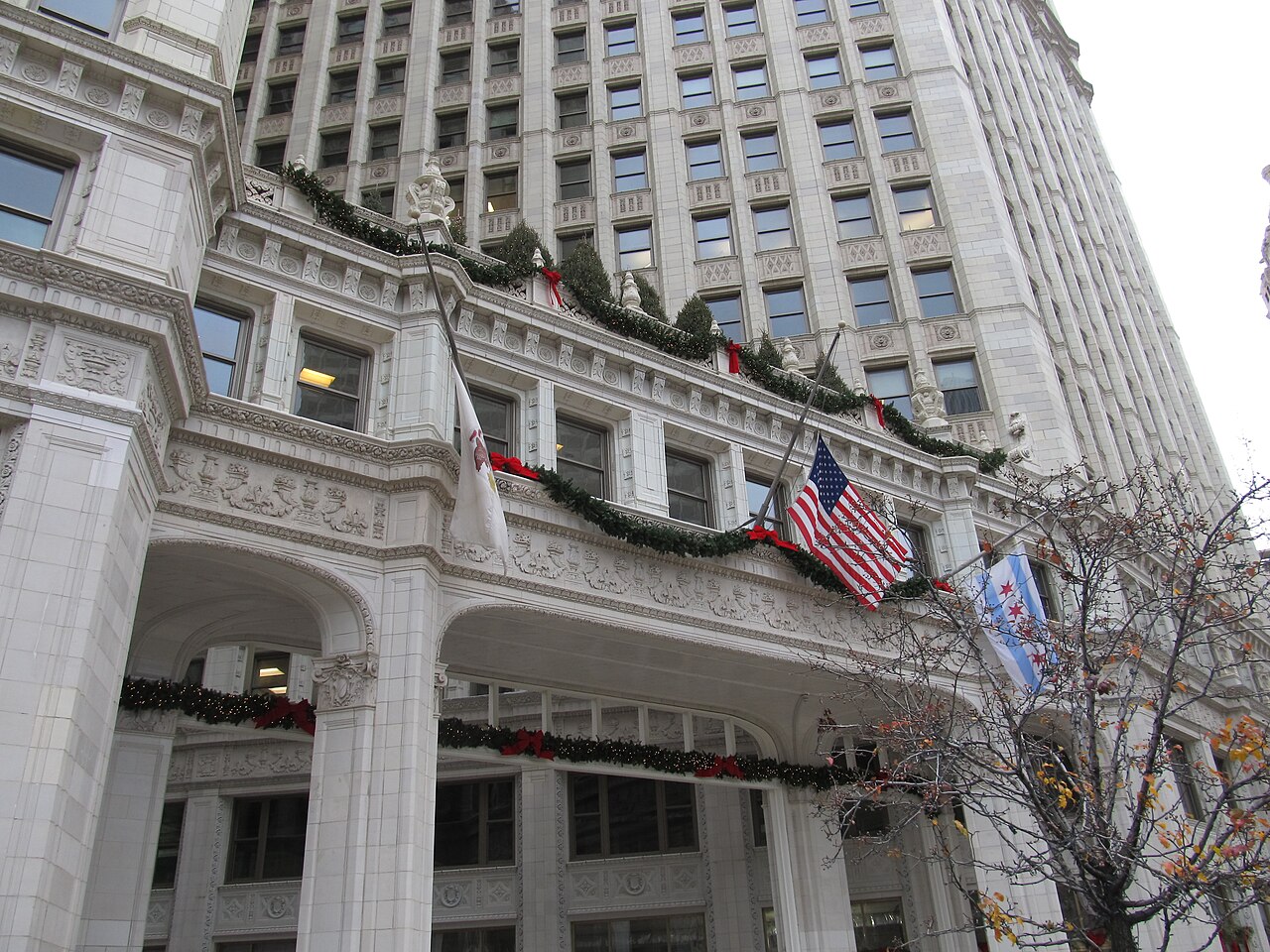
The Wrigley Building on North Michigan Avenue in Chicago, built to house the Wrigley Company's headquarters, photographed on 22 November 2013.
Fortune reported in October 2016 that Mars and Berkshire Hathaway had joined in 2008 to buy Wrigley for $23 billion, and that Mars had agreed to buy out Berkshire's remaining minority stake, on terms that were not disclosed.[10] The same report said Mars planned to combine its chocolate and Wrigley businesses as Mars Wrigley Confectionery.[10]
Kind and other snacks
Reuters reported on 18 November 2020 that Mars had agreed to buy Kind North America, the maker of granola and energy bars, about three years after buying a minority stake in the company; the companies did not disclose terms, and both declined to comment on a New York Times report that valued Kind at about $5 billion.[13] The companies said Kind would run as a separate business within Mars.[13]
Pet care and veterinary services
In January 2026 Mars described its Petcare segment as a $30 billion business with more than 100,000 Associates in more than 130 countries.[3] Its brand list, viewed in November 2026, includes pet foods such as Royal Canin, Pedigree, Whiskas, Iams, Eukanuba, Sheba, Cesar, Nutro and Greenies, science and technology businesses such as Wisdom Panel, and a group of veterinary businesses: Banfield, VCA, BluePearl, AniCura, Antech Diagnostics, Linnaeus and others.[4] On the same page Mars says its veterinary arm, Mars Veterinary Health, has about 3,000 clinics worldwide, that VCA runs more than 1,000 small-animal hospitals in the United States, Canada and Japan, and that AniCura has nearly 500 clinics in 15 countries.[4]
VCA
Mars completed its purchase of VCA Inc., a pet health care company, on 12 September 2017, at $93 per share in a deal valued at about $9.1 billion.[11] At the time, VCA had more than 800 small-animal hospitals in the United States and Canada and owned the Antech Diagnostics laboratory network.[11] As a condition of the deal, the United States Federal Trade Commission (FTC) required Mars to sell 12 specialty and emergency veterinary clinics in 10 localities; the Commission approved its final order by a 2-0 vote on 19 December 2017.[12]
Food and nutrition
Mars describes its Food & Nutrition segment as making food that is part of consumers' daily lives.[2] Mars entered the rice business in Houston in 1942 and opened its first European mill for the rice brand now called Ben's Original in Olen, Belgium, in 1977.[1] The brand was sold for about 70 years as Uncle Ben's.[14] On 23 September 2020 Mars announced that it would rename it Ben's Original and drop the image of a white-haired Black man that had appeared on its boxes since the 1940s, an image critics said evoked servitude.[14] Fiona Dawson, identified by the Associated Press as global president of Mars Food, said the company had listened to its Associates and customers.[14]
Acquisition of Kellanova
On 14 August 2024 Mars agreed to buy Kellanova, the snack company behind Pringles and Cheez-It, for $83.50 per share in cash, a total consideration of $35.9 billion including assumed net debt.[5] At the time Mars reported 2023 net sales of more than $50 billion and more than 150,000 Associates, and said Kellanova had 2023 net sales of more than $13 billion and about 23,000 employees.[5] Mars said it would pay with cash on hand and new debt.[5] Kellanova shareholders approved the deal on 1 November 2024.[9]
The deal needed 28 regulatory clearances.[8] On 25 June 2025 Mars said the FTC had finished its antitrust review without imposing conditions, leaving only the European Commission's review outstanding.[6] The European Commission, which had been notified on 16 May 2025, opened an in-depth investigation on 25 June 2025 into whether adding Kellanova's brands would strengthen Mars's bargaining power over retailers.[7] On 8 December 2025 it approved the deal without conditions, saying it had found no evidence of that risk.[7] Mars completed the purchase on 11 December 2025, and Kellanova's brands, including Pringles, Cheez-It, Pop-Tarts, Rice Krispies Treats, RXBAR and Kellogg's international cereal brands, became part of Mars Snacking.[9] Mars said in December 2025 that it expected the combined snacking business to have about $36 billion in annual revenue and nine brands with sales of more than $1 billion each.[8]
Controversies, recalls and court cases
Child labour in cocoa supply chains
Eight citizens of Mali brought a proposed class action under a United States federal anti-trafficking law against Mars, Hershey, Nestlé, Cargill, Mondelez, Barry Callebaut and Olam, seeking to hold them liable for forced child labour on cocoa farms in Côte d'Ivoire; a trial judge ruled for the companies in June 2022.[18] A three-judge panel of the United States Court of Appeals for the District of Columbia Circuit upheld that outcome in a ruling reported by Bloomberg Law on 22 July 2025, finding that the plaintiffs had not tied their injuries to the specific companies they sued.[19][18] The plaintiffs' lawyer said they were considering their options.[18]
Separately, in a statement dated 30 November 2023 responding to a CBS Evening News report on child labour in its supply chain, Mars said it "unequivocally condemns" child labour, that it was investigating the claims, and that it would act against suppliers that broke its Supplier Code of Conduct, while acknowledging that "more needs to be done".[16] In a report released on 17 September 2026, Mars said that all cocoa bought in 2025 from farmers in its Responsibly Sourced Cocoa Program in West Africa was covered by child labour monitoring and remediation systems, and that this programme supplied cocoa equivalent to 98 percent of its 2025 volume.[17]
Recalls
In February 2016 Mars recalled chocolate bars and other products, including Mars, Milky Way, Snickers and Celebrations, in 55 countries after a piece of plastic was found in one product; according to the German news agency dpa, Mars Germany said the recall was voluntary and covered goods made earlier that year in the Netherlands.[20] In the United States, Mars Petcare recalled 315 bags of Pedigree dry dog food sold at Walmart in four states in May 2024 because they might contain loose metal pieces; the company said no pet injuries or illnesses had been reported, and the FDA later listed the recall as terminated.[21] On 2 July 2026 Mars Petcare recalled two lots of Pedigree canned dog food that might contain metal and plastic, saying the lots had been sent to a third-party vendor for destruction but appeared to have been fraudulently diverted and sold, and that it had received no reports of illness or injury.[22]
In July 2022 a California man sued Mars, claiming that Skittles were unfit to eat because they contained heightened levels of titanium dioxide, an additive that the European Union had prohibited in food over concerns that it could damage DNA; Mars argued that its use of small amounts complied with FDA rules.[23] The plaintiff voluntarily dismissed the case without prejudice, meaning it could be refiled, and Reuters reported on 8 November 2022 that Mars reiterated its commitment to strict quality and safety requirements.[23]
UK veterinary market investigation
The United Kingdom's Competition and Markets Authority (CMA) investigated the market for veterinary services for household pets, naming six large veterinary groups, including Mars's Linnaeus.[24][4] Its final report of 24 March 2026 set out legally binding measures such as published price lists, caps on prescription fees and clear signs showing which group owns a practice.[24] The order putting these measures into effect was published on 22 September 2026.[25] In its response to the CMA's provisional findings, dated 14 November 2025, Linnaeus said it supported many of the transparency and regulatory reforms proposed.[26]
Sources
Mars, Incorporated. "Our History". No date shown; accessed 28 November 2026. mars.com/about/history
Mars, Incorporated and VCA Inc. Press release on completion of the acquisition, filed as Exhibit 99.1 to VCA Inc. Form 8-K, U.S. Securities and Exchange Commission. 12 September 2017; accessed 28 November 2026. sec.gov/Archives/edgar/data/817366/000119312517282381/d452580dex991…
U.S. Federal Trade Commission. "FTC Alters Final Consent Order in Response to Public Comments, Preserving Competition for Specialty and Emergency Veterinary Services in 10 U.S. Localities". 19 December 2017; accessed 28 November 2026. ftc.gov/news-events/news/press-releases/2017/12/ftc-alters-final-co…
U.S. Food and Drug Administration (company announcement). "Mars Petcare US, Inc. Voluntarily Recalls 315 Bags of PEDIGREE® Adult Complete Nutrition Grilled Steak & Vegetable Flavor Dry Dog Food, 44 lb. Bag Size". 17 May 2024; accessed 28 November 2026. fda.gov/safety/recalls-market-withdrawals-safety-alerts/mars-petcar…
U.S. Food and Drug Administration (company announcement). "Voluntary Recall of Two Lots of PEDIGREE® Can High Protein Chopped Chicken & Duck Flavor Wet Dog Food Due to Potential Fraudulent Distribution of Product Which May Contain Foreign Material". 2 July 2026; accessed 28 November 2026. fda.gov/safety/recalls-market-withdrawals-safety-alerts/voluntary-r…
UK Competition and Markets Authority. "Veterinary Services Market Investigation Order 2026 and Veterinary Services Market Investigation Royal College of Veterinary Surgeons Undertakings 2026". 22 September 2026; accessed 28 November 2026. gov.uk/government/publications/veterinary-services-market-investiga…