Version 1
Nov 29, 2026. Compare with the current version · Version history
Self-custody is holding cryptocurrency by keeping its private keys yourself, in a wallet you control, rather than leaving them with an exchange or other company that holds the assets for you.[2][6]
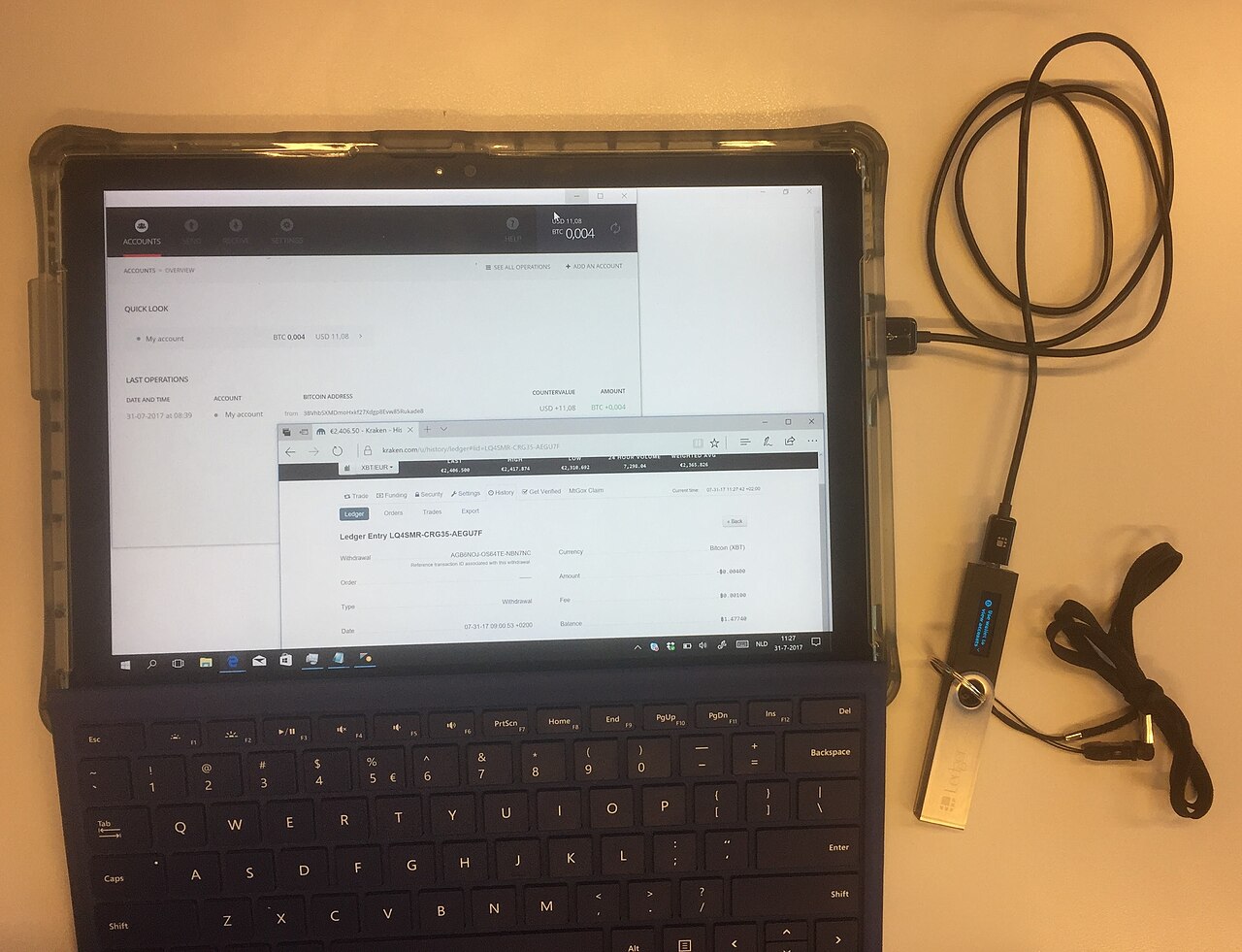
Via Wikimedia Commons: An actual Bitcoin transaction from the Kraken cryptocurrency exchange by FlippyFlink, CC BY-SA 4.0.
What the term means
A crypto wallet, as one court-filed report on the collapse of the FTX exchanges describes it, consists of a public key that identifies the owner on the blockchain ledger and a private key that is required to access the holdings, authorize transactions and exercise ownership over the asset.[6] Whoever holds the private key can move the coins, so custody comes down to who holds the key. The Bitcoin Project's guidance says that when a third party holds your keys, you rely entirely on its security and honesty, and it advises preferring wallets in which you hold your own keys over online services, which can be hacked, fail or freeze access to funds.[2]
The idea follows from the design in the 2008 Bitcoin paper, which defines an electronic coin as a chain of digital signatures in which each owner transfers the coin to the next.[1] The paper opens by describing a payment system based on cryptographic proof instead of trust in a financial institution acting as a third party.[1] Self-custody is the arrangement in which the owner, not an intermediary, holds the means of signing.
Keys, seeds and recovery phrases
Early wallets stored each key separately, so a backup made at one moment could miss keys created later. Bitcoin Core's documentation says that since version 0.13 it uses hierarchical deterministic (HD) wallets, in which all addresses are derived from one seed that works as a master key, so a single backup can restore every address.[4] The Bitcoin Project makes the same point for most modern wallets: a backup of the recovery phrase is enough to restore all past and future addresses.[2]
A recovery phrase is a seed written as words. BIP-39, a Bitcoin Improvement Proposal assigned on 10 September 2013 and listed as deployed, specifies how random data of 128 to 256 bits, plus a checksum, is turned into a sentence of 12, 15, 18, 21 or 24 words, and how that sentence and an optional passphrase are converted into the binary seed from which keys are derived.[5]
Backups, encryption and loss
Bitcoin Core's documentation states that its wallet file is not encrypted by default, that encryption covers only the private keys while transactions and public keys stay visible, and that if the wallet and all backups are lost for any reason, the bitcoins related to the wallet become permanently inaccessible.[4] The Bitcoin Project says that a wallet password can be lost with no recovery, that encryption does not protect against keylogging hardware or software, and that copies should be kept in more than one physical location.[2]
On the extreme case, the Bitcoin Project states that if you permanently lose access to your wallet, for example by losing your recovery phrase, your funds are gone permanently, and that Bitcoin has no central authority to reverse a mistake.[3] The same guidance lists measures it describes as reducing exposure: keeping only small amounts on everyday devices, offline or "cold" storage, hardware wallets, and multi-signature setups in which several independent approvals are needed to spend.[2] It also warns that without a plan for passing on access, funds may never be recovered after the owner's death or incapacity.[2]
Why custody matters: two exchange failures
When assets sit with a company, their safety depends on that company's conduct. Two cases are widely cited.
Mt. Gox. On 21 March 2014 the Associated Press reported that the Tokyo-based exchange Mt. Gox, which had filed for bankruptcy protection after shutting down in late February, said nearly all of its 850,000 bitcoins were missing, probably through theft, and that about 750,000 of them belonged to its users. It said it had found 200,000 bitcoins in old-format wallets, leaving about 650,000 unaccounted for.[7] As of the trustee's notice dated 16 October 2026, the repayment deadlines in the Japanese rehabilitation proceedings had been moved from 31 October 2026 to 31 October 2027.[8]
FTX. In April 2023 the new management of the bankrupt FTX group filed a report to its independent directors on control failures. It said the group's leaders commingled and misused corporate and customer funds, that FTX stored the private keys to its crypto assets in its cloud computing account, and that it kept virtually all crypto assets in hot wallets, which are connected to the internet and therefore more exposed to hacking and theft than cold wallets.[6] It also said that for the wallets where multiple keys were required to authorize a transfer, all three keys were stored together, so anyone with access to one had access to all.[6]
These are descriptions of two specific firms, not of every exchange, and the sources do not say that custodial services are in general unsafe or that self-custody is safer for any particular person. They show what each arrangement depends on: in custody with a company, on the company's controls and honesty; in self-custody, on the owner's own key handling and backups.
This entry explains; it is not financial advice.
Sources
- Satoshi Nakamoto, Bitcoin: A Peer-to-Peer Electronic Cash System (2008), bitcoin.org. bitcoin.org/bitcoin.pdf
- Bitcoin Project, "Securing your wallet" (read November 2026), bitcoin.org. bitcoin.org/en/secure-your-wallet
- Bitcoin Project, "You need to know" (read November 2026), bitcoin.org. bitcoin.org/en/you-need-to-know
- Bitcoin Core developers, "Managing wallets", Bitcoin Core documentation (read November 2026). github.com/bitcoin/bitcoin/blob/master/doc/managing-wallets.md
- M. Palatinus, P. Rusnak, A. Voisine and S. Bowe, "BIP-39: Mnemonic code for generating deterministic keys" (assigned 10 September 2013). github.com/bitcoin/bips/blob/master/bip-0039.mediawiki
- J. J. Ray III, First Interim Report of John J. Ray III to the Independent Directors on Control Failures at the FTX Exchanges, 9 April 2023, filed in Case 22-11068 (Bankr. D. Del.), Doc. 1242-1. storage.courtlistener.com/recap/gov.uscourts.deb.188450/gov.uscourt…
- Associated Press, "Mt. Gox finds 200,000 missing bitcoins", CBS News, 21 March 2014. cbsnews.com/news/mt-gox-finds-200000-missing-bitcoins/
- Mt. Gox Co., Ltd. rehabilitation trustee, notice of 16 October 2026 on the change of repayment deadlines (read November 2026). mtgox.com/
