Version 1
Nov 29, 2026. Compare with the current version · Version history
Israel, officially the State of Israel, is a country at the eastern end of the Mediterranean Sea whose independence was declared on 14 May 1948, and whose capital, by its own law, is Jerusalem, a status most countries do not recognise.[1][2][3]
Developing story. This entry is updated as events change; every changing fact is dated.
Geography
Excluding the West Bank and the Gaza Strip, Israel covers about 22,072 square kilometres (8,522 square miles), according to Britannica.[1] It stretches about 470 km (290 miles) from north to south and about 135 km (85 miles) from east to west at its widest point.[3] Britannica divides the country into four regions: the Mediterranean coastal plain, the northern and central hill regions, the Great Rift Valley in the east, and the Negev, a dry and thinly populated area that makes up the southern half of the country.[3]
The highest point is Mount Meron in the Galilee mountains, at 1,208 metres (3,963 feet).[3] The Jordan River flows south through the Great Rift Valley from Dan on the northern frontier, through the Hula Valley and Lake Tiberias, and on into the Dead Sea; south of the Dead Sea the rift continues as the ʿArava Valley.[3] Lake Tiberias, also called the Sea of Galilee or Yam Kinneret, is a freshwater lake about 209 metres below sea level that supplies water to much of the country's farmland.[3][1] The Dead Sea, about 400 metres below sea level, is the lowest natural feature on the Earth's surface.[3]
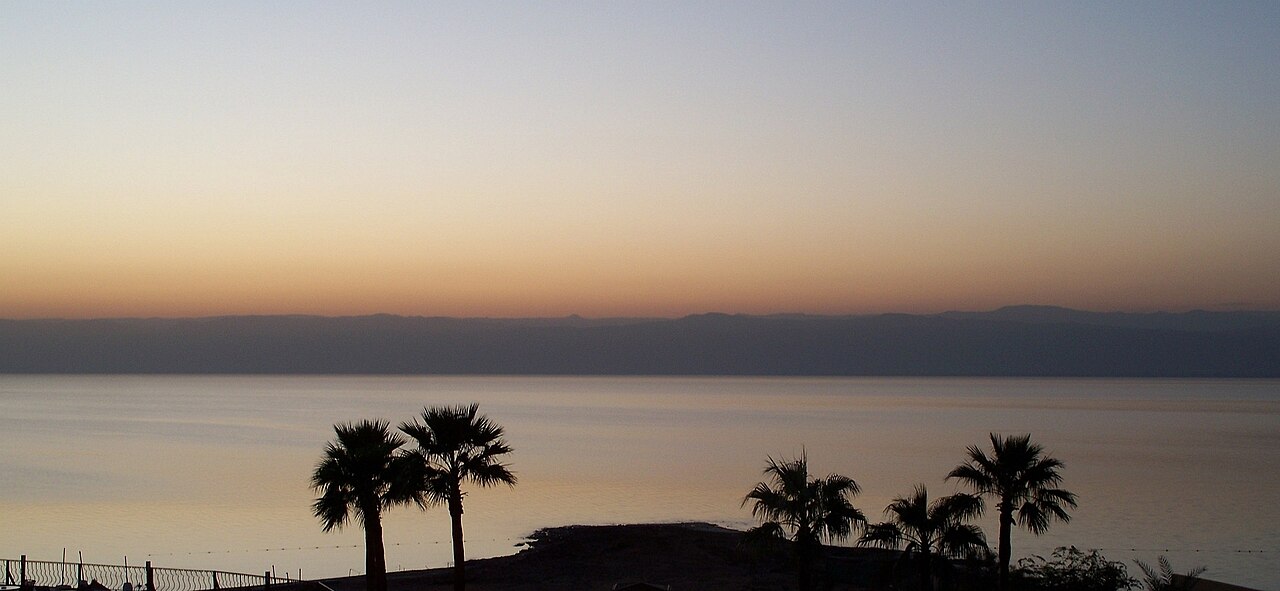
Via Wikimedia Commons: Dead Sea sunrise by High Contrast, CC BY 3.0 de.
Nearly nine-tenths of the population lives in towns and cities, mostly on the coastal plain and around Jerusalem.[1] Jerusalem is the seat of government and the proclaimed capital, but most countries do not formally recognise that status.[3] The Basic Law on the nation-state, adopted in 2018, states that "the complete and united Jerusalem is the capital of Israel".[4]
Population
People
On the eve of its 78th Independence Day in April 2026, Israel's Central Bureau of Statistics (CBS) put the population at 10.244 million, Ynet News reported on 19 April 2026.[5] Of these, 7.79 million (76%) were Jews or people classed as "others" (including non-Arab Christians and people with no listed religion), 2.157 million (21.1%) were Arabs, and about 296,000 (2.9%) were foreign workers.[5] The population had grown by about 146,000 (1.4%) over the previous year, with about 177,000 births, about 21,000 immigrants and about 48,000 deaths, while net emigration of Israelis was about 45,000.[5] The CBS figures cited by Ynet give a population of 806,000 at independence and more than 3.5 million immigrants since 1948, about 1.68 million of them since 1990.[5] The same report estimated the world's Jewish population at 15.8 million, about 45% of whom lived in Israel.[5] Britannica's 2026 estimate, which excludes Israelis living in the West Bank and the Gaza Strip, is 9,141,000.[1]
Israel's Jewish population is diverse in origin. Britannica distinguishes Ashkenazim, Jews from central and eastern Europe and their descendants, from Sephardim, Jews from the Mediterranean region and North Africa who follow Sephardic traditions, and notes that Ashkenazim have historically held social and political dominance.[6] Arabs are the largest single minority; most are Sunni Muslims, and Britannica describes them as holding equal civil and political rights, with some exceptions linked to military service, while facing disparities.[6]
Languages
The Basic Law "Israel – the Nation State of the Jewish People", adopted in 2018, declares Hebrew "the language of the State" and gives Arabic "a special status", leaving its use in state institutions to be regulated by law; it adds that the section does not weaken the status Arabic held in practice before the law took effect.[4] Britannica's country summary still lists Hebrew and Arabic as official languages.[1] The revival of Hebrew as an everyday language helped absorb newcomers, and since 1953 the government-founded Academy of the Hebrew Language has been the authority on questions of the language.[6][7] Arab citizens speak Levantine Arabic, learn Modern Standard Arabic at school, and many younger Arabs are also fluent in Hebrew.[6]
Religion
Jews make up about three-quarters of the population, according to Britannica, which describes religious Jews as a significant and outspoken part of society, often in tension with a secular sector.[6] The overwhelming majority of Israel's Muslims are Arabs, and the Bedouin are entirely Muslim.[6] Most Christians are also Arabs, with the Greek Catholic and Greek Orthodox churches the largest denominations.[6] The Druze, whose religion was founded in 11th-century Fatimid Egypt, live mainly in villages in Galilee and around Mount Carmel and have been recognised as a separate community since 1957.[6] The Bahá'í faith has its world centre in Haifa, the only religion other than Judaism with its world centre in Israel.[6]
The 2018 nation-state law describes the Land of Israel as "the historical homeland of the Jewish People" and states that the right to national self-determination in the State of Israel "is exclusive to the Jewish People".[4] Britannica notes that critics saw the law as weakening the rights of non-Jewish citizens.[8]
Government and politics
Israel has no single written constitution, because the first Knesset could not agree on a draft after independence.[8] Under a compromise of 1950, known as the Harari proposal, a constitution was to be built up chapter by chapter in the form of Basic Laws, passed like ordinary laws but in some cases protected by special majorities; Britannica lists 13 of them.[8] Britannica describes the state as a multiparty republic with one legislative house, the Knesset; the president is head of state and the prime minister heads the government.[1] The Knesset has 120 seats, and a governing coalition needs the support of 61.[9] As of October 2026 the president was Isaac Herzog.[10]
Judicial overhaul, 2023
In 2023 the governing coalition led by Prime Minister Benjamin Netanyahu planned changes to the Basic Law on the judiciary that would have placed the courts under greater legislative control, prompting mass protests and nationwide strikes.[8] Netanyahu delayed the plans in 2023 to "avoid civil war" after some of the largest protests in decades.[11] One measure that did pass barred judges from overturning government decisions they considered "unreasonable"; opponents argued that it could open the way to corruption and to the appointment of unqualified allies.[11] On 1 January 2024 the Supreme Court struck it down by eight votes to seven, saying it caused "severe and unprecedented harm to the core character of the State of Israel as a democratic country".[11] The justice minister, Yariv Levin, the main author of the plan, criticised the ruling as the opposite of the unity needed in wartime and said it "will not discourage us".[11]
Netanyahu's criminal trial
Netanyahu has been on trial since 2020 on charges of bribery, fraud and breach of trust in three cases, known as Case 1000, Case 2000 and Case 4000, which are heard together; he was the first sitting Israeli prime minister to face criminal charges and has repeatedly denied all the accusations.[37] He began testifying in late 2024, and the Anadolu news agency reported in April 2026 that he had asked President Herzog for a pardon in late 2025 without admitting guilt.[37] The trial was still hearing defence witnesses in November 2026, the Jerusalem Post reported.[38] No verdict had been reported by then; he is presumed innocent unless convicted, and the status may have changed.
Election of October 2026
In the Knesset election of 27 October 2026, Netanyahu's Likud won the most seats, 27 of 120, according to a report by the US Congressional Research Service (CRS) dated 30 October 2026, which described its figures as unofficial.[10] Likud and its allied parties won 53 seats, the rival bloc led by Gadi Eisenkot, a former military chief and leader of the Yashar party, won 48, and Arab-led parties won a record 19, leaving neither bloc with a clear majority.[10][12] Netanyahu alleged election fraud by Arab-led parties; the CRS reported that some Israeli authorities had opened an investigation, while others said the allegations lacked evidence.[10]
On 7 November 2026 President Herzog gave Eisenkot the first chance to form a government, with up to six weeks to do so, the Associated Press (AP) reported; most major parties had recommended him.[12] Eisenkot said the country needed a "national emergency government", while Netanyahu called for a national unity government and warned against relying on Arab-led parties; an Arab party has joined an Israeli governing coalition only once.[12] If no coalition can be formed, Netanyahu's government remains in office as a caretaker until a new election, which the CRS and AP said would probably be held in early 2027.[10][9] This is the status as reported on 7 November 2026, and it may have changed.
History
Before 1948
Human habitation in the region dates back to the Paleolithic period.[1] Jewish efforts to establish a national state there began in the late 19th century, and Britain, which supported Zionism (the movement for a Jewish national home), took political responsibility for Palestine in 1923.[1] Jewish immigration grew in the 1930s and 1940s as Jews fled Nazi persecution, and Britannica writes that the influx caused tension with the native Palestinian Arabs.[1][3]
Independence and the 1948 war
In 1947 the United Nations voted to divide Palestine into a Jewish state and an Arab state.[1] Israel declared its independence on 14 May 1948, and the United States quickly recognised it; David Ben-Gurion became the first prime minister.[2] Egypt, Transjordan (later Jordan), Syria, Lebanon and Iraq immediately declared war on the new state, and Israel won the war.[1] Britannica calls it Israel's costliest war: more than 6,000 Israelis were killed and 30,000 wounded, out of a population of about 780,000.[2]
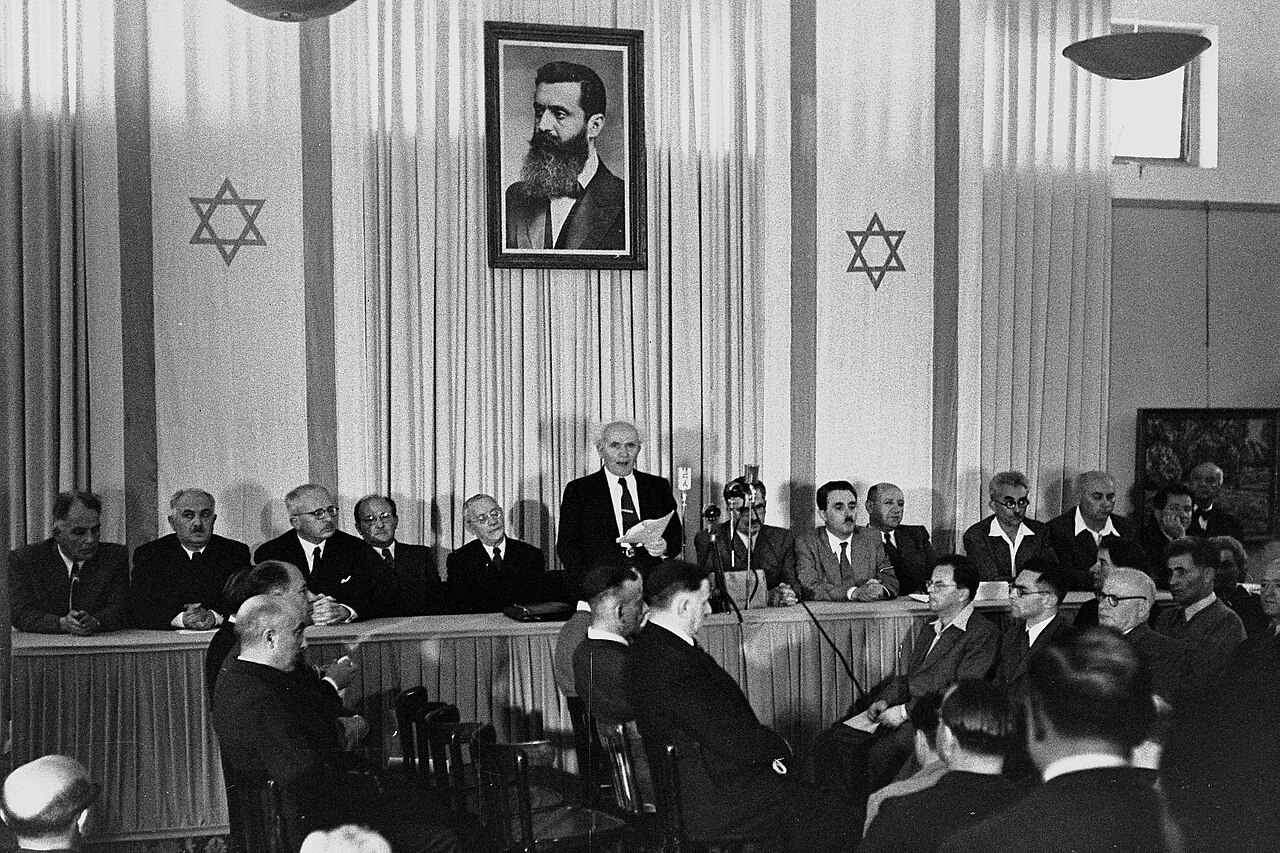
Via Wikimedia Commons: Declaration of State of Israel 1948 by Rudi Weissenstein, public domain.
During the war more than 700,000 Palestinian civilians were displaced, according to a 2010 special issue of UNHCR's Refugee Survey Quarterly, which refers to the displacement as the Nakba.[13] When the UN Relief and Works Agency for Palestine Refugees (UNRWA) began work in 1950, it was serving about 750,000 Palestine refugees, defined as people whose normal home had been in Palestine between June 1946 and May 1948 and who lost their homes and livelihoods in the 1948 conflict.[14] UNRWA says that some 5.9 million Palestine refugees, a figure that includes descendants, are eligible for its services, with more than 1.5 million living in 58 recognised camps in Jordan, Lebanon, Syria, Gaza and the West Bank, including East Jerusalem.[14]
Wars and peace, 1956 to 2021
On 29 October 1956, under a plan agreed with Britain and France after Egypt nationalised the Suez Canal, Israeli forces attacked across the Sinai Peninsula, and British and French troops landed days later.[35] The United Nations called for a ceasefire and the United States pressed all three governments to withdraw, which they did in late 1956 and early 1957.[36]
In the Six-Day War of 1967 Israel captured the West Bank, the Gaza Strip, the Golan Heights and East Jerusalem, which Britannica describes as occupying them.[1] Another war with its Arab neighbours followed in 1973.[1] The Camp David Accords led to a peace treaty with Egypt in 1979.[1] In 1982 Israel invaded Lebanon to expel the Palestine Liberation Organization (PLO).[1]
A Palestinian uprising, the intifada, broke out in the territories Israel had captured in 1967, in late 1987.[1] Peace negotiations began in 1991, and in 1993 Israel and the PLO agreed on a five-year plan for Palestinian self-government; Israel signed a peace treaty with Jordan in 1994.[1] Israel withdrew its forces from Lebanon in 2000, after repeated clashes with the Lebanese militia Hezbollah, and in the same year talks with the Palestinians broke down amid violence.[1] In 2005 Israel withdrew its soldiers and settlers from the whole of Gaza and from parts of the West Bank; a Hezbollah operation in 2006 led to a month-long war in Lebanon, and in 2007 Hamas took control of Gaza.[1] The peace process nearly stalled in the 2010s, and fighting with Hamas flared several times between 2012 and 2021.[1]
In the second half of 2020 Israel signed normalisation agreements, known as the Abraham Accords, with the United Arab Emirates, Bahrain and Morocco; alongside the Moroccan agreement the United States recognised Moroccan sovereignty over Western Sahara, and Sudan signed the accords' general declaration in January 2021.[15]
The Palestinian territories
In an advisory opinion requested by the UN General Assembly and delivered on 19 July 2024, the International Court of Justice (ICJ), the UN's top court, concluded that Israel's continued presence in what the court calls the Occupied Palestinian Territory is unlawful, that Israel must end it, must cease all new settlement activity at once and must make reparation for the damage caused, and that all states are obliged not to recognise the situation as lawful.[16] The opinion is not binding; the court also found that Israeli policies, including new settlements and the continued maintenance of a wall in the territory, amounted to annexation of large parts of the territory.[17] Netanyahu called it a "decision of lies" and said that "the Jewish people are not occupiers in their own land", while Palestinian leaders welcomed it as "historic".[17]
Israel's settlement policy remains a central dispute. In August 2025 Israel approved plans for about 3,400 homes in E1, an area east of East Jerusalem next to the Ma'ale Adumim settlement, which rights groups say would cut the West Bank in two; in August 2026 the housing ministry opened tenders for 1,234 homes there, Al Jazeera reported on 21 August 2026.[18] Finance Minister Bezalel Smotrich, who oversees the Settlement Administration, said in 2025 that approving E1 "buries the idea of a Palestinian state".[18] The United Kingdom, France, Germany, Italy, the Netherlands, Canada and Norway jointly called the tenders "unacceptable", and the UN Human Rights Office called E1 a "grave and unlawful step to consolidate annexation"; the Israeli organisation Ir Amim said the tenders had been published while a petition was pending before the Jerusalem District Court.[18]
The UN Office for the Coordination of Humanitarian Affairs (OCHA) recorded 55 attacks by Israeli settlers on Palestinians in the West Bank in the week of 17 to 23 November 2026, against a 2026 weekly average of 53, and 435 attacks linked to the olive harvest between 1 September and 15 November 2026, the most for any harvest since the UN began recording them.[19] OCHA counted 4,992 Palestinians displaced in the West Bank in 2026 by settler violence, access restrictions and demolitions.[19]
On 21 and 22 September 2025 the United Kingdom, Canada, Australia, Portugal, France and several smaller European states formally recognised the State of Palestine, joining about 147 of the 193 UN member states that had done so by April 2025, Al Jazeera reported.[20] Israel boycotted the conference in New York at which France announced its recognition, and its UN ambassador, Danny Danon, called it a "circus"; Netanyahu has repeatedly said he will not allow a Palestinian state.[20] The Palestinian Authority's president, Mahmoud Abbas, welcomed the recognitions and called for full UN membership, which the United States has blocked with its Security Council veto.[20]
War since October 2023
The 7 October attack
On 7 October 2023 Hamas launched an attack on Israel that Britannica describes as the deadliest day for Israel since independence, killing more than 1,200 people, most of them Israeli citizens.[1] About 1,200 people were killed and 251 were taken hostage into Gaza, AP reported.[21] OCHA, citing Israeli media reports of official figures, gives more than 1,200 Israelis and foreign nationals killed on the day and in its immediate aftermath, of whom 1,162 had been identified, including at least 33 children.[22] A war followed between Israel and Palestinian armed groups in the Gaza Strip, which Hamas had controlled since 2007.[1]
Casualties and humanitarian conditions in Gaza
As of 4 November 2026, the Gaza Ministry of Health had reported 74,618 Palestinians killed, according to OCHA; of the 74,237 the ministry had identified by 7 October 2026, 21,976 were children and 11,301 women.[22] OCHA notes that the ministry operates under Gaza's de facto authorities.[19] AP has reported that UN agencies and independent experts regard the ministry's figures as generally reliable, while the Israeli military disputes them.[21][23] OCHA, citing the Israeli military's website, recorded 474 Israeli soldiers killed and 3,004 injured since the start of the ground operation.[22] At least 600 aid workers had been killed in Gaza by 23 November 2026, according to OCHA, and the Palestinian Journalists Syndicate counted 262 journalists and media workers killed as of 30 June 2026.[19][22]
In August 2025 the Integrated Food Security Phase Classification (IPC), a UN-backed system for measuring hunger, confirmed famine in Gaza, affecting about 514,000 people; COGAT, the Israeli military body that coordinates aid, disputed the finding.[24] In December 2025, after aid deliveries increased under the ceasefire, the IPC said no area was classified as in famine but that the situation remained "highly fragile".[24] An IPC analysis of 23 July 2026, cited by OCHA, expected more than 1.4 million people (67%) to face "Crisis" or worse levels of food insecurity between July and December 2026.[22] OCHA reported that about 1.36 million people, 65% of Gaza's population, were living in tents and makeshift shelters in November 2026.[19]
Legal proceedings
South Africa brought a case at the ICJ accusing Israel of breaching the Genocide Convention in Gaza; Israel has consistently rejected the genocide allegations and argued that the court lacked jurisdiction.[25][26] On 26 January 2024 the court ordered provisional measures, which are temporary orders pending a final judgment.[27] By 15 votes to 2 it ordered Israel to take all measures in its power to prevent acts within the scope of the convention, to prevent and punish incitement to genocide, to allow urgently needed aid into Gaza and to report back within a month; it did not order a ceasefire and did not rule on whether genocide had occurred.[26] Israel filed its main written reply, including objections to the court's jurisdiction, in March 2026, and on 21 May 2026 the court gave South Africa until 22 November 2027 to answer and Israel until 22 May 2029 to respond, according to South Africa's presidency.[25]
Separately, a three-member commission of inquiry set up by the UN Human Rights Council concluded in September 2025 that Israel was responsible for committing genocide in Gaza. The commission does not speak for the United Nations as a whole; Israel, which had refused to cooperate with it, rejected what it called a "distorted and false" report.[39]
In
