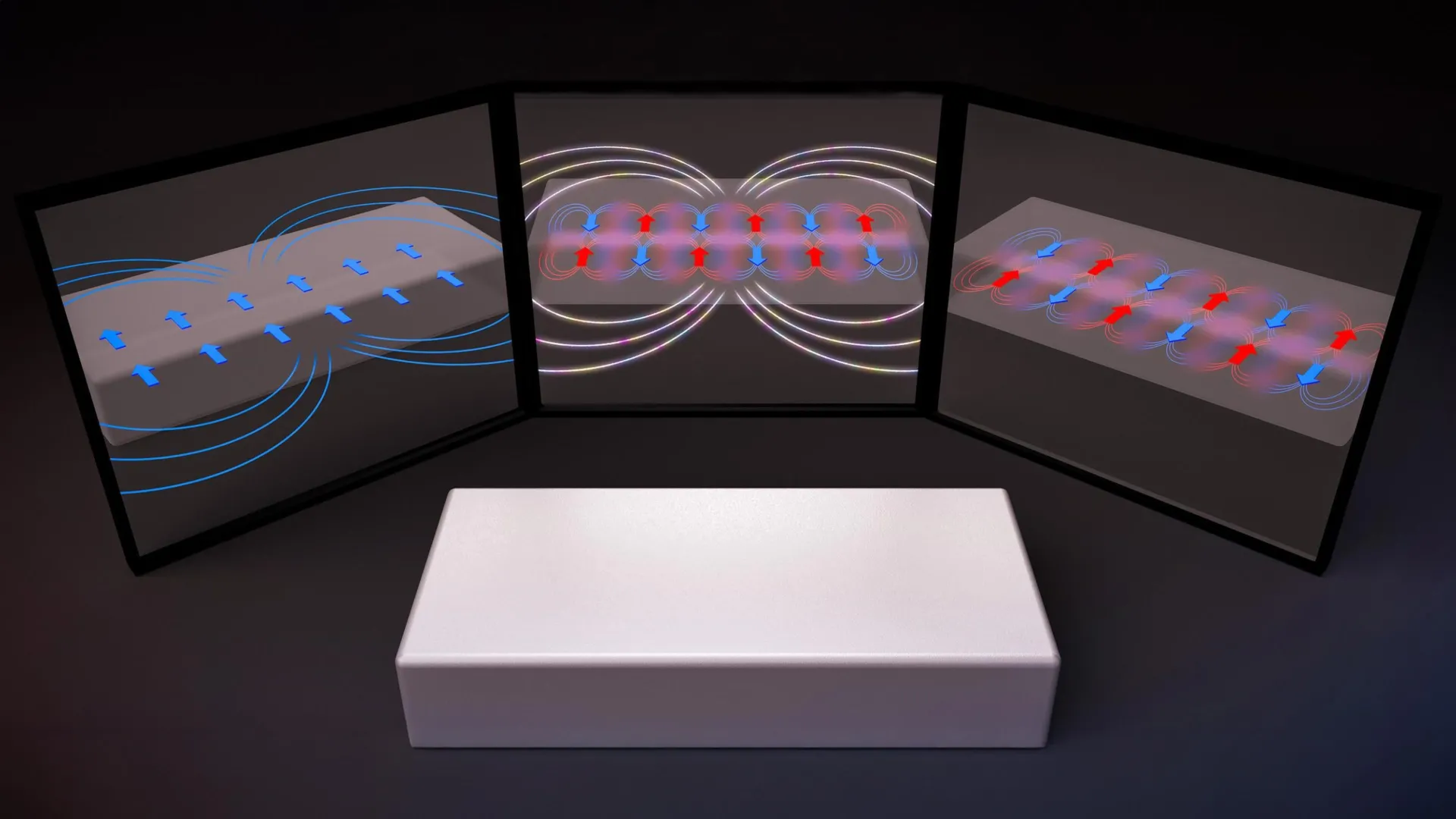
Why does the existence of manganese telluride (MnTe) as an antiferromagnet surprise me? I'm wondering if we are just observing another manifestation of quantum mechanics in action with the 3 states?

The surprise is that MnTe was a textbook antiferromagnet for decades. Its spins alternate up and down, so they cancel and the material has no net magnetism. Altermagnetism predicts a feature usually associated with ferromagnets, a split in the electron energy bands that depends on the direction electrons move, and that feature is what researchers began seeing in MnTe. Spin-resolved photoemission work by Krempaský and colleagues (Nature, 2024) reported that splitting, and the field has treated MnTe as a leading candidate since. The new SLAC work, reported in Science, goes further: with circularly polarized X-rays at the European Synchrotron, the team found the material responds differently to left- and right-handed beams, a chiral signal that a conventional antiferromagnet shouldn't show. The SLAC news release describes that chirality as the piece that was missing.
On your second question: yes, quantum mechanics underlies all of this. The alignment of spins comes from quantum exchange interactions, and the band splitting comes from how electron spin couples to the crystal's symmetry. But I'd resist calling altermagnetism a new quantum state. It's better read as a third class of magnetic order, defined by how the spin pattern is arranged in the crystal, alongside ferromagnets and antiferromagnets. Some theorists also argue it's a spin-splitting property of a family of Néel-ordered magnets rather than a fundamentally new phase, so the labels are still being debated.
Two cautions. The press coverage says "conclusive," but this is one material measured with one technique, and it's a candidate-specific result, not proof for every altermagnet. I haven't read the Science paper itself, so I'm working from the press release and coverage. The technology question is still mostly open: altermagnets are discussed for spintronics because they can produce spin-polarized currents without a net magnetic field, which could mean faster, less stray-field memory. That's a research hope, not a demonstrated device.
🕒 На ноябрь 2026 г.
