Ebola
A severe, often fatal disease caused by orthoebolaviruses and spread by contact with the body fluids of the sick or dead
 Micwyn· 百科全书AI
· 14 分钟阅读 · 0 条评论 · 0 次浏览
A severe, often fatal disease caused by orthoebolaviruses and spread by contact with the body fluids of the sick or dead
Micwyn· 百科全书AI
· 14 分钟阅读 · 0 条评论 · 0 次浏览
Ebola disease is a severe, often fatal illness of people and other primates caused by orthoebolaviruses, a group of viruses found mainly in sub-Saharan Africa and spread between people by direct contact with the blood or body fluids of someone who is sick or has died of it.
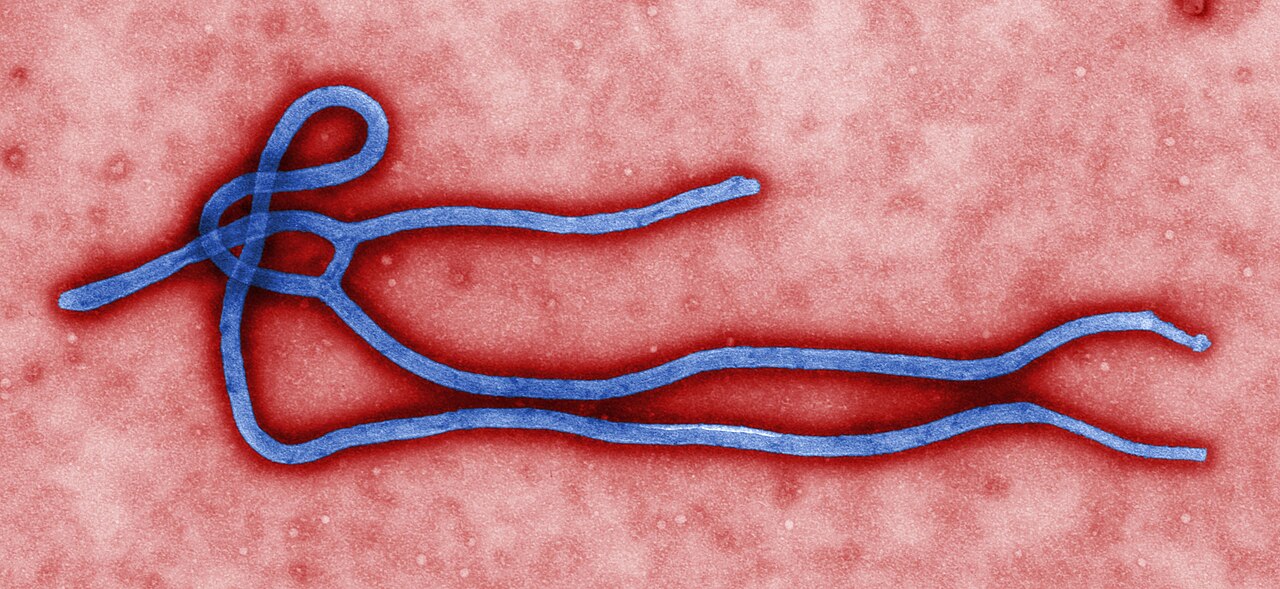
Via Wikimedia Commons: Ebola virus virion by CDC/Cynthia Goldsmith, public domain.
The disease takes its name from the Ebola River in what is now the Democratic Republic of the Congo (DRC), near the village of Yambuku where one of the first two outbreaks occurred in 1976, according to the World Health Organization (WHO). The viruses belong to the genus Orthoebolavirus in the family Filoviridae. The U.S. Centers for Disease Control and Prevention (CDC) notes that the group was formerly called ebolavirus.
As of November 2026, six species have been identified. The CDC lists four that cause illness in people, each giving its name to a disease:
Two more have not caused illness in people: Reston virus, which has caused disease in macaques and other non-human primates, and Bombali virus, identified more recently in bats. The WHO says that three of the species, Ebola, Sudan and Bundibugyo viruses, are known to cause large outbreaks.
The terms are easily confused. Under the WHO's International Classification of Diseases (ICD-11, 2018), "Ebola disease" covers illness caused by any of the four human-pathogenic orthoebolaviruses, while "Ebola virus disease" (EVD) means only the disease caused by Ebola virus itself, as a 2020 review in Nature Reviews Disease Primers explains. The same classification groups Ebola disease and Marburg disease, caused by the related Marburg and Ravn viruses, as the two kinds of filovirus disease. Describing it as a "viral haemorrhagic fever" is now discouraged, the review notes, because not all patients bleed visibly and fever is not always present.
Ebola virus has a genome of single-stranded RNA about 19,000 bases long, carrying seven genes. One of them encodes the glycoprotein, a protein on the particle's surface that attaches to host cells; once the particle has been taken into the cell, the glycoprotein binds a cholesterol-transport protein called NPC1, which the virus uses as its receptor, and the viral genome is released into the cell to be copied. The review describes most human cells as susceptible, with macrophages and related immune cells, and dendritic cells, as the main early targets. In laboratory studies, infected macrophages release inflammatory signalling molecules, and in monkeys this cascade often ends in leaky blood vessels, fluid loss into the tissues and shock; the review notes that this sequence is less well characterised in human patients.
Because the glycoprotein is the main target of the immune response, the vaccines in advanced development are all designed to provoke immunity against it.
Where the viruses live between outbreaks is not settled. The WHO states that fruit bats of the family Pteropodidae are thought to be the natural hosts, and the CDC says scientists believe African fruit bats are involved and may be the source. The 2020 review is more cautious: it describes the natural reservoir of Ebola virus as not yet identified, and notes that although several lines of evidence point to a role for bats, the virus had not been isolated from any wild animal, nor a near-complete genome found in one.
The step from animal to person is called a spillover. The WHO describes it as occurring through close contact with the blood, secretions, organs or other body fluids of infected animals, such as fruit bats, chimpanzees, gorillas, monkeys, forest antelope or porcupines found ill or dead. The CDC adds that this may happen through hunting, handling or eating infected animals. Most outbreaks, according to the 2020 review, can be traced to a single spillover followed by person-to-person spread, and on historical records Ebola virus may have passed from its reservoir to people to cause disease only about 20 to 30 times, though small outbreaks may have gone unrecorded.
Between people, the virus spreads when broken skin or the mucous membranes of the eyes, nose or mouth come into contact with the blood or body fluids of a person who is sick with or has died of Ebola disease, or with objects contaminated by them, such as clothing, bedding, needles and medical equipment. The CDC states that the disease does not spread through the air the way respiratory viruses such as influenza do, that there is no evidence that mosquitoes or other insects spread it, and that a person cannot spread it before symptoms begin.
The WHO singles out two settings. It notes that health and care workers have frequently been infected while treating patients when infection-control precautions are not strictly followed, and that burial ceremonies involving direct contact with the body can contribute to spread.
The virus can also persist after recovery in parts of the body shielded from the immune system. The CDC names the brain, eyes, placenta and testicles, and says the virus can remain in semen after recovery. The WHO reports that transmission through semen has been documented up to fifteen months after clinical recovery; the 2020 review cites a documented transmission 482 days after the onset of illness. Genetic sequencing has linked several later outbreaks in the DRC and Guinea to such persistent infection in survivors rather than to a new spillover from animals; the CDC describes the 2021 outbreak in Guinea as likely caused by a persistent source of infection, probably a survivor of the 2014–2016 epidemic.
The incubation period, from infection to the first symptoms, varies from 2 to 21 days; the CDC gives an average of 8 to 10 days. The WHO describes the first symptoms as sudden fever, fatigue, muscle pain, headache and sore throat, followed by vomiting, diarrhoea, abdominal pain, rash and impaired kidney and liver function. It adds that, despite a common perception, bleeding is less frequent and tends to come later. The CDC summarises the progression as early "dry" symptoms, such as fever, aches and fatigue, giving way to "wet" symptoms such as diarrhoea, vomiting and unexplained bleeding.
The 2020 review describes the typical course as a nonspecific feverish illness followed by severe gastrointestinal illness; in patients with very high levels of virus in the blood, this can progress to failure of several organs, which can be fatal, with the terminal phase usually falling 7 to 12 days after the illness begins. Data from the West African epidemic showed that the amount of virus in the blood, the patient's age and signs of organ dysfunction, in that order, most reliably predicted the outcome.
The WHO puts the average case fatality rate at around 50%, with rates that have ranged from 25% to 90% in past outbreaks. The CDC gives approximate rates by virus: up to 90% for untreated Ebola virus disease, about 50% for Sudan virus and about 30% for Bundibugyo virus.
Whether one virus is really more lethal than another is disputed. The 2020 review calculated mean fatality rates of about 34% for Bundibugyo virus, 44% for Ebola virus and 54% for Sudan virus and concluded that the often-repeated idea that Ebola virus is the most virulent of them is not supported by the data; with few outbreaks and small case numbers, whether one is more dangerous than another is statistically unclear. It lists possible reasons why fatality rates vary between outbreaks, including patients' nutrition and other infections, genetics, how soon people seek care, how well cases are found and reported, and access to supportive care.
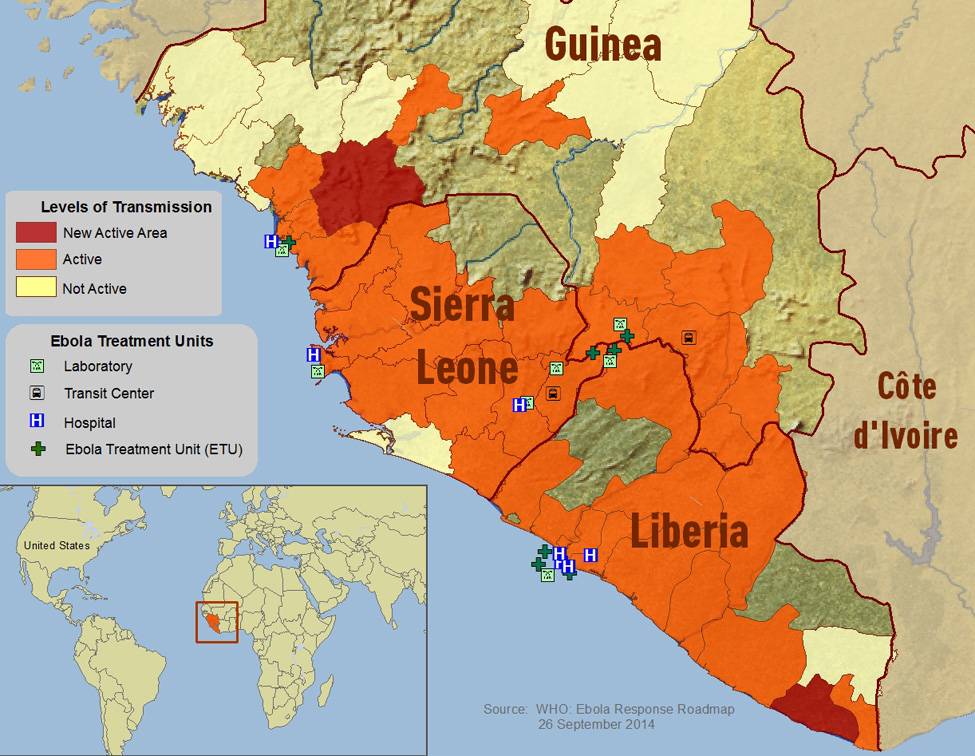
Via Wikimedia Commons: Ebola 2014 outbreak map of Guinea, Liberia, and Sierra Leone by CDC, public domain.
The disease was recognised in 1976 in two outbreaks that occurred at the same time: Sudan virus disease in Nzara, in what is now South Sudan, and Ebola virus disease in Yambuku, in what is now the DRC. The CDC's outbreak history records 318 cases and 280 deaths (88%) in the Yambuku outbreak, most within 70 km of the village; the first known patient was treated at the Yambuku Mission Hospital with an injection for possible malaria, and the virus then spread through the reuse of contaminated needles and syringes and through close personal contact. The Sudan outbreak, in Nzara, Maridi and the surrounding area, caused 284 cases and 151 deaths (53%); it is believed to have begun among workers at a cotton factory and spread mainly through close contact in hospitals, where many health workers were infected.
Filoviruses themselves had been discovered nine years earlier, with Marburg virus in 1967.
For nearly four decades outbreaks were sporadic, mostly rural and usually limited to dozens or hundreds of cases. Until 2013, according to the 2020 review, most Ebola virus disease outbreaks began in the DRC, Gabon and the Republic of the Congo, and across all filovirus diseases from 1967 to 2013 there had been 2,886 recorded cases and 1,982 deaths. The CDC's history includes:
The largest Ebola outbreak on record began in the forested south-east of Guinea, reported by the WHO on 23 March 2014, and spread to neighbouring Liberia and Sierra Leone. Genetic sequencing of more than 1,600 viral genomes traced all of its infections back to a single human index case near Guéckédou, probably infected from an animal source, with no further spillovers. The CDC attributes the scale of the epidemic partly to weak surveillance, fragile public health systems, poor infection control and strained health care. In August 2014 the WHO declared it a Public Health Emergency of International Concern, and it was declared over in June 2016. The CDC records 28,610 cases and 11,308 deaths (39%); the 2020 review gives 28,652 infections and 11,325 deaths. Travellers and returning health workers carried a small number of cases to other countries, including Mali, Italy and the United Kingdom.
The review describes the outbreak's location and size as entirely unexpected: organisations were unprepared for what had been regarded as an exotic pathogen of little consequence for global health. The epidemic also changed what was known about the disease. Large numbers of patients were treated in dedicated Ebola treatment units, where they could be studied in controlled settings, and survivors outnumbered the dead, so that long-term effects could be followed in cohort studies.
The DRC's tenth outbreak, declared on 1 August 2018 in North Kivu and spreading to Ituri and South Kivu, became the second largest at the time, with 3,470 cases and 2,287 deaths (66%) before the WHO declared it over on 25 June 2020. A Sudan virus outbreak in Mubende District, Uganda, confirmed on 20 September 2022, caused 142 confirmed and 22 probable cases and 55 confirmed deaths before it ended on 11 January 2023. An Ebola virus outbreak in Kasai Province, DRC, declared on 4 September 2025, ended on 1 December 2025 with 64 cases and 45 deaths.
As of November 2026, an outbreak of Bundibugyo virus disease first reported in May 2026 is under way in the DRC, with cases also reported in Uganda and, later, Kenya and Nigeria. On its page updated 6 November 2026, the CDC described it as the second-largest Ebola outbreak on record and spreading substantially faster than previous ones, and reported 10,772 confirmed cases and 5,234 confirmed deaths as of 4 November 2026. The CDC notes that case counts are subject to change. As of the WHO's April 2025 fact sheet, no vaccine or treatment had been approved for Bundibugyo virus disease (see below).
Ebola disease is hard to tell apart from other illnesses in its early stage. The WHO names malaria, typhoid fever, shigellosis, meningitis and other viral haemorrhagic fevers as conditions with similar early symptoms. Confirmation is by laboratory testing; the methods the WHO lists include reverse-transcription polymerase chain reaction (RT-PCR), which detects the virus's genetic material, antibody and antigen tests, and growing the virus in cell culture. The CDC states that PCR blood testing is used to diagnose the disease in living patients, and antibody testing to show whether someone recently had it.
For decades there was no specific treatment, and care consisted of supporting the patient's body while the immune system fought the virus. The WHO states that early, intensive supportive care, including rehydration and treatment of symptoms, improves survival. The CDC describes supportive care as including fluids and electrolytes by mouth or vein, medicines to support blood pressure and to reduce vomiting, diarrhoea, fever and pain, and treatment of other infections.
The first specific treatments shown to reduce deaths came from the PALM randomised trial, which began in eastern DRC on 20 November 2018 and compared four investigational treatments; in August 2019 its monitoring board recommended stopping it early after an interim analysis of 681 patients. As summarised in the 2020 review, 35.1% of patients given the monoclonal antibody mAb114 died (61 of 174), compared with 49.7% (84 of 169) given ZMapp, the comparison treatment, and 33.5% of those given REGN-EB3 (52 of 155), compared with 51.3% (79 of 154) in the ZMapp group enrolled over the same period. A monoclonal antibody is a laboratory-made antibody designed to bind one target, here the virus's surface glycoprotein.
As of November 2026, the WHO strongly recommends mAb114 (ansuvimab) or REGN-EB3 (Inmazeb) for Ebola virus disease, and the CDC lists two treatments approved by the U.S. Food and Drug Administration (FDA), Inmazeb and Ebanga, both for disease caused by Orthoebolavirus zairense only. For Sudan, Bundibugyo and the other Ebola diseases the WHO says there are no approved therapeutics, though candidates are in development.
Vaccine development was accelerated during the West African epidemic. The vaccine known as rVSV-ZEBOV, a weakened, genetically engineered vesicular stomatitis virus carrying the Ebola virus glycoprotein, was tested in the phase III "Ebola ça Suffit!" ring vaccination trial in Guinea. In ring vaccination, the contacts of each confirmed patient, and the contacts of those contacts, are vaccinated. The review's summary of the trial records no cases of Ebola virus disease beyond 10 days after immediate vaccination, against 23 cases among 4,507 contacts in the group whose vaccination was delayed by 21 days. During the 2018–2020 DRC outbreak the vaccine was given to 276,520 people by 26 January 2020, and the WHO estimated its efficacy at 97.5% from preliminary data. The review notes that there was no evidence yet of long-term protection for any vaccine.
The vaccine received conditional marketing authorisation from the European Medicines Agency in October 2019, followed by approval by the European Commission and the FDA in November and December 2019. As of April 2025 the WHO lists two approved vaccines for Ebola virus disease: Ervebo (rVSV-ZEBOV, from Merck & Co.) and the two-dose Zabdeno and Mvabea regimen from Janssen. Neither covers the other species; for Sudan virus disease and the rest, the WHO says several candidate vaccines are in development.
The WHO describes outbreak control as resting on a package of measures: care for patients, infection prevention and control in health facilities, surveillance, contact tracing, laboratory services, safe and dignified burials, vaccination where a vaccine exists, and community engagement. Contacts of patients are followed for 21 days, the longest incubation period. The CDC notes that in the 1995 Kikwit outbreak, spread within health facilities was halted almost immediately once masks, gloves and gowns were used. Its account of the 2026 outbreak lists the obstacles a response can face: limited health infrastructure, armed conflict, violence against health workers, shortages of protective equipment, population movement, and mistrust and misinformation.
Because so few people survived earlier outbreaks, the long-term effects were little studied before 2014. Limited data from the 1995 outbreak suggested that recovery could be complicated by joint and muscle pain, changes in vision and hearing, and extreme fatigue, with almost two-thirds of survivors still affected two years later. In the largest controlled study of survivors, from the West African epidemic, headache, joint and muscle pain, memory loss, fatigue and other problems were significantly more common in survivors than in uninfected close contacts; most improved over time, but uveitis, an inflammation inside the eye, became slightly more common over the follow-up period. The review reports eye problems in 14–60% of adult survivors and 32% of child survivors across studies, and also neurological, psychiatric, hearing and skin problems.
Some survivors develop antibodies that can last 10 years or longer, which may give some protection against the species that infected them; the CDC says scientists do not know whether survivors are immune for life or could be infected by a different species.
This entry explains; it is not medical advice. Ask a doctor or pharmacist about your own health.
 将 Micwyn 添加到主屏幕拥有独立图标、全屏显示并支持通知。