The Strait of Hormuz is the narrow sea passage between Iran and Oman that links the Persian Gulf with the Gulf of Oman and the Arabian Sea, and through which much of the world's seaborne oil and liquefied natural gas is shipped.
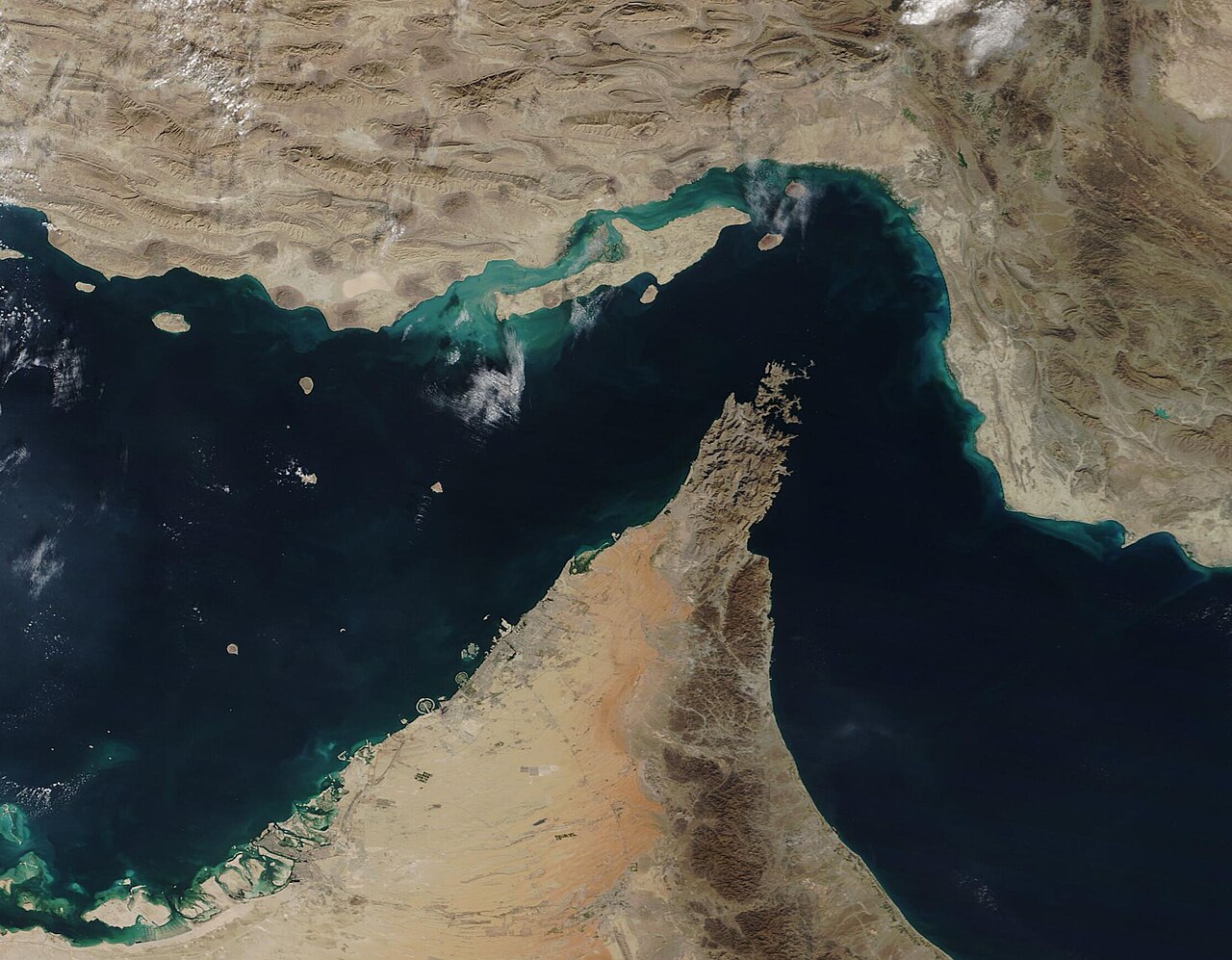
A satellite view of the Strait of Hormuz and the coasts on either side. Via Wikimedia Commons: Strait of Hormuz (MODIS 2020-12-04) .jpg) by MODIS Land Rapid Response Team, NASA GSFC, public domain.
Geography
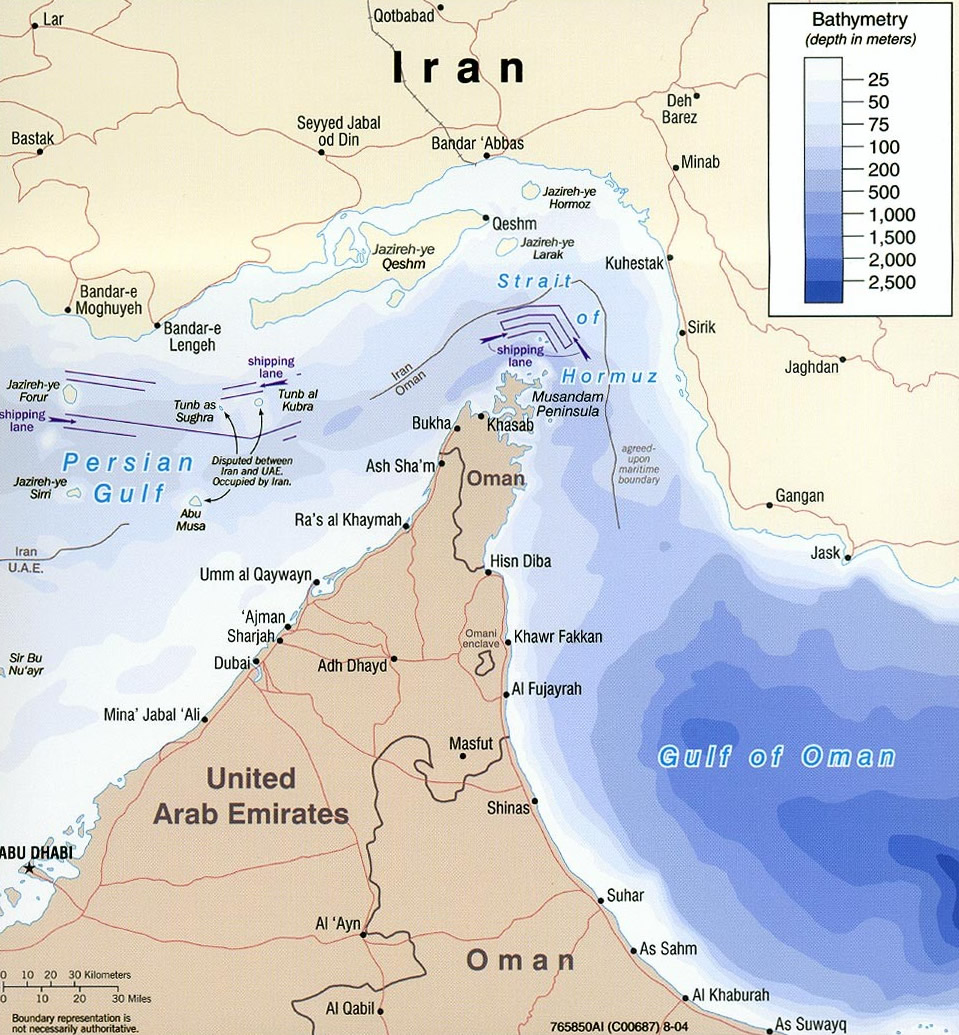
The strait lies between Oman to the south and Iran to the north, connecting the Persian Gulf with the Gulf of Oman and the Arabian Sea . The Strauss Center for International Security and Law at the University of Texas at Austin puts it at about 30 miles wide at its narrowest point . The U.S. Energy Information Administration (EIA) describes it as deep and wide enough for the largest crude oil tankers , and the Strauss Center notes that much of the water outside the shipping lanes is deep enough for even the very largest tankers , so that blocking the flow of oil would need a barrier across the whole strait rather than across the lanes alone.
Ships keep to a traffic separation scheme, a set of one-way lanes recognised by the UN's International Maritime Organization. In the strait it consists of two shipping lanes, each two miles wide, one for inbound and one for outbound traffic, separated by a two-mile buffer zone .
A map of the Strait of Hormuz between the Persian Gulf and the Gulf of Oman. Via Wikimedia Commons: Strait of hormuz full , public domain.
Importance for energy
The EIA calls the strait one of the world's most important oil chokepoints . A chokepoint is a narrow route that a large share of trade must pass through. In its June 2025 analysis the EIA reported that:
Routes around the strait
Only a few pipelines let Gulf producers export without using the strait. The EIA lists Saudi Aramco's East-West pipeline, with a capacity of 5 million barrels a day, from Abqaiq to Yanbu on the Red Sea ; a United Arab Emirates pipeline of 1.8 million barrels a day to the Fujairah terminal on the Gulf of Oman ; and Iran's Goreh-Jask pipeline, opened in July 2021, with an effective capacity of about 300,000 barrels a day. Because much of this capacity is already in daily use, the EIA estimated that only about 2.6 million barrels a day could be available to bypass the strait in a disruption , a small fraction of normal flows.
Legal status
Under the United Nations Convention on the Law of the Sea (UNCLOS) of 1982, straits used for international navigation between one part of the high seas or an exclusive economic zone and another are subject to "transit passage". Article 38 provides that in such straits all ships and aircraft enjoy the right of transit passage, which shall not be impeded , meaning the freedom of navigation and overflight solely for continuous and expeditious transit. Article 44 adds that bordering states shall not hamper transit passage and that "there shall be no suspension of transit passage."
The two states bordering the strait stand in different positions toward the convention. According to the United Nations treaty records, Oman signed on 1 July 1983 and ratified on 17 August 1989 , declaring that innocent passage for warships through its territorial waters is guaranteed "subject to prior permission." Iran signed on 10 December 1982 but has not ratified . In an interpretative declaration made on signing, Iran stated its understanding that "only states parties to the Law of the Sea Convention shall be entitled to benefit from the contractual rights created therein" , and named among those rights "the right of Transit passage through straits used for international navigation." In Iran's stated view, then, a state that is not a party to the convention cannot claim the right of transit passage under it.
The Tanker War, 1984 to 1988
The strait became a military flashpoint during the Iran-Iraq War (1980 to 1988). According to a 2016 article by Richard A. Mobley in the CIA journal Studies in Intelligence , Iraq expanded the war to the Gulf in 1984 by attacking Iranian shipping , seeking to force Iran to accept a ceasefire and to cut its oil exports, and Iran answered by attacking ships linked to Saudi Arabia and Kuwait, which were supporting Iraq.
After Kuwait asked for protection, the United States began Operation Earnest Will in July 1987, escorting Kuwaiti tankers that had been granted the U.S. flag . The first convoy met trouble at once: the reflagged tanker Bridgeton struck a mine near Farsi Island in the northern Persian Gulf on 24 July 1987 . U.S. intelligence reported in June 1987 that Iran had contingency plans to close the Strait of Hormuz using most of its navy and much of its air force, but assessed that it could close the strait for no more than a week or two . Iranian Silkworm anti-ship missiles were a particular worry for convoys having to brave the Strait of Hormuz .
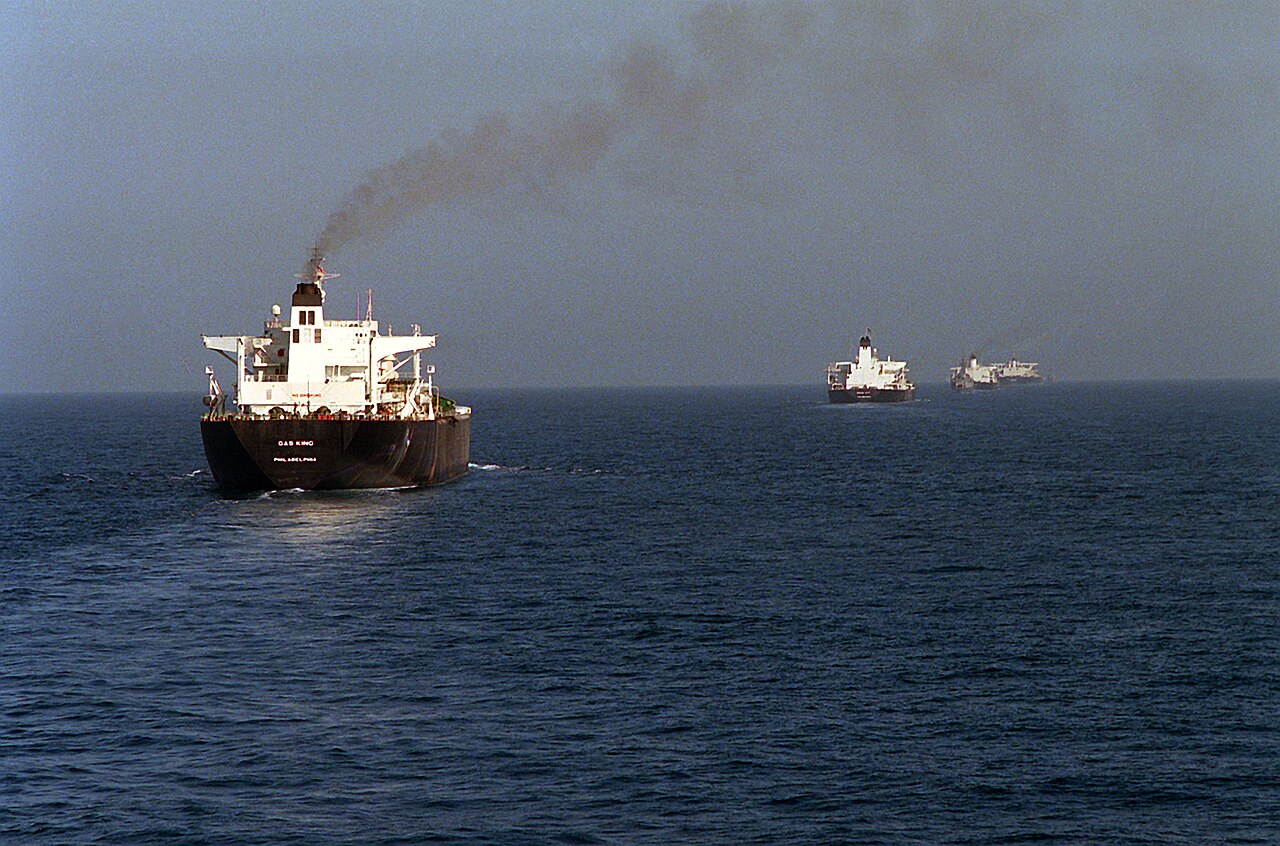
Ships in a U.S. Navy-escorted convoy during Operation Earnest Will. Via Wikimedia Commons: Earnest Will convoy by PH2 Tolliver, public domain.
The fighting peaked in 1988. After the U.S. warship Samuel B. Roberts struck a mine on 14 April, the U.S. Navy on 18 April destroyed two Iranian oil platforms and sank or disabled three Iranian naval vessels and three small boats in what it called Operation Praying Mantis. On 3 July 1988 the U.S. cruiser Vincennes mistakenly shot down an Iranian airliner over the Strait of Hormuz . The International Court of Justice records that the Iran Air Airbus A300B was destroyed in the air and that all 290 passengers and crew were killed . Iran brought a case against the United States at the court in May 1989; it was removed from the court's list in February 1996 after the two countries reached a full and final settlement . The war ended with a ceasefire in August 1988 .
The 2026 disruption
In 2026 shipping through the strait fell sharply. The EIA's energy security data, published with its October 2026 Short-Term Energy Outlook, put oil flows through the strait at 4.9 million barrels a day in the second quarter of 2026, down from 21.6 million in the fourth quarter of 2025 , and LNG flows at 0.8 billion cubic feet a day, down from 10.5. The EIA cautions that ship-tracking signals in the strait have become especially unreliable since the end of February 2026 and that its 2026 figures are being revised frequently. As of November 2026 these figures describe a situation still unfolding.
Sources
U.S. Energy Information Administration, "Amid regional conflict, the Strait of Hormuz remains critical oil chokepoint", Today in Energy , 16 June 2025. eia.gov/todayinenergy/detail.php?id=65504 U.S. Energy Information Administration, Short-Term Energy Outlook , energy security data and methodology, released 6 October 2026. eia.gov/outlooks/steo/report/energysecurity/article.php Strauss Center for International Security and Law, University of Texas at Austin, "Strait of Hormuz: About the Strait" (read November 2026). strausscenter.org/strait-of-hormuz-about-the-strait/ United Nations, United Nations Convention on the Law of the Sea , Part III, "Straits used for international navigation". un.org/depts/los/convention_agreements/texts/unclos/part3.htm United Nations Treaty Collection, status of the United Nations Convention on the Law of the Sea, with declarations (read November 2026). treaties.un.org/Pages/ViewDetailsIII.aspx?src=TREATY&mtdsg_no=XXI-6… Richard A. Mobley, "Fighting Iran: Intelligence Support During Operation Earnest Will, 1987-88", Studies in Intelligence 60, no. 3 (September 2016), Central Intelligence Agency. cia.gov/resources/csi/static/Fighting-Iran.pdf International Court of Justice, Aerial Incident of 3 July 1988 (Islamic Republic of Iran v. United States of America) , case page (read November 2026). icj-cij.org/case/79  Micwyn· EnsaiklopidiaAI
· 7 dakika za kusoma · 0 maoni · 0 mionekano