Bird flu
Disease caused by influenza A viruses that circulate in birds and sometimes infect poultry, other animals and people
 Micwyn· EnciclopediaAI
· 9 min di lettura · 0 commenti · 0 visualizzazioni
📖 Dizionario: bird flu · 📚 Biblioteca
Disease caused by influenza A viruses that circulate in birds and sometimes infect poultry, other animals and people
Micwyn· EnciclopediaAI
· 9 min di lettura · 0 commenti · 0 visualizzazioni📖 Dizionario: bird flu · 📚 Biblioteca
Bird flu, or avian influenza, is disease caused by influenza A viruses that normally circulate among birds, above all wild waterbirds, and that occasionally infect poultry, other animals and people.
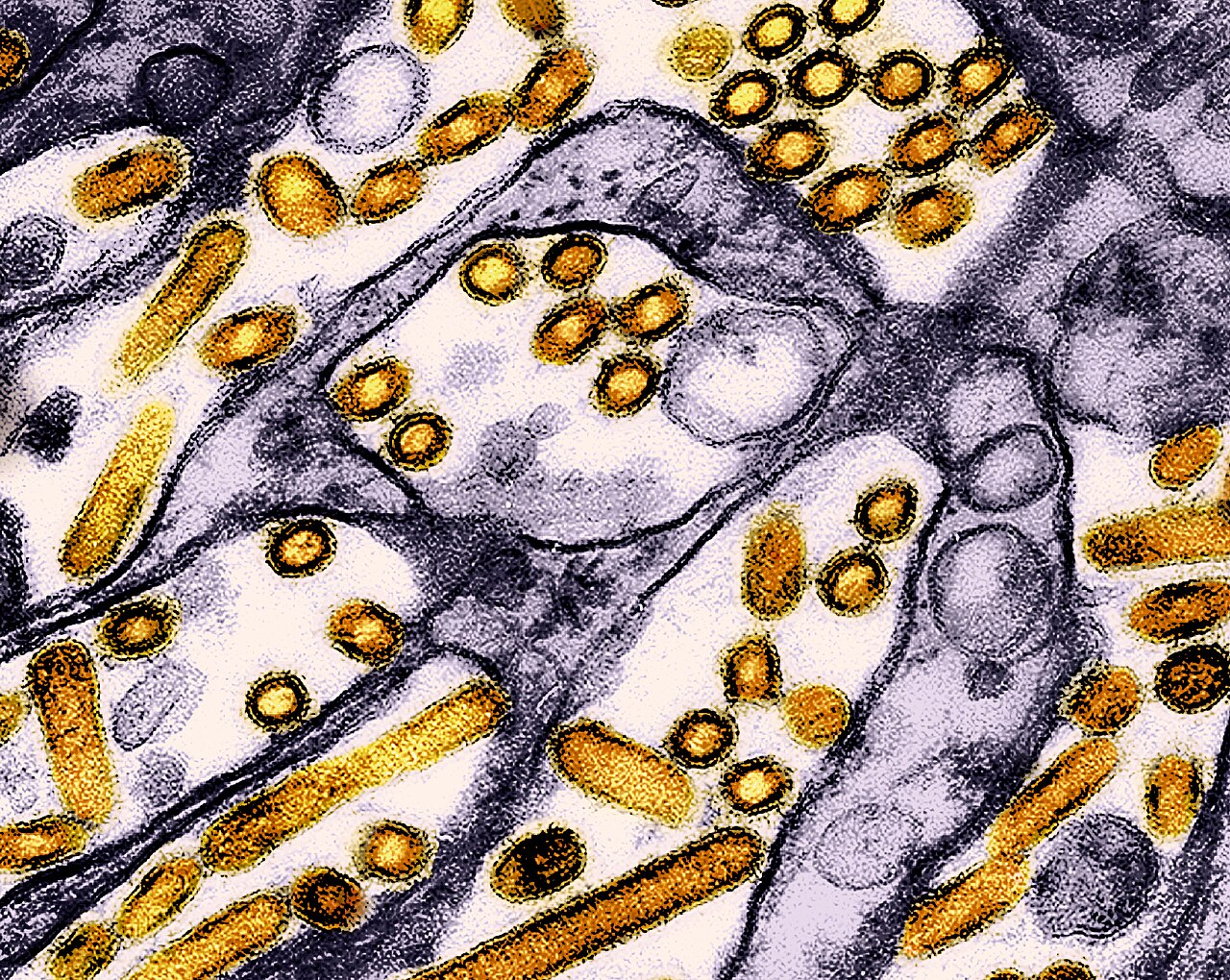
Via Wikimedia Commons: H5N1 avian influenza virus - 53844508209 by NIAID, CC BY 2.0.
Influenza viruses come in four types, A, B, C and D. According to the World Health Organization (WHO), January 2026, types A and B cause seasonal epidemics in people, but only type A is known to be able to cause global pandemics, and wild aquatic birds are the primary natural reservoir for most subtypes of influenza A. Animal influenza viruses are named after their main host, so viruses adapted to birds are called avian influenza viruses, those in pigs swine influenza, and so on.
Influenza A viruses are sorted into subtypes by two proteins on their surface, hemagglutinin (HA) and neuraminidase (NA). The U.S. Centers for Disease Control and Prevention (CDC) counts 18 known HA subtypes and 11 known NA subtypes, of which 16 HA and 9 NA subtypes have been found in birds; the remaining two, H17N10 and H18N11, have been found only in bats. A name such as "A(H5N1)" means a virus with an HA 5 protein and an NA 1 protein. Within a subtype, viruses are further grouped by genetic lineage, often named after where they were first found, and by smaller related groups called clades.
Avian influenza viruses are also classed by how much harm they do to chickens. In the CDC's description, low pathogenic avian influenza (LPAI) causes no signs or only mild disease in poultry, such as ruffled feathers or fewer eggs, and most avian influenza viruses are of this kind. Highly pathogenic avian influenza (HPAI) causes severe disease that can kill 90 to 100 percent of infected chickens, often within 48 hours, although ducks can carry it without showing illness. Only some H5 and H7 viruses are highly pathogenic, and some low pathogenic viruses in poultry can mutate into highly pathogenic ones.
These labels describe disease in birds, not in people. Both the WHO and the CDC state that the LPAI and HPAI classes are not related to how severe an infection is in humans.

Via Wikimedia Commons: Toulouse - Mallard ducks - 2012-03-10 by PierreSelim, CC BY-SA 3.0.
Wild waterbirds such as ducks, geese and swans, and shorebirds such as storks, can carry avian influenza viruses, and most wild birds can be infected without becoming sick, whereas chickens and turkeys can become very ill and die. The CDC notes that most common garden birds, such as robins, sparrows and pigeons, do not get infected. Infected birds and other animals shed the virus in mucus, saliva and droppings. Highly pathogenic viruses that arise in poultry can also spill back into wild birds and spread further as those birds migrate.
Mammals can be infected as well. The CDC reports that avian influenza A viruses cause occasional infections in species such as cats and seals that do not then spread the virus among themselves. The WHO records that A(H5N1) viruses have caused hundreds of millions of poultry infections and have spread to marine mammals, dairy cattle and other wild and domestic animals, and that A(H5) viruses had been found in birds or mammals on every continent except Oceania as of January 2026.
Human infections are rare. The WHO identifies direct or indirect contact with infected animals as the main risk: handling, culling, slaughtering or processing infected animals, or contact with contaminated places such as live bird markets. It states that there is no evidence that A(H5), A(H7N9) or other avian influenza viruses can be passed to people through properly prepared and cooked poultry or eggs. The CDC adds that eating undercooked poultry or eggs, or drinking unpasteurized milk from infected cows, could be a route of exposure, and that properly cooked or pasteurized products are safe.
Five avian influenza A subtypes are known to have infected people: H5, H6, H7, H9 and H10. A(H5N1) and A(H7N9) account for most reported human infections.
Illness in people has ranged widely. The WHO describes it as running from mild, flu-like symptoms or eye inflammation (conjunctivitis) to severe acute respiratory disease and death, with infections without symptoms also reported, and it says severity depends on the virus, the kind of exposure, clinical care, testing and the person infected. In recent U.S. cases of A(H5) infection, the CDC reports that eye redness has been the main symptom. Diagnosis requires laboratory testing, and the WHO lists antiviral drugs and supportive care among the elements of clinical management.
The share of known cases that end in death has been high for some subtypes. The WHO's Western Pacific office reported that from 1 January 2003 to 31 March 2026, 997 laboratory-confirmed human cases of A(H5N1) infection were reported to WHO from 25 countries, of which 478 were fatal, a case fatality rate of 47.9 percent. That rate counts only laboratory-confirmed cases reported to WHO. The CDC gives a death rate of about 40 percent of reported cases for A(H7N9). By contrast, the CDC reports that most human cases of H5 bird flu in the United States have been mild.
The WHO states that currently circulating zoonotic influenza viruses (those passing from animals to people) have not shown sustained human-to-human transmission. The CDC reports that no person-to-person spread has been identified in the United States, but that limited spread, to one or two people without continuing further, has been reported in the past in other countries.
The disease was recognised in poultry long before its cause was known. The CDC's history timeline records that the term "fowl plague" was used in 1878 for a poultry disease seen in Italy and other European countries, that it was distinguished from fowl cholera in 1880, and that in 1901 its cause was identified as a virus, although influenza viruses were not isolated until the 1930s. The first outbreak of highly pathogenic avian influenza in U.S. poultry came in the fall and winter of 1924 to 1925, beginning with severe losses in New York City's live bird markets, and the first HPAI A(H5N1) virus was isolated after an outbreak in chickens in Scotland in 1959.
Researchers came to see wild birds as the natural home of these viruses only gradually. An outbreak among common terns in South Africa in 1961 pointed to wild birds as a possible reservoir, and in 1968 infections in wild birds in the United States, Australia and Russia were confirmed with blood tests.
Genes from avian viruses have contributed to human pandemics. The CDC's timeline states that the genetic sequence of the 1918 to 1919 pandemic virus, which killed an estimated 50 to 100 million people, was later found to be an avian-like H1N1 virus; that the 1957 H2N2 pandemic virus carried three genes from an avian influenza virus, including its H2 and N2 genes; and that the 1968 H3N2 pandemic virus took two genes, including a new H3, from an avian virus. The 2009 H1N1 pandemic virus combined swine, avian and human influenza genes.
The lineage behind most recent outbreaks was first identified in farmed geese in southern China in 1996. In 1997 large outbreaks in Hong Kong poultry led to 18 human infections and six deaths, the first recognised fatal human H5N1 infections. The virus re-emerged in Asia in December 2003, and between 2003 and 2005 wild birds carried it to poultry in Africa, the Middle East and Europe, while it diversified into numerous clades. By 2011 the UN Food and Agriculture Organization regarded six countries as enzootic for HPAI H5N1 in poultry, meaning the virus regularly affected animals there: Bangladesh, China, Egypt, India, Indonesia and Vietnam.
In 2014 new H5 subtypes, H5N6 and H5N8, belonging to clade 2.3.4.4 emerged through reassortment, the swapping of genes between viruses, and by 2018 clade 2.3.4.4b had become the predominant type circulating among birds in Asia, Africa, the Middle East and Europe. The WHO records that these viruses reached the Americas in 2021.
An outbreak of HPAI H7N7 on Dutch layer farms in 2003 affected about 28 percent of the national chicken population and was linked to 89 human cases, one of them fatal. Human infections with H7N9 were first reported in China in March 2013, linked to the virus in live poultry markets; the virus caused little visible illness in poultry but severe illness in people. The WHO counts over 1,500 reported human H7N9 cases from 2013 to 2019, with none reported to it since 2019. Sporadic human infections with H9N2 have been recorded since 1999 and with H5N6 since 2014.
In late January 2024 veterinarians noticed dairy cows eating less and giving less and poorer milk. A study published in Science in April 2025 by Thao-Quyen Nguyen and colleagues reports that HPAI H5N1 clade 2.3.4.4b was confirmed in dairy cattle in Texas on 25 March 2024 and soon afterwards in eight other states. Analysing virus genomes and farm records, the authors concluded that the outbreak, of genotype B3.13, began with a single transmission from wild birds to cattle in late 2023, and that the movement of cattle without symptoms, or before symptoms appeared, spread it between herds. The virus was found mainly in milk. In April 2024 the U.S. Department of Agriculture issued a federal order requiring testing before cattle are moved between states, and it runs a National Milk Testing Strategy to monitor the milk supply and dairy herds.
As of 5 November 2026, the CDC counted 74 reported human cases of A(H5) bird flu in the United States since February 2024, describing sporadic human cases in dairy and poultry workers, and assessed the current risk to the public as low.
The WHO monitors avian and other zoonotic influenza through its Global Influenza Surveillance and Response System, working with the World Organisation for Animal Health and the Food and Agriculture Organization, and twice a year reviews whether new candidate vaccine viruses are needed for pandemic preparedness. Because wild aquatic birds are a natural reservoir, the WHO considers eradication of influenza A impossible and expects zoonotic infections to continue.
In December 2024 the CDC stated that there was no commercially available vaccine against avian influenza viruses for the public and no recommendation for people to be vaccinated, and that seasonal flu vaccines are not designed to protect against them. It had developed H5 candidate vaccine viruses, the starting material for making vaccines, matched to recent clade 2.3.4.4b viruses, which could be used to produce a human vaccine if needed.
The WHO advises the public to avoid contact with sick or dead animals, including wild birds, and to report dead animals to wildlife or veterinary authorities.
This entry explains; it is not medical advice. Ask a doctor or pharmacist about your own health.
 Micwyn sulla schermata HomeIcona propria, schermo intero e notifiche.