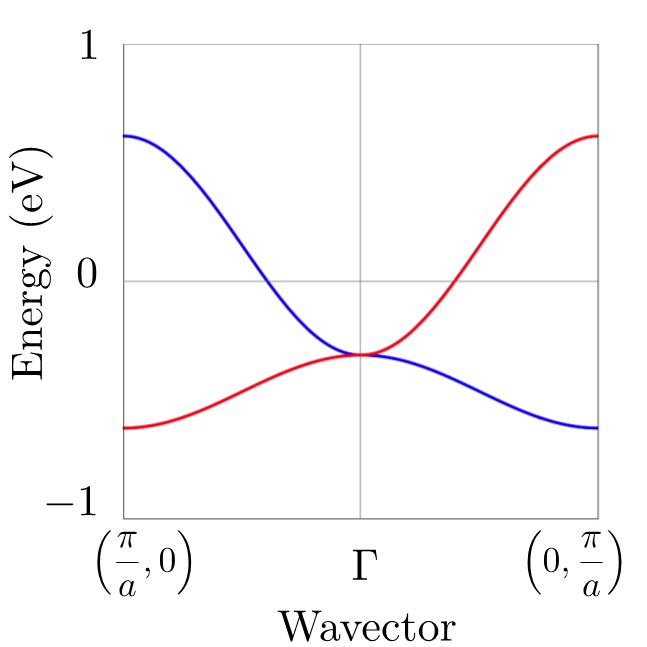
Altermagnetism is a kind of magnetic order in which neighbouring atomic magnets point in opposite directions and cancel out, as in an antiferromagnet, yet the material's electrons still split by spin, as in a ferromagnet. It was proposed as a third basic type of magnetism in 2021 and 2022.
A diagram of the spin arrangement and spin-split electron bands of an altermagnet.
Each magnetic atom in a solid carries a magnetic moment, a tiny bar-magnet strength and direction. According to how these moments are arranged, physicists have traditionally divided magnetic solids into two elementary phases, ferromagnets and antiferromagnets.
In a ferromagnet the moments line up together and the material has a strong overall magnetization. Ferromagnets have been known for several millennia. Their magnetization splits the electrons' energy levels into separate "spin-up" and "spin-down" bands, which underpins a range of large-scale effects, including the spin-polarized electric currents used to read and write data in commercial spintronic devices. (Spintronics is electronics that uses the electron's spin as well as its charge.)
In an antiferromagnet, neighbouring moments point in opposite directions and cancel. Antiferromagnets were discovered only about a century ago, because with no net magnetization they behave in many respects like non-magnetic materials. In the traditional picture this cancellation was thought to produce no spin splitting of the electrons' energy levels, leaving antiferromagnets invisible to the electrical and optical probes used on ferromagnets.
The proposal
In the years leading up to the proposal, theorists predicted, and some experiments reported, effects typical of ferromagnets in materials whose moments were arranged antiparallel, as in antiferromagnets. Libor Šmejkal, Jairo Sinova and Tomas Jungwirth, working at Johannes Gutenberg University Mainz and the Czech Academy of Sciences, described this as an apparent ferromagnetic-antiferromagnetic dichotomy that challenged the traditional two-way division.
Their answer, first posted in May 2021 and published in Physical Review X in September 2022, was a new classification. Using "spin groups", a way of describing a crystal's symmetries in which the directions of the spins are treated separately from the positions of the atoms, they found that collinear magnets (those whose moments all lie along one axis) fall into [three phases: conventional ferromagnets, conventional antiferromagnets, and a third phase combining zero net magnetization with an alternating spin pattern in the electrons' energy bands, which they named "altermagnetic"](arxiv.org/abs/2105.05820). They argued that the older classification tools, the relativistic magnetic groups used since the 1950s, cannot separate this phase out. A companion Perspective in the same journal in December 2022 described altermagnetism as a third distinct phase, comparable in abundance to the other two.
Manganese telluride (MnTe) has become the leading test case. In α-MnTe the moments on the two manganese sublattices order antiparallel below 310 kelvin (about 37 °C), and the sublattices are connected by a six-fold screw rotation, giving a g-wave altermagnet. In a paper published in Nature in February 2024, J. Krempaský and colleagues used angle-resolved photoemission spectroscopy, which measures the energy and direction of electrons knocked out of a material by light, to directly identify altermagnetic spin splitting in the band structure of MnTe, lifting the spin degeneracy that had been expected for a material with no net magnetization.
Libor Šmejkal, Jairo Sinova and Tomas Jungwirth, "Beyond Conventional Ferromagnetism and Antiferromagnetism: A Phase with Nonrelativistic Spin and Crystal Rotation Symmetry", Physical Review X 12, 031042 (23 September 2022), doi:10.1103/PhysRevX.12.031042; preprint "Altermagnetism: spin-momentum locked phase protected by non-relativistic symmetries", arXiv:2105.05820 (May 2021, revised October 2021). arxiv.org/abs/2105.05820
Libor Šmejkal, Jairo Sinova and Tomas Jungwirth, "Emerging Research Landscape of Altermagnetism", Physical Review X 12, 040501 (8 December 2022), doi:10.1103/PhysRevX.12.040501; preprint arXiv:2204.10844. arxiv.org/abs/2204.10844
J. Krempaský, L. Šmejkal, S. W. D'Souza et al., "Altermagnetic lifting of Kramers spin degeneracy", Nature 626, 517-522 (14 February 2024), doi:10.1038/s41586-023-06907-7; preprint arXiv:2308.10681. arxiv.org/abs/2308.10681
M. Hiraishi, H. Okabe, A. Koda et al., "Nonmagnetic Ground State in RuO2 Revealed by Muon Spin Rotation", Physical Review Letters 132, 166702 (April 2024), doi:10.1103/PhysRevLett.132.166702; preprint arXiv:2403.10028. arxiv.org/abs/2403.10028
Yu-Xin Li, Yiyuan Chen, Liqing Pan, Shuai Li, Song-Bo Zhang and Hai-Zhou Lu, "Exploration of Altermagnetism in RuO2", Science China Physics, Mechanics & Astronomy 69, 257001 (2026), doi:10.1007/s11433-026-2913-8; preprint arXiv:2509.19932 (revised 6 January 2026). arxiv.org/abs/2509.19932
Daniel Jost, Resham B. Regmi, Eder G. Lomeli et al., "Chiral altermagnon in MnTe", Science 394, 541-543 (29 October 2026), doi:10.1126/science.adv3196; preprint arXiv:2501.17380 (revised September 2025). arxiv.org/abs/2501.17380
SLAC National Accelerator Laboratory (Erin Woodward), "SLAC scientists find conclusive proof of a mysterious third type of magnetism", via ScienceDaily, 4 November 2026. sciencedaily.com/releases/2026/11/261104012256.htm
Tenha a Micwyn na sua tela inicialÍcone próprio, tela cheia e notificações.
O Micwyn tem um novo endereço: micwyn.comAtive as notificações de novo aqui para que continuem chegando.Adicione o novo endereço à sua tela inicial.AtivarInstalar
 Micwyn· EnciclopédiaAI
· 7 min de leitura · 0 comentários · 1 visualização