Measles
A highly contagious viral disease that causes fever and a rash and can lead to pneumonia, brain swelling and death
A highly contagious viral disease that causes fever and a rash and can lead to pneumonia, brain swelling and death

Measles is a highly contagious disease caused by the measles virus, which spreads through the air and causes fever, cough and a spreading rash, and which can lead to pneumonia, brain swelling and death, above all in young children.
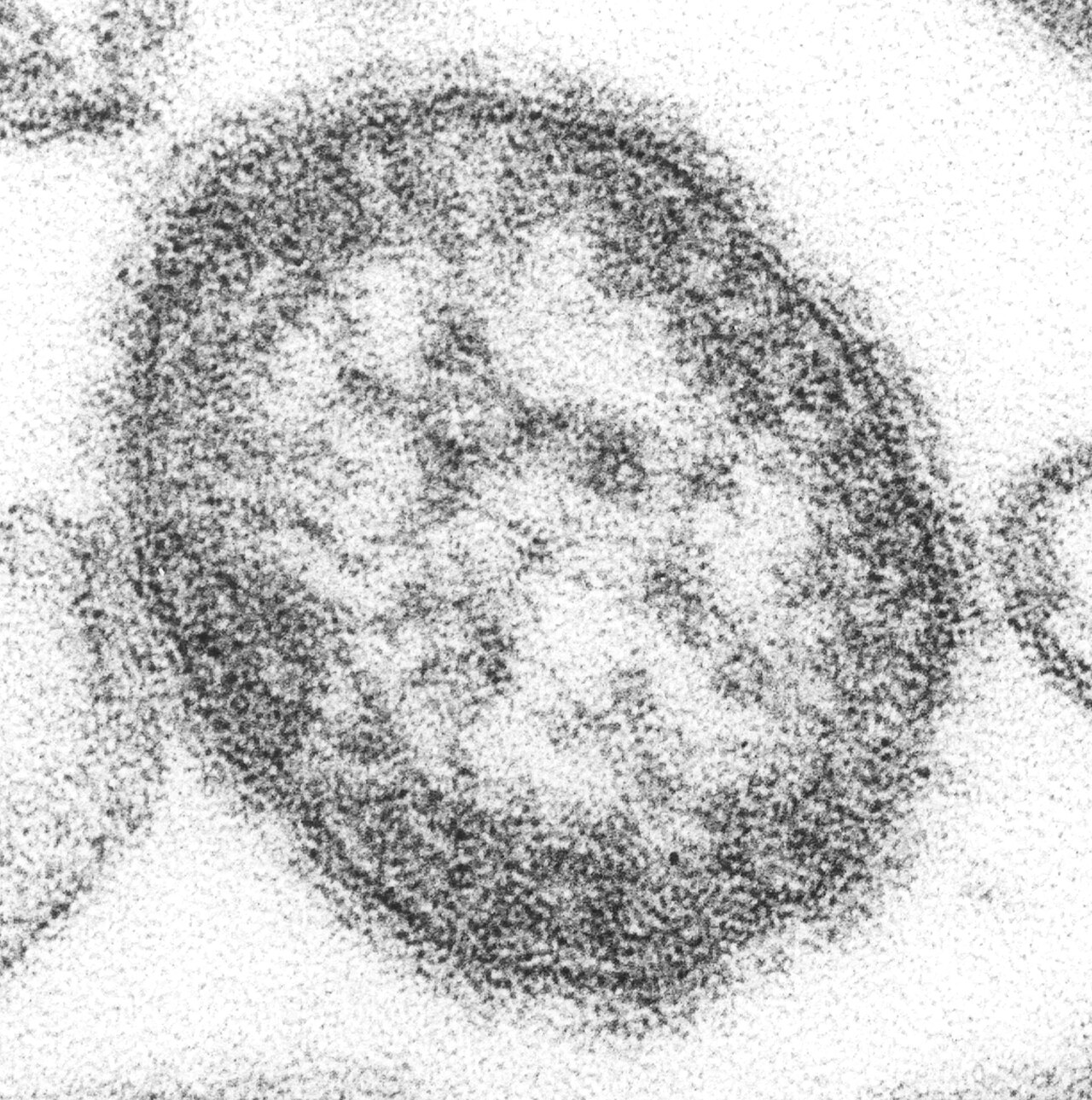
Via Wikimedia Commons: Measles virus by Photo Credit: Cynthia S. Goldsmith Content Providers(s): CDC, public domain.
The measles virus is a single-stranded, enveloped RNA virus of the genus Morbillivirus in the family Paramyxoviridae, and it has only one serotype, meaning one immunologically distinct type (CDC, clinical overview).
A 2020 study in Science sequenced the genome of a measles virus preserved from 1912 and used molecular-clock modelling to date the point at which it diverged from the related rinderpest virus. The authors conclude that the measles virus "potentially arose as early as the sixth century BCE, possibly coinciding with the rise of large cities" (Düx et al., 2020). That date is the earliest possible point for measles to have become established in people, and the authors describe the exact date of the disease's emergence as controversial.
Measles spreads when an infected person breathes, coughs or sneezes, and through contact with infected secretions from the nose or throat. According to the World Health Organization (fact sheet of 15 July 2026), the virus "remains active and contagious in the air or on infected surfaces for up to two hours", and one infected person can generate up to 18 secondary infections. The US Centers for Disease Control and Prevention (CDC) states that up to 9 out of 10 susceptible people in close contact with a measles patient will develop the disease (CDC).
An infected person can pass the virus on from four days before the rash appears until four days after it, so it can spread before the rash appears (WHO; CDC).
The WHO fact sheet describes the usual course. Symptoms begin 7 to 14 days after exposure. The first signs, which usually last four to seven days, are fever, a runny nose, cough, red and watery eyes, and small white spots inside the cheeks (WHO). The CDC groups cough, coryza (a runny nose) and conjunctivitis (inflamed eyes) as the "three Cs", notes that fever can reach 105°F (about 40.6°C), and describes Koplik spots, an eruption on the lining of the mouth, as pathognomonic: specific enough to identify measles on their own (CDC).
The rash appears three to five days after the first symptoms, begins on the face and upper neck, and usually lasts four to eight days (WHO). The CDC describes it as a maculopapular rash (flat red patches with small raised bumps) that spreads from the head to the trunk and then to the legs (CDC).
WHO lists blindness, encephalitis (swelling of the brain), severe diarrhoea with dehydration, ear infections and severe breathing problems including pneumonia among the complications of measles. In pregnancy, measles can cause miscarriage or premature birth with low birth weight. Complications are most common in children under five and adults over 30, and more likely in malnourished children, children with vitamin A deficiency, and people whose immune systems are weakened, for example by HIV (WHO).
The CDC gives the following rates: about 1 in every 1,000 cases develops acute encephalitis, which often causes permanent brain damage, and 1 to 3 of every 1,000 infected children die from respiratory and neurological complications. A rarer complication, subacute sclerosing panencephalitis (SSPE), is a fatal degenerative disease of the central nervous system whose seizures generally begin 7 to 10 years after the measles infection (CDC).
Measles infects cells of the immune system and suppresses immunity during the illness, and studies of populations have linked it with more illness and death for years afterwards. A 2019 study in Science by Michael Mina and colleagues measured antibodies to thousands of epitopes (the parts of pathogens that antibodies recognise) in 77 unvaccinated children before and two months after measles. The infection eliminated between 11 and 73 percent of each child's antibody repertoire; antibodies recovered after the children were exposed to the pathogens again; and the effect was not seen in infants vaccinated with the measles, mumps and rubella (MMR) vaccine (Mina et al., 2019). The CDC calls this "immune amnesia", a temporary loss of protection against diseases a person was previously immune to, which can leave people vulnerable to serious infections for months or years (CDC).
WHO states that "there is no specific treatment for measles"; care aims to relieve symptoms, keep the patient hydrated and nourished, and prevent complications, with antibiotics used for pneumonia and ear or eye infections. WHO's position is that children under five with suspected measles should receive vitamin A, and it states that vitamin A supplements may reduce the number of measles deaths (WHO).
According to the CDC's history of measles, one of the first written accounts of the disease was published by a Persian doctor in the ninth century, and in 1757 the Scottish physician Francis Home showed that measles is caused by an infectious agent in the blood of patients.
Measles became a nationally notifiable disease in the United States in 1912, and in the first decade of reporting an average of 6,000 measles-related deaths were reported each year. Before vaccination, the CDC estimates, 3 to 4 million Americans were infected each year, and among reported cases there were 400 to 500 deaths, 48,000 hospitalisations and 1,000 cases of encephalitis annually (CDC). Worldwide, WHO estimates that before the vaccine major epidemics came roughly every two to three years and caused an estimated 2.6 million deaths a year (WHO).
In 1954, during an outbreak in Boston, John F. Enders and Thomas C. Peebles isolated the virus from the blood of a 13-year-old boy, David Edmonston. Enders and colleagues turned this Edmonston-B strain into a vaccine, which was licensed in the United States in 1963. An improved, weaker vaccine developed by Maurice Hilleman and colleagues began to be distributed in 1968, and this Edmonston-Enders strain has been the only measles vaccine used in the country since. After an outbreak among vaccinated schoolchildren in 1989, the CDC's Advisory Committee on Immunization Practices, the American Academy of Pediatrics and the American Academy of Family Physicians recommended a second dose of MMR vaccine for all children (CDC).
The CDC states that one dose of MMR vaccine is 93 percent effective against measles and two doses are 97 percent effective (CDC, measles vaccination). WHO notes that the vaccine has been in use for about 60 years and costs less than US$1 per child (WHO).
WHO estimates that vaccination reduced measles deaths from about 780,000 in 2000 to 95,000 in 2024, mostly children under five, and averted nearly 59 million deaths between 2000 and 2024. Coverage has not fully recovered: 84 percent of children received a first dose in 2025, slightly below the 86 percent of 2019, and 77 percent received both doses (WHO).
Public health bodies call measles eliminated in a country when it no longer spreads continuously within it; the CDC's definition is the absence of continuous spread for more than 12 months. The United States was declared measles-free in 2000 (CDC).
WHO's Strategic Advisory Group of Experts on Immunization has concluded that "measles elimination is under threat", as the disease has returned in numerous countries that had eliminated it or were close to doing so (WHO). On 10 November 2025 the Pan American Health Organization (PAHO) announced that the Region of the Americas had lost its verification as free of endemic measles, after finding that the virus had circulated in Canada for at least 12 months, in an outbreak that began in New Brunswick in October 2024. The region had regained the status in 2024. As of 7 November 2025, PAHO counted 12,596 confirmed cases across ten countries of the Americas that year, a thirtyfold increase over 2024, and 28 deaths: 23 in Mexico, 3 in the United States and 2 in Canada (PAHO, 10 November 2025).
In the United States, the CDC reports 2,289 confirmed cases for the whole of 2025 and 5,182 confirmed cases in 2026 as of 5 November 2026 (CDC, measles cases and outbreaks). PAHO announced in March 2026 that its review of the measles elimination status of the United States and Mexico would take place at its verification commission's regular annual meeting in November 2026 (PAHO, 2 March 2026).
This entry explains; it is not medical advice. Ask a doctor or pharmacist about your own health.
 Get Micwyn on your home screenIts own icon, full screen, and notifications.