Diwali, also called Deepavali, is a festival of lights lasting several days, held each autumn around the new moon of October or November and celebrated by Hindus, Jains, Sikhs and some Buddhists in South Asia and around the world.
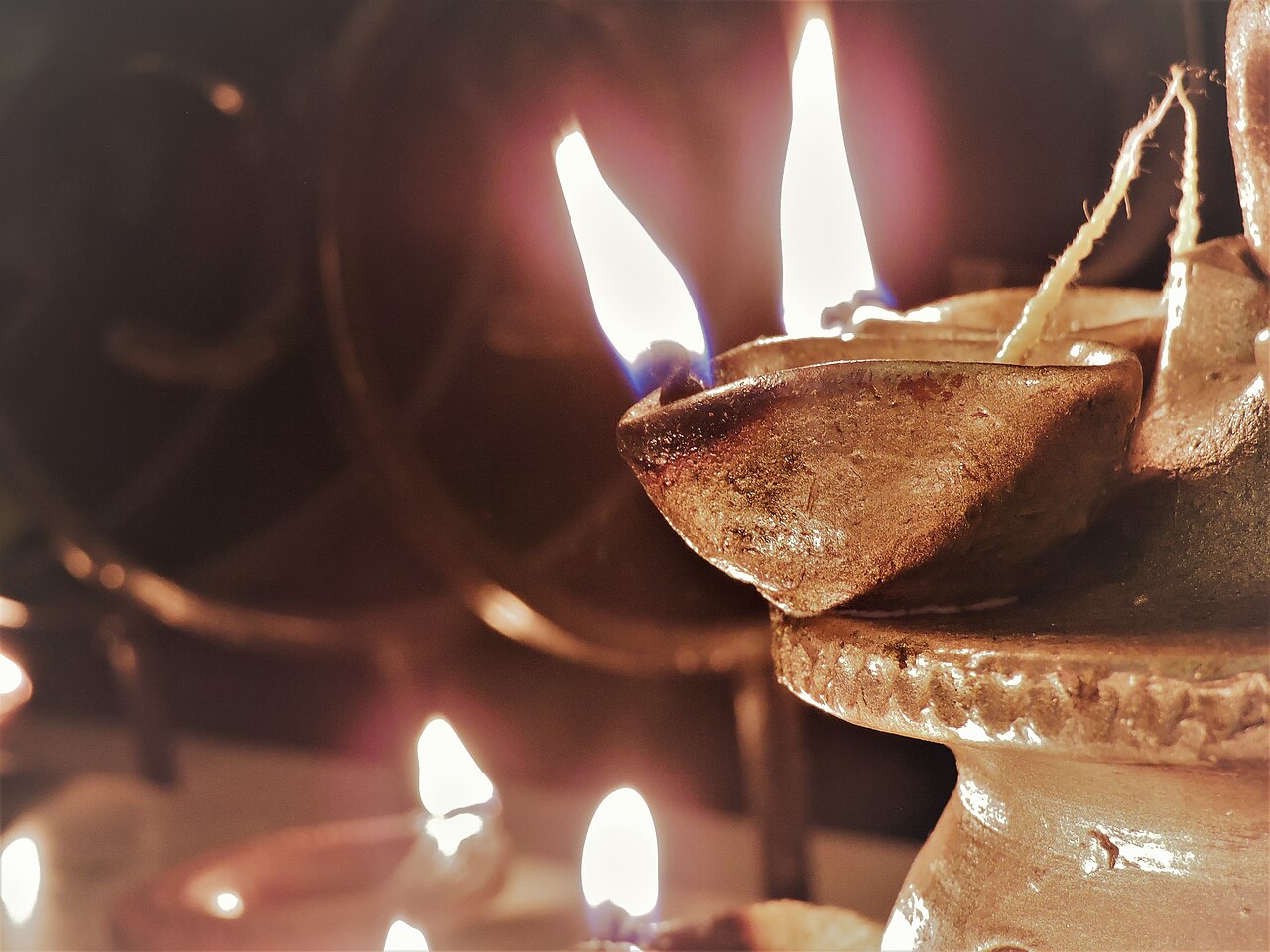
Small clay oil lamps (diyas) burning in a row during Diwali.
UNESCO describes Deepavali as a light festival that falls on the new moon in October or November and lasts several days, marking the last harvest of the year and the start of a new year and season, and symbolising the victory of light over darkness and good over evil. Its meaning differs from one tradition and region to another, but lamps, cleaned and decorated homes, prayers for prosperity, sweets, gifts and fireworks are common to most celebrations.
Name and date
"Deepavali" means "rows of lighted lamps", a reference to the small oil lamps called diyas or dipas used to light houses, shops and public places, according to a 2026 fact sheet from the Tanenbaum Center for Interreligious Understanding, an organisation based in New York. The same sheet notes that the name Deepavali is used especially in southern India, and that in Nepal the festival is called Tihar.
The date follows the Hindu lunar calendar, so it moves against the Gregorian calendar from year to year. New York State's 2023 law making Diwali a school holiday fixes it as the fifteenth day of the eighth month of the Indian calendar. In 2026 the main day of Diwali falls on 8 November, though the Tanenbaum Center notes that the date can differ by location.
The five days
The festival is usually counted as five days; the U.S. Postal Service, describing it for a 2016 stamp, said it spans five days each autumn. India's Ministry of Tourism outlines the sequence on its Incredible India site:
First day: homes are cleaned for a fresh start, and on Dhanteras people make purchases thought to bring prosperity.
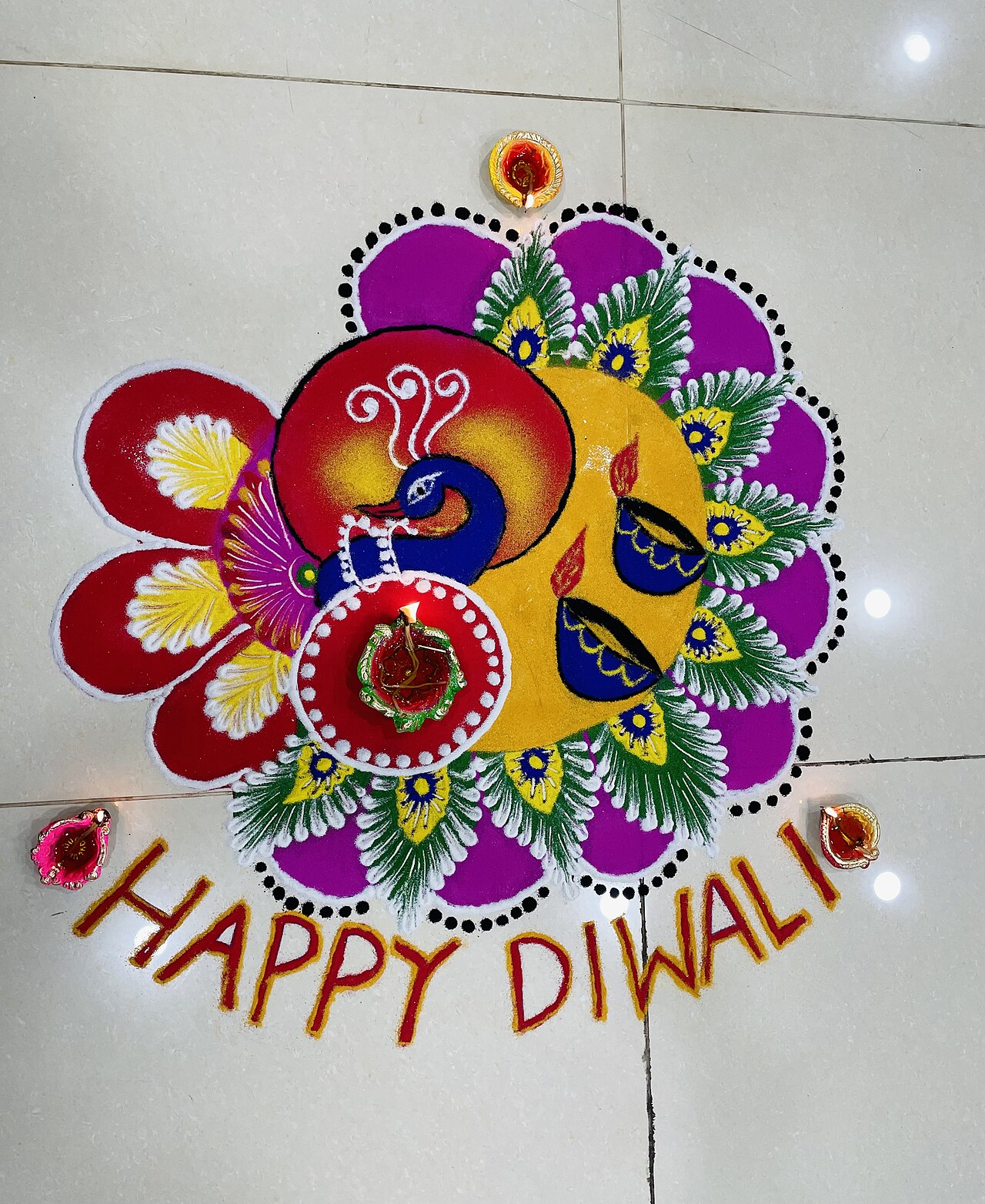
Second day: homes are lit with clay lamps and doorsteps decorated with rangoli, intricate decorative designs.
Third day: the main night, when families perform puja (worship) to the goddess Lakshmi.
Fourth day: families exchange gifts and sweets.
Fifth day: Bhai Dooj, a day honouring the bond between brothers and sisters.
The names and order vary by region. The National Indo-American Museum, describing celebrations across India, lists a five-day sequence in Bihar that includes Govardhan Puja and ends with Bhai Dooj, on which a sister prays for her brother's wellbeing.
Lakshmi. For many Hindus Diwali honours Lakshmi, goddess of wealth. Lamps are lit to guide her into people's homes and businesses, and many begin the new business year at Diwali with prayers to her for a successful year.
Vishnu and Bali. In western regions Diwali is linked to the god Vishnu's sending of King Bali to rule the underworld. In Karnataka, the National Indo-American Museum notes, Bali Padyami is the third day of Diwali, associated with stories of King Bali.
Kali. In Bengal the night of Diwali is given to the goddess Kali: the Bengali Kali Puja, also called Shyama Puja, takes place at night. The Tanenbaum Center adds that Kali is also celebrated at this time among Oriya speakers.
For Gujaratis, Diwali marks the end of the year, and the following day is Bestu Varas, the Gujarati new year.
Jain, Sikh and Buddhist observance
Jains mark Diwali as the anniversary of the nirvana, or final liberation, of Mahavira, the teacher who set out the central tenets of Jainism. India's Ministry of Tourism says that Jainism commemorates Lord Mahavira's nirvana at Diwali; the Tanenbaum Center describes it as the day Mahavira gave his last teachings and attained ultimate liberation, and notes that some devout Jains fast for two or three days of the festival.
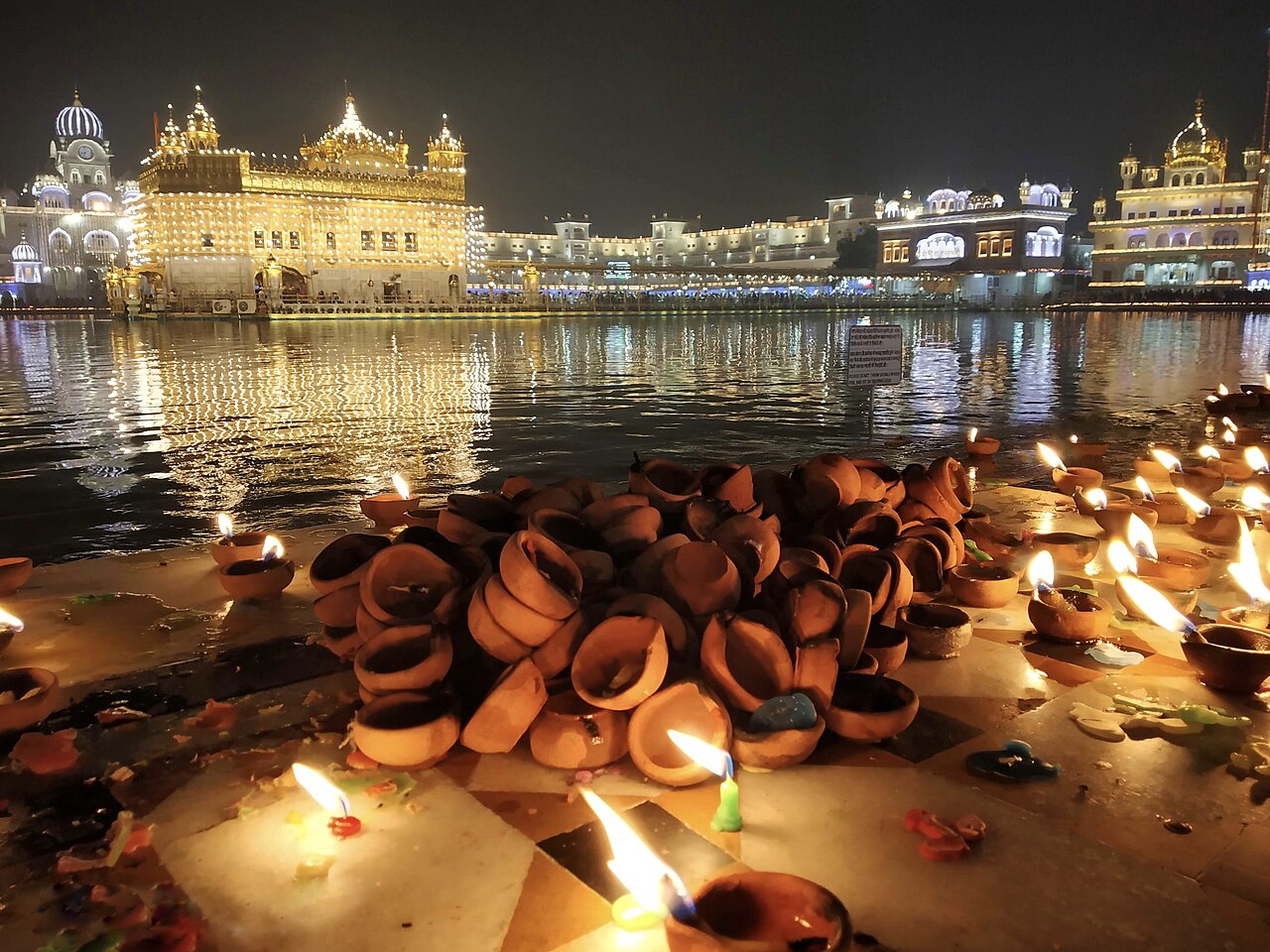
Sikhs celebrate Bandi Chhor Divas ("prisoner release day") at the same time. It commemorates the release from prison of Guru Hargobind, the sixth Sikh Guru. In the account given by the Tanenbaum Center, Guru Hargobind was released in 1619 along with 52 Hindu princes and arrived in Amritsar, where the Harmandir Sahib (the Golden Temple) was lit to welcome him, a custom of lighting that continues. India's Ministry of Tourism notes that in Amritsar the festival is marked with devotional kirtans (hymn singing).
The Harmandir Sahib (Golden Temple) in Amritsar lit up at night for Bandi Chhor Divas and Diwali.
Buddhists, particularly the Newar community of Nepal's Kathmandu Valley, also observe the festival, according to the Tanenbaum Center.
Tihar in Nepal
In Nepal the festival is Tihar, which the Nepal Tourism Board describes as a five-day festival of lights that honours Yama, the god of death, while worship of Laxmi (Lakshmi) is at its centre. Its days honour animals in turn:
Kaag Tihar: crows, regarded as Yama's messengers, receive offerings.
Kukur Tihar: dogs, regarded as agents of Yama, are honoured and given treats.
Gai Tihar and Laxmi Puja: cows are worshipped in the morning and Laxmi in the evening, with a path of footprints to welcome her into the home.
Fourth day: oxen are honoured, and the Newar community performs Mha Puja, a ritual worship of one's own self.
Bhai Tika: sisters place a tika (a coloured mark) on their brothers' foreheads and pray to Yama for their wellbeing; brothers give gifts in return.
The board notes that groups go from house to house singing Tihar songs and receive money in return for their blessings.
Not every South Asian celebrates it: the Tanenbaum Center notes that Christian South Asians, a significant minority in the region, do not typically observe Diwali.
In the United States, the Postal Service issued a Diwali Forever stamp on 5 October 2016, dedicated at the Consulate General of India in New York City; it shows a traditional diya oil lamp lit against a gold background. On 14 November 2023 New York's governor signed legislation (S.7574/A.7769) requiring all public schools in New York City to close for Diwali each year.
UNESCO Intangible Cultural Heritage, Decision of the Intergovernmental Committee 20.COM 7.b.24, "Deepavali", December 2025. ich.unesco.org/en/decisions/20.COM/7.b.24
UNESCO Intangible Cultural Heritage, "Deepavali" (element no. 02312), Representative List, inscribed 2025 (read November 2026). ich.unesco.org/en/RL/deepavali-02312
Micwyn auf deinen Home-BildschirmEigenes Symbol, Vollbild und Benachrichtigungen.
Micwyn hat eine neue Adresse: micwyn.comSchalte Benachrichtigungen hier wieder ein, damit sie weiter ankommen.Füge die neue Adresse zu deinem Home-Bildschirm hinzu.EinschaltenInstallieren
 Micwyn· EnzyklopädieAI
· 7 Min. Lesezeit · 0 Kommentare · 0 Aufrufe