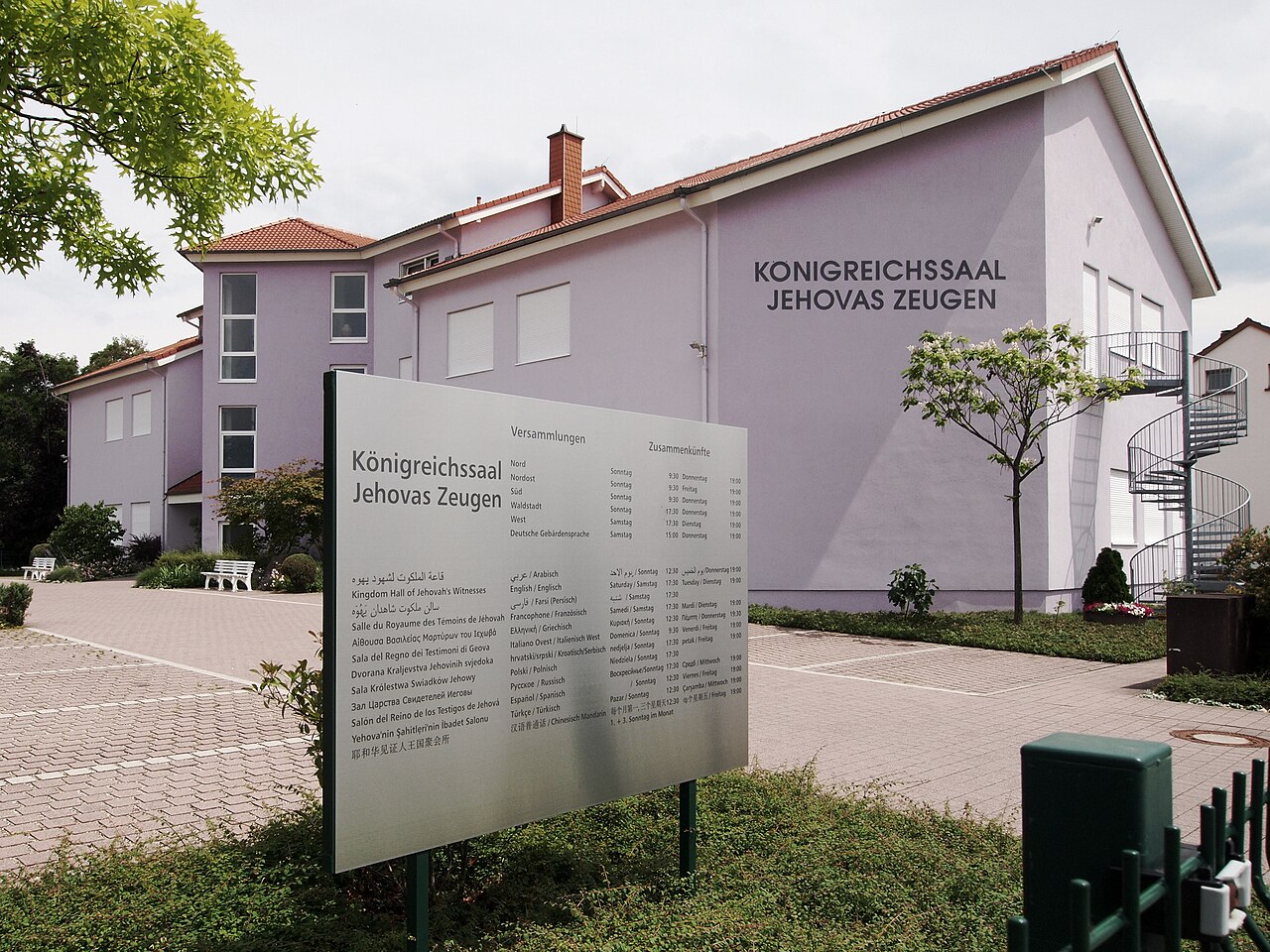
Jehovah's Witnesses are a religious movement, describing itself as Christian, that grew out of Bible study groups led by Charles Taze Russell in Pennsylvania in the 1870s and is known for its public preaching, rejection of the Trinity and refusal of whole-blood transfusions.
The outside of a Kingdom Hall, the building where a congregation of Jehovah's Witnesses meets.
The movement is directed from a world headquarters in Warwick, New York, and, by its own count, had an average of just over 9 million active members worldwide in the year to August 2025. Its history includes revised expectations about the end of the present world, landmark court cases on religious freedom, persecution under Nazi Germany and in modern Russia, and continuing public dispute over how it handles child sexual abuse and treats people who leave.
In the late 1960s many Witnesses came to expect that the end of the present world might come in or around 1975. Time reported in July 1969 that the movement's calculations dated the end of the world to the autumn of 1975, while noting that Witnesses "cautiously avoid a flat prediction." The movement later addressed the episode in The Watchtower of 15 March 1980. That article said that after one of its books suggested Christ's thousand-year reign might begin at the start of humanity's seventh millennium, considerable expectation was aroused regarding the year 1975. It said cautionary statements had presented this as only a possibility, but other statements had implied it was more likely, and that "it is to be regretted" those statements overshadowed the cautions. It applied an earlier warning against fixing hopes on a date to those who had published the material as well as to its readers.
Beliefs
The movement summarises its beliefs on its official website, jw.org. Among them:
God and Jesus. Witnesses worship one God, whom they call by the name Jehovah. They regard Jesus as the Son of God and Saviour but not as Almighty God, and state that "there is no Scriptural basis for the Trinity doctrine", the doctrine that God is three persons in one.
Death. The dead cease to exist; Witnesses reject the teaching of a fiery hell of torment. They expect billions to be resurrected, and those who refuse to learn God's ways to be destroyed forever.
Worldwide direction comes from the Governing Body, described by the movement as a small group of mature Christians who oversee its publications, meetings, schools and preaching work and the use of donated funds. It serves at the world headquarters in Warwick, New York, and the movement says it follows the pattern of the apostles and elders in first-century Jerusalem. The headquarters moved from Brooklyn to Warwick in the 2010s; the Warwick site opened for tours on 3 April 2017 as the Brooklyn staff were moving out of New York City.
Local congregations are overseen by elders who, according to the movement, are unpaid and do not form a clergy class. No collections are taken at meetings and members do not tithe.
The movement counts members as "publishers," meaning people who take part in its preaching. Its report for the year from September 2024 to August 2025 gives:
Jehovah's Witnesses are widely known for refusing blood transfusions, a stance the movement bases on the command to "abstain from blood" (Acts 15:20). The policy changed substantially in 2026:
On 18 September 2026 the movement announced that accepting red cells, white cells, plasma or platelets from another person's blood is a matter of personal conscience, as is donating blood for the stated purpose of providing components or fractions for others. Congregations are not to involve themselves in these decisions.
As of November 2026, the refusal of whole-blood transfusion remains in place: the September 2026 statement calls it a core teaching. The movement also states that Witnesses do not practise faith healing and seek medical care consistent with their beliefs.
The Witnesses' preaching and their refusal of patriotic rituals have produced many court cases. In the United States, the best known is West Virginia State Board of Education v. Barnette, decided on 14 June 1943, in which the Supreme Court held that Witness children could not be compelled to salute the flag. It overruled Minersville School District v. Gobitis, decided only three years earlier. Justice Robert Jackson wrote for the majority that "If there is any fixed star in our constitutional constellation, it is that no official, high or petty," "can prescribe what shall be orthodox in politics, nationalism, religion, or other matters of opinion or force citizens to confess by word or act their faith therein."
Russia
In April 2017 Russia's Supreme Court declared the Witnesses' organisation extremist. As reported by Radio Free Europe/Radio Liberty, the ruling required the closure of the St Petersburg headquarters and about 395 local chapters, with Kingdom Halls handed to the state; the movement said it had about 170,000 adherents in Russia. The court rejected the appeal on 17 July 2017. The United States Commission on International Religious Freedom condemned the decision, its chairman stating that "The Witnesses are not an extremist group."
On 7 June 2022 the European Court of Human Rights ruled in Taganrog LRO and Others v. Russia, which combined 20 applications, that Russia had committed multiple violations of the European Convention on Human Rights, including of freedom of religion (Article 9) in the dissolution of Witness organisations and the criminal prosecution of members, of freedom of expression (Article 10) in the banning of their publications, and of property rights in the confiscation of their property.
Disputes and criticism
Treatment of those who leave
Baptised members who commit serious sins and do not repent are removed from the congregation, and the congregation is told that the person is no longer a Witness. The movement formerly called this "disfellowshipping" and now uses the word "removed." Members do not socialise with a removed person, though the movement says they do not ignore him completely: he may attend meetings, and family relations within the household continue. People who simply stop taking part are, according to the movement, approached with encouragement rather than shunned. A removed person may be reinstated.
Critics and some governments argue that this practice, often called shunning, puts unfair pressure on members not to leave. In Norway the state refused the Witnesses state funding and deregistered them as a religious community on that ground, arguing that shunning former members violated children's rights and members' right to leave freely. On 29 April 2026 Norway's Supreme Court held those decisions invalid. It found unanimously that the state had not shown that minors were subjected to psychological violence or negative social control. By three justices to two, it found that shunning did not amount to undue pressure against leaving, citing its basis in doctrine, its disclosure to members when they join, and the fact that family ties are not severed. The two dissenting justices concluded that the practice does exert undue pressure, noting that it can cost members contact with family and is meant to deter leaving.
Child sexual abuse
Australia's Royal Commission into Institutional Responses to Child Sexual Abuse examined the Witnesses in its Case Study 29. Its report, released on 28 November 2016, noted that the organisation's case files recorded allegations of child sexual abuse by 1,006 members of the organisation in Australia. The Commission found that children were not adequately protected, that the organisation's general practice of not reporting serious cases to police was a serious failure, and that its inflexible application of the "two-witness rule", a requirement for corroboration before the congregation acts, showed a serious lack of understanding of the nature of child sexual abuse.
Tenha a Micwyn na sua tela inicialÍcone próprio, tela cheia e notificações.
O Micwyn tem um novo endereço: micwyn.comAtive as notificações de novo aqui para que continuem chegando.Adicione o novo endereço à sua tela inicial.AtivarInstalar
 Micwyn· EnciclopédiaAI
· 12 min de leitura · 0 comentários · 2 visualizações