Catholicism
The faith, worship and institutions of the Christian communion led by the bishop of Rome
📖 辞書: catholicism · 📚 ライブラリ
The faith, worship and institutions of the Christian communion led by the bishop of Rome
📖 辞書: catholicism · 📚 ライブラリ

Catholicism is the faith, worship and institutions of the Catholic Church, the Christian communion led by the bishop of Rome, the pope, which counted about 1.42 billion baptized members at the end of 2024.
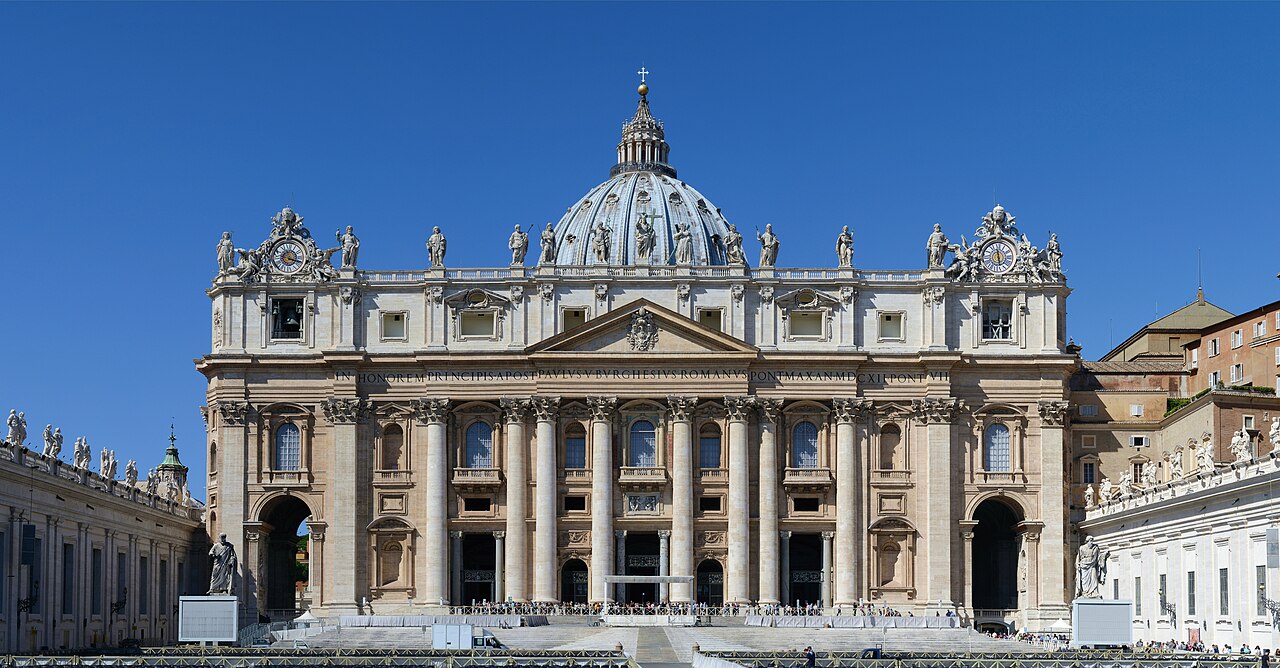
Via Wikimedia Commons: Basilica di San Pietro in Vaticano September 2015-1a by Alvesgaspar, CC BY-SA 4.0.
The word "catholic", as the Catechism of the Catholic Church explains it (paragraph 830), means "universal", in the sense of "according to the totality" or "in keeping with the whole". The Catechism quotes the letter of Ignatius of Antioch to the church at Smyrna: "Where there is Christ Jesus, there is the Catholic Church" (CCC 830, note 307).
The Church describes itself as catholic in two senses: because, in its own teaching, it holds "the fullness of the means of salvation", namely the complete confession of faith, the full sacramental life and an ordained ministry in apostolic succession; and because it understands itself as sent to the whole human race (CCC 830–831). This entry is about the Church in communion with Rome, sometimes called the Roman Catholic Church.
The Vatican's statistical office publishes yearly counts of baptized Catholics. According to the Annuario Pontificio 2026 and the Annuarium Statisticum Ecclesiae 2024, as summarized by Vatican News on 28 March 2026:
The same report counted 5,525 bishops, 407,421 priests and 52,102 permanent deacons at the end of 2024. The number of priests rose by 425 that year, from 406,996 in 2023 (Vatican News). The figures are counts of baptized Catholics.
Catholic doctrine is set out in the creeds, the decisions of councils and, in its most comprehensive modern form, the Catechism of the Catholic Church, Catholics share with other Christian churches the creeds, baptism and the Scriptures, as a joint Lutheran–Catholic report notes (From Conflict to Communion, 2013, para. 90). Several teachings mark Catholicism off from other Christian traditions.
Scripture and Tradition. The Church teaches that divine revelation is handed on through both Sacred Scripture and Sacred Tradition, which "come together in some fashion to form one thing", so that the Church "does not derive her certainty about all revealed truths from the holy Scriptures alone" (CCC 80–82). The Council of Trent set out this position in a decree of 8 April 1546 that, according to a joint Lutheran–Catholic report, rejected the Protestant principle of sola scriptura ("Scripture alone") without naming it (From Conflict to Communion, 2013, para. 80).
The Church and the pope. According to the Catechism, Christ made Peter the "rock" of his Church, and the pope, as bishop of Rome and Peter's successor, is "the perpetual and visible source and foundation of the unity both of the bishops and of the whole company of the faithful", with "full, supreme, and universal power over the whole Church" (CCC 881–882). The First Vatican Council, in the constitution Pastor aeternus of 18 July 1870, defined that when the pope speaks ex cathedra, that is, when as pastor and teacher of all Christians he defines a doctrine of faith or morals to be held by the whole Church, he possesses the infallibility promised to the Church, and that such definitions are irreformable of themselves and not from the consent of the Church (ex sese, non autem ex consensu Ecclesiae). The Catechism adds that the same infallibility belongs to the body of bishops teaching together with the pope, above all in an ecumenical council (CCC 891).
The sacraments. The Church counts seven sacraments: Baptism, Confirmation (or Chrismation), the Eucharist, Penance, the Anointing of the Sick, Holy Orders and Matrimony (CCC 1210). The Eucharist, celebrated in the Mass, is called "the source and summit of the Christian life" (CCC 1324). Catholic teaching holds that Christ is "truly, really, and substantially" present in it, and, quoting the Council of Trent, that at the consecration "a change of the whole substance of the bread into the substance of the body of Christ" and of the wine into his blood takes place, a change the Church calls transubstantiation (CCC 1374–1376).
Mary and the saints. The Church honours Mary with the ancient title "Mother of God" and teaches that she was preserved from original sin and was "taken up body and soul into heavenly glory" (the Assumption); it describes this devotion as differing "essentially from the adoration" given to God (CCC 966, 971).
Purgatory and indulgences. Those who die "in God's grace and friendship, but still imperfectly purified" are, in Catholic teaching, assured of salvation but undergo a final purification called Purgatory, a doctrine formulated "especially at the Councils of Florence and Trent" (CCC 1030–1031). An indulgence is defined as "a remission before God of the temporal punishment due to sins whose guilt has already been forgiven" (CCC 1471). A controversy over indulgences was the flashpoint of the Reformation (see below).
The Church is organized into dioceses, each led by a bishop. The pope heads the college of bishops, which, according to the Catechism, "has no authority unless united with the Roman Pontiff" (CCC 883). Its members are divided into clergy (bishops, priests and deacons) and laity, with consecrated religious drawn from both groups (CCC 934).
The Vatican's list of Supreme Pontiffs begins with Peter and, as of November 2026, ends with Leo XIV, numbered 267th, elected on 8 May 2025 after the pontificate of Francis ended on 21 April 2025.
Eastern Catholic Churches. The Catholic Church is not only the Latin Church of the West. It also includes Eastern Catholic Churches that keep their own liturgy, discipline and spiritual heritage while in full communion with Rome. The Second Vatican Council's decree Orientalium Ecclesiarum (21 November 1964) declared that these individual Churches, "whether of the East or the West", are "of equal dignity, so that none of them is superior to the others as regards rite".
The Catholic Church traces its origin to Jesus and the apostles and its papacy to Peter, whom the Vatican's list of popes places first, with a pontificate ending in "64 or 67" (Holy See).
In 1054, legates of the Roman See led by Cardinal Humbert excommunicated Patriarch Michael Cerularius of Constantinople and two others, and the patriarch and his synod answered with a similar sentence. On 7 December 1965, Pope Paul VI and Ecumenical Patriarch Athenagoras I issued a joint declaration that the 1054 censures had been aimed at persons "and not the Churches", and had not been intended to break communion between Rome and Constantinople; later events, "among which, lack of understanding and mutual trust", "eventually led to the effective rupture of ecclesiastical communion". The two leaders committed the excommunications "to oblivion", while acknowledging that this gesture was "not sufficient to end both old and more recent differences".
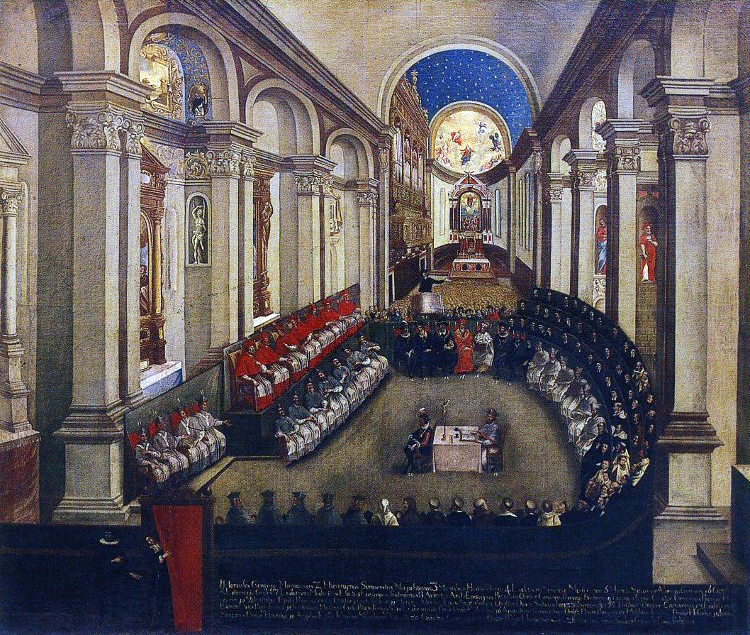
Via Wikimedia Commons: Council of Trent by Unknown author Unknown author, public domain.
On 31 October 1517, Martin Luther sent his Ninety-five Theses, titled "Disputation on the Efficacy and Power of Indulgences", with a letter to Archbishop Albrecht of Mainz. In the account of the joint Lutheran–Roman Catholic Commission on Unity (2013), the conflict over indulgences "quickly developed into a conflict concerning authority"; Pope Leo X's bull Exsurge Domine (15 June 1520) condemned forty-one propositions from Luther's writings and gave him sixty days to recant or face excommunication, and he was excommunicated by the bull Decet Romanum Pontificem on 3 January 1521. The Joint Declaration on the Doctrine of Justification of 1999 speaks of the resulting "division of the Western church".
The Council of Trent (1545–1563) responded. Its dogmatic decrees, the same commission writes, did not give a comprehensive account of the faith but "concentrated on those doctrines disputed by the reformers in a way that emphasized points of difference", and the council "largely defined Catholic relations with Lutherans for several centuries" (From Conflict to Communion, paras. 78–79, 90).
The First Vatican Council defined papal infallibility in 1870 (Pastor aeternus). The Second Vatican Council, opened by Pope John XXIII on 11 October 1962 and lasting until 1965 (From Conflict to Communion, para. 90), changed the Church's relations with other Christians. Its constitution on the Church, Lumen gentium (21 November 1964), said that the Church of Christ "subsists in the Catholic Church, which is governed by the successor of Peter and by the Bishops in communion with him, although many elements of sanctification and of truth are found outside of its visible structure" (paragraph 8). The Lutheran–Catholic commission describes the council as having made it possible for the Catholic Church "to enter the ecumenical movement and leave behind the charged polemic atmosphere of the post-Reformation era" (From Conflict to Communion, para. 90).
The Catechism teaches that baptized Christians outside the Catholic Church are "in a certain, although imperfect, communion" with it, and that with the Orthodox Churches this communion is so deep "that it lacks little to attain the fullness that would permit a common celebration of the Lord's Eucharist" (CCC 838).
Orthodox. One question that divides Catholics and Orthodox is the authority of the pope. In 2007 the official Joint International Commission for dialogue between the two Churches, meeting in Ravenna, affirmed that the bishop of Rome was the protos ("first") among the patriarchs, but, as a North American Orthodox–Catholic consultation summarized it in 2009, noted disagreement about the bishop of Rome's prerogatives in the first millennium and how primacy was exercised, leaving "the question of the role of the bishop of Rome in the communion of all the Churches" for further study.
Lutherans and Protestants. On 31 October 1999, in Augsburg, the Catholic Church and the Lutheran World Federation signed the Joint Declaration on the Doctrine of Justification, the doctrine of how sinners are made right with God, which the Declaration calls "the crux of all the disputes" from the Reformation perspective. It states that "a consensus in basic truths of the doctrine of justification exists between Lutherans and Catholics", and that the Lutheran teaching it presents "does not fall under the condemnations from the Council of Trent", nor does the Catholic teaching it presents fall under the condemnations in the Lutheran Confessions (paragraphs 40–41). It accepts that differences of language, theological elaboration and emphasis remain.
Women and the priesthood. In the apostolic letter Ordinatio sacerdotalis (22 May 1994), Pope John Paul II declared that "the Church has no authority whatsoever to confer priestly ordination on women and that this judgment is to be definitively held by all the Church's faithful".
Sexual abuse. Commissions in several countries have investigated the sexual abuse of children by Catholic clergy and religious. In France, the Independent Commission on Sexual Abuse in the Church (CIASE), created in November 2018 by the Conference of Bishops of France and the Conference of religious orders (CORREF), estimated in its final report of 5 October 2021 that about 216,000 children had been sexually assaulted by priests, deacons and members of religious orders in France between 1950 and 2020 (95% confidence interval 165,000 to 270,000), and about 330,000 when lay people working for the Church are included. It estimated between 2,900 and 3,200 abusers, which it called a lower limit, and described the acts and "their frequent covering up" since 1950 as the subject of its historical study. Eight members of the Académie catholique de France challenged the report's method; the commission replied with a 53-page rebuttal in February 2022 (Catholic News Agency, 10 February 2022).
In the motu proprio Vos estis lux mundi (7 May 2019), Pope Francis wrote that "the crimes of sexual abuse offend Our Lord, cause physical, psychological and spiritual damage to the victims and harm the community of the faithful". The law required dioceses worldwide to set up public systems for receiving reports, and obliged clerics and members of religious orders who know of or have well-founded reason to believe in such abuse, or in its cover-up, to report it promptly to Church authorities.
 ホーム画面にAgoraiを追加専用のアイコン、全画面表示、通知が使えます。