Hypertension
High blood pressure: a common, usually symptomless condition that raises the risk of heart attack, stroke and kidney disease
📖 사전: hypertension · 📚 서재
High blood pressure: a common, usually symptomless condition that raises the risk of heart attack, stroke and kidney disease
📖 사전: hypertension · 📚 서재

Hypertension, or high blood pressure, is a common condition in which the pressure of blood against the walls of the arteries is too high. It usually causes no symptoms but raises the risk of heart attack, stroke, heart failure and kidney disease.
Blood pressure is the force of blood on the walls of the arteries, the vessels that carry blood from the heart to the organs (NHLBI). It is written as two numbers in millimetres of mercury (mm Hg), such as 120/80, read as "120 over 80". The first, the systolic pressure, is the pressure in the vessels when the heart contracts; the second, the diastolic pressure, is the pressure when the heart rests and refills between beats (WHO fact sheet, 25 September 2025; NHLBI). Blood pressure changes through the day with a person's activity (NHLBI), which is why a single reading does not establish the condition.
Where the line for "high" is drawn depends on whose definition is used.
| Category | Systolic (mm Hg) | Diastolic (mm Hg) | |
|---|---|---|---|
| Normal | under 120 | and | under 80 |
| Elevated | 120–129 | and | under 80 |
| High blood pressure, stage 1 | 130–139 | or | 80–89 |
| High blood pressure, stage 2 | 140 or higher | or | 90 or higher |
| Hypertensive crisis | higher than 180 | or | higher than 120 |
Because of the different thresholds, a reading such as 130/80 counts as stage 1 high blood pressure under the US categories but falls below the WHO and NHS thresholds, and prevalence figures from the two systems are not directly comparable.
The WHO estimated that in 2024 about 1.4 billion adults aged 30 to 79 had hypertension, 33% of people in that age range, up from 650 million in 1990; it attributes the increase mainly to the growing number of older adults in low- and middle-income countries, where two-thirds of those with the condition live (WHO, 25 September 2025). By the same estimates, about 600 million of them (44%) did not know they had it, and about 320 million (23%) had it under control. Prevalence was highest in the WHO Eastern Mediterranean Region (38%) and lowest in the Western Pacific Region (29%).
In the United States, using its lower threshold, the CDC reports that nearly half of adults (48.1%, 119.9 million) have high blood pressure, that about 1 in 4 of them (22.5%) have it under control, and that in 2024 high blood pressure was a primary or contributing cause of 680,179 deaths (CDC, page reviewed 2 June 2026). The CDC gives prevalence of 50% among men and 42.1% among women, and 59.6% among non-Hispanic Black adults. It estimated the condition's annual costs in the United States at $219 billion in 2019.
The WHO divides risk factors into those that can be changed, such as a diet high in salt or in saturated and trans fats, low intake of fruit and vegetables, physical inactivity, tobacco and alcohol use, and being overweight or obese, and those that cannot, such as a family history of hypertension, age over 65 and coexisting diseases such as diabetes or kidney disease. It names air pollution as the most significant environmental risk factor (WHO). The NHS adds ethnicity, noting a higher risk among people with a Black African, Black Caribbean or South Asian background, and long-term stress (NHS).
The NHLBI notes that some people are highly sensitive to salt, and lists other conditions that can cause high blood pressure, among them some tumours, chronic kidney disease, metabolic syndrome, obesity, sleep apnoea and thyroid problems. It also names medicines that can raise blood pressure, including antidepressants, decongestants, hormonal birth control pills and non-steroidal anti-inflammatory drugs (NHLBI, "Causes and Risk Factors", 30 April 2024).
Most people with hypertension feel no symptoms, which is why it so often goes undetected; very high pressures, usually 180/120 or above, can cause symptoms such as severe headache, chest pain, dizziness, breathlessness and blurred vision (WHO). The WHO calls hypertension a major cause of premature death worldwide. It explains that excess pressure can harden the arteries and reduce the flow of blood and oxygen to the heart, leading to angina, heart attack, heart failure and irregular heartbeat, and that it can burst or block arteries supplying the brain, causing a stroke, and damage the kidneys. The NHS also lists vascular dementia among the possible consequences, and the NHLBI says controlling blood pressure may help prevent it (NHS; NHLBI).
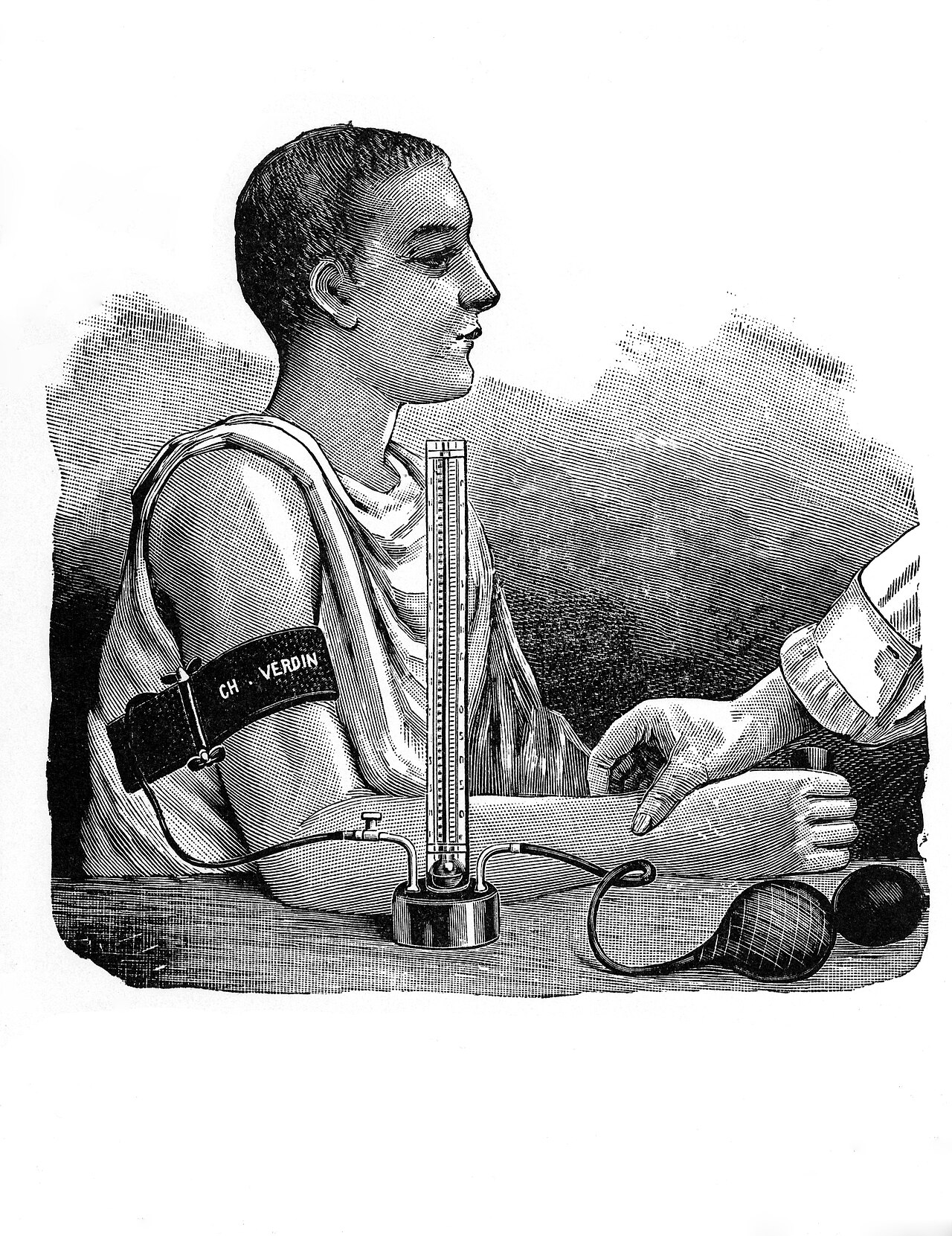
Via Wikimedia Commons: Riva-Rocci's spygmomanometer in use. Wellcome M0018871, CC BY 4.0.
The first recorded measurement of blood pressure was made in 1733 by Stephen Hales, who inserted a glass tube into an artery of a horse and observed that the column of blood rose and fell with each pulse (Schutte, Kollias and Stergiou, Nature Reviews Cardiology, 2022). In 1828 Jean Léonard Marie Poiseuille described the mercury manometer for the purpose. In 1896 Scipione Riva-Rocci introduced a method of estimating systolic pressure non-invasively by measuring the pressure needed to close off an artery, improved in 1901 by von Recklinghausen's wider inflatable cuff. In 1905 the Russian surgeon Nikolai Korotkoff reported that sounds heard through a stethoscope as the cuff is let down could give both the systolic and the diastolic pressure, the method that has defined clinical measurement since (Rader and Victor, JACC: Basic to Translational Science, 2017).
The Riva-Rocci–Korotkoff cuff method, now usually built into automatic oscillometric devices with an arm cuff, remains the dominant way of measuring blood pressure, and its readings form the basis of WHO recommendations and clinical guidelines (Schutte et al., 2022). The same review describes its limits. Readings taken in a clinic can be raised by the "white-coat effect": about 15 to 25% of people with hypertension who attend blood-pressure clinics have white-coat hypertension, high in the clinic but normal outside it, while masked hypertension, normal in the clinic but high elsewhere, is found in 10 to 20%. The review describes 24-hour ambulatory monitoring as the method currently proposed as best for diagnosis, and states that the accuracy and usefulness of newer cuffless wearable devices remain uncertain. The NHS likewise describes home monitoring, repeat checks and 24-hour portable monitors as ways of confirming a raised reading (NHS).
According to the WHO, lifestyle changes such as a healthier, low-salt diet, weight loss, physical activity and stopping tobacco can lower blood pressure, and some people also need medicines. Its fact sheet lists four common classes: ACE inhibitors and angiotensin II receptor blockers, which relax blood vessels and protect the kidneys; calcium channel blockers, which relax blood vessels; and diuretics, which remove extra water from the body (WHO). The NHLBI states that controlling blood pressure can help prevent or delay chronic kidney disease, heart attack, heart failure, stroke and possibly vascular dementia (NHLBI).
Control remains limited worldwide. The WHO published a guideline on the drug treatment of hypertension in adults in 2021, and with the US CDC launched the Global Hearts Initiative in September 2016, whose HEARTS technical package promotes standardized treatment protocols and team-based care. According to the WHO, since 2017 such programmes in more than 40 low- and middle-income countries have put 13.5 million people on protocol-based treatment. A global target for noncommunicable diseases set out to reduce the prevalence of uncontrolled hypertension by 25% between 2010 and 2025 (WHO).
This entry explains; it is not medical advice. Ask a doctor or pharmacist about your own health.
 홈 화면에 Micwyn 추가전용 아이콘, 전체 화면, 알림을 제공합니다.