A Tale of Two Cities
Charles Dickens's 1859 novel of London and Paris before and during the French Revolution
Charles Dickens's 1859 novel of London and Paris before and during the French Revolution

A Tale of Two Cities is a historical novel by Charles Dickens, first published in weekly instalments in 1859, set in London and Paris in the years before and during the French Revolution.
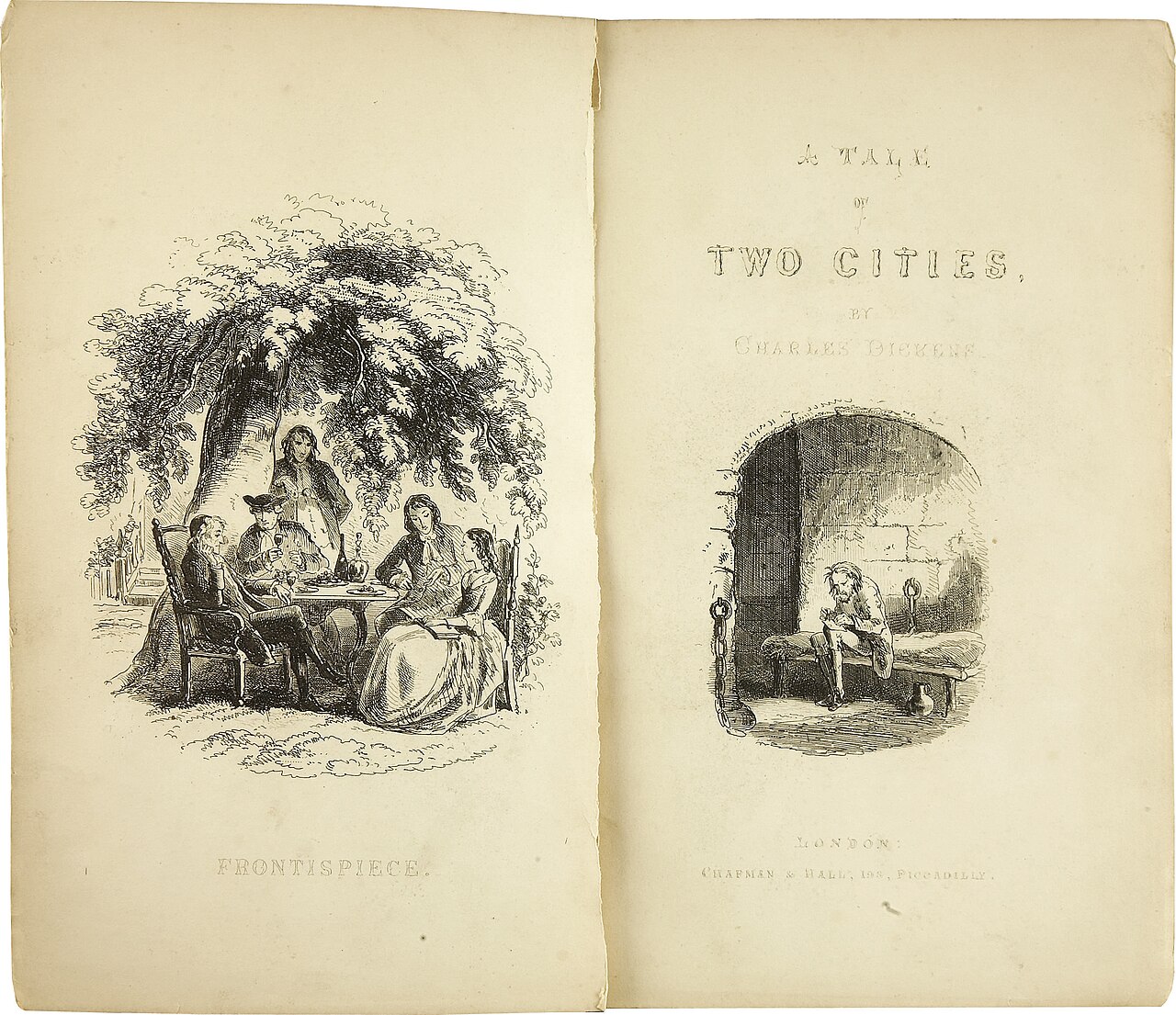
Via Wikimedia Commons: Charles Dickens- A Tale of Two Cities-With Illustrations by H K Browne by Hablot Knight Browne (Phiz). Photographer: Heritage Auctions, public domain.
It opens in 1775 and ends during the Terror of the 1790s, following a French aristocrat who renounces his family's estate, the doctor whose daughter he marries, and the English lawyer who resembles him and finally takes his place on the guillotine. It was the first serial in Dickens's new weekly magazine All the Year Round (Gresham College lecture, 2007; text, Standard Ebooks).
Dickens wrote the novel during one of the most turbulent periods of his life. In 1857 he helped Wilkie Collins write the play The Frozen Deep, which was staged at his home, and played its leading role, Richard Wardour; later that year he met the young actress Ellen Ternan. He separated from his wife, Catherine, in May 1858, and that year began giving public readings for profit (Williams, Gresham College, 3 July 2007).
The separation also ended his partnership with his publishers, Bradbury and Evans. Dickens wanted a statement about his domestic affairs printed in the press and expected them to carry it in Punch, the comic magazine they published; they declined, and he broke with them. He forced the closing of Household Words, the weekly he had co-owned with them, whose last issue appeared on 28 May 1859, and founded All the Year Round in its place, owning 75% of the shares with his sub-editor W. H. Wills (Slater, OUPblog, 22 July 2015).
In the novel's preface Dickens traced its central idea to The Frozen Deep: he wrote that he "first conceived the main idea of this story" while acting in Collins's drama with his children and friends, and that he had "certainly done and suffered it all myself" (preface, Standard Ebooks text). In the play, the character Dickens acted sacrifices himself for a rival, the situation the novel's ending reworks (Gresham College, 2007).
The preface also names Dickens's main historical source. He hoped "to add something to the popular and picturesque means of understanding that terrible time," while conceding that no one could add to "the philosophy of Mr. Carlyle's wonderful book," Thomas Carlyle's The French Revolution (1837) (preface). Dickens had known Carlyle since 1840 and sent him proofs of the novel in October 1859 (Gresham College, 2007). It was his second historical novel, after Barnaby Rudge (1841), which dealt with the Gordon Riots in London in 1780 (Slater, 2015; Gresham College, 2007).
The story's events reach back to 1757, when Dr Manette witnesses the crime that leads to his imprisonment, and run to the Terror of 1793–94; its main action begins in 1775 (Gresham College, 2007). The novel's first chapter fixes that opening date: "It was the year of Our Lord one thousand seven hundred and seventy-five" (text, Project Gutenberg).
The novel ran in All the Year Round from the first issue, 30 April 1859, to 26 November 1859, in thirty-one weekly parts (Slater, 2015; Victorian Web). It was also issued in eight monthly parts from June to December 1859, illustrated by Hablot Knight Browne ("Phiz"), and as a single volume in December 1859 (Gresham College, 2007; Victorian Web).
In the United States it ran in Harper's Weekly from 7 May to 3 December 1859, a week behind the British instalments, with sixty-four illustrations by the magazine's illustrator John McLenan; Harper's said it had paid "five thousand dollars" for early proof sheets (Victorian Web).
The serial was a commercial success. All the Year Round began with a circulation of 120,000 and settled at around 100,000, against a maximum of about 40,000 for Household Words (Slater, 2015; Gresham College, 2007).
The novel is divided into three books: "Recalled to Life" (six chapters), "The Golden Thread" (twenty-four chapters) and "The Track of a Storm" (fifteen chapters) (text, Project Gutenberg).
Book the First. Jarvis Lorry, a clerk of Tellson's Bank in London, travels to Paris with Lucie Manette, a young woman who had believed her father dead. Dr Alexandre Manette has been released after almost eighteen years in the Bastille, in a cell recorded as "One Hundred and Five, North Tower," and is found in the care of his former servant Ernest Defarge, who keeps a wine-shop in the poor district of Saint Antoine. The doctor, his mind broken, has spent his imprisonment making shoes (text).
Book the Second. Five years later, Charles Darnay, a French émigré living in England, is tried for treason at the Old Bailey. The case against him collapses when his counsel, Mr Stryver, shows that a witness cannot tell Darnay apart from Stryver's dissolute junior, Sydney Carton, whom he resembles closely. Darnay marries Lucie; Carton, who also loves her, tells her that he would "embrace any sacrifice for you and for those dear to you." Darnay is in fact the nephew of the Marquis St. Evrémonde, a cruel aristocrat who is murdered by a peasant after his carriage kills a child. In Paris, the Defarges lead the revolutionaries of Saint Antoine, and Madame Defarge records those to be condemned in her knitting, the "knitted register" of the book's phrase. The Bastille falls in July 1789. In 1792 a letter from Théophile Gabelle, the family's former agent, now imprisoned in the Abbaye, draws Darnay back to Paris to help him (text).
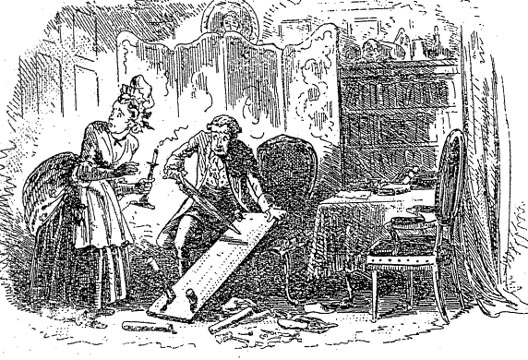
Via Wikimedia Commons: Mr Lorry and Miss Pross guiltily destroy Dr Manette's workbench (Phiz).jpeg) by Hablot Knight Browne (Phiz), public domain.
Book the Third. In Paris, Darnay is imprisoned as an émigré aristocrat. Dr Manette's standing as a former prisoner of the Bastille wins his release, but he is denounced again. At the second trial the Defarges produce a statement Manette wrote in his cell, dated the last night of 1767, which tells how the Evrémonde brothers had abused a peasant family and had him imprisoned to silence him, and which denounces them and their descendants "to the last of their race." Darnay is condemned. Carton, using his likeness to Darnay, takes his place in prison, and the family escapes from France. In a struggle with Madame Defarge, Miss Pross, Lucie's devoted English companion, is left deafened when Madame Defarge's pistol goes off and kills her. Carton goes to the guillotine beside a young seamstress (text).
The title of the first book announces the novel's central idea, resurrection: Dr Manette is "recalled to life" after almost eighteen years in prison (Gresham College, 2007). The grave-robbing of Jerry Cruncher, a messenger for Tellson's Bank who is secretly a "Resurrection-Man" (a body-snatcher), gives the same theme a grotesque echo in the chapter titled "The Honest Tradesman" (text).
Doubling runs through the book: two cities, two lovers, and two men alike enough to be exchanged. The 2007 Gresham lecture notes that Dickens considered calling Carton "Dick", which would have recalled the Richard Wardour he played in The Frozen Deep and given the two look-alikes the mirrored initials C. D. and D. C.; it calls doubleness a major concern for Dickens at this time (Gresham College, 2007).
The novel also differs from most of Dickens's work in tone. The Dickens scholar Michael Slater describes it as highly romantic and melodramatic and notes the near-absence of the humour usual in his novels (Slater, 2015).
The first sentence sets the period through paired opposites: "It was the best of times, it was the worst of times, it was the age of wisdom, it was the age of foolishness," and so on, concluding that the period "was so far like the present period" that its loudest authorities insisted on describing it only in the superlative (text).
The novel ends with what Carton might have said at the scaffold, closing: "It is a far, far better thing that I do, than I have ever done; it is a far, far better rest that I go to than I have ever known" (text). Dickens wrote of the book that it was "the best story I have ever written," and of its hero, "I must say I like my Carton" (Gresham College, 2007).
The story was adapted almost at once. Tom Taylor's stage version opened at the Lyceum Theatre in London in March 1860 and ran for 35 performances, and The Only Way, a stage version centred on Carton, opened at the Lyceum in 1899. Film versions followed in 1908 and 1925; the first sound version, starring Ronald Colman, appeared in 1935, and another, starring Dirk Bogarde, in 1958. The BBC televised it in 1948 (Gresham College, 2007).
Micwyn's books square is reading the novel together, part by part, starting from the conversation about its author and times.
 Get Micwyn on your home screenIts own icon, full screen, and notifications.