Creatine
A compound made in the body and eaten in meat and fish that muscle and brain cells use to store energy, also widely taken as a supplement
A compound made in the body and eaten in meat and fish that muscle and brain cells use to store energy, also widely taken as a supplement

Creatine is a natural compound, made in the body from amino acids and eaten in meat and fish, that muscle and brain cells use to store and quickly release energy; it is also one of the most widely used dietary supplements in sport.
Chemically, creatine is a small nitrogen-containing molecule that a 2017 review by the International Society of Sports Nutrition (ISSN) describes as a naturally occurring non-protein amino acid compound found primarily in red meat and seafood. Almost all of it, about 95%, sits in skeletal muscle, with small amounts in the brain and testes. Inside cells it exists in two forms: free creatine and phosphocreatine, creatine with a phosphate group attached. The same review gives about two thirds of the creatine in muscle as phosphocreatine; a 2022 review in the Journal of Cachexia, Sarcopenia and Muscle puts the split for the whole body at about 40% free creatine and 60% phosphocreatine, in a total pool of about 100 to 150 g in adults.
The French chemist Michel Eugène Chevreul discovered creatine in meat extracts in 1832. In 1913 the biochemists Myers and Fine confirmed that it is present in vertebrate skeletal muscle and other tissues and noted "a constant relation" between the body's total creatine and the creatinine it excretes each day. In 1927 two groups working separately, the Eggletons at Cambridge and Fiske and Subbarow at Harvard, found that creatine exists in the body in a free and a phosphorylated form, phosphocreatine.
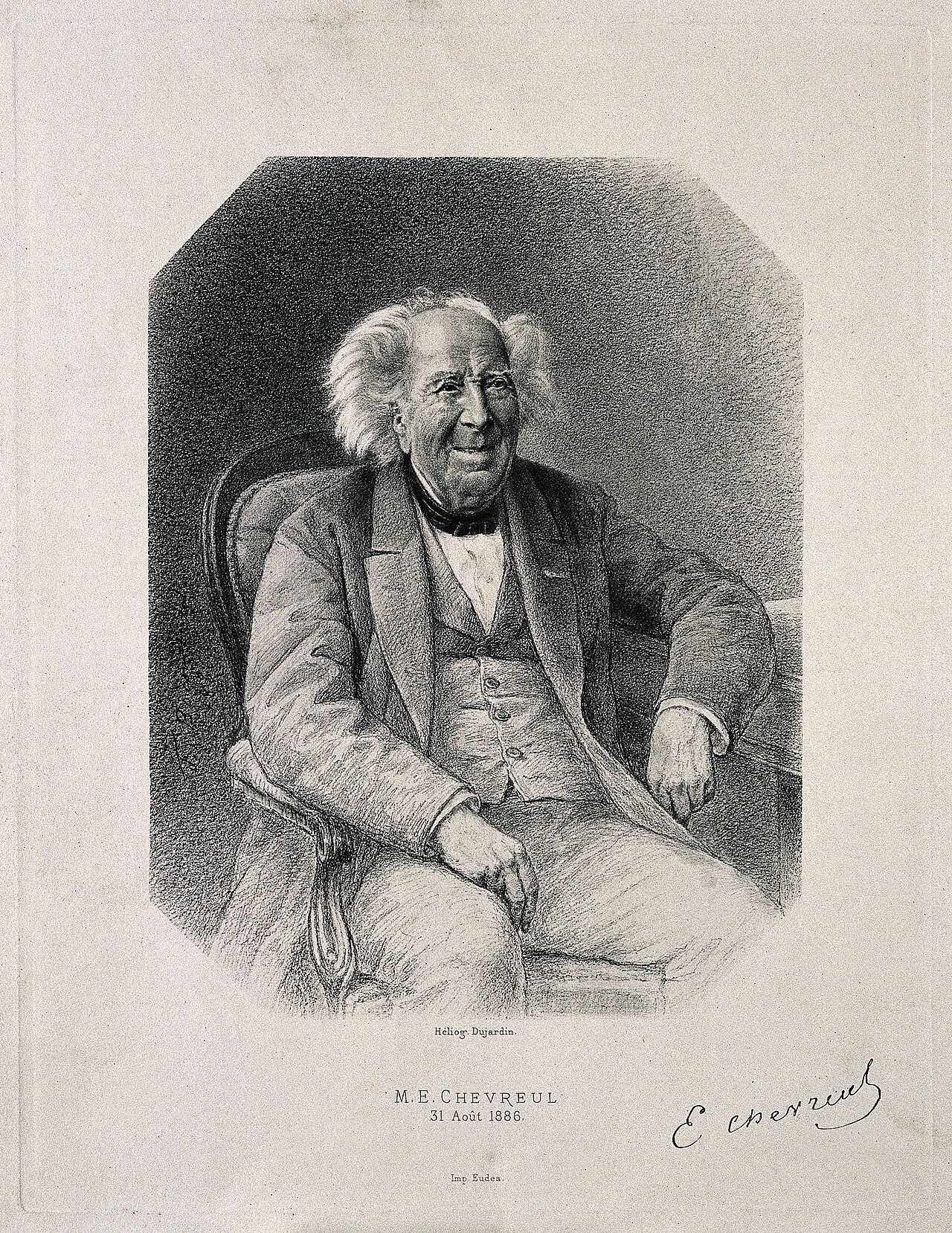
Via Wikimedia Commons: Michel Eugène Chevreul. Photogravure after a photograph by F Wellcome , CC BY 4.0.
An early study of creatine as a supplement, published in 1992 by Harris, Söderlund and Hultman at the Karolinska Institute in Sweden, showed that creatine taken by mouth was absorbed and raised the total creatine content of the thigh muscle of healthy volunteers, most in those who started lowest, and by as much as 50% in some. The Australian Institute of Sport credits Harris with leading the original studies into creatine supplementation.
The body gets creatine from two sources in roughly equal shares. The 2022 review gives diet and the body's own synthesis as each contributing about 1 g a day in omnivorous adults, and the Australian Institute of Sport gives the same figures. Synthesis takes place mainly in the liver and kidneys in two steps. First, an enzyme called arginine:glycine amidinotransferase (AGAT) moves a cluster of nitrogen and hydrogen atoms from the amino acid arginine to glycine, forming guanidinoacetic acid. Second, guanidinoacetate methyltransferase (GAMT) completes the conversion to creatine, adding a methyl group taken from S-adenosyl methionine. Creatine is carried into cells by a transporter protein encoded by the SLC6A8 gene.
Its main job is energy buffering. Cells run on adenosine triphosphate (ATP), which releases energy when it loses a phosphate group and becomes adenosine diphosphate (ADP). The enzyme creatine kinase moves phosphate between creatine and these molecules, so that phosphocreatine can rapidly rebuild ATP when demand is high, particularly in maximal sprint-type exercise. The ISSN review also describes a "creatine kinase/phosphocreatine shuttle" that carries energy from the mitochondria to the places in the cell where it is used.
Creatine and phosphocreatine break down steadily, without any enzyme, into a waste product called creatinine. The 2022 review gives the rate as about 1.7% of the body's creatine a day, or about 1.5 to 2.0 g, which is why the store has to be replenished daily. The kidneys filter creatinine out of the blood into the urine, and its level in blood is a routine measure of kidney health. The US National Library of Medicine's MedlinePlus explains that if the kidneys are not working well, creatinine can build up in the blood, and that creatinine testing alone is not the best gauge because people make different amounts depending on their muscle mass, diet, age and activity. MedlinePlus also notes that people may be asked not to eat meat for 24 hours before the test, because meat can temporarily raise creatinine levels, and that some supplements can affect the results.
The steady link between creatine and creatinine is also used to estimate how much muscle a person has, a method whose development from the early twentieth century onward is traced in the 2022 Journal of Cachexia, Sarcopenia and Muscle review.
Three rare inherited disorders interfere with creatine, each at a different step, and all mainly affect the brain.
Creatine is sold as a supplement, most often as creatine monohydrate. Supplementation raises the creatine stored in muscle: the ISSN review says a normal diet leaves muscle stores about 60 to 80% saturated, and that supplements can raise muscle creatine and phosphocreatine by 20 to 40%. People who eat no meat tend to start lower; the same review reports that vegetarians have lower stores in muscle and may see larger gains.
The Australian Institute of Sport places creatine in its Group A of sports supplements, the category with "strong scientific evidence for use in specific situations in sport". The ISSN's 2017 position stand calls creatine monohydrate "the most effective ergogenic nutritional supplement currently available to athletes" for increasing high-intensity exercise capacity and lean body mass during training. The ISSN also states that creatine is not banned by any sport organization, because it is found in ordinary food.
Its use is widespread. The ISSN review reports that Americans consume over four million kilograms of creatine a year, and that surveys of athletes and military personnel have generally found 15 to 40% using it, more often among men in strength and power sports. In a 2014 survey by the US National Collegiate Athletic Association cited by the ISSN, reported use among male athletes ranged from 11.1% in soccer to 29.4% in ice hockey, and among female athletes from 0.2 to 3.8%.
Creatine draws a little water into cells. The ISSN review reports that initial studies found a short-term fluid retention of about 0.5 to 1.0 litre when supplementation began, roughly in proportion to the weight gained. Concerns have been raised over the years about cramping, dehydration and kidney damage. The ISSN's position, based on the studies it reviewed, is that the peer-reviewed literature shows no evidence that creatine increases muscle injuries, dehydration, cramping, gastrointestinal upset or kidney dysfunction, and it reports long-term studies in patient groups without an increased incidence of renal dysfunction. The position stand's own competing-interests statement discloses that several of its authors have received research funding from, or worked for or advised, companies that sell creatine or other supplements, and that its lead author prepared it at the request of the Council for Responsible Nutrition and the ISSN.
Researchers have studied creatine in many other settings. The ISSN review lists clinical studies in neurodegenerative diseases, diabetes, osteoarthritis, fibromyalgia, aging, brain and heart ischaemia, adolescent depression and pregnancy, with results that vary by condition.
Depression has been the subject of several trials and reviews, and as of November 2026 the evidence remains debated.
This entry explains; it is not medical advice. Ask a doctor or pharmacist about your own health.
 Get Micwyn on your home screenIts own icon, full screen, and notifications.