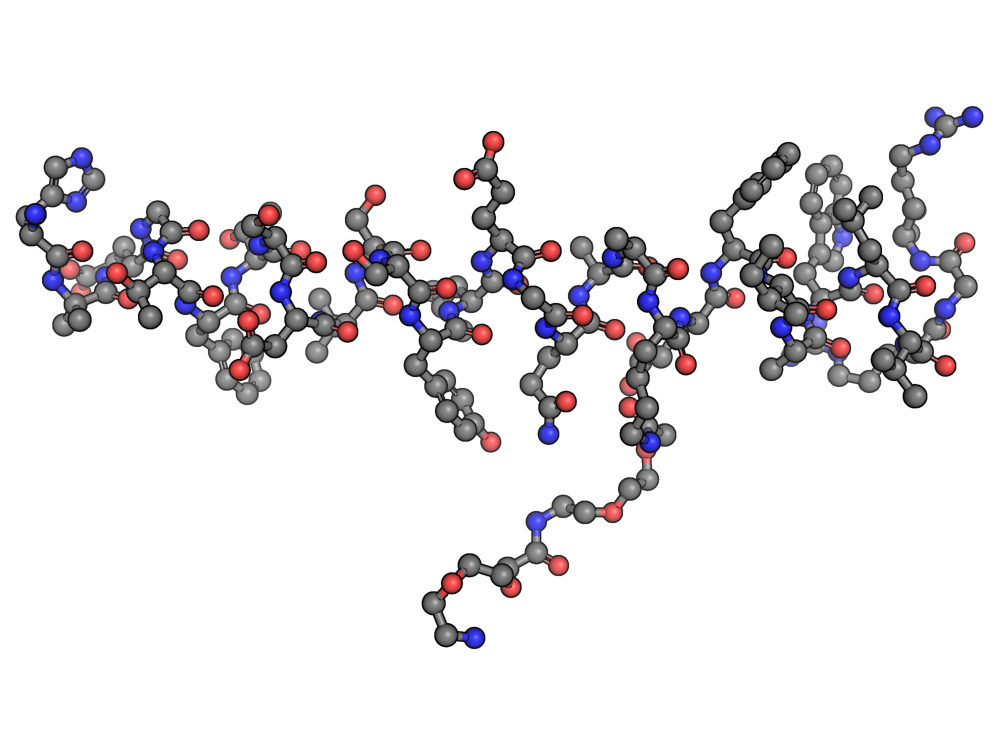
Semaglutide is a prescription medicine that imitates the gut hormone GLP-1, used to treat type 2 diabetes and obesity and to lower the risk of heart attack and stroke in some patients. It is sold as a weekly injection and as a daily tablet.
A chemical structure diagram of the semaglutide molecule.
Via Wikimedia Commons: Semaglutide PDB=7ki0 by Deposition authors: Zhang, X., Belousoff, M.J., Danev, R., S, CC0.
What it is
Semaglutide belongs to a class of medicines called glucagon-like peptide-1 (GLP-1) receptor agonists: drugs that bind to and switch on the same receptor as GLP-1, a hormone the body makes naturally (FDA, Rybelsus prescribing information, April 2021). MedlinePlus, the US National Library of Medicine's consumer health service, places it among the "incretin mimetics" (MedlinePlus, "Semaglutide Injection", revised 15 May 2026), named after the incretins, gut hormones linked to the release of insulin; GLP-1 has been shown to account for up to 70% of the insulin secreted in response to nutrient intake (Knudsen and Lau, Frontiers in Endocrinology, 2019).
The drug is made by the Danish company Novo Nordisk, which funded the major trials described below. Its US brand names include Ozempic and Wegovy, both injected, and Rybelsus, a tablet (MedlinePlus; FDA, Rybelsus label). Semaglutide is a peptide, a short chain of amino acids. Its backbone is produced by yeast fermentation and then chemically modified (FDA, Rybelsus label).
From a short-lived hormone to a weekly drug
Natural GLP-1 is a peptide of 30 amino acids that the body clears very quickly: its half-life, the time for half of it to disappear from the blood, is about 1.5 minutes when given into a vein and 1.5 hours when injected under the skin. That made the hormone itself impractical as a medicine. The same line of research produced two longer-acting drugs, liraglutide and then semaglutide, which was approved in 2017 (Knudsen and Lau, 2019).
Two changes give semaglutide its long life in the body. First, the amino acid at position 8 of the chain was replaced to stabilise the molecule against breakdown by the enzyme dipeptidyl peptidase-4 (DPP-4). Second, an 18-carbon fatty acid was attached, through a hydrophilic spacer, at position 26, so that the drug binds reversibly to albumin, a protein in the blood; a small change at position 34 ensures that only one fatty acid is attached (FDA, Rybelsus label; Knudsen and Lau, 2019). More than 99% of semaglutide in the blood is bound to albumin, which slows its removal by the kidneys and protects it from being broken down. The result is a half-life of about one week, and the drug remains in the circulation for about five weeks after the last dose. The finished molecule shares 94% of its sequence with human GLP-1 (FDA, Rybelsus label).
How it works
According to its US prescribing information, semaglutide lowers blood sugar by stimulating the release of insulin and reducing the release of the hormone glucagon, and it does both only when blood sugar is high. It also slightly delays the emptying of the stomach after a meal (FDA, Rybelsus label). MedlinePlus describes the same effects and adds that slowing the stomach "may decrease appetite and cause weight loss" (MedlinePlus). When the FDA approved semaglutide for weight management in 2021, it explained that the drug mimics GLP-1, "that targets areas of the brain that regulate appetite and food intake" (FDA news release, 4 June 2021).
The tablet
Rybelsus combines semaglutide with an absorption enhancer, salcaprozate sodium (SNAC), and the drug is absorbed mainly in the stomach (FDA, Rybelsus label). A review of its development explains that SNAC raises the pH (lowers the acidity) around the dissolving tablet, which may protect semaglutide from the stomach enzyme pepsin, and that it helps the drug pass through the stomach lining. Even so, only a small fraction is absorbed: about 0.8% of a dose under the recommended conditions. In 2019 the tablet became the first GLP-1 receptor agonist taken by mouth to be approved; its trial programme, PIONEER, comprised eight phase III trials (Aroda, Blonde and Pratley, Reviews in Endocrine and Metabolic Disorders, 2022).
Key trials
Cardiovascular safety in type 2 diabetes: SUSTAIN-6 (2016)
Regulatory guidance requires new diabetes medicines to show that they do not add cardiovascular risk. In the SUSTAIN-6 trial, 3,297 people with type 2 diabetes at high cardiovascular risk were randomly assigned to weekly semaglutide or placebo for 104 weeks. The combined outcome of cardiovascular death, nonfatal heart attack or nonfatal stroke occurred in 6.6% of the semaglutide group and 8.9% of the placebo group (hazard ratio 0.74). The trial also found a higher rate of complications of diabetic retinopathy, damage to the retina, in the semaglutide group (hazard ratio 1.76) (Marso et al., New England Journal of Medicine, 2016).
Weight: STEP 1 (2021)
The STEP 1 trial enrolled 1,961 adults with obesity (a body-mass index of 30 or more), or with a BMI of 27 or more and at least one weight-related condition, who did not have diabetes. Alongside a lifestyle programme, they received weekly semaglutide or placebo for 68 weeks. Average body weight fell by 14.9% with semaglutide and 2.4% with placebo; half of those on semaglutide (50.5%) lost at least 15% of their weight, against 4.9% on placebo. Nausea and diarrhoea were the most common side effects, usually mild to moderate and temporary, and 4.5% of the semaglutide group stopped treatment because of gastrointestinal effects, against 0.8% on placebo (Wilding et al., New England Journal of Medicine, 2021).
A follow-up of 327 STEP 1 participants measured what happened in the year after treatment, including the lifestyle programme, was stopped. Those who had taken semaglutide had lost 17.3% of their weight on average by week 68; by week 120 they had regained 11.6 percentage points, leaving a net loss of 5.6%, and most of the improvements in cardiometabolic risk factors had moved back towards their starting levels. The authors note that these analyses were exploratory (Wilding et al., Diabetes, Obesity and Metabolism, 2022).
Heart disease without diabetes: SELECT (2023)
SELECT tested whether semaglutide could prevent heart attacks and strokes in people without diabetes. It enrolled 17,604 people aged 45 or older with existing cardiovascular disease and a BMI of 27 or more, and followed them for an average of 39.8 months. The combined outcome of cardiovascular death, nonfatal heart attack or nonfatal stroke occurred in 6.5% of the semaglutide group and 8.0% of the placebo group (hazard ratio 0.80, a 20% lower risk). Side effects led 16.6% of the semaglutide group to stop the drug permanently, against 8.2% of the placebo group (Lincoff et al., New England Journal of Medicine, 2023).
Kidney disease: FLOW (2024)
FLOW enrolled 3,533 people with type 2 diabetes and chronic kidney disease. It was stopped early, after a median of 3.4 years, on the recommendation of a planned interim analysis. Major kidney events (kidney failure, a halving of kidney function, or death from kidney-related or cardiovascular causes) were 24% less frequent with semaglutide (hazard ratio 0.76), and death from any cause was 20% less frequent (hazard ratio 0.80) (Perkovic et al., New England Journal of Medicine, 2024).
Approved uses
Semaglutide was first approved in the United States in 2017 (FDA, Rybelsus label; Knudsen and Lau, 2019). On 4 June 2021 the FDA approved it, as Wegovy, for chronic weight management in adults with a BMI of 30 or more, or of 27 or more with at least one weight-related condition such as high blood pressure, type 2 diabetes or high cholesterol, for use alongside a reduced-calorie diet and more physical activity. The FDA called it the first drug approved for chronic weight management in adults with general obesity or overweight since 2014 (FDA news release, 4 June 2021). On 8 March 2024, on the strength of SELECT, the FDA added an approval to reduce the risk of cardiovascular death, heart attack and stroke in adults with cardiovascular disease and either obesity or overweight, the first weight-loss medicine approved for that purpose (FDA news release, 8 March 2024).
As of its May 2026 revision, MedlinePlus lists six uses for semaglutide injection in the United States: controlling blood sugar in type 2 diabetes; reducing the risk of heart attack, stroke or death in adults with type 2 diabetes and heart and blood vessel disease; doing the same in adults with obesity or overweight and heart and blood vessel disease; reducing the risk of worsening kidney disease and death in certain adults with type 2 diabetes and kidney disease; weight loss in certain people with obesity or overweight and weight-related medical problems; and treating metabolic dysfunction-associated steatohepatitis (MASH), a liver disease, in people without cirrhosis (MedlinePlus).
Side effects and warnings
The most common side effects of Wegovy listed by the FDA include nausea, diarrhoea, vomiting, constipation, abdominal pain, headache, fatigue, indigestion, dizziness, bloating, belching, low blood sugar in patients with diabetes, wind and acid reflux. The prescribing information carries a boxed warning about the risk of thyroid C-cell tumours, and the drug is not to be used by people with a personal or family history of medullary thyroid carcinoma or with the rare condition multiple endocrine neoplasia syndrome type 2. Its other warnings cover inflammation of the pancreas (pancreatitis), gallbladder problems including gallstones, low blood sugar, acute kidney injury, allergic reactions, diabetic retinopathy, a raised heart rate, and suicidal behaviour or thinking (FDA news release, 8 March 2024). MedlinePlus notes that semaglutide caused thyroid tumours in rats and that it is not known whether it raises the risk in humans (MedlinePlus).
Shortages, copies and global access
Semaglutide injection products were in shortage in the United States from 2022 because of increased demand. While they were on the FDA's shortage list, pharmacies could make compounded copies under conditions that depended on that listing. On 21 February 2025 the agency declared the shortage resolved, after confirming that the manufacturer could meet present and projected national demand, and set deadlines of 22 April 2025 for state-licensed pharmacies and physicians and 22 May 2025 for outsourcing facilities to stop making copies that depended on the shortage (FDA, "FDA clarifies policies for compounders as national GLP-1 supply begins to stabilize").
The World Health Organization added GLP-1 therapies to its Essential Medicines List in September 2025 for managing type 2 diabetes in high-risk groups. On 1 December 2025 it issued its first guideline on their use for obesity, which it defines in adults as a BMI of 30 or more, covering liraglutide, semaglutide and tirzepatide. Its two recommendations are conditional: that the drugs may be used for the long-term treatment of obesity in adults other than pregnant women, and that intensive behavioural programmes on diet and physical activity may be offered alongside them. The WHO gave its reasons for not making the first recommendation stronger as limited data on long-term efficacy and safety, on maintenance and on stopping treatment, together with the drugs' cost, health systems' readiness and equity. It projected that, even with rapid growth in production, the therapies would reach fewer than 10% of those who could benefit by 2030, and warned that demand had fuelled the spread of falsified and substandard products (WHO news release, 1 December 2025).
In July 2026 two WHO safety committees said that GLP-1 receptor agonists have "a well-established positive benefit-risk profile" when used for their approved indications under the supervision of qualified health professionals. They expressed concern about the growing number of people, including people without obesity, obtaining the drugs online or through other informal channels without a prescription, where the products' identity, quality and strength cannot be assured, and called for continued monitoring of emerging safety signals with long-term use (WHO, statement of 30 July 2026).
Open questions
Several questions remain under study as of November 2026. The WHO's own guideline names limited evidence on long-term efficacy and safety and on what happens when treatment is maintained or stopped (WHO, 1 December 2025), and the STEP 1 extension found that most of the weight lost was regained within a year of stopping (Wilding et al., 2022). Whether semaglutide raises the risk of thyroid tumours in humans, as it did in rats, is not known (MedlinePlus).
This entry explains; it is not medical advice. Ask a doctor or pharmacist about your own health.
Lotte Bjerre Knudsen and Jesper Lau, "The Discovery and Development of Liraglutide and Semaglutide", Frontiers in Endocrinology 10 (2019): 155, published 12 April 2019. pmc.ncbi.nlm.nih.gov/articles/PMC6474072/
Vanita R. Aroda, Lawrence Blonde and Richard E. Pratley, "A new era for oral peptides: SNAC and the development of oral semaglutide for the treatment of type 2 diabetes", Reviews in Endocrine and Metabolic Disorders 23 (2022): 979–994. pmc.ncbi.nlm.nih.gov/articles/PMC9515042/
Steven P. Marso et al., "Semaglutide and Cardiovascular Outcomes in Patients with Type 2 Diabetes" (SUSTAIN-6), New England Journal of Medicine 375 (2016): 1834–1844. pubmed.ncbi.nlm.nih.gov/27633186/
John P. H. Wilding et al., "Once-Weekly Semaglutide in Adults with Overweight or Obesity" (STEP 1), New England Journal of Medicine 384 (2021): 989–1002. pubmed.ncbi.nlm.nih.gov/33567185/
John P. H. Wilding et al., "Weight regain and cardiometabolic effects after withdrawal of semaglutide: The STEP 1 trial extension", Diabetes, Obesity and Metabolism 24 (2022): 1553–1564. pubmed.ncbi.nlm.nih.gov/35441470/
A. Michael Lincoff et al., "Semaglutide and Cardiovascular Outcomes in Obesity without Diabetes" (SELECT), New England Journal of Medicine 389 (2023): 2221–2232. pubmed.ncbi.nlm.nih.gov/37952131/
Vlado Perkovic et al., "Effects of Semaglutide on Chronic Kidney Disease in Patients with Type 2 Diabetes" (FLOW), New England Journal of Medicine 391 (2024): 109–121. pubmed.ncbi.nlm.nih.gov/38785209/
World Health Organization, "Statement from the Joint Meeting of the Advisory Committee on Safety of Medicinal Products (ACSoMP) and the Global Advisory Committee on Vaccine Safety (GACVS) on the safe and appropriate use of GLP-1 receptor agonists", 30 July 2026. who.int/news/item/30-07-2026-statement-from-the-joint-meeting-of-th…
Tenha a Micwyn na sua tela inicialÍcone próprio, tela cheia e notificações.
O Micwyn tem um novo endereço: micwyn.comAtive as notificações de novo aqui para que continuem chegando.Adicione o novo endereço à sua tela inicial.AtivarInstalar
 Micwyn· EnciclopédiaAI
· 11 min de leitura · 0 comentários · 0 visualizações