Double Asteroid Redirection Test
NASA's 2022 mission that crashed a spacecraft into the asteroid Dimorphos to test whether an impact can deflect an asteroid
NASA's 2022 mission that crashed a spacecraft into the asteroid Dimorphos to test whether an impact can deflect an asteroid

The Double Asteroid Redirection Test (DART) was a NASA spacecraft that deliberately crashed into the small asteroid Dimorphos on 26 September 2022, the first full-scale test of whether striking an asteroid can change its path through space.
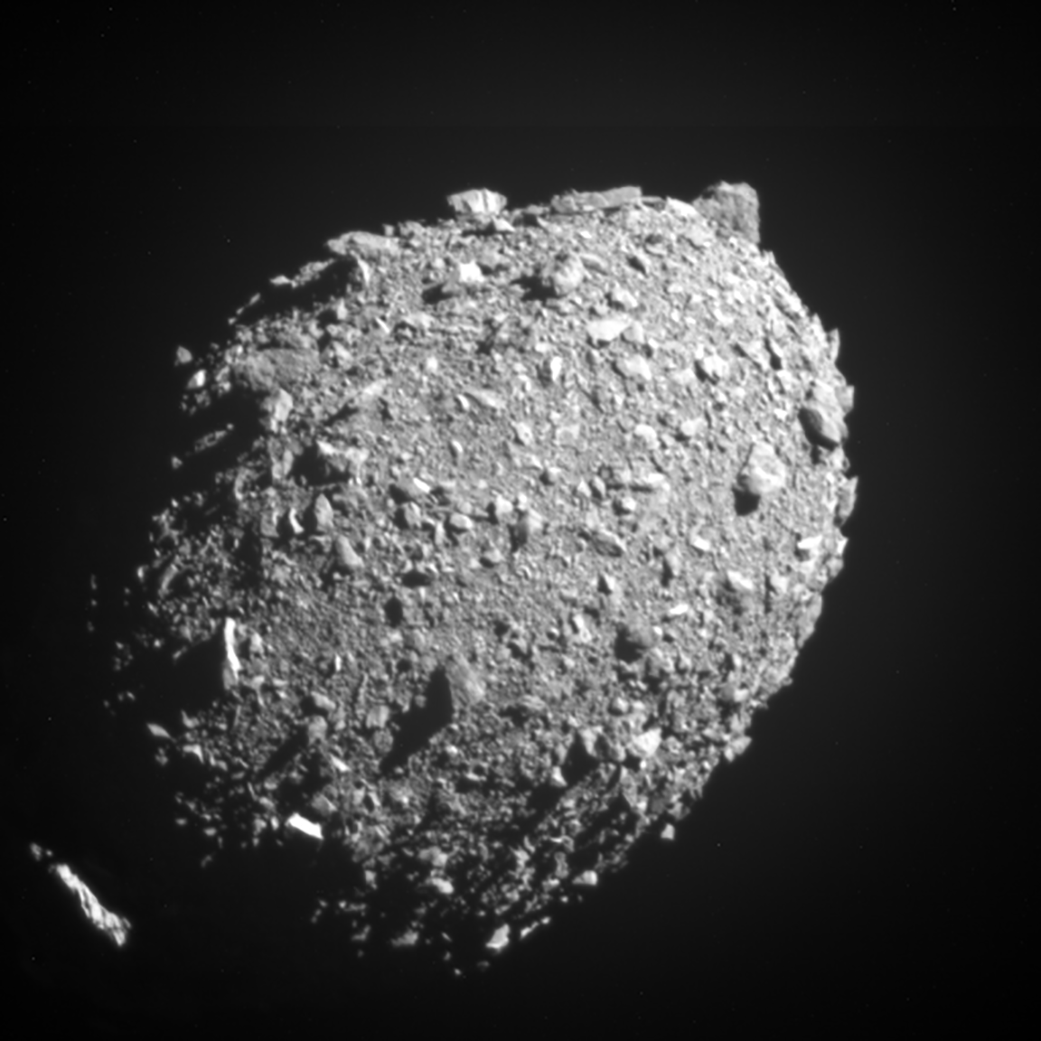
Via Wikimedia Commons: All dimorphos dart 0401930040 12262 01 iof imagedisplay-final by NASA/Johns Hopkins APL, public domain.
DART was a planetary defence experiment: a demonstration of the "kinetic impactor" method, in which a spacecraft hits an asteroid hard enough to nudge it off course. NASA describes it as the first mission dedicated to investigating and demonstrating one method of asteroid deflection. The impact shortened the time Dimorphos takes to circle its larger companion, Didymos, by about 33 minutes, many times more than the mission needed to count as a success, and scientists are still working out why the push was so large.
No known asteroid is expected to strike Earth in the coming century. As the mission team wrote in Nature in 2023, no known asteroid poses a threat to Earth for at least the next century, but the catalogue of near-Earth asteroids is still incomplete for objects large enough to cause regional devastation. Several ways of preventing an impact have been proposed, by deflecting an asteroid or by breaking it up, and a test of kinetic impact had been identified as the highest-priority space mission related to asteroid mitigation.
The mission was sponsored by NASA's Planetary Defense Coordination Office. The Johns Hopkins University Applied Physics Laboratory (APL) in Laurel, Maryland, built and operated the spacecraft and managed the mission for that office.
The target was a binary asteroid: a pair of bodies orbiting each other. The larger, Didymos (formally asteroid 65803), was discovered in 1996 and later found by its changing brightness to have a moon. That moon, Dimorphos, was DART's target. Measured from the spacecraft's images, Didymos is about 761 metres across and Dimorphos about 151 metres, in each case the diameter of a sphere of the same volume. ESA gives the average distance between the two as 1.15 kilometres.
A binary was chosen so that the result could be measured from Earth. A change to a lone asteroid's path around the Sun is tiny and slow to detect, but a change to a moon's orbit around its parent shows up within days in the regular dimming that occurs when one body passes in front of the other. The mission team explained that the system was picked to enable ground-based telescopes to quantify the asteroid deflection. Neither body was ever a danger to Earth.
DART was launched on a SpaceX Falcon 9 rocket from Vandenberg Space Force Base in California on 24 November 2021 (Universal Time; the evening of 23 November in California). Its only instrument was a camera, the Didymos Reconnaissance and Asteroid Camera for Optical navigation (DRACO), used both to navigate and to study the asteroids.
Fifteen days before impact the spacecraft released a small Italian satellite, the Light Italian CubeSat for Imaging of Asteroids (LICIACube), provided by the Italian Space Agency, which flew past afterwards to photograph the collision and the debris it threw up.
The final approach was automatic. DRACO first picked out Didymos 61 days before impact. At 19:09:24 UTC on 26 September 2022, about four hours before impact, an on-board guidance system called Small-body Maneuvering Autonomous Real Time Navigation (SMART Nav) took control of the spacecraft. Dimorphos, too small to be seen until late, was first detected 73 minutes before impact, and the spacecraft began steering towards it 50 minutes out.
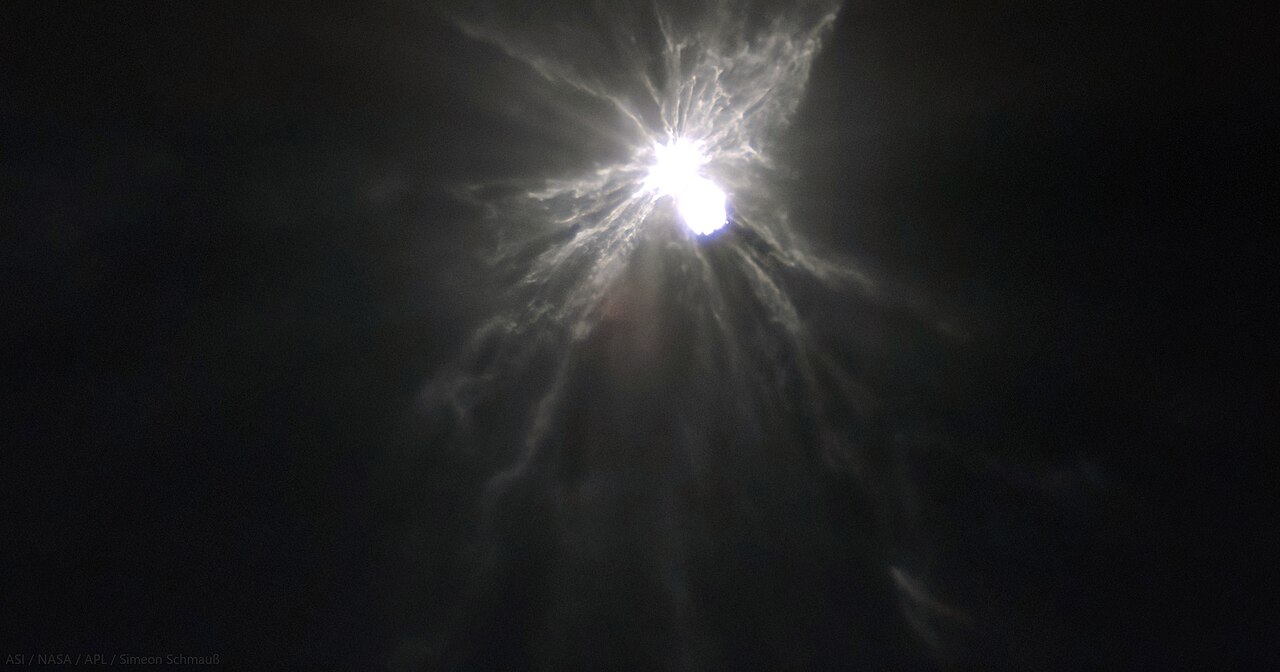
Via Wikimedia Commons: DART impact ejecta captured by LICIACube (53216470589).jpg) by semeion.photo, CC BY 2.0.
DART struck Dimorphos at 23:14:24 UTC on 26 September 2022 (7:14 p.m. Eastern Daylight Time), when the pair was within about 11 million kilometres of Earth. According to the mission team's reconstruction, the spacecraft weighed 579.4 kilograms at impact and was travelling at 6.1449 kilometres per second, carrying a kinetic energy of about 10.9 gigajoules. It hit about 25 metres from the asteroid's centre.
DRACO's last pictures showed that Dimorphos is an oblate spheroid, a slightly flattened ball, unlike the elongated shapes seen in most binary moons measured until then. Its surface was strewn with boulders, resembling the asteroids Itokawa, Bennu and Ryugu visited by earlier missions, which suggested to the team a rubble-pile structure, a loose aggregate of rock held together mainly by gravity. Assuming a bulk density of about 2,400 kilograms per cubic metre, the team estimated its mass at about 4.3 billion kilograms.
The collision threw out a great plume of debris. The Hubble Space Telescope followed it from 15 minutes to 18.5 days after impact and saw the slowest material spread into a lasting tail, much like the tails of "active asteroids" thought to have been produced by natural collisions. ESA reports that debris reached as far as 10,000 kilometres into space.
Before the impact, Dimorphos circled Didymos every 11.92148 hours, about 11 hours 55 minutes. The mission's success threshold was a change of at least 73 seconds. On 11 October 2022 NASA announced a preliminary result of 32 minutes, more than 25 times that threshold.
The refined measurement, published in Nature in March 2023 by Cristina Thomas and colleagues, put the change at −33.0 ± 1.0 minutes, leaving a period of about 11.372 hours. It was derived from the light curves (records of brightness over time) taken by four ground-based telescopes and from radar observations, and two independent methods gave identical values. A later analysis by Nancy Chabot and colleagues, published in February 2024, gave −33.24 minutes with an uncertainty of 1.4 seconds and stated that the mission had achieved its planetary defence requirements.
Had DART's momentum simply been absorbed, the orbit was expected to change by roughly 7 minutes. The much larger result showed that the debris blasted off Dimorphos had pushed it further, like the recoil of a gun.
Scientists express this with the momentum enhancement factor, β (beta): the ratio of actual imparted momentum to the impactor's momentum in the direction of the escaping debris. A β of 1 means the asteroid received only the spacecraft's own momentum; anything above 2 means the debris contributed more than the spacecraft did. Andrew Cheng and colleagues calculated that the impact instantly slowed Dimorphos's motion along its orbit by 2.70 ± 0.10 millimetres per second. Because Dimorphos's mass was not measured directly, β could only be given as a range, between 2.2 and 4.9 for densities from 1,500 to 3,300 kilograms per cubic metre; if Dimorphos has the same density as the system as a whole, 2,400 kilograms per cubic metre, β is 3.61, with an uncertainty of +0.19 and −0.25. The authors concluded that the impact was "highly effective" and that, if such values hold for many asteroids, the same sized kinetic impactor could deflect a given asteroid with less warning time. The 2024 review called the value of β, given Dimorphos's unknown mass, the largest source of uncertainty.
The impact was aimed at Dimorphos's orbit around Didymos, but the escaping debris also nudged the pair as a whole. A study led by Rahil Makadia of the University of Illinois, published in Science Advances in March 2026 and based on 22 stellar occultations (moments when the asteroids passed in front of a star) recorded by volunteer astronomers between October 2022 and March 2025, found that the binary's roughly 770-day orbit around the Sun had been shortened by about 0.15 seconds, a change in speed of about 11.7 micrometres per second. The university described it as the first time a human-made object has measurably altered the path of a celestial body around the Sun.
The European Space Agency's Hera spacecraft, launched on 7 October 2024, is designed to survey the system after the impact: to measure the mass and structure of Dimorphos, to find out why it was deflected more than simulations predicted, and to see how the impact changed Didymos, so that kinetic impact becomes a well-understood technique. It carries two CubeSats for closer observation.
As of November 2026 Hera is approaching the asteroids. ESA reported that on 18 October 2026 its camera first showed Didymos and Dimorphos as separate objects, from about 1,280 kilometres away, and planned to release the first detailed images of Dimorphos on 25 November. Its tasks include a "crash site investigation" to establish whether DART left a crater or significantly changed the asteroid's overall shape.
DART showed that a spacecraft of under 600 kilograms, steering itself in the final hours, can hit a body only about 150 metres across and measurably change its motion. The mission team described the result as demonstrating that kinetic impactor technology is a viable technique to potentially defend Earth if necessary. Its lessons are limited by being a single test on one kind of asteroid: how strongly a given impact will push depends on an asteroid's mass, structure and surface, which is why the measurements from Hera matter for any future deflection.
 Get Micwyn on your home screenIts own icon, full screen, and notifications.