Data center
A building or room that houses computer servers, storage and networking equipment, with the power and cooling systems that keep them running
📖 词典: data center · 📚 书库
A building or room that houses computer servers, storage and networking equipment, with the power and cooling systems that keep them running
📖 词典: data center · 📚 书库

A data center (British spelling: data centre) is a building, or a room within one, that houses computer servers, data storage and networking equipment, together with the power supply and cooling systems that keep that equipment running.
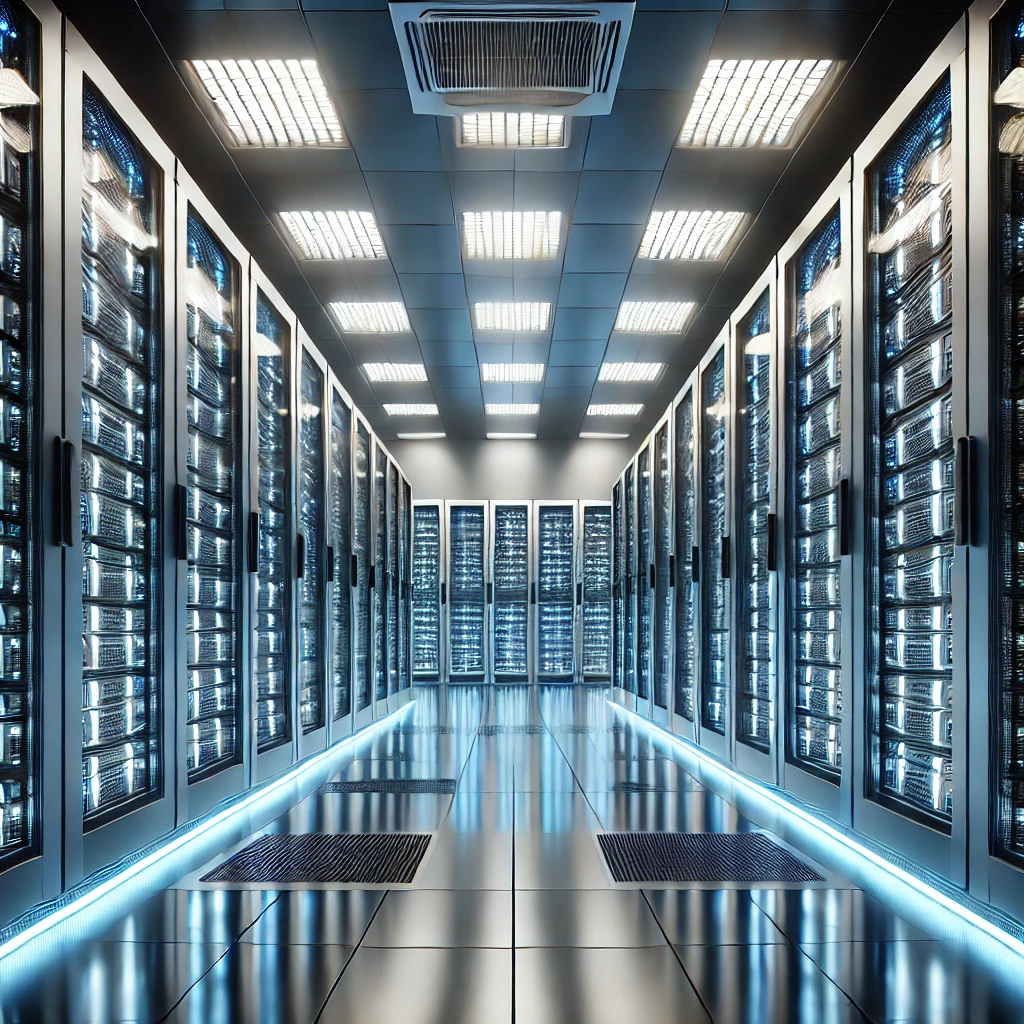
Via Wikimedia Commons: DALL·E 2025-01-31 21.58.22 - A realistic image of the interior of a mo by Cbrasil0, CC BY-SA 4.0.
The U.S. Environmental Protection Agency's 2007 report to Congress describes a data center as a facility that contains primarily electronic equipment used for data processing (servers), data storage and communications (network equipment), known collectively as information technology (IT) equipment. Alongside it, data centers usually hold specialised equipment for converting power and supplying backup power, and environmental controls that keep temperature and humidity within the range the IT equipment needs.
Data centers vary greatly in size. The same report notes that they range from server closets and small rooms inside ordinary buildings to dedicated buildings that can be several hundred thousand square feet in size, and that they are found in nearly every sector of the economy, from financial services and media to universities and government. Because they are designed for computers rather than people, they typically have no windows and minimal circulation of fresh air.
European Union law distinguishes data centers by who runs the equipment inside them. Commission Delegated Regulation (EU) 2024/1364 defines an enterprise data centre as one operated by an enterprise solely to meet that enterprise's own IT needs; a colocation data centre as one in which customers install and manage their own networks, servers and storage; and a co-hosting data centre as one in which customers run their own services and applications on IT equipment and building infrastructure provided as a service by the operator.
A further term, "hyperscale", is used for the very largest facilities. A 2016 report by Lawrence Berkeley National Laboratory (LBNL) for the U.S. Department of Energy found that nearly all growth in U.S. server shipments since 2010 had gone to servers destined for large hyperscale data centers, where servers are often run at high utilisation, so fewer are needed to provide the same services than in traditional, smaller data centers.
Electricity reaching a data center passes through several stages before it reaches the computers. The EPA's 2007 report describes the usual chain: power first enters an uninterruptible power supply (UPS), a battery backup that protects the IT equipment from power disruptions, in which alternating current (AC) is converted to direct current (DC) to charge the batteries and then back to AC; from there it goes to a power distribution unit, which feeds the equipment racks; and inside each server a power supply converts it again to low-voltage DC for the processor, memory, drives and fans. The report notes that electricity consumed in this delivery chain accounts for a substantial portion of the building's load.
Nearly all the electricity used by IT equipment ends up as heat. The EPA report states that all of the electric power is converted to heat, and that the energy use of a single rack of servers can exceed 20 kilowatts (kW). It describes a common arrangement in which computer room air conditioning (CRAC) units on the data center floor cool air across coils carrying chilled water from a chiller outside the room, and push it through a raised floor; the cold air rises through perforated floor tiles, server fans pull it through the equipment, and the warmed air returns to the CRAC units.
A widely used layout places racks in long rows facing alternately in opposite directions, so that equipment draws cool air from one aisle and exhausts hot air into the next. The EPA report calls this a hot aisle/cold aisle layout and describes it as a common best practice. It also notes that, because of the overhead for power conversion, backup power and cooling, only about half the power entering a data center was then used by the IT equipment itself.
The standard measure of that overhead is power usage effectiveness (PUE): the total energy used by a data center divided by the energy used by its IT equipment. The EU's 2024 regulation sets it out as PUE = E(DC) / E(IT), alongside a water usage effectiveness (WUE) measure of water taken in per unit of IT energy, an energy reuse factor for waste heat put to other use, and a renewable energy factor. As Google's explanation of the measure puts it, a PUE of 2.0 means one unit of overhead energy for every unit used by IT equipment, and a value close to 1.0 means almost all the energy goes to computing. Google, for example, reports that its global fleet of large data centers had an average annual PUE of 1.09 in 2025, and cites the Uptime Institute's 2025 Global Data Center Survey as giving an average PUE of 1.54 among the data centers of the survey's respondents.
As computing moved from paper records to digital systems, data centers multiplied. The EPA estimated in 2007 that U.S. servers and data centers had consumed about 61 billion kilowatt-hours (kWh) in 2006, or 1.5 percent of total U.S. electricity use, at a cost of about $4.5 billion, and that this was more than double the amount used for the same purpose in 2000. It also observed that data centers could be more than 40 times as energy intensive as conventional office buildings, making large ones more like industrial facilities than commercial buildings in their energy use.
Growth then slowed for a time. LBNL's 2016 report estimated that U.S. data centers used about 70 billion kWh in 2014, about 1.8 percent of national electricity consumption, and that consumption had grown by about 4 percent from 2010 to 2014, against an estimated 24 percent from 2005 to 2010 and nearly 90 percent from 2000 to 2005. It attributed the slowdown to slower growth in the number of servers, flat power demand per server since about 2005, more efficient storage, networking and cooling, server "virtualization" (running many workloads on fewer physical machines) and the shift of work to efficient hyperscale facilities.
That plateau did not last. In December 2024 the Department of Energy published LBNL's updated study, which found that U.S. data centers consumed about 4.4 percent of total U.S. electricity in 2023, that their use had climbed from 58 terawatt-hours (TWh, billions of kWh) in 2014 to 176 TWh in 2023, and that it could reach between 325 and 580 TWh, about 6.7 to 12 percent of U.S. electricity, by 2028. The department linked the projected growth to data center expansion and the rise of artificial intelligence (AI) applications. The two LBNL studies give different estimates for 2014, about 70 billion kWh in the 2016 report and 58 TWh (58 billion kWh) in the 2024 one.
Data centers use water in two ways. LBNL's 2016 report explains that water is consumed in generating the electricity they use, a U.S. national average of 7.6 litres (2.0 gallons) per kWh, and on site, where larger facilities often use cooling towers that reject heat by evaporating water. It cites data centers with 15 megawatts (MW) of IT capacity consuming between 80 and 130 million gallons a year, and estimated total U.S. data center water consumption at about 626 billion litres in 2014. The report cautions that the water attributable to any one data center depends on its location and electricity supplier.
The European Union requires larger data centers to report their performance. Under Delegated Regulation (EU) 2024/1364, adopted on 14 March 2024 under the Energy Efficiency Directive (EU) 2023/1791, operators of data centers with an installed IT power demand of at least 500 kW must report information and key performance indicators, covering energy consumption, power use, temperature set points, waste heat use, water use and renewable energy, to a European database, by 15 September 2024, then by 15 May 2025 and every year after. The database is public only in aggregated form, at member-state and EU level, and the regulation sorts data centers into size classes from "very small" (100 to 500 kW of IT power) to "very large" (more than 10 MW).
In the United States, Congress directed the EPA to study data center energy use in Public Law 109-431, which produced the 2007 report, and the Energy Act of 2020 called for the update to LBNL's 2016 study that was published in 2024.
New data centers can divide the communities around them. In Morrow County in eastern Oregon, which Oregon Public Broadcasting describes as one of the state's biggest hubs for data center development, county officials and Amazon representatives held an event to promote data centers on 5 November 2026, while residents at a planning meeting in nearby Irrigon the same evening raised concerns about water, air pollution and transparency. A county commissioner said he hoped a proposed battery storage site would let data centers rely less on diesel generators. OPB also reported that in the November 2026 midterm elections voters across the United States had delivered dozens of rebukes to data centers.
 将 Micwyn 添加到主屏幕拥有独立图标、全屏显示并支持通知。