Randomized controlled trial
An experiment that assigns participants to groups by chance to test whether a treatment or intervention works
An experiment that assigns participants to groups by chance to test whether a treatment or intervention works

A randomized controlled trial (RCT) is an experiment in which participants are assigned by chance to groups, one receiving the treatment being tested and another, the control group, not, so that differences in outcome can be credited to the treatment.

Via Wikimedia Commons: J. Lind; A treatise of the scurvy. Wellcome L0019183, CC BY 4.0.
A trial is controlled when the people receiving a new treatment are compared with a group who receive something else: no treatment, a placebo (a dummy treatment made to look like the real one), the usual care, or another active treatment. It is randomized when chance, not the judgment of the researchers or the participants, decides who goes into which group.
Chance allocation answers a particular problem. If doctors choose which patients get a new treatment, they may, knowingly or not, give it to patients who are healthier or more likely to recover, and the treatment will look better than it is. The statistician Austin Bradford Hill, who designed the random allocation of the landmark 1948 streptomycin trial, valued randomization chiefly for this reason: according to a 2025 history by Robert Matthews for the James Lind Library, Hill remained convinced that its value in clinical trials lay in its ability to prevent allocation bias, the bias that arises when the person allocating patients influences who goes where.[1] The statistician Ronald Fisher, who developed the theory of randomization for agricultural experiments, justified it on statistical grounds: random allocation gives a statistically valid estimate of both the treatment effect and the uncertainty around it.[1]
Randomization does not make the groups identical in any single trial. Angus Deaton and Nancy Cartwright point out that it does not equalize everything other than the treatment: it balances the groups only in expectation, that is, on average over the many ways the allocation could have fallen, and a particular trial can still end up with groups that differ by chance.[8] What randomization does guarantee is that such differences are due to chance alone, which is what statistical methods are built to measure.
Randomized trials are used to test medicines, vaccines, surgical procedures, diets, health services, teaching methods and social and economic policies. In medicine they are generally regarded as strong evidence for judging whether an intervention works, but only when, in the words of the 2025 CONSORT reporting guideline, they are appropriately designed, conducted, analysed and reported.[9]
Comparing treatments side by side is much older than randomization. The best-known early example is James Lind's experiment on scurvy. In his Treatise of the Scurvy, first published in Edinburgh in 1753, Lind described how on 20 May 1747 he selected twelve patients with scurvy on board the Salisbury at sea, whose cases were "as similar as I could have them," kept them in one place on one common diet, and gave pairs of them six different remedies: cider, elixir of vitriol, vinegar, sea water, two oranges and a lemon a day, and a medicinal paste of garlic, mustard seed and other ingredients.[2][3] In the text of the third edition (1772) he reported that "the most sudden and visible good effects were perceived from the use of oranges and lemons," one of the two men given them being fit for duty after six days.[2]
Lind's trial was controlled but not randomized. He chose who got which remedy himself, and his own account says that two of the worst patients were put on sea water, exactly the kind of choice that random allocation was later designed to prevent.[2]
Over the following century, trials more often divided patients by alternation, giving each successive patient the other treatment. Matthews traces the prominence of alternation to the mid-1800s and notes that it remained the main approach until the early 1960s; Fibiger's 1898 trial of diphtheria serum used it, although its author described his patients as "randomly selected." Alternation looks fair, but anyone who knows the sequence can predict the next assignment.[6] The same history identifies the 1835 Nuremberg salt test as the oldest known report of randomised allocation in a clinical trial, and notes sporadic earlier use of random allocation.[1]
The theory came from agriculture. Fisher developed it while working at the Rothamsted agricultural research institute in the 1920s, and his books Statistical Methods for Research Workers (1925) and The Design of Experiments (1935) carried his influence from crop trials into clinical research.[1] Fisher wrote in 1935 that randomization "relieves the experimenter from the anxiety of considering and estimating the magnitude of the innumerable causes" that might otherwise disturb the result.[1]
The trial usually taken as the start of the modern clinical trial was the British Medical Research Council's (MRC) test of the antibiotic streptomycin for pulmonary tuberculosis, published in the British Medical Journal on 30 October 1948. Matthews describes it as generally regarded as marking the emergence of the modern clinical trial, with a random allocation method designed by Bradford Hill.[1]
John Crofton, writing in 2006, recalled that a control group was accepted partly because of a shortage: Britain's lack of dollars meant the government was only prepared to purchase a limited quantity of the drug, and given the uncertain course of the disease and the limited supply, Hill argued that a comparison group was justified.[4] Each sex in each hospital was given a numbered series of sealed envelopes, whose order was based on a series of random numbers, so that no clinician could know in advance which treatment the next patient would receive. Chest X-rays were assessed by three specialists who did not know which group each patient was in.[4]
After six months, 4 of the 55 patients allocated streptomycin had died, compared with 15 of the 52 allocated bed rest alone.[4] The trial also exposed a weakness of the drug: tubercle bacilli could still be cultured from 47 of the 55 treated patients, and deterioration among them coincided with the bacteria becoming resistant to streptomycin.[4] Crofton describes the study as widely regarded as a milestone in the history of clinical trials.[4]
Generating a random sequence is not enough; the people enrolling participants must not know what comes next. The Cochrane Handbook, the methods manual for the Cochrane systematic reviews, calls successful allocation sequence concealment a vital part of randomization, because knowing the next assignment can allow selective enrolment of participants on the basis of how well they are likely to do.[6] It lists the ways concealment fails, including a predictable rule such as alternation, date of birth or day of admission, and envelopes that are unsealed or translucent enough to be held against a light.[6]
A trial is blinded (or masked) when participants, the people treating them, or those measuring outcomes do not know who received which intervention; "double-blind" usually means that neither participants nor investigators know. Blinding stops expectations from changing how people behave, how they are treated, or how outcomes are judged. A placebo makes this possible when the treatment is a pill or injection. The Cochrane Handbook cautions that an attempt to blind does not ensure successful blinding in practice, since side effects or other clues can reveal the assignment.[6]
Many trials cannot be blinded at all, such as those comparing surgery with medication, or most trials of social policy. Deaton and Cartwright note that many social and economic trials, medical trials and public health trials are not blinded, and many cannot be.[8] A trial in which everyone knows the assignments is called open-label.
Once allocated, participants are normally analysed in the group they were assigned to, whether or not they took the treatment as planned. This is the intention-to-treat principle, which the Cochrane Handbook describes as analysing participants in the intervention groups to which they were randomized and including all randomized participants in the analysis.[6] Dropping people who stopped treatment, for example, could reintroduce the very differences between groups that randomization removed.
The Handbook's tool for judging a trial's risk of bias, known as RoB 2, looks at five areas: bias arising from the randomization process, from deviations from intended interventions, from missing outcome data, in measurement of the outcome, and in selection of the reported result.[6]
In the commonest design, the parallel-group trial, each participant receives one intervention. Other designs randomize differently:
- In a cluster-randomized trial, groups of individuals rather than individuals are randomized, such as schools, villages, medical practices or families.[7] It suits interventions that act on a whole group, such as herd immunity from vaccination, or that would spill over between people in the same place. Analysing such a trial as if individuals had been randomized makes its confidence intervals artificially narrow.[7]
- In a crossover trial, every participant receives every intervention in a randomly ordered sequence, often with a "wash-out" period between them so that the effect of the first does not carry over into the second.[7]
- Very large trials can answer urgent questions quickly. The RECOVERY trial, an open-label trial in patients hospitalized with COVID-19 at 176 National Health Service organizations in the United Kingdom, randomly assigned 2,104 patients to the steroid dexamethasone and 4,321 to usual care; within 28 days 22.9 percent of the dexamethasone group and 25.7 percent of the usual-care group had died.[12] The benefit was found among patients receiving oxygen or mechanical ventilation, but not among those receiving no respiratory support.[12]
### Phases of drug trials
New medicines pass through numbered phases of clinical research. The U.S. Food and Drug Administration (FDA) describes them as follows (page current as of January 2018): phase 1 studies involve 20 to 100 healthy volunteers or people with the condition and examine safety and dosage; phase 2 studies involve up to several hundred people with the condition and examine efficacy and side effects; phase 3 studies involve 300 to 3,000 people and examine efficacy and adverse reactions over one to four years; and phase 4 studies involve several thousand people and examine safety and efficacy.[13] The FDA estimates that about 70 percent of drugs move from phase 1 to phase 2, about 33 percent from phase 2 to phase 3, and 25 to 30 percent from phase 3 onward.[13]
A trial whose results are published only when they are favourable gives a distorted picture of the evidence. In September 2004 the International Committee of Medical Journal Editors (ICMJE) stated that selective reporting does occur, and it distorts the body of evidence available for clinical decision-making, and announced that its member journals would consider a trial only if it had been entered in a public registry before enrolment began: for trials starting enrolment after 1 July 2005, at or before that point, and for trials already under way, by 13 September 2005.[10] At the time it named ClinicalTrials.gov, run by the U.S. National Library of Medicine, as the only registry known to meet its criteria.[10] The World Medical Association's Declaration of Helsinki, in its October 2024 revision, likewise requires research involving human participants to be registered in a publicly accessible database before recruitment of the first participant, and states that negative and inconclusive as well as positive results must be made public.[11]
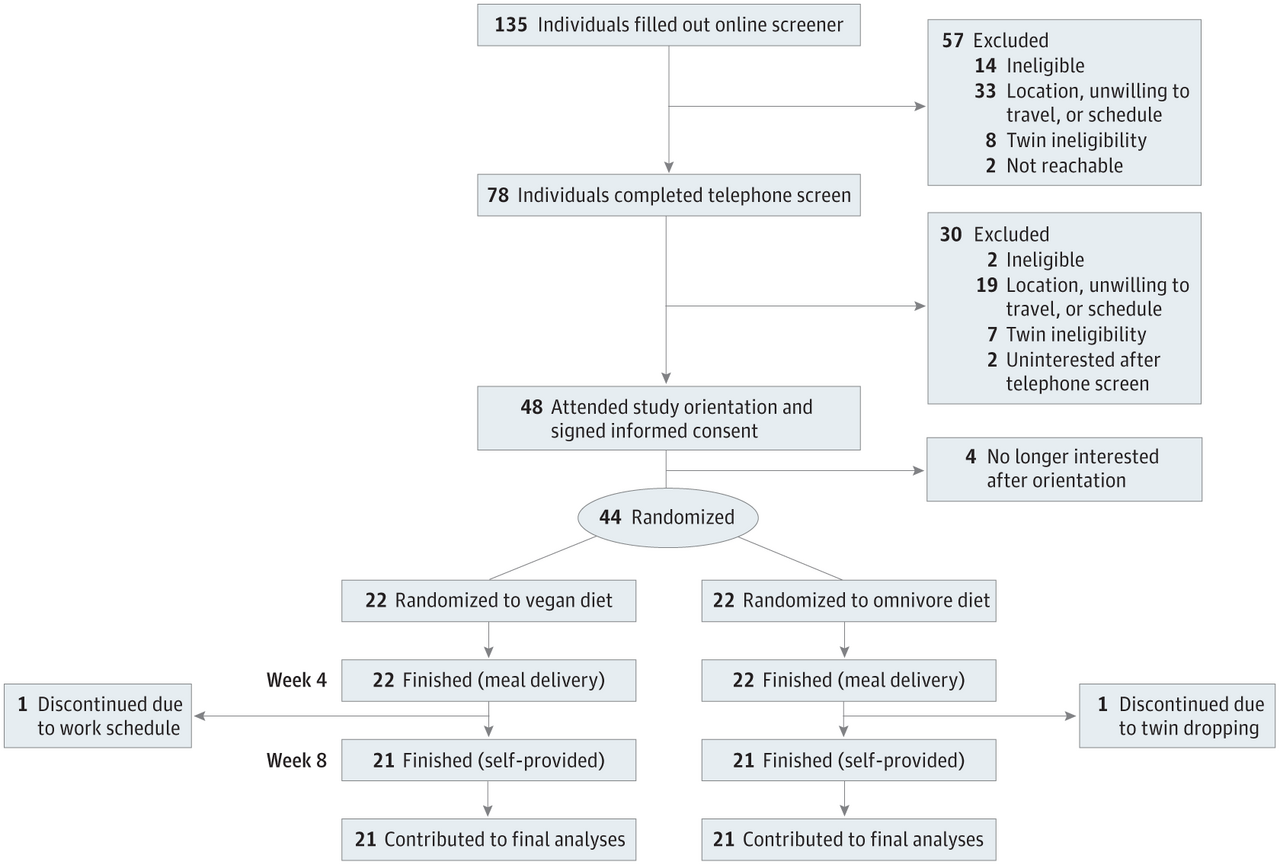
Via Wikimedia Commons: TwiNS CONSORT Flow Diagram of identical twins diet trial by Authors of the study: Matthew J. Landry, PhD, RDN1,2; Cather, CC BY 4.0.
How trials are written up is guided by the CONSORT statement (Consolidated Standards of Reporting Trials), first published in 1996 and revised in 2001, 2010 and 2025. The 2025 version, by Sally Hopewell and colleagues, published on 14 April 2025 in several journals at once, is a 30-item checklist with a diagram tracking participants through each stage of the trial. It added an open science section covering trial registration, access to the protocol and statistical analysis plan, sharing of de-identified participant data and code, and authors' conflicts of interest, along with new items on how harms were assessed and how patients or the public were involved.[9]
Leaving a control group without an effective treatment raises ethical questions. The Declaration of Helsinki allows a placebo or no intervention as the comparison if no proven intervention exists, or where it is methodologically necessary and participants will not be exposed to additional risk of serious or irreversible harm from not receiving the best proven intervention.[11] In the 1948 streptomycin trial, the scarcity of the drug was part of the case for a comparison group.[4]
RCTs are often described as the "gold standard" of evidence. Deaton and Cartwright, in a 2018 paper in Social Science & Medicine, argue that the gold standard or "truth" view does harm when it leads people to set aside other evidence, and they contest the idea that an average effect calculated from an RCT is automatically reliable.[8] Their main points are that:
They add that they are not against RCTs, only magical thinking about them.[8] The Cochrane bias domains show that a randomized trial can still go wrong after allocation, through missing data, unblinded outcome measurement or selective reporting of results.[6]
This entry explains; it is not medical advice. Ask a doctor or pharmacist about your own health.
Numbered the sources. Twelve of the thirteen were read and support what the entry uses them for; the Medical Research Council's 1948 paper (source 5) could be confirmed only by its citation details, because its text is available only as page images, so no sentence cites it yet. These sentences have no source number yet, so they can be checked:
 Get Micwyn on your home screenIts own icon, full screen, and notifications.