Compare versions
Version 1 → Version 2. Removed · Added. This shows the entry's text as it is written, including its formatting marks.
Version 1 · Version 2 · Version history
Side by side · Together
Version 1Version 2
17 unchanged paragraphs
Tarbela Dam is an earth- and rock-filled dam on the Indus River in Pakistan, about 60 km northwest of Islamabad, built in the 1970s to store river water for irrigation and since expanded into a major source of hydroelectric power.
Tarbela Dam is an earth- and rock-filled dam on the Indus River in Pakistan, about 60 km northwest of Islamabad, built in the 1970s to store river water for irrigation and since expanded into a major source of hydroelectric power.
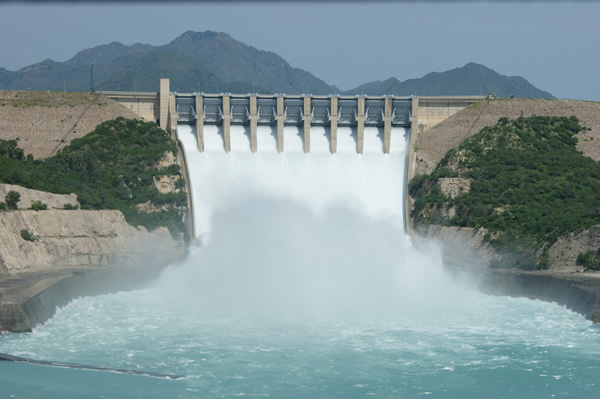

*Via Wikimedia Commons: [Tarbela Dam, KPK, Pakistan](https://commons.wikimedia.org/wiki/File:Tarbela_Dam,_KPK,_Pakistan.jpg) by w:USAID, public domain.*
*Via Wikimedia Commons: [Tarbela Dam, KPK, Pakistan](https://commons.wikimedia.org/wiki/File:Tarbela_Dam,_KPK,_Pakistan.jpg) by w:USAID, public domain.*
## Overview
## Overview
The World Bank's 2012 appraisal of a power project at the dam describes it as [the world's largest earth and rock filled structure](https://documents1.worldbank.org/curated/en/779371468057882621/pdf/609630PAD0corrigendum0R20120003602.pdf), 485 feet (148 metres) high and 9,000 feet (2,743 metres) long. An earth- and rock-filled dam, or embankment dam, holds back water with a mass of compacted soil and rock rather than with concrete. A World Bank completion report of 1992 put its scale another way, noting that the volume of its earth fill was [three times larger than the Aswan High Dam of Egypt](https://documents1.worldbank.org/curated/en/591951468333841354/pdf/multi-page.pdf).
The World Bank's 2012 appraisal of a power project at the dam describes it as [the world's largest earth and rock filled structure](https://documents1.worldbank.org/curated/en/779371468057882621/pdf/609630PAD0corrigendum0R20120003602.pdf), 485 feet (148 metres) high and 9,000 feet (2,743 metres) long. An earth- and rock-filled dam, or embankment dam, holds back water with a mass of compacted soil and rock rather than with concrete. A World Bank completion report of 1992 put its scale another way, noting that the volume of its earth fill was [three times larger than the Aswan High Dam of Egypt](https://documents1.worldbank.org/curated/en/591951468333841354/pdf/multi-page.pdf).
The dam plays three roles: it stores water for irrigation, generates electricity and reduces floods. The same 2012 document states that it is [operated with priority for irrigation and produces hydropower as a byproduct](https://documents1.worldbank.org/curated/en/779371468057882621/pdf/609630PAD0corrigendum0R20120003602.pdf), storing the Indus's summer flood flows and releasing them in the dry winter months. It supplies water to the whole Indus Basin Irrigation System, which the World Bank calls the largest irrigation system in the world. The dam has five tunnels through which water can be released and two spillways, channels that carry surplus water past the dam; in 2012 the Bank noted that more than 70 percent of the water reaching it each year passed over the spillways rather than through the turbines.
The dam plays three roles: it stores water for irrigation, generates electricity and reduces floods. The same 2012 document states that it is [operated with priority for irrigation and produces hydropower as a byproduct](https://documents1.worldbank.org/curated/en/779371468057882621/pdf/609630PAD0corrigendum0R20120003602.pdf), storing the Indus's summer flood flows and releasing them in the dry winter months. It supplies water to the whole Indus Basin Irrigation System, which the World Bank calls the largest irrigation system in the world. The dam has five tunnels through which water can be released and two spillways, channels that carry surplus water past the dam; in 2012 the Bank noted that more than 70 percent of the water reaching it each year passed over the spillways rather than through the turbines.
## Origins in the Indus Waters Treaty
## Origins in the Indus Waters Treaty
The dam grew out of the partition of British India in 1947, after which most rivers of the Indus system flowed through India before reaching Pakistan. After close to ten years of negotiation, the two countries signed the Indus Waters Treaty in 1960. In the summary given by the Asian Infrastructure Investment Bank (AIIB), it allocated [three Eastern Rivers (Ravi, Sutlej and Beas) to India](https://www.aiib.org/en/projects/approved/2016/_download/pakistan-tarbela-5/approved_project_document_tarbela_5_hydropower_extension.pdf) and the three Western Rivers, the Indus, Jhelum and Chenab, to Pakistan, which was to meet the needs once served by the eastern rivers by building "replacement works".
The dam grew out of the partition of British India in 1947, after which most rivers of the Indus system flowed through India before reaching Pakistan. After close to ten years of negotiation, the two countries signed the Indus Waters Treaty in 1960. In the summary given by the Asian Infrastructure Investment Bank (AIIB), it allocated [three Eastern Rivers (Ravi, Sutlej and Beas) to India](https://www.aiib.org/en/projects/approved/2016/_download/pakistan-tarbela-5/approved_project_document_tarbela_5_hydropower_extension.pdf) and the three Western Rivers, the Indus, Jhelum and Chenab, to Pakistan, which was to meet the needs once served by the eastern rivers by building "replacement works".
Tarbela was built as part of that programme, known as the Indus Basin Project. The World Bank's 2012 document states that its purpose was [to compensate for the loss of water supplies of the eastern rivers](https://documents1.worldbank.org/curated/en/779371468057882621/pdf/609630PAD0corrigendum0R20120003602.pdf) that India would now use exclusively. According to the AIIB, donors including the World Bank provided Pakistan with [close to one billion US Dollars](https://www.aiib.org/en/projects/approved/2016/_download/pakistan-tarbela-5/approved_project_document_tarbela_5_hydropower_extension.pdf) toward these works, among them the Tarbela Dam on the Indus and the Mangla Dam on the Jhelum.
Tarbela was built as part of that programme, known as the Indus Basin Project. The World Bank's 2012 document states that its purpose was [to compensate for the loss of water supplies of the eastern rivers](https://documents1.worldbank.org/curated/en/779371468057882621/pdf/609630PAD0corrigendum0R20120003602.pdf) that India would now use exclusively. According to the AIIB, donors including the World Bank provided Pakistan with [close to one billion US Dollars](https://www.aiib.org/en/projects/approved/2016/_download/pakistan-tarbela-5/approved_project_document_tarbela_5_hydropower_extension.pdf) toward these works, among them the Tarbela Dam on the Indus and the Mangla Dam on the Jhelum.
## Construction and first filling
## Construction and first filling
Tarbela had its own financing arrangement. The World Bank's 1992 report records that a Tarbela Development Fund [was established in 1968](https://documents1.worldbank.org/curated/en/591951468333841354/pdf/multi-page.pdf), with foreign exchange contributions from several industrialised countries and a Bank loan, to build the dam both to supplement the Indus's dry-season flows and to generate electricity. The dam is run by Pakistan's Water and Power Development Authority (WAPDA), the state body that owns and operates the country's largest hydropower plants. The 1992 report gives the dam's cost as over $2 billion in 1973.
Tarbela had its own financing arrangement. The World Bank's 1992 report records that a Tarbela Development Fund [was established in 1968](https://documents1.worldbank.org/curated/en/591951468333841354/pdf/multi-page.pdf), with foreign exchange contributions from several industrialised countries and a Bank loan, to build the dam both to supplement the Indus's dry-season flows and to generate electricity. The dam is run by Pakistan's Water and Power Development Authority (WAPDA), the state body that owns and operates the country's largest hydropower plants. The 1992 report gives the dam's cost as over $2 billion in 1973.
The first filling of the reservoir went badly. According to the 1992 report, several of the dam's features were designed to carry discharges and flow speeds never before handled at any dam, and during the [first reservoir filling in the summer of 1974](https://documents1.worldbank.org/curated/en/591951468333841354/pdf/multi-page.pdf) the power and irrigation tunnels, the stilling basins and spillway structures were damaged, and sinkholes were found in the dam's impervious blanket and upstream face. Repair work began at once and continued for years; the Tarbela Development Fund, which paid for it, was not closed until the end of December 1991. The World Bank's 2012 appraisal concluded that, despite those early failures, the dam [has been extremely safe since then](https://documents1.worldbank.org/curated/en/779371468057882621/pdf/609630PAD0corrigendum0R20120003602.pdf), and that its safety had improved as silt settling in the reservoir reduced seepage through the dam. The AIIB dates the completed dam to 1976.
The first filling of the reservoir went badly. According to the 1992 report, several of the dam's features were designed to carry discharges and flow speeds never before handled at any dam, and during the [first reservoir filling in the summer of 1974](https://documents1.worldbank.org/curated/en/591951468333841354/pdf/multi-page.pdf) the power and irrigation tunnels, the stilling basins and spillway structures were damaged, and sinkholes were found in the dam's impervious blanket and upstream face. Repair work began at once and continued for years; the Tarbela Development Fund, which paid for it, was not closed until the end of December 1991. The World Bank's 2012 appraisal concluded that, despite those early failures, the dam [has been extremely safe since then](https://documents1.worldbank.org/curated/en/779371468057882621/pdf/609630PAD0corrigendum0R20120003602.pdf), and that its safety had improved as silt settling in the reservoir reduced seepage through the dam. The AIIB dates the completed dam to 1976.
## Sedimentation
## Sedimentation
Tarbela's reservoir traps sediment carried down by the Indus. In 2012 the World Bank estimated that the reservoir had [lost about 30 percent of its capacity](https://documents1.worldbank.org/curated/en/779371468057882621/pdf/609630PAD0corrigendum0R20120003602.pdf) in the 36 years since commissioning. Its figures show gross storage falling from 11.620 million acre-feet (about 14.3 billion cubic metres) when the dam was commissioned to 7.732 million acre-feet (about 9.5 billion cubic metres) by 2012, and live storage, the part that can actually be released, from 9.679 to 6.625 million acre-feet. An acre-foot is the volume of water that would cover one acre to a depth of one foot; the Bank's conversion is 1 million acre-feet to 1.234 billion cubic metres.
Tarbela's reservoir traps sediment carried down by the Indus. In 2012 the World Bank estimated that the reservoir had [lost about 30 percent of its capacity](https://documents1.worldbank.org/curated/en/779371468057882621/pdf/609630PAD0corrigendum0R20120003602.pdf) in the 36 years since commissioning. Its figures show gross storage falling from 11.620 million acre-feet (about 14.3 billion cubic metres) when the dam was commissioned to 7.732 million acre-feet (about 9.5 billion cubic metres) by 2012, and live storage, the part that can actually be released, from 9.679 to 6.625 million acre-feet. An acre-foot is the volume of water that would cover one acre to a depth of one foot; the Bank's conversion is 1 million acre-feet to 1.234 billion cubic metres.
The silt has built up into a delta inside the reservoir that creeps toward the dam. In 2012 the Bank put its front [about 14 km from the intake of the powerhouse](https://documents1.worldbank.org/curated/en/779371468057882621/pdf/609630PAD0corrigendum0R20120003602.pdf). To keep sediment out of the turbines, the reservoir's dead storage level, below which water is not normally drawn off, was raised to 1,378 feet above sea level on 1 August 2010, and raised intakes were added to the power tunnels in the later extensions. The Bank considered the dam's useful life to be more than 80 years, and noted that dams planned upstream, such as Diamer-Basha, would trap sediment and so extend Tarbela's life. It also recorded the wider cost: storage lost to sedimentation at Tarbela and at the Mangla reservoir exceeds the roughly 2.9 million acre-feet added by raising Mangla Dam, and canal diversions for irrigation, which reached as high as 105 million acre-feet a year after Tarbela was built, averaged [94.5 MAF](https://documents1.worldbank.org/curated/en/779371468057882621/pdf/609630PAD0corrigendum0R20120003602.pdf) in 2001 to 2010.
The silt has built up into a delta inside the reservoir that creeps toward the dam. In 2012 the Bank put its front [about 14 km from the intake of the powerhouse](https://documents1.worldbank.org/curated/en/779371468057882621/pdf/609630PAD0corrigendum0R20120003602.pdf). To keep sediment out of the turbines, the reservoir's dead storage level, below which water is not normally drawn off, was raised to 1,378 feet above sea level on 1 August 2010, and raised intakes were added to the power tunnels in the later extensions. The Bank considered the dam's useful life to be more than 80 years, and noted that dams planned upstream, such as Diamer-Basha, would trap sediment and so extend Tarbela's life. It also recorded the wider cost: storage lost to sedimentation at Tarbela and at the Mangla reservoir exceeds the roughly 2.9 million acre-feet added by raising Mangla Dam, and canal diversions for irrigation, which reached as high as 105 million acre-feet a year after Tarbela was built, averaged [94.5 MAF](https://documents1.worldbank.org/curated/en/779371468057882621/pdf/609630PAD0corrigendum0R20120003602.pdf) in 2001 to 2010.
## Resettlement
## Resettlement
The resettlement of people for the dam left problems that lasted for decades. The World Bank's 2012 document describes [the poor implementation of the Tarbela resettlement program](https://documents1.worldbank.org/curated/en/779371468057882621/pdf/609630PAD0corrigendum0R20120003602.pdf), dating back more than 30 years, as having left difficult outstanding issues. At that time 40 claims from the original Tarbela project and 410 from the later Ghazi Barotha hydropower project, which runs on water released from Tarbela, were still pending in Pakistan's courts, and the Bank's project financed a programme to settle them. The AIIB reported in 2016 that several of these legacy cases had been [addressed through a Resettlement Commission](https://www.aiib.org/en/projects/approved/2016/_download/pakistan-tarbela-5/approved_project_document_tarbela_5_hydropower_extension.pdf) and that the commission would continue its work.
The resettlement of people for the dam left problems that lasted for decades. The World Bank's 2012 document describes [the poor implementation of the Tarbela resettlement program](https://documents1.worldbank.org/curated/en/779371468057882621/pdf/609630PAD0corrigendum0R20120003602.pdf), dating back more than 30 years, as having left difficult outstanding issues. At that time 40 claims from the original Tarbela project and 410 from the later Ghazi Barotha hydropower project, which runs on water released from Tarbela, were still pending in Pakistan's courts, and the Bank's project financed a programme to settle them. The AIIB reported in 2016 that several of these legacy cases had been [addressed through a Resettlement Commission](https://www.aiib.org/en/projects/approved/2016/_download/pakistan-tarbela-5/approved_project_document_tarbela_5_hydropower_extension.pdf) and that the commission would continue its work.
## Contractors and workforce
Webuild, the Italian construction group, describes Tarbela on its project page as a site where [as many as 45,000 workers from 26 different countries](https://www.webuildgroup.com/en/projects/dams-hydroelectric-plants/tarbela-hydroelectric-plant/) worked, and as [five times the size of the largest construction sites the company had managed until then](https://www.webuildgroup.com/en/projects/dams-hydroelectric-plants/tarbela-hydroelectric-plant/). It says the construction of the dam, powerhouse and tunnels [started in 1968](https://www.webuildgroup.com/en/projects/dams-hydroelectric-plants/tarbela-hydroelectric-plant/) for WAPDA, and puts the length of the main dam at its crest at [almost 3 km](https://www.webuildgroup.com/en/projects/dams-hydroelectric-plants/tarbela-hydroelectric-plant/), in line with the 2,743 metres given by the World Bank. The same page states that [in the early 1980s the Tarbela consortium was commissioned to enhance the plant's hydroelectric capacity](https://www.webuildgroup.com/en/projects/dams-hydroelectric-plants/tarbela-hydroelectric-plant/) with a new power station. The page names neither the consortium's members nor the contract value.
Sources differ on the end of construction. Dawn, reporting on the dam's 50th anniversary in September 2024 and drawing on figures from WAPDA's media wing, wrote that work began in 1968 and that [WAPDA finished the civil works in the third quarter of 1974](https://www.dawn.com/news/1858636), with the powerhouse developed in phases from 1974. The AIIB, as noted above, dates the completed dam to 1976.
3 unchanged paragraphs
## Power extensions
## Power extensions
Hydropower units were first installed on three of the dam's tunnels. By 2012 the dam had an installed capacity of 3,478 megawatts (MW). The Fourth Extension, approved by the World Bank on 20 March 2012, added a [1,410 MW powerhouse](https://documents1.worldbank.org/curated/en/099050726004512277/pdf/P115893-4852f86a-62e0-4157-b8ed-ae179505683a.pdf) on Tunnel 4 and has been in operation since 2018; the World Bank reported in May 2026 that it had generated more than 32,548 gigawatt-hours (GWh) since commissioning. With it, the Bank gives the Tarbela complex 4,888 MW of dependable capacity and an annual output of 17,000 to 18,000 GWh, about half of WAPDA's hydropower output.
Hydropower units were first installed on three of the dam's tunnels. By 2012 the dam had an installed capacity of 3,478 megawatts (MW). The Fourth Extension, approved by the World Bank on 20 March 2012, added a [1,410 MW powerhouse](https://documents1.worldbank.org/curated/en/099050726004512277/pdf/P115893-4852f86a-62e0-4157-b8ed-ae179505683a.pdf) on Tunnel 4 and has been in operation since 2018; the World Bank reported in May 2026 that it had generated more than 32,548 gigawatt-hours (GWh) since commissioning. With it, the Bank gives the Tarbela complex 4,888 MW of dependable capacity and an annual output of 17,000 to 18,000 GWh, about half of WAPDA's hydropower output.
The Fifth Extension converts Tunnel 5, previously used only to release irrigation water, into a [1,530 megawatt (MW) powerhouse](https://documents1.worldbank.org/curated/en/099050726004512277/pdf/P115893-4852f86a-62e0-4157-b8ed-ae179505683a.pdf), which would bring the dam's capacity to 6,418 MW (4,888 plus 1,530). It is financed by a World Bank loan of $390 million approved on 20 September 2016, a $300 million loan from the AIIB approved a week later, and money from WAPDA. The World Bank's document of 7 May 2026 described a further $300 million to cover a cost overrun, which it attributed to inflation, larger quantities of work, the need to replace and rehabilitate the gates in Tunnel 5, and interest during construction. It expected the generating units to be commissioned in July 2027.
The Fifth Extension converts Tunnel 5, previously used only to release irrigation water, into a [1,530 megawatt (MW) powerhouse](https://documents1.worldbank.org/curated/en/099050726004512277/pdf/P115893-4852f86a-62e0-4157-b8ed-ae179505683a.pdf), which would bring the dam's capacity to 6,418 MW (4,888 plus 1,530). It is financed by a World Bank loan of $390 million approved on 20 September 2016, a $300 million loan from the AIIB approved a week later, and money from WAPDA. The World Bank's document of 7 May 2026 described a further $300 million to cover a cost overrun, which it attributed to inflation, larger quantities of work, the need to replace and rehabilitate the gates in Tunnel 5, and interest during construction. It expected the generating units to be commissioned in July 2027.
## Output and costs reported in 2024
In September 2024, on the fiftieth anniversary of the first filling, Dawn published figures attributed to WAPDA's media wing. It reported that over the 50 years the dam had [released 406 million acre-feet (MAF) of stored water for agriculture and generated 590,361 million units of electricity](https://www.dawn.com/news/1858636) for the national grid. The same article gave the cost of the original project, including power units 1 to 14, as [$2,630 million](https://www.dawn.com/news/1858636), of the Fourth Extension (units 15 to 17) as [$1,075 million](https://www.dawn.com/news/1858636), and of the Fifth Extension, then under construction, as [$807 million](https://www.dawn.com/news/1858636).
Dawn also reported that the reservoir, which spreads over 259 square kilometres, had an initial live storage of 9.68 MAF that had [fallen to 5.77 MAF through sedimentation](https://www.dawn.com/news/1858636). This is lower than the 6.625 MAF the World Bank gave for 2012, and the two figures come from different dates and sources, with no method stated in the newspaper report. The media wing also put the economic and financial benefit of the dam at $406 billion, but Dawn's report describes this as [based on an assumed value of $1 billion per MAF](https://www.dawn.com/news/1858636) of water released, so it is a WAPDA estimate resting on that assumption, not a measured figure.
4 unchanged paragraphs
## Cofferdam failures
## Cofferdam failures
A cofferdam is a temporary barrier built to keep water out of a construction site. Pakistani business news site Profit, citing the newspaper Dawn, reported on 13 July 2026 that a government inquiry into an August 2025 cofferdam collapse at the Fifth Extension site had held the contractor, the consultant and WAPDA responsible, finding that [unauthorised design changes and contractual violations](https://profit.pakistantoday.com.pk/2026/07/13/tarbela-5-cost-surges-to-rs317-billion-after-cofferdam-collapse-delays-project-by-two-years) contributed to the failure. According to that report, the inquiry found that river flows at the time were within Tarbela's historical range and well below the cofferdam's design capacity. The report said the collapse delayed the project by at least two years, raised its estimated cost from Rs82.36 billion in 2017 to Rs317 billion, and moved its expected completion to the end of June 2028.
A cofferdam is a temporary barrier built to keep water out of a construction site. Pakistani business news site Profit, citing the newspaper Dawn, reported on 13 July 2026 that a government inquiry into an August 2025 cofferdam collapse at the Fifth Extension site had held the contractor, the consultant and WAPDA responsible, finding that [unauthorised design changes and contractual violations](https://profit.pakistantoday.com.pk/2026/07/13/tarbela-5-cost-surges-to-rs317-billion-after-cofferdam-collapse-delays-project-by-two-years) contributed to the failure. According to that report, the inquiry found that river flows at the time were within Tarbela's historical range and well below the cofferdam's design capacity. The report said the collapse delayed the project by at least two years, raised its estimated cost from Rs82.36 billion in 2017 to Rs317 billion, and moved its expected completion to the end of June 2028.
On 9 November 2026 Al Jazeera reported that [a protective barrier collapsed](https://www.aljazeera.com/video/newsfeed/2026/11/9/partial-collapse-of-pakistans-tarbela-dam-causes-flood-water-surge) at the partly built Fifth Extension project in Khyber Pakhtunkhwa province, causing a flood; a worker swept away was rescued and no casualties were reported. The report gave no cause.
On 9 November 2026 Al Jazeera reported that [a protective barrier collapsed](https://www.aljazeera.com/video/newsfeed/2026/11/9/partial-collapse-of-pakistans-tarbela-dam-causes-flood-water-surge) at the partly built Fifth Extension project in Khyber Pakhtunkhwa province, causing a flood; a worker swept away was rescued and no casualties were reported. The report gave no cause.
## Sources
## Sources
- World Bank, *Project Appraisal Document on a Proposed Loan … for the Tarbela Fourth Extension Hydropower Project (T4HP)*, Report No. 60963-PK, 23 February 2012. https://documents1.worldbank.org/curated/en/779371468057882621/pdf/609630PAD0corrigendum0R20120003602.pdf
- World Bank, *Project Completion Report: Pakistan, Reservoir Maintenance Facilities Project*, Report No. 10725, 1992. https://documents1.worldbank.org/curated/en/591951468333841354/pdf/multi-page.pdf
- Asian Infrastructure Investment Bank, *Project Document: Pakistan, Tarbela 5 Hydropower Extension Project*, Report No. 0005-PAK, 9 December 2016. https://www.aiib.org/en/projects/approved/2016/_download/pakistan-tarbela-5/approved_project_document_tarbela_5_hydropower_extension.pdf
- World Bank, *Second Additional Financing for Tarbela Fourth Extension Hydropower Project (P115893)*, Project Information Document / Integrated Safeguards Data Sheet, Report No. ISDSIA0117, 7 May 2026. https://documents1.worldbank.org/curated/en/099050726004512277/pdf/P115893-4852f86a-62e0-4157-b8ed-ae179505683a.pdf
- Profit by Pakistan Today, "Tarbela-5 cost surges to Rs317 billion after cofferdam collapse delays project by two years", 13 July 2026. https://profit.pakistantoday.com.pk/2026/07/13/tarbela-5-cost-surges-to-rs317-billion-after-cofferdam-collapse-delays-project-by-two-years
- Al Jazeera, "Partial collapse of Pakistan's Tarbela dam causes flood water surge", 9 November 2026. https://www.aljazeera.com/video/newsfeed/2026/11/9/partial-collapse-of-pakistans-tarbela-dam-causes-flood-water-surge
- Webuild, "Tarbela Hydroelectric Plant", project page (undated; read 15 November 2026). https://www.webuildgroup.com/en/projects/dams-hydroelectric-plants/tarbela-hydroelectric-plant/
- Dawn, "Tarbela Dam marks 50th anniversary", by Muhammad Sadaqat, 13 September 2024. https://www.dawn.com/news/1858636
