Sarcopenia
The progressive loss of skeletal muscle mass and strength, most often with age, now recognised as a disease
📖 Dictionary: sarcopenia · 📚 Library
The progressive loss of skeletal muscle mass and strength, most often with age, now recognised as a disease
📖 Dictionary: sarcopenia · 📚 Library

Sarcopenia is a progressive, generalised disease of skeletal muscle in which a person loses muscle mass and strength, most often with age, raising the risk of falls, fractures, disability and death.
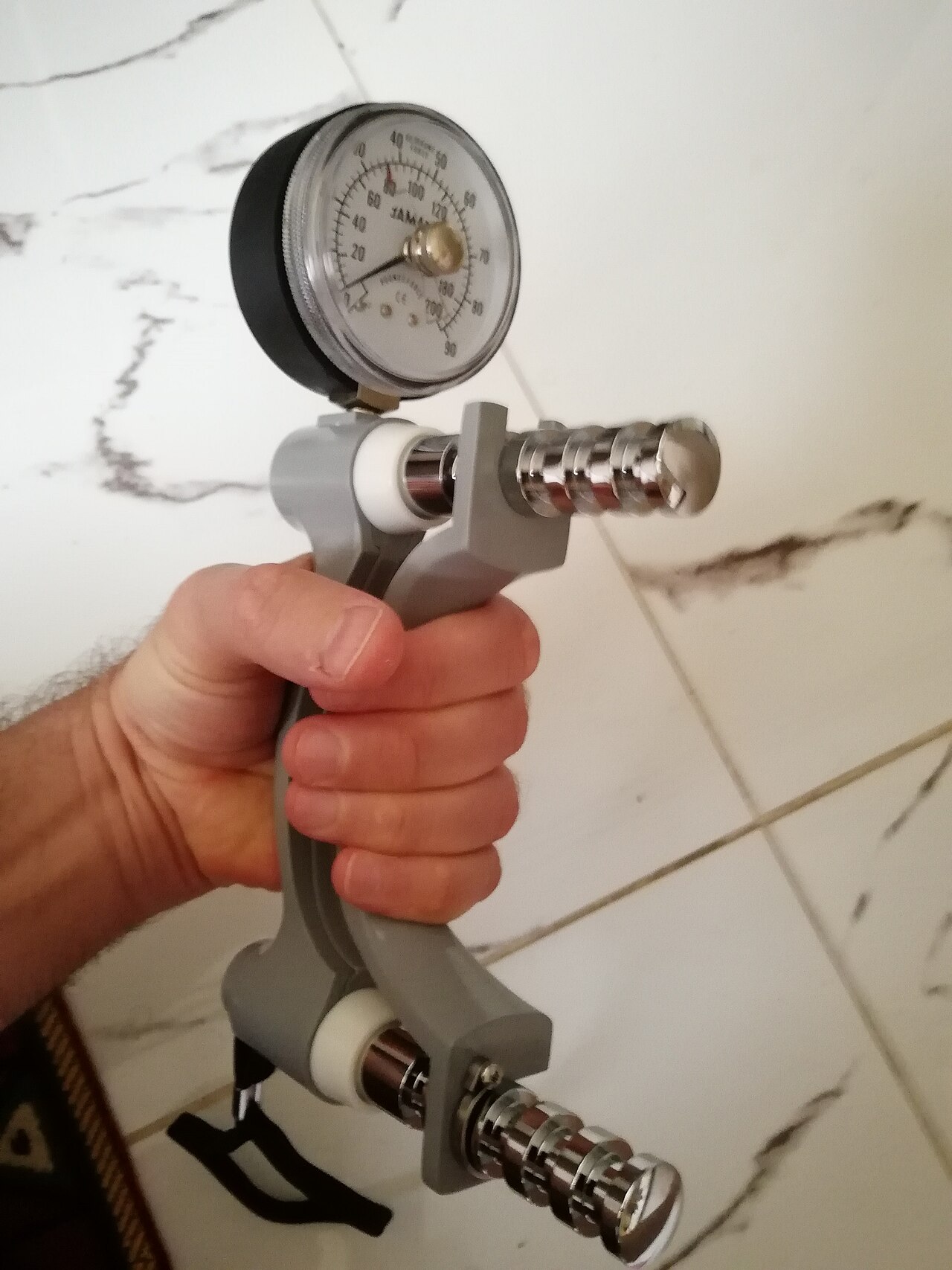
Via Wikimedia Commons: Hand dynamometer by Ashashyou, CC0.
The term covers more than ordinary thinning of the muscles. The European Working Group on Sarcopenia in Older People, in its revised consensus of 2018, describes sarcopenia as "a progressive and generalised skeletal muscle disorder" associated with an increased likelihood of falls, fractures, physical disability and mortality, and calls it a form of "muscle failure". The Global Leadership Initiative in Sarcopenia, an international panel, described it in 2024 as "the age-related loss of muscle mass and strength/function".
The word was proposed by Irwin Rosenberg at a meeting in Albuquerque, New Mexico, in 1988, according to a 2010 review by Stephan von Haehling, John Morley and Stefan Anker. It combines the Greek sarx, flesh, and penia, loss, so that it means "poverty of flesh". The same authors note that the loss of muscle in the limbs in old age had been reported long before, by Critchley in 1931 (Anker, Morley and von Haehling, 2016).
For two decades the word described a process rather than a diagnosis. In 2010 the European Working Group on Sarcopenia in Older People (EWGSOP) published a definition that, by its own later account, was widely used worldwide. Other groups produced their own, including the Asian Working Group for Sarcopenia, the Foundation for the National Institutes of Health in the United States, and the International Working Group on Sarcopenia, each with different measurements and cut-off points (Petermann-Rocha and others, 2022).
In September 2016 sarcopenia was given its own diagnostic code, M62.84, in ICD-10-CM, a clinical modification of the International Classification of Diseases that is used to report medical claims and monitor diagnosis and treatment. An editorial in the Journal of Cachexia, Sarcopenia and Muscle called the code "a major step forward in recognizing sarcopenia as a disease", comparing it with the earlier recognition of osteoporosis as a disease, and predicted that it would encourage doctors to diagnose the condition and drug companies to look for treatments.
Muscle mass and strength decline with age in everyone, but at different rates. The 2018 European consensus cites losses after the age of 50 of 1 to 2 percent of leg muscle mass per year and 1.5 to 5 percent of strength per year, and notes that the development of sarcopenia is now recognised to begin earlier in life. A fact sheet from a campaign funded by the Office on Women's Health of the U.S. Department of Health and Human Services gives a loss of 3 to 5 percent of muscle mass per decade after the age of 30 without proper exercise and nutrition.
Several changes inside ageing muscle contribute. The 2010 review by von Haehling and colleagues describes a loss of motor units through denervation (a motor unit is a nerve cell together with the muscle fibres it controls), with surviving units taking over the work of those lost; a net shift from fast type II muscle fibres to slow type I fibres, which reduces the power needed for tasks such as rising from a chair; and the deposit of fat within muscle fibres, which lowers strength without necessarily changing body weight.
The European consensus distinguishes two kinds. Sarcopenia is "primary" (or age-related) when no other specific cause is evident. It is secondary when other causes are at work as well as or instead of ageing: a systemic disease, especially one involving inflammation such as cancer or organ failure; physical inactivity; or an inadequate intake of energy or protein. The same document separates sarcopenia that lasts less than six months (acute) from that lasting six months or more (chronic). It treats sarcopenic obesity, reduced lean body mass in the context of excess body fat, as a distinct condition.
The revised European definition, known as EWGSOP2, published online on 24 September 2018, changed the emphasis from muscle mass to muscle strength. It "elevates low strength to the forefront" as the primary indicator of probable sarcopenia, describing low muscle strength as having overtaken low muscle mass as the principal determinant. Its approach runs in steps, summarised as find, assess, confirm and gauge severity:
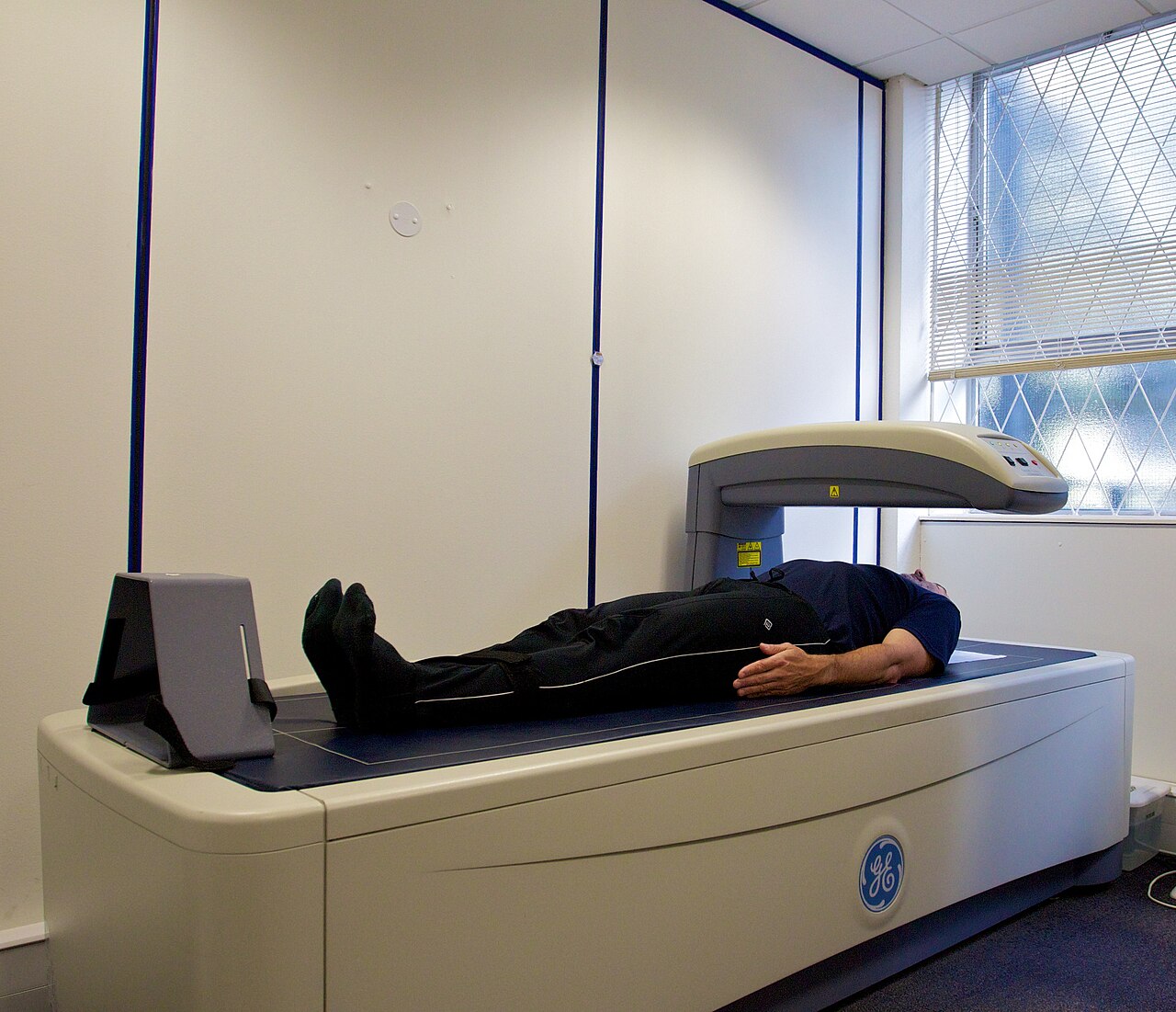
Via Wikimedia Commons: DEXA scanner in use ALSPAC by Nick Smith photography, CC BY-SA 3.0.
The consensus gives cut-off points for each test (Cruz-Jentoft and others, 2019):
| Measure | Men | Women |
|---|---|---|
| Grip strength | under 27 kg | under 16 kg |
| Five rises from a chair | over 15 seconds | over 15 seconds |
| Appendicular skeletal muscle mass (arms and legs) | under 20 kg | under 15 kg |
| The same, divided by height squared | under 7.0 kg/m² | under 5.5 kg/m² |
| Walking speed | 0.8 m/s or slower | 0.8 m/s or slower |
| Timed up-and-go test | 20 seconds or more | 20 seconds or more |
| 400-metre walk | not completed, or 6 minutes or more | not completed, or 6 minutes or more |
Earlier definitions were specific to regions, which produced wide variation in prevalence estimates and made the results of trials hard to compare. To create a single definition, the Global Leadership Initiative in Sarcopenia (GLIS) set out to agree one conceptual definition. Its Delphi survey, a structured process of repeated voting, involved 107 participants from 29 countries, and statements needed more than 80 percent agreement to be accepted (Kirk, Cawthon and others, 2024).
The panel agreed that sarcopenia comprises the concurrent combination of reduced muscle mass and reduced muscle strength. Muscle mass (89.4 percent agreement), muscle strength (93.1 percent) and muscle-specific strength, meaning strength standardised to muscle size (80.8 percent), were accepted as components. Impaired physical performance was accepted as an outcome of sarcopenia rather than a component, alongside falls, fractures, hospitalisation, admission to a nursing home, poor quality of life and death. Proposals to include physical performance as a component (about 80 percent, just below the threshold), muscle power (68.4 percent) and severity levels (77.0 percent) were not accepted. The panel also agreed that sarcopenia is a generalised disease of skeletal muscle, that its prevalence increases with age, and that it is potentially reversible (Kirk, Cawthon and others, 2024).
The conceptual definition was intended as the basis for an operational definition with specific measurements. An editorial by three of its members, published in May 2024, said the definition was expected to be endorsed by the World Health Organization for inclusion in the next International Classification of Diseases.
Estimates depend heavily on which definition is used. A systematic review and meta-analysis by Fanny Petermann-Rocha and colleagues, published online on 23 November 2021, drew on 151 studies with 692,056 participants, whose mean age was 68.5 years. Using different classifications and cut-off points, it found the prevalence of sarcopenia varied between 10 and 27 percent, and the prevalence of severe sarcopenia between 2 and 9 percent.
The definitions disagree even on who is more affected. Under EWGSOP2, men had a higher prevalence than women (11 percent against 2 percent); under the International Working Group on Sarcopenia, women did (17 percent against 12 percent). The highest estimates came from studies in Oceania using the original 2010 European definition and the lowest from studies in Europe using EWGSOP2 (Petermann-Rocha and others, 2022). The authors concluded that prevalence varied considerably with the classification used.
The U.S. Office on Women's Health campaign fact sheet puts the figure at about 10 percent of adults aged 60 and older, rising to 24 percent among those in hospital, and to 31 percent of women and 51 percent of men living in nursing homes.
Sarcopenia matters chiefly for what follows from it. The European consensus links it to falls, fractures, physical disability and death, to difficulty with daily activities, and to higher health-care costs (Cruz-Jentoft and others, 2019). The Office on Women's Health fact sheet reports that people with sarcopenia have a 58 percent higher risk of bone fractures and a 13.8 percent higher risk of losing independence than those without it, and that they are nearly twice as likely to be admitted to hospital.
The European consensus states that interventions including nutrition and exercise training "seem to slow or reverse these processes", and the 2024 global panel agreed that the condition is potentially reversible. The Office on Women's Health fact sheet reports that there is no medication to cure sarcopenia and that supplements including protein, amino acids, vitamin D and omega-3 fatty acids have shown promising effects, especially combined with diet and exercise, while more research is needed.
Among the open questions the European consensus lists is which outcomes are best used as sensitive measures of response to sarcopenia treatments. The 2016 editorial expected formal recognition as a disease to spur the development of drugs for sarcopenia; the 2024 global definition was designed in part so that trials around the world could use the same criteria (Kirk, Cawthon and Cruz-Jentoft, 2024).
This entry explains; it is not medical advice. Ask a doctor or pharmacist about your own health.
 Get Micwyn on your home screenIts own icon, full screen, and notifications.