Version 1
Nov 12, 2026. Compare with the current version · Version history
Impeachment is the process by which a legislature formally charges a public official with serious misconduct, the first step toward a trial that can remove that official from office.
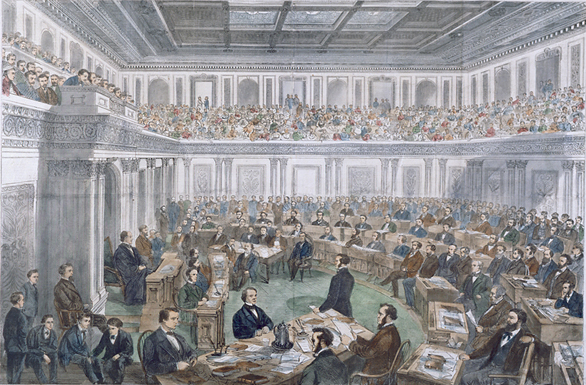
Via Wikimedia Commons: The Senate as a Court of Impeachment for the Trial of Andrew Johnson ( by Theodore Russel Davis, public domain.
In the United States the word names only the charge. The House of Representatives impeaches, and the Senate then holds a trial; an official who has been impeached has not thereby been removed. The United States Constitution gives the House "the sole Power of Impeachment" and the Senate "the sole Power to try all Impeachments", and removal follows only on conviction.
Origins in England
The practice began in the English Parliament. The United States Senate's historical account dates it to 14th-century England, where Parliament used it to hold the king's advisers to account, and notes that it was revived in the early 1600s. The House of Representatives' history office describes it in the same terms, as a British practice that developed from the fourteenth century as Parliament's way of holding the Crown's ministers accountable. In the English form the House of Commons brought the charges and the House of Lords tried them.
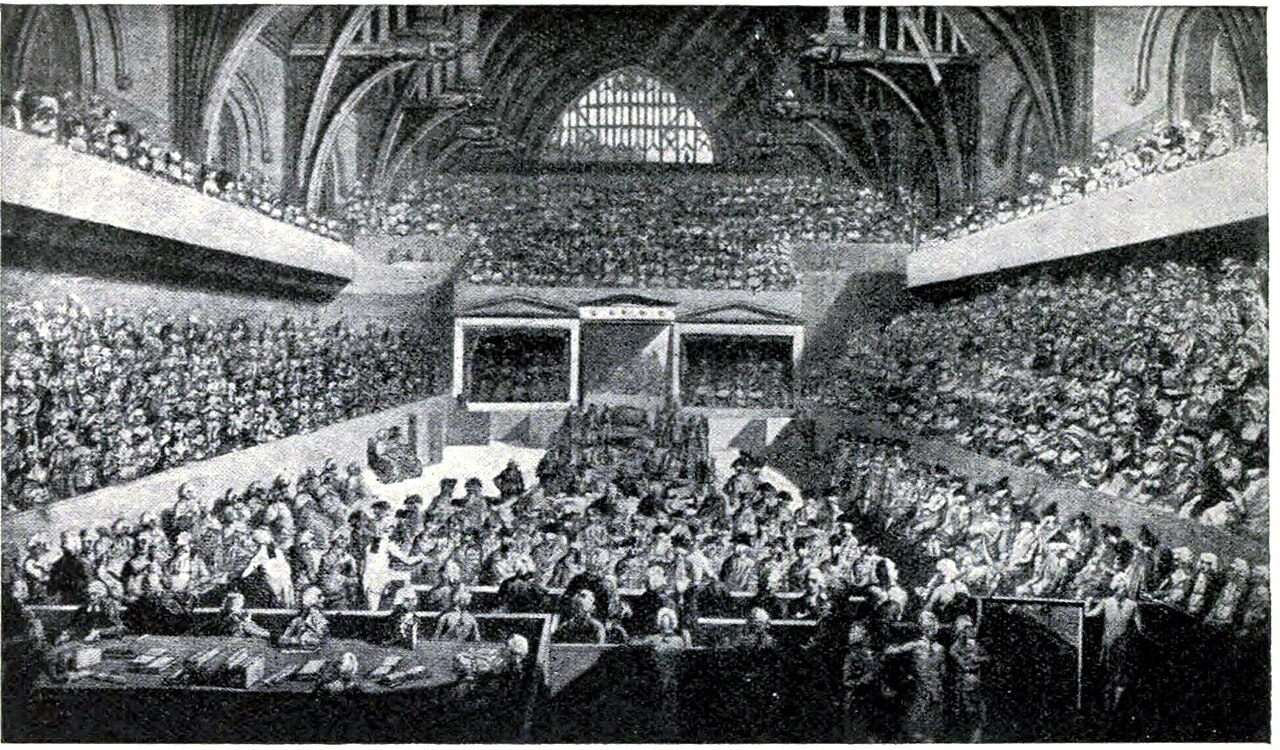
Via Wikimedia Commons: The trial of Warren Hastings, 1788 by Robert Pollard / Francis Jukes / Edward Dayes, public domain.
English impeachment trials could be long, public occasions. When the Commons debated on 26 March 1806 where the trial of Viscount Melville should be held, Melville's son Robert Dundas argued against Westminster Hall on grounds of time and cost, recalling that the case of Warren Hastings, tried in Westminster-hall, had lasted eight sessions. Supporters of the Hall argued that publicity and solemnity were essential to an impeachment, and their motion was carried.
Adoption in the United States
Many American colonial and state governments used impeachment before the Constitution, according to the Senate. The House history office notes that some states allowed it for "maladministration" or "corruption" before the Constitution was ratified in 1788.
At the Constitutional Convention of 1787 the delegates disagreed over whether a president should be impeachable at all. Rufus King of Massachusetts argued that elections were the proper check, since a president would periodically be tried for his behaviour by his electors. Elbridge Gerry, also of Massachusetts, took the other side: "A bad one ought to be kept in fear of them." When the grounds for removal were debated, James Madison objected that "maladministration" was too vague, and George Mason proposed "other high Crimes and Misdemeanors" instead, which the delegates accepted. An early plan would have given a role in impeachments to the judiciary; the delegates instead followed the British model, with the lower house prosecuting and the upper house judging.
Alexander Hamilton defended the arrangement in Federalist No. 65. He wrote that the offences impeachment deals with are those that proceed from the misconduct of public men, "or, in other words, from the abuse or violation of some public trust", and that they could properly be called "POLITICAL". He also foresaw the strain they would cause: a prosecution of this kind, he wrote, "will seldom fail to agitate the passions of the whole community, and to divide it into parties".
What the Constitution says
The impeachment provisions are spread across the Constitution:
- Article I, Section 2 gives the House of Representatives the sole power of impeachment.
- Article I, Section 3 gives the Senate the sole power to try impeachments. When the president is tried, the Chief Justice of the United States presides, and no one may be convicted without the agreement of two-thirds of the senators present. The judgment may go no further than removal from office and disqualification from holding federal office in future, but the person convicted remains liable to ordinary prosecution and punishment under the law.
- Article II, Section 2 lets the president grant pardons for offences against the United States, "except in Cases of Impeachment".
- Article II, Section 4 provides that the president, the vice president and all civil officers of the United States shall be removed on impeachment for, and conviction of, "Treason, Bribery, or other high Crimes and Misdemeanors".
- Article III, Section 2 requires criminal trials to be held by jury, except in cases of impeachment.
The Constitution does not define "high Crimes and Misdemeanors". The Senate notes that the meaning of the phrase has long been debated.
How it works
In the House, the process usually begins with a resolution introduced by a member or a resolution authorizing an inquiry. The Judiciary Committee ordinarily has jurisdiction; it decides whether to draw up articles of impeachment, the formal charges, and reports them to the full House, which adopts them by a simple majority. Before the Judiciary Committee was created in 1813, special committees handled the charges. The House then appoints members, called managers, to prosecute the case in the Senate.
The Senate sits as a court, hears evidence and witnesses, and votes on each article. Conviction requires a two-thirds vote; the penalty is removal from office, in some cases the Senate has also barred the person from holding office again, and there is no appeal.
Since a rule adopted in 1935, the Senate may appoint a committee of senators to take evidence and report to the full Senate, and its impeachment rules were revised in 1986. Trial committees heard evidence in the cases of the judges Harry Claiborne in 1986, Alcee Hastings and Walter Nixon in 1989, and Thomas Porteous in 2010, according to the Senate Historical Office.
Walter Nixon, a former chief judge of the federal district court for the southern district of Mississippi, had been convicted by a jury of making false statements to a federal grand jury before the House impeached him. He challenged his removal on the ground that a committee hearing was not a trial by the Senate. On 13 January 1993 the Supreme Court, in an opinion by Chief Justice William Rehnquist, held in Nixon v. United States that his claim was nonjusticiable: the Constitution's word "try" did not set a limit the courts could enforce, so how the Senate conducts an impeachment trial is for the Senate to decide.
Cases in the United States
The House has begun impeachment proceedings more than 60 times, and roughly a third of those led to impeachment, according to its history office. Its list of impeachments, read in November 2026, records 22 impeachments of 21 people since 1797: 15 federal judges, three presidents (one of them twice), two cabinet secretaries and one senator.
- William Blount, a senator from Tennessee, was impeached on 7 July 1797, the first case. The Senate expelled him before his trial, and the charges were dismissed for want of jurisdiction. The House history office notes that the case established that members of Congress are not "civil officers" within the meaning of the Constitution.
- Samuel Chase, an associate justice of the Supreme Court, was impeached in 1804 and acquitted.
- Andrew Johnson became the first president to be impeached, on 24 February 1868. The trial turned on whether a president could remove a cabinet officer without Congress's approval. On the first vote, on the eleventh article, the Senate divided 35 guilty to 19 not guilty, one vote short of the 36 needed, with seven Republicans joining the twelve Democrats to acquit.
- William W. Belknap, secretary of war, was impeached in 1876 and acquitted.
- Bill Clinton was impeached on 19 December 1998 and acquitted on 12 February 1999.
- Donald Trump was impeached on 18 December 2019 and acquitted on 5 February 2020, and impeached again on 13 January 2021 and acquitted on 13 February 2021.
- Alejandro Mayorkas, secretary of homeland security, was impeached on 13 February 2024. On 17 April 2024 the Senate dismissed the charges as unconstitutional, and no trial was held.
The House history office counts eight people, all federal judges, convicted and removed, and three of them, all removed judges, also barred from holding federal office in future: West H. Humphreys, Robert W. Archbald and G. Thomas Porteous Jr., according to the House's list. Several other judges resigned before or during their trials, which ended the proceedings, among them Mark Delahay in 1873, George English in 1926 and Samuel Kent in 2009.
Outside the United States
Impeachment exists outside the United States as well, though the body that judges the case can differ. In South Korea the National Assembly impeaches and the Constitutional Court decides whether the impeachment stands. In December 2016 the National Assembly voted to impeach President Park Geun-hye, and on 10 March 2017 the Constitutional Court unanimously approved that vote, removing her from office. As an analysis in the Yale Journal of International Law notes, the court ruled on the legitimacy of the Assembly's decision to impeach, not on her criminal guilt.
Debate
Arguments about impeachment go back to the Convention. One side, put by Rufus King, holds that elections are the proper remedy for a bad executive; the other, put by Elbridge Gerry, holds that an executive must be answerable between elections. Because the Constitution leaves "high Crimes and Misdemeanors" undefined, each case reopens the question of what conduct the phrase reaches, a question the Senate itself describes as long debated. Hamilton, for his part, called impeachable offences "POLITICAL" and warned that impeachments would divide the community into parties.
As of November 2026, presidents have been impeached four times and none has been convicted; every official the Senate has convicted has been a federal judge.
Sources
- The Constitution of the United States: A Transcription. U.S. National Archives. archives.gov/founding-docs/constitution-transcript
- Alexander Hamilton, The Federalist No. 65. The Avalon Project, Yale Law School. avalon.law.yale.edu/18th_century/fed65.asp
- "Impeachment". Office of the Historian and Office of Art and Archives, U.S. House of Representatives. history.house.gov/Institution/Origins-Development/Impeachment/
- "List of Individuals Impeached by the House of Representatives". U.S. House of Representatives, History, Art & Archives (read 12 November 2026). history.house.gov/Institution/Impeachment/Impeachment-List/
- "Impeachment". United States Senate, Powers and Procedures. senate.gov/about/powers-procedures/impeachment.htm
- "Impeachment" (historical briefing). United States Senate Historical Office. senate.gov/artandhistory/history/common/briefing/Senate_Impeachment…
- "Complete List of Senate Impeachment Trials". United States Senate (read 12 November 2026). senate.gov/about/powers-procedures/impeachment/impeachment-list.htm
- Nixon v. United States, 506 U.S. 224 (1993), decided 13 January 1993. Legal Information Institute, Cornell Law School. law.cornell.edu/supremecourt/text/506/224
- "Impeachment of Lord Melville", House of Commons debate, 26 March 1806, Hansard vol. 6. UK Parliament, Historic Hansard. api.parliament.uk/historic-hansard/commons/1806/mar/26/impeachment-…
- "A Closer Look at the Korean Constitutional Court's Ruling on Park Geun-hye's Impeachment". Yale Journal of International Law, 18 May 2017. yjil.yale.edu/posts/2017-05-18-a-closer-look-at-the-korean-constitu…
