Version 3 (current)
Nov 13, 2026. Version history
Impeachment is the process by which a legislature formally charges a public official with serious misconduct, the first step toward a trial that can remove that official from office.
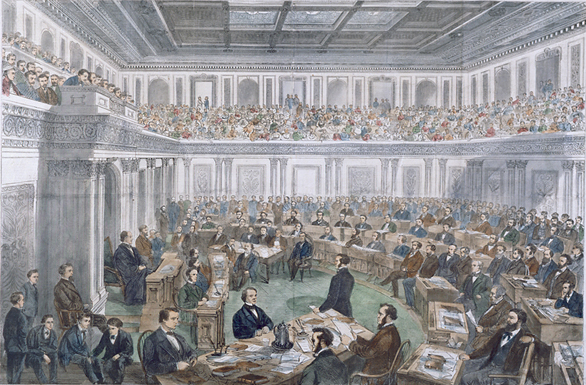
Via Wikimedia Commons: The Senate as a Court of Impeachment for the Trial of Andrew Johnson ( by Theodore Russel Davis, public domain.
In the United States the word names only the charge. The House of Representatives impeaches, and the Senate then holds a trial; an official who has been impeached has not thereby been removed.[1][21] The United States Constitution gives the House "the sole Power of Impeachment" and the Senate "the sole Power to try all Impeachments", and removal follows only on conviction.[1]
The practice began in medieval England and passed to the American colonies and then into the United States Constitution of 1787.[3][25] Other countries have since written it, in different forms, into their own constitutions, among them South Korea, Brazil and the Philippines.[54][56][57] Some leave the verdict to the upper house of the legislature; others, such as South Korea and Germany, hand it to a constitutional court.[54][56][57][62] In Britain, where it began, it has not been used since 1806.[12]
Origins in England
The practice began in the English Parliament. The United States Senate's historical account dates it to 14th-century England, where Parliament used it to hold the king's advisers to account, and notes that it was revived in the early 1600s.[6] The House of Representatives' history office describes it in the same terms, as a British practice that developed from the fourteenth century as Parliament's way of holding the Crown's ministers accountable.[3] In the English form the House of Commons brought the charges and the House of Lords tried them.[3]
The medieval cases
The first recorded impeachment took place in the "Good Parliament" of 1376, late in the reign of Edward III.[25] According to Charles Moreton of the History of Parliament, the Commons, speaking through Sir Peter de la Mare, who is generally recognised as the first Speaker, drew up formal allegations against courtiers and financiers they suspected of incompetence and corruption, and the Lords tried the charges as a high court.[25] Those impeached included the king's chamberlain, William, Lord Latimer, and the London merchant and financier Richard Lyons.[25] Chris Monaghan, a law lecturer, notes that Latimer was impeached over financial irregularities and his military record.[12]
The procedure was used again in the political crises of the following decades. In the "Wonderful Parliament" of 1386 the chancellor, Michael de la Pole, earl of Suffolk, was impeached, and in the "Merciless Parliament" of 1388 Richard II's leading courtiers were attacked through appeals of treason and impeachment; the king's former tutor, Sir Simon Burley, was impeached and executed.[25] A House Judiciary Committee staff report of 1974 states that the phrase "high Crimes and Misdemeanors" first appears in the 1386 case against de la Pole, and that some of the charges against him were not ordinary crimes at all: one accused him of failing to spend money Parliament had set aside to ransom the town of Ghent, which was then lost.[22] In 1450 the Commons impeached his grandson, William de la Pole, duke of Suffolk, for "high Crimes and Misdemeanors" that included squandering the public treasure.[22][25] By the mid-15th century impeachment had fallen into disuse.[6]
Revival under the Stuarts
Parliament revived the procedure in the early 17th century, and used it frequently under James I and Charles I.[6][22] The 1974 staff report counts more than 100 impeachments voted by the House of Commons between 1620 and 1649, some for high treason and others for high crimes and misdemeanors.[22] The most prominent was that of Thomas Wentworth, earl of Strafford, chief among the ministers Parliament blamed for advancing Charles I's absolutist aims, whom the Commons impeached in 1640; the first article accused him of having "traiterously endeavored to subvert the Fundamental Laws and Government" of the realm.[22] Strafford defended himself on the ground that the acts charged were not treason under the Statute of Treasons of 1352, and the Commons did not bring his trial to a vote in the Lords; instead he was put to death under a bill of attainder.[22] A bill of attainder is an act of the legislature that declares a named person guilty and punishes him without a trial. After the Restoration of 1660, Parliament impeached officers of the Crown for such things as negligence in their duties and impropriety in office.[22]
English impeachment reached far beyond what the American framers later allowed. The Commons could impeach anyone except the monarch, including private citizens, for offences thought to be beyond the reach of the ordinary courts.[20][21] The Lords could convict by a simple majority and impose any punishment, including imprisonment, fines or death, and the Crown could pardon a person convicted on impeachment.[20][21] The framers of the American Constitution narrowed the procedure: impeachment there reaches only federal officers, the grounds are limited to treason, bribery and high crimes and misdemeanors, conviction needs two-thirds, the punishment stops at removal and disqualification, and the president cannot pardon it.[20][21]
Hastings, Melville and the end of the practice
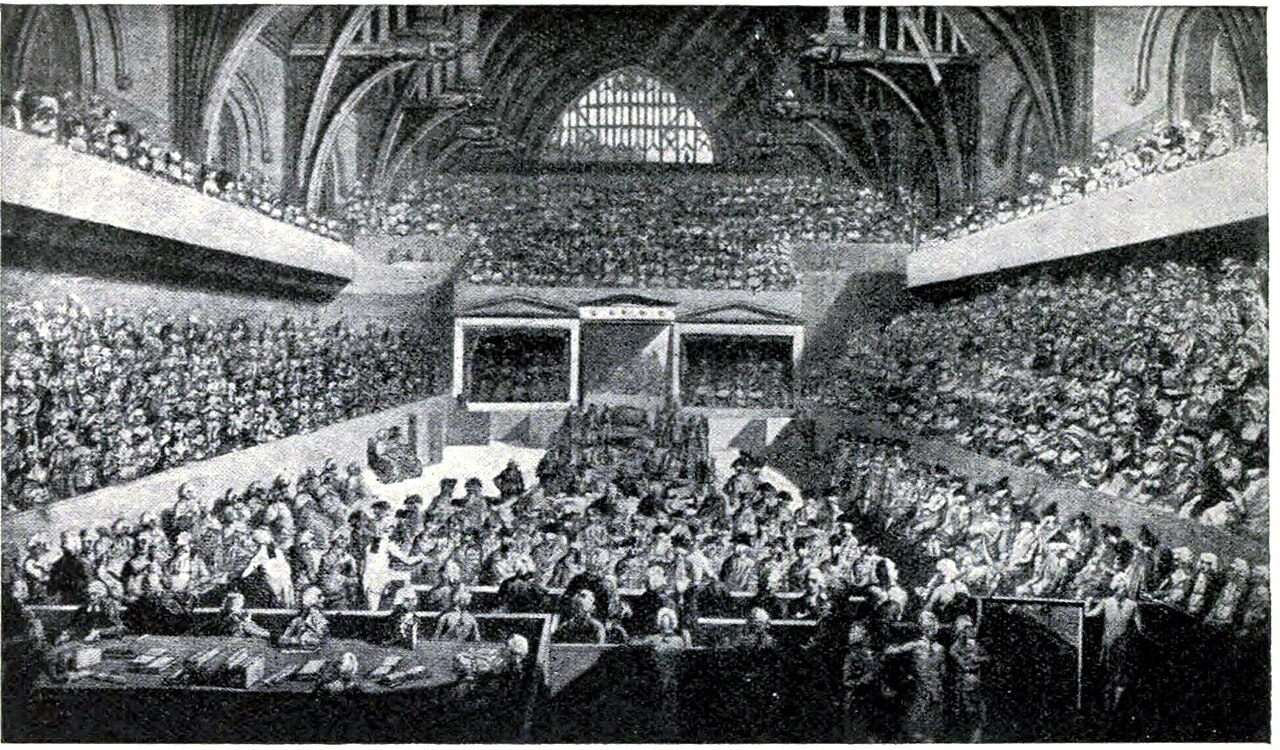
Via Wikimedia Commons: The trial of Warren Hastings, 1788 by Robert Pollard / Francis Jukes / Edward Dayes, public domain.
The best-known English case was that of Warren Hastings, the former governor-general of Bengal.[11][12] The campaign against him was led by Edmund Burke and Charles James Fox, and grew out of years of concern in London about the conduct of the East India Company's servants in India.[12] The Commons impeached him in 1787, and his trial before the House of Lords, with Burke and Richard Sheridan among the managers who prosecuted it, lasted seven years and ended in his acquittal.[12] The articles charged him with "high crimes and misdemeanors" in the form of gross maladministration, corruption in office and cruelty toward the people of India, and the proceedings ended in 1795.[22] The trial was still in progress while the American Constitution was being drafted, and was followed closely in America.[6]
English impeachment trials could be long, public occasions. When the Commons debated on 26 March 1806 where the trial of Viscount Melville should be held, Melville's son Robert Dundas argued against Westminster Hall on grounds of time and cost, recalling that the case of Warren Hastings, tried in Westminster-hall, had lasted eight sessions.[10] Supporters of the Hall argued that publicity and solemnity were essential to an impeachment, and their motion was carried.[10]
Melville's was the last impeachment in Britain. He had been accused of misusing public funds, and the House of Lords acquitted him in 1806.[12] The case began in 1805 with a report accusing him of negligence as Treasurer of the Navy, and the Commons' vote to censure him that April was carried only on the Speaker's casting vote.[11] The History of Parliament describes impeachment as a power Parliament has held since medieval times that may still exist "in theory at least".[11] The law lecturer Chris Monaghan, writing in 2022, traces its decline to the period from the 1740s onward, when other means of holding ministers to account began to supersede it.[12] He dates that change to the resignation of Sir Robert Walpole, who left office when he realised he no longer had the confidence of the House of Commons.[12] He notes that in 2004 a group of members of Parliament drafted a motion to impeach the prime minister, Tony Blair, backed by a legal opinion, and that the attempt went nowhere.[12]
Adoption in the United States
Many American colonial and state governments used impeachment before the Constitution, according to the Senate.[5] The House history office notes that some states allowed it for "maladministration" or "corruption" before the Constitution was ratified in 1788.[3] The colonies narrowed the English model, largely limiting impeachment to officeholders, for misconduct in office, with removal as the punishment; many of the state constitutions written between 1776 and 1787 did the same, while also allowing disqualification from future office.[20][21] The body that tried impeachments varied from state to state; New York's constitution of 1777, for example, gave the task to a court made up of state senators, the judges of the state supreme court and the chancellor.[20]
The Constitutional Convention
At the Constitutional Convention of 1787 the delegates disagreed over whether a president should be impeachable at all. Rufus King of Massachusetts argued that elections were the proper check, since a president would periodically be tried for his behaviour by his electors.[3][23] Elbridge Gerry, also of Massachusetts, took the other side: "A bad one ought to be kept in fear of them."[3][23]
That exchange came on 20 July 1787, when Pinckney of South Carolina and Gouverneur Morris of Pennsylvania moved to strike out the clause making the executive removable on impeachment, according to James Madison's notes of the debate.[23] George Mason of Virginia replied: "Shall any man be above Justice? Above all shall that man be above it, who can commit the most extensive injustice?"[23] Benjamin Franklin argued that where no such procedure existed, the recourse against an obnoxious chief magistrate had been assassination, and that impeachment would allow both the punishment of a guilty executive and the "honorable acquittal" of one unjustly accused.[23] Madison thought it "indispensable" to guard against "the incapacity, negligence or perfidy of the chief Magistrate".[23] Morris changed his mind during the debate, pointing out that even Charles II had been bribed by Louis XIV, and the convention voted, eight states to two, to keep the executive removable by impeachment.[21][23]
When the grounds for removal were debated, James Madison objected that "maladministration" was too vague, and George Mason proposed "other high Crimes and Misdemeanors" instead, which the delegates accepted.[3] The draft before the convention on 8 September 1787 allowed impeachment only for treason and bribery.[24] Mason objected that treason as the Constitution defined it would not reach "many great and dangerous offences", remarking that "Hastings is not guilty of Treason", and moved to add "or maladministration".[24] Madison answered that so vague a term "will be equivalent to a tenure during pleasure of the Senate", and Mason then substituted "other high crimes & misdemesnors agst. the State", which passed by eight states to three.[24] The 1974 staff report notes that the phrase was added with virtually no debate, but that there is evidence the framers knew the technical meaning it had acquired in English impeachments.[22]
An early plan would have given a role in impeachments to the judiciary; the delegates instead followed the British model, with the lower house prosecuting and the upper house judging.[3] According to the Senate Historical Office, Madison and Charles Cotesworth Pinckney objected to trial by the Senate on the ground that it would make the president too dependent on the legislature, and suggested the Supreme Court or a panel of state judges instead.[6] On 8 September Madison moved to remove the Senate as the trial court; Morris answered that the Supreme Court was too small and "might be warped or corrupted", Roger Sherman objected that the president would appoint the justices, and the motion failed with only two states in favour.[24] The framers also gave the Chief Justice the chair at a president's trial, so that a vice president, the Senate's usual presiding officer, would not preside over a proceeding that could make him president.[21]
Hamilton and the ratification debates
Alexander Hamilton defended the arrangement in Federalist No. 65. He wrote that the offences impeachment deals with are those that proceed from the misconduct of public men, "or, in other words, from the abuse or violation of some public trust", and that they could properly be called "POLITICAL".[2] He also foresaw the strain they would cause: a prosecution of this kind, he wrote, "will seldom fail to agitate the passions of the whole community, and to divide it into parties".[2] He asked of the trial court: "Where else than in the Senate could have been found a tribunal sufficiently dignified, or sufficiently independent?"[2]
Speakers at the state ratifying conventions gave further hints about what they thought the phrase covered. In North Carolina, James Iredell said impeachment would reach crimes "not easy to describe" that everyone would recognise as high crimes and misdemeanors against government, arising from "acts of great injury to the community"; in Virginia, Edmund Randolph said it was appropriate for a "willful mistake of the heart" but not for wrong opinions.[20][21] James Wilson, a delegate who later sat on the Supreme Court, called impeachments a matter of "political crimes and misdemeanors, and ... political punishments".[20][21]
What the Constitution says
The impeachment provisions are spread across the Constitution:
- Article I, Section 2 gives the House of Representatives the sole power of impeachment.[1]
- Article I, Section 3 gives the Senate the sole power to try impeachments. When the president is tried, the Chief Justice of the United States presides, and no one may be convicted without the agreement of two-thirds of the senators present. The judgment may go no further than removal from office and disqualification from holding federal office in future, but the person convicted remains liable to ordinary prosecution and punishment under the law.[1] Senators sitting for an impeachment must also be "on Oath or Affirmation".[1]
- Article II, Section 2 lets the president grant pardons for offences against the United States, "except in Cases of Impeachment".[1]
- Article II, Section 4 provides that the president, the vice president and all civil officers of the United States shall be removed on impeachment for, and conviction of, "Treason, Bribery, or other high Crimes and Misdemeanors".[1]
- Article III, Section 2 requires criminal trials to be held by jury, except in cases of impeachment.[1]
The Constitution does not define "high Crimes and Misdemeanors". The Senate notes that the meaning of the phrase has long been debated.[5] Federal judges, who under Article III hold office "during good Behaviour", can be removed only by impeachment.[1][20]
How it works
In the House
In the House, the process usually begins with a resolution introduced by a member or a resolution authorizing an inquiry.[3] The Judiciary Committee ordinarily has jurisdiction; it decides whether to draw up articles of impeachment, the formal charges, and reports them to the full House, which adopts them by a simple majority.[3] Before the Judiciary Committee was created in 1813, special committees handled the charges.[3] The House then appoints members, called managers, to prosecute the case in the Senate.[3][5]
A member may also force the issue by offering an impeachment resolution on the floor as a "question of the privileges of the House", which the Speaker must schedule within two legislative days, according to the Congressional Research Service (CRS), Congress's research agency.[53] The House can then vote on the resolution, refer it to the Judiciary Committee, or "table" it, which disposes of it permanently; as of January 2024 no resolution brought up this way had been approved, and the House had nearly always investigated first before impeaching anyone.[53]
Neither chamber has adopted a rule setting the standard of proof. In practice each member decides for himself or herself how convinced to be, and some members have argued that the House, like a grand jury, need only find probable cause, leaving proof of guilt to the Senate.[21]
In the Senate
The Senate sits as a court, hears evidence and witnesses, and votes on each article.[5] Conviction requires a two-thirds vote; the penalty is removal from office, in some cases the Senate has also barred the person from holding office again, and there is no appeal.[5] Each senator swears or affirms to "do impartial justice according to the Constitution and laws", an oath first adopted for the trial of Senator William Blount in 1798.[21][32] A conviction on any one article is enough to remove the official.[21]
Disqualification from future office is decided by a separate vote. The practice began in 1862, when the Senate convicted Judge West H. Humphreys, who had taken a judgeship under the Confederacy without resigning his federal seat, and then voted separately to disqualify him.[21] Since then the Senate has treated disqualification as needing only a simple majority; the Senate disqualified Judge Robert Archbald in 1913 by 39 votes to 35.[21] In the most recent case, on 8 December 2010, the Senate voted 94 to 2 to disqualify Judge G. Thomas Porteous Jr. after convicting him.[50]
Since a rule adopted in 1935, the Senate may appoint a committee of senators to take evidence and report to the full Senate, and its impeachment rules were revised in 1986.[6] Trial committees heard evidence in the cases of the judges Harry Claiborne in 1986, Alcee Hastings and Walter Nixon in 1989, and Thomas Porteous in 2010, according to the Senate Historical Office.[6]
Walter Nixon, a former chief judge of the federal district court for the southern district of Mississippi, had been convicted by a jury of making false statements to a federal grand jury before the House impeached him.[9] He challenged his removal on the ground that a committee hearing was not a trial by the Senate.[9] On 13 January 1993 the Supreme Court, in an opinion by Chief Justice William Rehnquist, held in Nixon v. United States that his claim was [no
