Endangered language
A language at risk of falling out of use as its speakers stop passing it on to their children
A language at risk of falling out of use as its speakers stop passing it on to their children

An endangered language is a language at risk of falling out of use, usually because its speakers are no longer passing it on to their children and are shifting to another, more widely spoken language.[1][3]
Experts writing for UNESCO in 2003 defined the term plainly: a language is endangered when it is on a path toward extinction, and it is in danger when its speakers stop using it, use it in fewer and fewer areas of life, and stop passing it from one generation to the next.[1] Estimates of how many languages are affected depend on how they are counted, but a 2021 global statistical study found that 37 percent of the 6,511 spoken languages it examined were threatened or worse.[3]
A language rarely disappears because all of its speakers die. More often, people keep living but change the language they speak. The authors of a 2021 study in Nature Ecology & Evolution stressed that language loss often occurs when people shift from using their heritage language to a different language, rather than through a fall in the number of people in a community, and that not all small languages are endangered.[3] Linguists call this process language shift.
The UNESCO experts' report describes both outside and inside pressures. Endangerment, it says, can result from military, economic, religious, cultural, or educational subjugation, or from a community's own negative attitude towards its language, though such internal pressures often have their source in external ones.[1] The report observes that many Indigenous peoples, associating their disadvantaged social position with their culture, have come to believe that their languages are not worth keeping, and give them up in the hope of escaping discrimination, earning a living or improving their social standing.[1] It adds that people in this position have often been offered an either-or choice between keeping their mother tongue and identity or getting on in life, whereas, in the experts' view, maintaining and using both languages gives better chances still.[1]
Earlier, in 1992, the linguist Michael Krauss had listed the circumstances that had led to language loss as ranging from outright genocide, social, economic or habitat destruction, displacement and "demographic submersion" to language suppression through forced assimilation or assimilatory education.[6] To these he added electronic media, especially television, which he called "cultural nerve gas".[6]
Size matters too. About 97 percent of the world's people speak about 4 percent of its languages, the same report notes, citing the anthropologist H. Russell Bernard, while about 96 percent of the world's languages are spoken by about 3 percent of the world's people.[1] A small community is more exposed to disease, war or natural disaster, and may merge with a neighbouring group and lose its language in the process.[1] Even so, numbers alone are not decisive: even languages with many thousands of speakers, the report says, are no longer being learned by children.[1] Krauss gave two examples: Breton, with perhaps a million speakers within living memory but by then very few child speakers, and Navajo, with well over 100,000 speakers a generation earlier but an uncertain future.[6]
Writing in 2013 about language loss in the digital age, the researcher András Kornai summarized three signs that a language is approaching death well before its last speaker dies: loss of function, as other languages take over whole areas such as commerce; loss of prestige, seen most clearly in the attitudes of the young; and loss of competence, seen in "semi-speakers" who understand the older generation but use a much simplified version of the grammar.[15]
Linguists had studied language shift and "language death" long before the subject reached a wide audience; Lewis and Simons describe an extensive literature on its causes, processes, symptoms and results.[2] A widely cited starting point for the modern concern was a symposium on endangered languages at the annual meeting of the Linguistic Society of America in January 1991, whose papers were published together in the society's journal Language in March 1992.[6][7]
The first essay in that collection, "The world's languages in crisis", was by Michael Krauss of the Alaska Native Language Center at the University of Alaska Fairbanks.[6] Krauss called a language that children no longer learn as their mother tongue "moribund", since unless the course was dramatically reversed it was already doomed; a language still being learned by children, but likely to stop being learned during the coming century, merely "endangered"; and the rest "safe".[6] He noted that, unlike a biological species, a language is potentially revivable under certain conditions, as the case of Hebrew showed.[6]
His figures were stark. In Alaska only 2 of the 20 Native languages were still being learned by children; across the United States and Canada he counted 149 of 187 Native languages, or 80 percent, as moribund; and in Australia he put 90 percent of the roughly 250 Aboriginal languages still spoken in that category.[6] He judged the situation in Central and South America to be much better, with about 17 percent of Meso-American and 27 percent of South American Indigenous languages likely to be moribund.[6] Taking 6,000 as a round figure for the world's languages, and counting as "safe" only those with official state support or at least about 100,000 speakers, he arrived at perhaps 600 safe languages, and noted that the median language had only 5,000 or 6,000 speakers.[6] He concluded that, at the rate things were going, the coming century would see "either the death or the doom of 90% of mankind's languages".[6] Krauss contrasted this with the 7.4 percent of mammal species and 2.7 percent of bird species then listed as endangered or threatened, and asked why linguists were so much quieter about the threat to linguistic diversity than biologists were about biological diversity.[6]
Writing two decades later, Gary Simons and M. Paul Lewis of SIL International called Krauss's essay "the great linguistic call to arms" and noted that its warning about the possible loss of 90 percent of languages had been repeated again and again.[7] Not every linguist agreed. In a later 1992 issue of Language, Peter Ladefoged argued, as H. Russell Bernard summarized the exchange, that in places such as Tanzania, where the authorities encouraged Swahili as a means of building the nation, it would not be responsible for linguists to work for the preservation of local languages, and he described a speaker of Dahalo who was proud that his teenage sons did not speak it.[8] The linguist Nancy Dorian replied in 1993 that much language death takes place in democracies, where economic pressures rather than political ones discourage parents from passing on their language, and where working for language diversity is not a dangerous political act.[8]
UNESCO had earlier run a project called The Red Book of Languages in Danger of Disappearing, to gather information on endangered languages and encourage research on them; the 2003 expert group, of which Krauss was a member, criticized it for lacking the goal of working with communities themselves on maintaining and revitalizing their languages.[1] In October 2001 UNESCO's General Conference had unanimously adopted the Universal Declaration on Cultural Diversity, which recognized a relationship between biodiversity, cultural diversity and linguistic diversity.[1]
Because no single figure captures a language's health, linguists use graded scales. Three prominent ones were brought together in 2010.[2]
Fishman's GIDS. The sociolinguist Joshua Fishman's Graded Intergenerational Disruption Scale, set out in his 1991 book Reversing Language Shift, ranks a language in eight levels according to how far its transmission between generations has been disrupted.[2] In 2010 the linguists M. Paul Lewis and Gary F. Simons called it the seminal and best-known evaluative framework of language endangerment of the previous two decades.[2]
UNESCO's nine factors. The 2003 UNESCO framework, Language Vitality and Endangerment, was prepared by an ad hoc expert group and submitted to an international expert meeting in Paris on 10 to 12 March 2003.[1] It uses six factors to assess a language's vitality, two to assess attitudes towards it and one for the urgency of documenting it.[1] The six vitality factors are [intergenerational transmission, the absolute number of speakers, the proportion of speakers in the total population, trends in the areas of life where the language is used, its response to new areas and media, and the materials available for education and literacy](ich.unesco.org/doc/src/00120-EN.pdf).[1] The attitude factors cover government and institutional policy, including official status, and the attitudes of community members towards their own language; the last factor is the amount and quality of documentation.[1] The report insists that none of the factors should be used alone.[1] It also warns against simply adding up the grades, and suggests the factors be examined according to the purpose of an assessment, whether a community's own self-assessment or an outside evaluation by other bodies.[1]
Its first factor, transmission between generations, gives the scale that is most often quoted:
The report adds that even "safe" does not guarantee a language's future, because speakers may stop passing it on at any time.[1] It also stresses that multilingualism is a fact of life in most of the world and does not in itself lead to language loss; what matters is that the language keeps a meaningful role in culturally important areas of life.[1]
The Expanded GIDS. In 2010 Lewis and Simons, later co-editors of Ethnologue, the catalogue of the world's languages published by SIL International, aligned Fishman's scale, UNESCO's and Ethnologue's own categories into a single scale of 13 levels, the EGIDS.[2][7] Its upper levels run from international use (level 0) through national, regional, trade, educational and written use (level 5), and its lower levels mirror UNESCO's: "Threatened" (level 6b) corresponds to UNESCO's "vulnerable", and "Shifting", "Moribund" and "Nearly Extinct" to UNESCO's definitely, severely and critically endangered.[2] Unlike Fishman's original, the EGIDS can place a language that no longer has any speakers.[2] A language's level is found by answering five key questions, about its identity function, its use as a language of wider communication, whether it is being passed on to children, how literacy in it is acquired, and which is the youngest generation of proficient speakers.[2] For the 17th edition of Ethnologue, published in 2013, its editors used the scale to estimate a level for every one of the 7,480 living and extinct languages the catalogue tracked, the first time the catalogue had rated the vitality of every language.[7]
How to describe a language that no one speaks as a first language has become a question in its own right. Lewis and Simons recorded that Ethnologue received a volume of correspondence from members of ethnic groups who objected to the label of "extinct" for their heritage languages.[2] Its 16th edition therefore introduced the category "Dormant" for a language that is no longer spoken but still serves as a marker of identity for a living community, keeping "Extinct" for a language with which no one still identifies.[2] In the EGIDS, a dormant language (level 9) is one in which no one has more than symbolic proficiency; Lewis and Simons noted that revitalization may already be under way or contemplated, and that documentation of a language approaching extinction can make it possible to recover at least that level later if the community wishes.[2] Bromham and her co-authors used the word "Sleeping" for languages with no first-language speakers, the term preferred by many speakers of endangered languages.[3]
For languages coming back into use, Lewis and Simons proposed separate labels for the same levels, reflecting movement upwards rather than downwards: "Rediscovered" (level 9), when adults take up the language again for symbolic and identity purposes; "Reintroduced" and "Reawakened" (levels 8b and 8a), as adults bring it back into everyday interaction and children begin to acquire it in community and some home settings; and "Revitalized" and "Re-established" (levels 7 and 6b), as a second and then a third generation of children acquire it at home.[2]
Counts differ because sources list different numbers of languages and draw the line between "threatened" and "safe" in different places.
The study led by Lindell Bromham of the Australian National University analysed 6,511 spoken languages against 51 predictor variables, covering population, documentation, legal recognition, education policy, socioeconomic indicators and environmental features.[3] Its main findings were these:
The areas with the most endangered languages in absolute numbers were New Guinea, Central America, the Himalayas and Yunnan, and the region between Central and West Africa, which the authors attributed largely to how many languages those areas hold.[3] The areas with the highest proportion of their languages endangered included Australia, North China, Siberia, North Africa and Arabia, North America and parts of South America, and the greatest loss to date had been in Australia, South America and the United States.[3]
Looking ahead, the model predicted that without intervention language loss would at least triple within 40 years, amounting to at least one language lost per month, and that by the end of the century at least 1,500 languages would cease to be spoken.[3] The greatest absolute losses were predicted for the west coast of North America, Central America, the Amazon rainforest, West Africa, the north coast of New Guinea and northern Australia, and the greatest proportional losses for the Arctic, the interior plains of North America, temperate southern Chile and the Sahara.[3] The authors stressed that these predictions were "not death knells" but possible outcomes in the absence of investment.[3] They gave the example of Alutiiq in Alaska, whose community had begun a revitalization programme that might counter the trend their model predicted.[3]
The 2013 Ethnologue analysis found sharply different outcomes in different parts of the world. In Australia, Canada and the United States more than 75 percent of the languages in use in 1950 were extinct or moribund, while in sub-Saharan Africa the figure was less than 10 percent.[7] In its regional tables, 317 of the 388 languages of Australia and New Zealand were classed as dead or dying, against 56 of the 899 languages of Western Africa and 81 of the 1,071 languages of Melanesia.[7] Simons and Lewis concluded that Krauss's analysis had proved largely accurate for the parts of the world he and his correspondents knew best, North America and Australia, but was overly pessimistic for the world as a whole.[7]
To explain the difference they pointed to the linguist Salikoko Mufwene's distinction between settlement colonization, in which colonizers settled virtually all of the land and displaced its Indigenous inhabitants, and exploitation colonization, in which a territory was run for the benefit of the home country without mass settlement.[7] The places with the most profound language loss were settlement colonies; sub-Saharan Africa and Melanesia, where loss has been comparatively small, were not.[7] They suggested that urbanization, which draws speakers of minority languages into cities where they need the dominant language, may be the next great threat, citing a UN projection that the urban share of the world's population would rise from 49 percent in 2007 to 70 percent in 2050.[7]
UNESCO's framework grades government attitudes and policies on a six-step scale, from "equal support", where all of a country's languages are protected by law, through "differentiated support", "passive assimilation", "active assimilation" (encouraging minority groups to abandon their languages through education in the dominant language) and "forced assimilation", to "prohibition", where minority languages are banned from use in any domain.[1] The report notes that a state that sees many languages as a threat to national unity may legislate to discourage or even prohibit the others, and that even equal legal status does not guarantee a language's survival.[1]
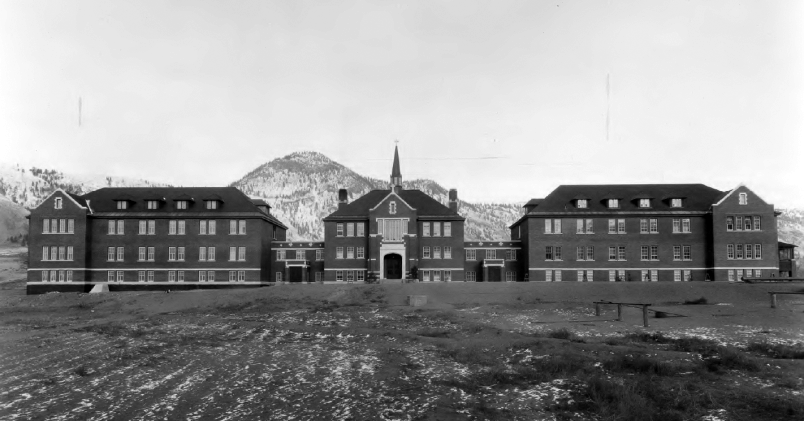
Via Wikimedia Commons: Kamloops-indian-residential-school-1930 by Unknown author Unknown author, public domain.
Canada. The Truth and Reconciliation Commission of Canada, which reported in 2015, found that residential schools were a central element of a policy towards Aboriginal peoples that it described as "cultural genocide", among whose features it listed the banning of languages.[9] The federal government moved in 1883 to establish three large residential schools in western Canada, and it has estimated that at least 150,000 First Nation, Métis and Inuit students passed through the system; the last federally supported schools remained open until the late 1990s.[9] Government officials insisted that children be discouraged, and often prohibited, from speaking their own languages; an 1893 Programme of Studies for Indian Schools advised that "every effort must be made to induce pupils to speak English".[9] The Commission found that some survivors refused to teach their own children their languages because of the stigma attached to them at school, which had contributed significantly to the fragile state of Aboriginal languages in Canada.[9] It reported that the share of the Aboriginal population whose first language learned was an Aboriginal language fell from 26 percent in the 1996 census to 18 percent in 2006 and 14.5 percent in 2011, and that UNESCO listed 36 percent of Canada's Aboriginal languages as critically endangered.[9] Its Calls to Action asked the federal government to recognize Aboriginal language rights, to pass an Aboriginal Languages Act and to appoint an Aboriginal Languages Commissioner.[9] The Indigenous Languages Act, which received royal assent on 21 June 2019, refers in its preamble to the Commission's Calls to Action and establishes an Office of the Commissioner of Indigenous Languages.[10]
New Zealand. In a 2012 report the Waitangi Tribunal summarized the decline of the Māori language (te reo Māori) in the twentieth century as it had described it in 1986: in the first quarter of the century children spoke Māori at home but, on pain of punishment, only English at school; in the second, many of those former pupils spoke Māori with adults but not with their children; and in the third, monocultural schooling and mass urbanization produced a generation with little or no Māori.[11] It cited research by Bruce Biggs finding that the share of Māori schoolchildren able to speak the language fell from 90 percent in 1913 to 55 percent in 1950 and 5 percent in 1975, and a survey by Richard Benton in the 1970s which found that the youngest child was fluent in Māori in only 4 percent of Māori households with children.[11]
Hawaiʻi. In Hawaiʻi, teaching in the Hawaiian language in public and private schools was banned for some 90 years, until the state legislature lifted the ban in 1986.[12]
The UNESCO experts argued that the extinction of each language means the irrecoverable loss of unique cultural, historical, and ecological knowledge, and that each lost language leaves less evidence for understanding the structure of human language, human prehistory and the ecosystems its speakers know.[1] They added that speakers may experience the loss as a loss of their ethnic and cultural identity.[1] The same report drew a parallel with conservation biology, recording that the linguist Michael Krauss had coined the word "logosphere" for the web linking the world's languages, by analogy with the biosphere.[1] It also noted that many ethnolinguistic groups live within the 238 ecoregions that the WWF considers of the utmost importance for the world's ecological viability, peoples who have built up rich ecological knowledge over a long history in their environment.[1] Bromham's study made a similar comparison, setting the share of languages endangered beside the roughly 40 percent of amphibian species, 25 percent of mammals and 14 percent of birds then threatened with extinction.[3]
Responses fall into two broad kinds: recording a language, and helping it to be spoken again.
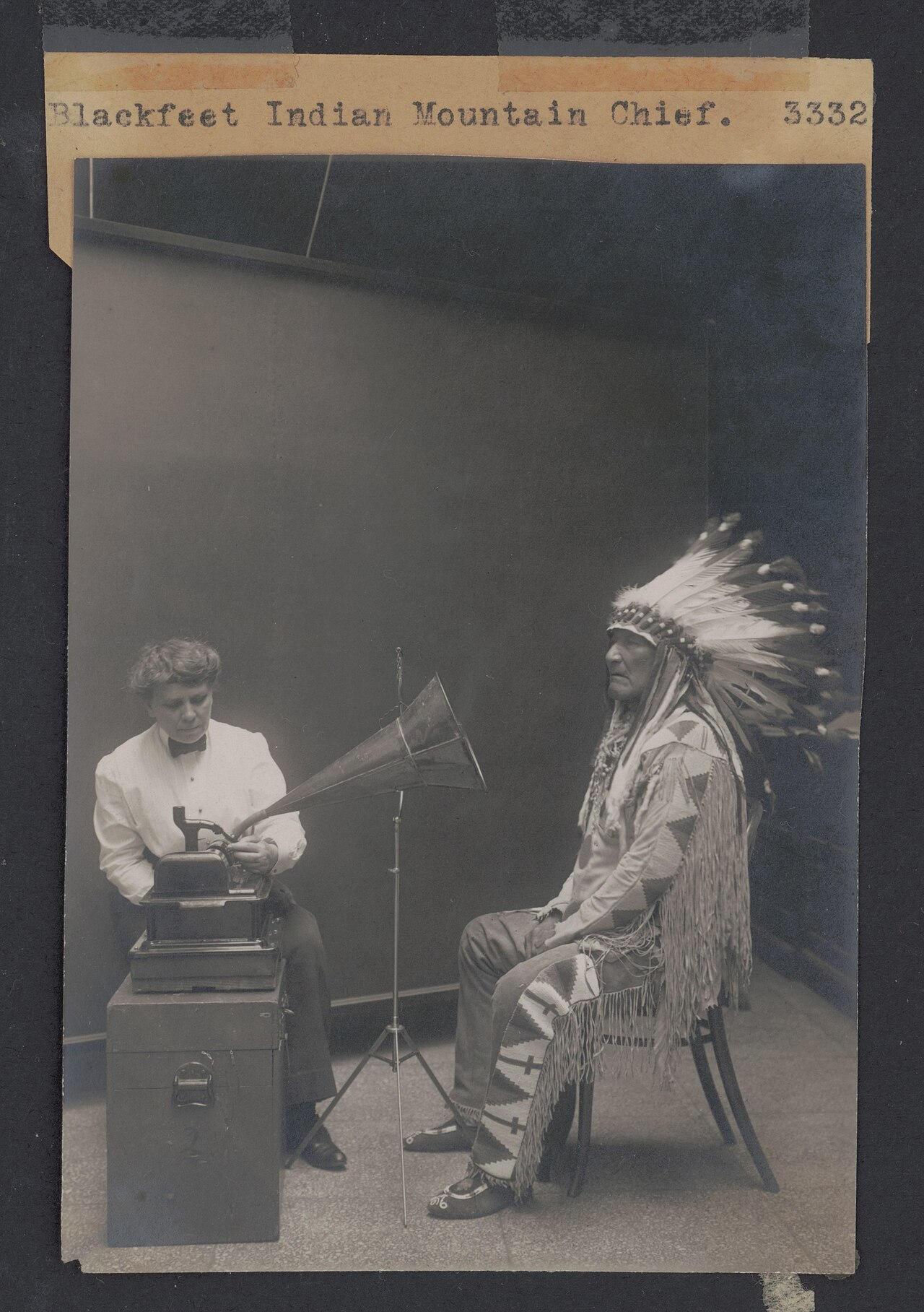
Via Wikimedia Commons: Piegan Indian, Mountain Chief, listening to recording with ethnologist by National Photo Company Collection, public domain.
Documentation. The UNESCO report holds that a language that can no longer be maintained or revitalized still merits the most complete documentation possible, and notes that the work of documenting often helps the speakers who take part to reactivate their own knowledge.[1] It also records a change in how such research is done: speakers increasingly demand control over the terms of research and rights to its results, and want an equal relationship with outside researchers.[1] Krauss had defined documentation in 1992 as a grammar, a dictionary and a body of texts, now supplemented by audio and video recordings, held in a network of archives and centres.[6] He argued that such records have symbolic and social value for the community as well as scientific value, and that with them a language can keep a limited role in schools or ceremonies even after its last native speaker has died, from which it may grow back into first-language use where the will of the people is strong enough, as with Hebrew and perhaps Cornish.[6]
Revitalization. The same report stresses that it is the speakers, not outsiders, who maintain or abandon languages, and that some communities set up daycare centres, schools or classes where only their language is spoken.[1] It lists five areas in which communities most often ask for help: training teachers in linguistics and teaching methods; developing writing systems, literacy and local documentation skills; national language policy; educational policy; and the living conditions and human rights of speakers.[1] On education, it observed that teaching only in dominant languages spreads them at the expense of endangered ones, giving the example that fewer than 10 percent of the roughly 2,000 African languages were then used in teaching, none of them endangered, and that research shows bilingual ability need not reduce competence in the official language.[1] Lewis and Simons noted that efforts at maintenance and revitalization were redoubled, particularly in North America, after Krauss and others raised the alarm in the early 1990s, and that the EGIDS can be applied, with minor changes, to languages being revitalized.[2]
The UNESCO report distinguishes three kinds of language activism: revival, re-introducing a language that has been in limited use for some time, as with Hebrew after the creation of the state of Israel or Gaelic in Ireland; fortification, increasing the presence of a non-dominant language to counter a perceived threat from a dominant one, as with Welsh; and maintenance, supporting the stable spoken and written use of a non-dominant language alongside a dominant one, as with Māori in New Zealand.[1]
International attention. The United Nations General Assembly, in resolution A/RES/74/135, proclaimed 2022 to 2032 the International Decade of Indigenous Languages, to draw attention to the critical situation of many Indigenous languages and to mobilize support for their preservation, revitalization and promotion.[5] UNESCO, which led the 2019 International Year of Indigenous Languages from which the Decade grew, is the lead UN agency for it, and 2027 marks its mid-term.[5] UNESCO has launched a Global Action Plan for the Decade covering ten thematic areas, among them education, digital inclusion and heritage preservation.[5] The UN Permanent Forum on Indigenous Issues, which recommended the Decade, has repeatedly called for constitutional and legal recognition of Indigenous languages and adequate funding for their revitalization.[4]
Māori. During the 1970s Māori campaigners petitioned Parliament for Māori language and culture to be taught in all schools, and new initiatives followed, including the Te Ātaarangi language-learning programme in 1979.[11] The first kōhanga reo, a Māori-immersion early-childhood centre, opened at Pukeatua Marae in Wainuiomata in April 1982; by 1985 there were nearly 400, taking in more than 6,000 children.[11] Numbers peaked in 1993 at 809 centres with 14,514 children enrolled, when kōhanga reo accounted for about half of all Māori children enrolled in early-childhood education, and then fell to 586 centres with 9,808 children in 2001.[11] The Waitangi Tribunal described the movement in 2012 as still the principal institutional means of passing the Māori language and customs from older generations to the youngest.[11]
Hawaiian. In January 1983 a group of Hawaiian-language educators met to plan ways to keep the language alive, and founded the organization ʻAha Pūnana Leo.[12] Its first Hawaiian-immersion preschool opened in Kekaha, Kauaʻi, in August 1984, followed by schools in Hilo and Honolulu in 1985.[12] After the 1986 law lifted the ban on teaching in Hawaiian, the organization worked with the state Department of Education on the first elementary-school Indigenous-language immersion classes in the United States, which opened in 1987.[12] In 1990 the federal Native American Languages Act was signed into law.[6][12] By 2018 the organization counted some 6,000 alumni of its preschool and infant programmes.[12]
Welsh. In the 2021 census, about 538,300 residents of Wales aged three or over could speak Welsh, 17.8 percent of the population, down from 562,000 (19.0 percent) in 2011; the percentage was the lowest ever recorded in a census.[13] In 1921 there had been 922,100 Welsh speakers; the number fell to a low of about 503,500 in 1981 and rose between 1981 and 2001 before falling again.[13] The largest fall between 2011 and 2021 was among children aged 5 to 15, from 40.3 to 34.3 percent, though the Welsh Government noted that the census took place during the COVID-19 pandemic and that it is not known how this may have affected reported ability.[13] The Welsh Government measures progress towards its goal of a million Welsh speakers by 2050 by the census.[13]
Hebrew. Both Krauss and the UNESCO experts cited Hebrew as a language brought back into use: Krauss in 1992 as proof that a language can return to first-language use, and the UNESCO experts as an example of revival after the creation of the state of Israel.[1][6]
The UNESCO framework applies to sign languages as well as spoken ones.[1] The sign-language researcher Rachel McKee wrote in 2017 that, like minority spoken languages, sign languages are threatened by small and scattered populations, disrupted transmission between generations, restricted areas of use, lack of documentation and weak policy protection.[14] Transmission is especially fragile because only about 5 percent of deaf children are born to deaf parents, so schools for deaf children have traditionally been where sign languages are passed on; in most developed countries such schools have been downsized or closed as deaf children are placed in mainstream schools.[14] McKee also pointed to universal newborn hearing screening and early cochlear implants, which have increased support for teaching deaf children spoken language first.[14]
Between 2011 and 2013 a version of the UNESCO questionnaire adapted for sign languages was completed for 15 sign languages; none was rated safe, three were rated critically endangered, and even national sign languages with strong official recognition, such as those of Austria, Brazil, Denmark and New Zealand, were rated unsafe or vulnerable.[14] The most endangered were isolated village sign languages, threatened by a national sign language or by a falling incidence of deafness.[14] McKee's own assessment placed New Zealand Sign Language, an official language since 2006, at EGIDS level 6b, "threatened".[14]
New media can work against small languages. The UNESCO report observes that schools, new workplaces and new media, including broadcasting and the Internet, usually expand the reach of the dominant language at the expense of endangered ones, and counts a language's response to new domains and media among its six vitality factors.[1] In 2013 András Kornai argued that the usual estimate of endangerment greatly understated the danger of what he called digital language death, because fewer than 5 percent of all languages could still "ascend" to the digital realm, and that the digital divide was causing "a massive die-off".[15] He estimated that there were fewer than 250 digitally ascending languages worldwide.[15] On his reading, the signs of decline take digital forms: loss of function as more of daily life moves online, loss of prestige captured in the adage "if it's not on the web, it does not exist", and loss of competence in the failure to raise "digital natives" in the language.[15] The Global Action Plan for the International Decade of Indigenous Languages counts digital inclusion among its thematic areas.[5]
Several questions remain open. Counts of endangered languages depend on which catalogue and which scale is used, and the UNESCO report itself warns that even assessing the number of actual speakers of a language is difficult.[1] Krauss made the same point in 1992, noting that statistics on language viability were very hard to come by, partly because some regions were barely known and partly because governments favouring one language had reason not to report, or to distort, figures for others.[6] Ethnologue reports each language country by country, and in its 2013 analysis took the strongest rating in any country as the language's overall level, on the reasoning that a language's longevity depends on where it is strongest.[7]
The pace of loss is also disputed. Lewis and Simons wrote in 2010 that although some contest the prediction of massive language loss by the end of the century, no credible arguments to the contrary have been forthcoming; Bromham and her co-authors noted that earlier predictions had not been based on statistically rigorous analysis, which their study set out to supply, and that their model is conservative because it did not project change for languages currently being passed on to children.[2][3] Simons and Lewis themselves concluded in 2013 that Krauss's global picture had been overly pessimistic, while confirming heavy losses in particular regions.[7]
Whether outsiders should work to preserve languages has been argued too, as in the exchange between Ladefoged and Dorian, and the UNESCO experts' observation that it is speakers, not outsiders, who maintain or abandon languages.[1][8] The biological comparison at the heart of much of the discussion, with its "language death", "extinction" and "endangered" languages, has a long history. Krauss observed that the term "endangerment" was presumably drawn from biological usage, and Kornai noted that the metaphor of languages as living organisms goes back at least to Herder and to Darwin's The Descent of Man, and that, although not without its detractors, it has been widely accepted both in research and in guiding political action.[6][15] Finally, the choice of words is itself debated, as the move from "extinct" towards "dormant" and "sleeping" shows.[2][3]
This entry describes the general idea; individual endangered languages, and the ratings given to them by UNESCO, Ethnologue and other catalogues, differ by source and change over time.
 Get Micwyn on your home screenIts own icon, full screen, and notifications.